
Rapid Passports

Your Essential Guide to the Business Visa for Saudi Arabia for UK Citizens

Securing a business visa for Saudi Arabia is a meticulous process, not a simple box-ticking exercise, particularly for UK professionals. Your entire application hinges on a critical document: a valid invitation from a Saudi sponsor. This isn't a mere formality but the official green light from the Kingdom's authorities, making it essential to get right.

Navigating The Saudi Business Visa Framework

For UK professionals in sectors like energy, finance, or logistics, the process of securing a business visa for Saudi can seem daunting. Unlike a straightforward tourist e-visa, business travel is scrutinised far more closely, and every document submitted carries significant weight. Understanding the landscape from the outset is fundamental to success. Let’s walk through the core requirements.

The Sponsor Is Your Cornerstone

Everything begins and ends with your sponsor in Saudi Arabia. This entity—be it a client, partner company, or local subsidiary—is responsible for formally inviting you through the Saudi Ministry of Foreign Affairs (MOFA). This is not a simple letter but a formally registered document that officially authorises your business visit.
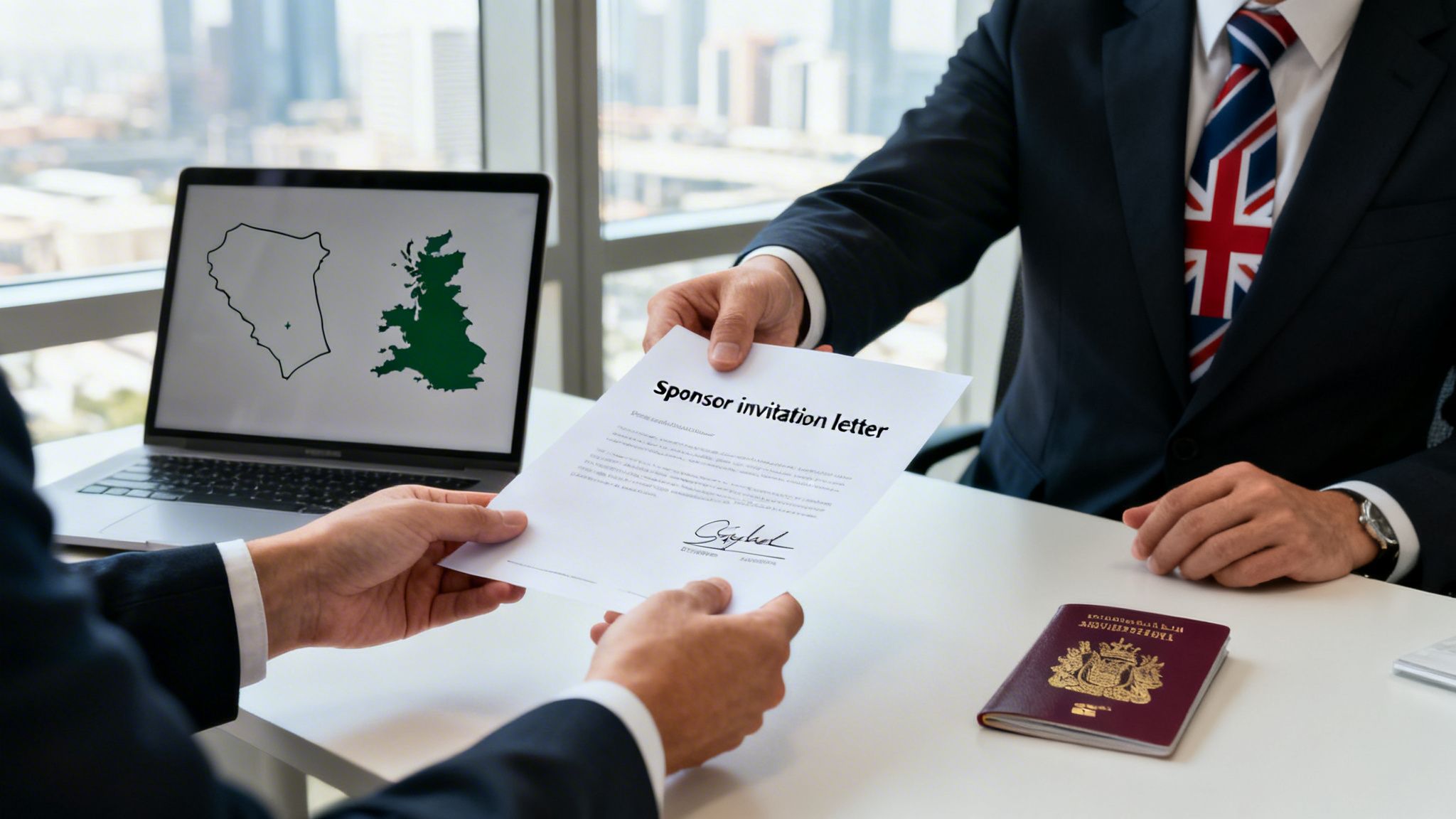
Two businessmen exchanging a sponsor invitation letter for a UK visa, with a passport and maps on the table.

The standing of your sponsor within Saudi Arabia is paramount. While the Kingdom issues over 50,000 'Investor Visitor' visas annually, checks on sponsor companies have tightened. As a British applicant, you must be invited by a Saudi company in good standing with the Nitaqat (Saudization) programme. If your sponsor holds a 'Yellow' or 'Red' status, your visa is almost certain to be denied. We've observed a sharp increase in rejections for this very reason. You can find more insights about UK visa statistics and their implications for travellers.

Key Takeaway: Your visa application's strength is directly tied to your Saudi sponsor. Before gathering any documents, discreetly confirm their Nitaqat status to avoid an immediate—and costly—rejection.

To help you get organised, here's a quick summary of the main requirements.

Saudi Business Visa Key Requirements at a Glance

Requirement Description Critical Importance
UK Passport Must be valid for at least 6 months beyond your intended stay with two blank pages. High
Saudi Sponsor A registered Saudi company in good Nitaqat standing to provide the invitation. Highest
MOFA Invitation Letter The official invitation issued by your sponsor via the Saudi Ministry of Foreign Affairs. Highest
UK Employer Letter A letter from your UK company confirming employment, role, and travel purpose. High
Completed Application The visa application form, filled out accurately and completely. High

Getting these core elements right from the start will streamline the rest of the process significantly.

The Challenge of Concurrent Travel: The Overlapping Visa Trap

A common problem that catches out many frequent flyers is the "Overlapping Visa Trap." When applying for a visa, an embassy can hold your passport for weeks, completely freezing your ability to travel elsewhere. This creates a logistical nightmare for professionals with back-to-back international commitments.

This is precisely where a second UK passport becomes an indispensable tool for maintaining Operational Continuity. It is a fully legitimate "hidden solution" offered by Her Majesty’s Passport Office (HMPO) for professionals who can demonstrate a genuine need. With a second passport, you can submit one for a lengthy visa process (like the business visa for Saudi) while using the other for immediate travel needs. It's a smart strategy for Risk Mitigation that prevents administrative delays from derailing your professional schedule.

Getting Your Documents Right: The Make-or-Break Checklist

When it comes to a Saudi business visa, your paperwork is everything. Countless applications stall or are rejected over minor details. Getting every document perfectly in order from the start is the only way to ensure a smooth process.
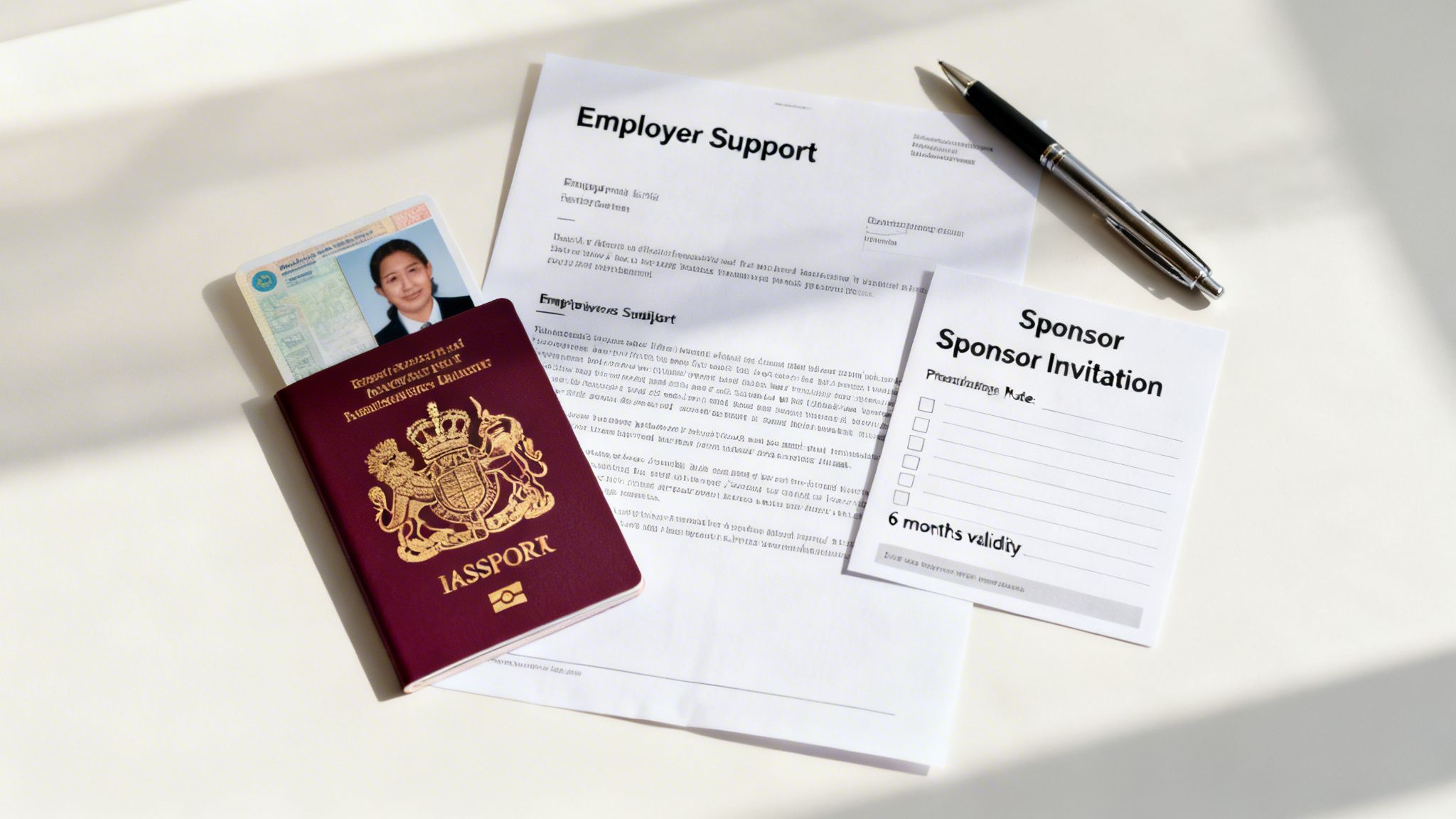
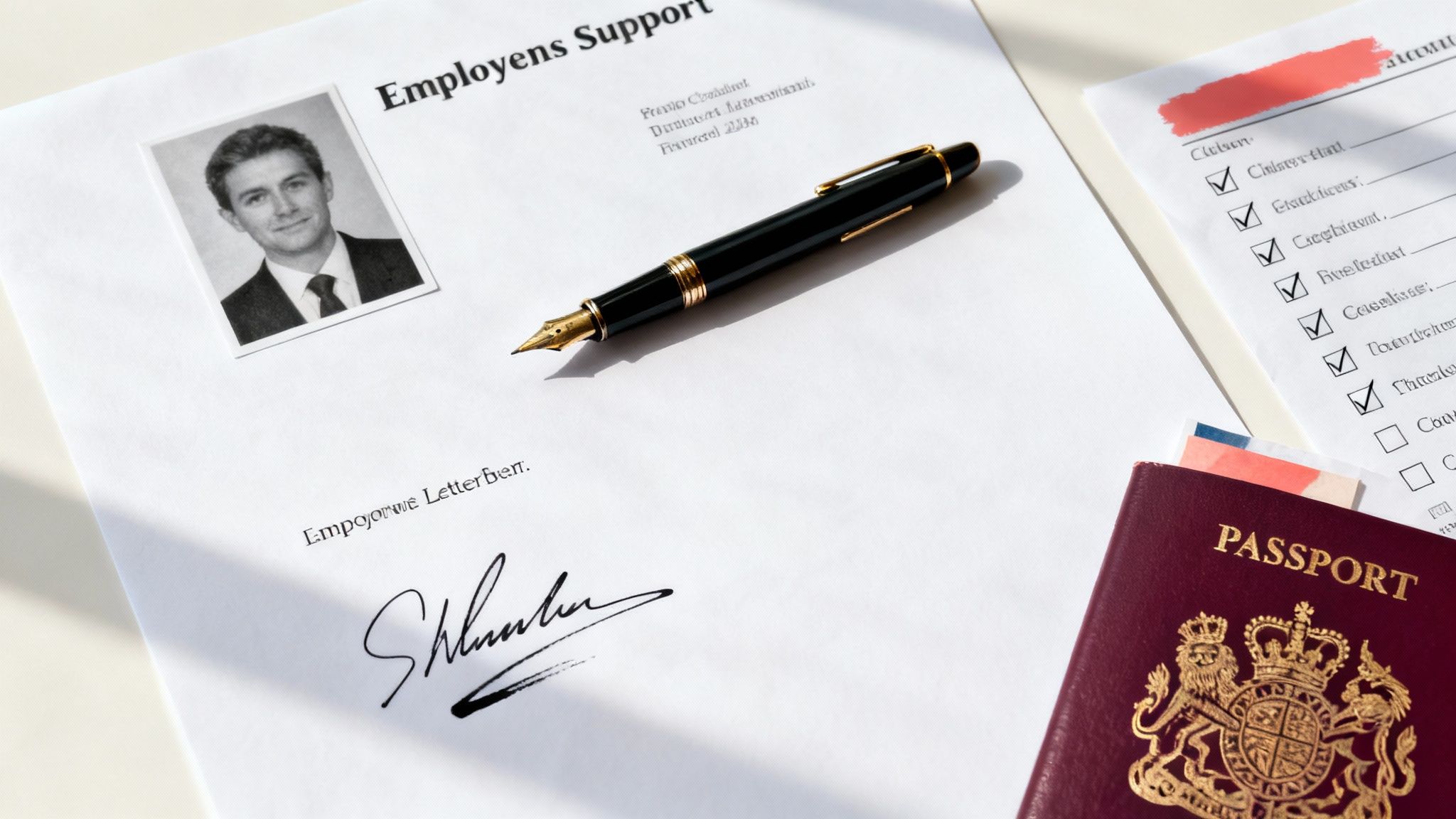
A passport with an ID card, employer support letter, sponsor invitation, and pen on a table.

Let's go through each requirement piece by piece, highlighting the common pitfalls that trip people up time and again.

Your British Passport: The First Hurdle

Your passport is the first item an official examines, and it's an easy place to fail before you've even begun. Before proceeding, check your biometric passport against these non-negotiable rules:

  • Six Months' Validity (From Entry!): Your passport must be valid for at least six months from your planned date of entry into Saudi Arabia, not your application date.
  • Two Blank, Consecutive Pages: You need at least two completely empty, side-by-side visa pages. Pages with any stamps or markings, even those titled 'Amendments', do not count.
  • No Israeli Stamps: An Israeli entry or exit stamp is a major red flag and can lead to immediate rejection. This is a primary reason why a second UK passport is so valuable, as it allows you to isolate travel histories between politically conflicting regions.

Crucially, as of February 25, 2026, UK entry rules have tightened. British dual nationals can no longer use a foreign passport to enter the UK; they must present a valid British passport or a digital Certificate of Entitlement (COE) to avoid being denied boarding. Since British citizens are ineligible for the new Electronic Travel Authorisation (ETA) system, a valid British passport is the only seamless way to enter the UK.

The ENJAZIT Form and Your Photos

The online application, typically completed via the ENJAZIT platform, demands absolute accuracy. Every field is cross-referenced with your supporting documents. A common mistake, such as a slight variation in job title between the form and your employer letter, is enough to trigger a denial.

Your photos are subject to equally strict requirements. They must be recent (within the last three months), in colour, and set against a plain white background. No glasses or headwear (unless for religious reasons) are permitted, and a neutral expression is mandatory.

The Two Letters That Must Be Perfect

While every document is important, the heart of your application lies in two letters: the support letter from your UK employer and the invitation from your Saudi sponsor. These documents must be perfectly synchronised.

I can't stress this enough: a mismatch between the visa validity your employer requests and what your sponsor has been approved for is a primary reason for rejection. If your company letter asks for a 12-month, multiple-entry visa but the Saudi invitation is only for a 90-day single entry, it's a guaranteed problem.

1. UK Employer Support Letter: This must be on official company letterhead with a genuine "wet-ink signature" from a senior company figure. A digital or scanned signature will be rejected. The letter must confirm your role, detail the exact purpose of your visit, and formally state that your company is covering all travel expenses.

2. Saudi Sponsor Invitation Letter: This is the cornerstone. Your Saudi partner obtains this for you through their Ministry of Foreign Affairs (MOFA), and it must be officially stamped by the Saudi Chamber of Commerce. This document dictates the terms of your visa—validity, number of entries, and purpose.

Think of these two letters as two halves of a whole. Your job title, stated purpose of the trip, and requested visa duration must be identical on both. Any difference creates doubt, and doubt leads to rejection of your business visa for Saudi application.

Understanding the Saudi Invitation Letter

Let’s be clear: the invitation letter from your Saudi sponsor isn't just a formality. It’s the absolute foundation of your business visa application. Think of it as your official endorsement within the Kingdom, a government-registered document that vouches for you. Without a perfectly executed invitation, your application is dead on arrival.

This letter is generated by your Saudi partner company through their portal with the Ministry of Foreign Affairs (MOFA). It then has to be officially attested by the Saudi Chamber of Commerce. This crucial step formalises the request and tells the Saudi authorities that your sponsor is taking responsibility for your visit.

Why Your Sponsor's 'Nitaqat' Status Matters

Before your Saudi partner even thinks about drafting the invitation, their own company's standing is under the microscope. Saudi Arabia has a nationalisation scheme called Nitaqat, which grades companies based on how many Saudi nationals they employ. This is a critical detail that many applicants miss.

If your sponsor has a high compliance level—'Platinum' or 'Green'—it signals to the authorities that they are a reputable business. On the flip side, an invitation from a company with a 'Yellow' or 'Red' Nitaqat status is a major red flag.

I’ve seen it happen time and again: a perfectly good visa application gets rejected out of hand because the sponsoring company had a poor Nitaqat rating. The Saudi authorities simply won't accept an endorsement from a business they consider non-compliant.

It’s well worth having a candid conversation with your Saudi hosts about their Nitaqat status before they start the process. It’s a simple question that could save you a world of time, money, and hassle.

What A Valid Invitation Must Include

The invitation has to be precise. Any mistake, no matter how small, can cause serious delays or even get your application thrown out. Make sure your sponsor includes these details, exactly as they appear in your other documents:

  • Your Full Name and Nationality: This must be an exact match to what’s in your passport. No abbreviations or variations.
  • Your Job Title: This needs to align perfectly with the job title mentioned in your UK employer’s support letter.
  • Your Passport Number: Get them to double- and triple-check this for accuracy. A single wrong digit will derail everything.
  • Sponsor's Full Company Name and Address: As officially registered in Saudi Arabia.
  • Sponsor's Commercial Registration (CR) Number: This is their unique 10-digit business ID in the Kingdom.
  • Visa Type, Validity, and Entries: The letter must be specific. Does it request a single or multiple-entry visa? For what duration—90 days, 180 days? Leave no room for ambiguity.

The purpose of your visit also needs to be explained with real business clarity. Vague phrases like "for business meetings" just won't cut it. A much better, more specific description would be something like, "To attend technical project meetings and conduct contract negotiations regarding the Riyadh Metro expansion project."

A Quick Checklist for Your Saudi Sponsor

To help your Saudi partner get it right the first time, you can share this simple checklist with them. It covers the essentials the consulate will be looking for and is a key step towards getting your business visa for Saudi.

  1. Confirm Nitaqat Status: First things first, is your company’s Nitaqat rating 'Green' or higher?
  2. Verify Applicant Details: Have you checked the applicant's name, passport number, and job title against the documents they sent you?
  3. Specify Visa Terms: Does the invitation clearly state the correct visa type (single/multiple entry) and the duration we agreed upon?
  4. Detail the Purpose: Is the reason for the visit explained in specific, commercial terms, not just generic phrases?
  5. Include CR Number: Is your 10-digit Commercial Registration number clearly visible on the letter?
  6. Secure Attestation: Finally, has the letter been processed through MOFA and officially stamped by the Chamber of Commerce?

Getting these details right from the start dramatically boosts the chances of the invitation being accepted, setting you up for a smooth and successful visa application.

Navigating The Visa Application And Submission Process

Once you’ve gathered all your documents and double-checked everything, you’re ready to get the application submitted. For UK business travellers heading to Saudi, there isn't just one way to do this. You have a couple of distinct choices, and each comes with its own pros and cons regarding speed, cost, and how much hands-on support you get.

The two main routes are applying directly through an official processing centre, like VFS TasHeel, or handing the whole thing over to a specialist visa agency. Knowing the practical differences between them is crucial for picking the path that aligns with your schedule and business objectives.

Before you can even start your side of the application, remember that your Saudi sponsor has to kick things off by securing that all-important invitation letter.
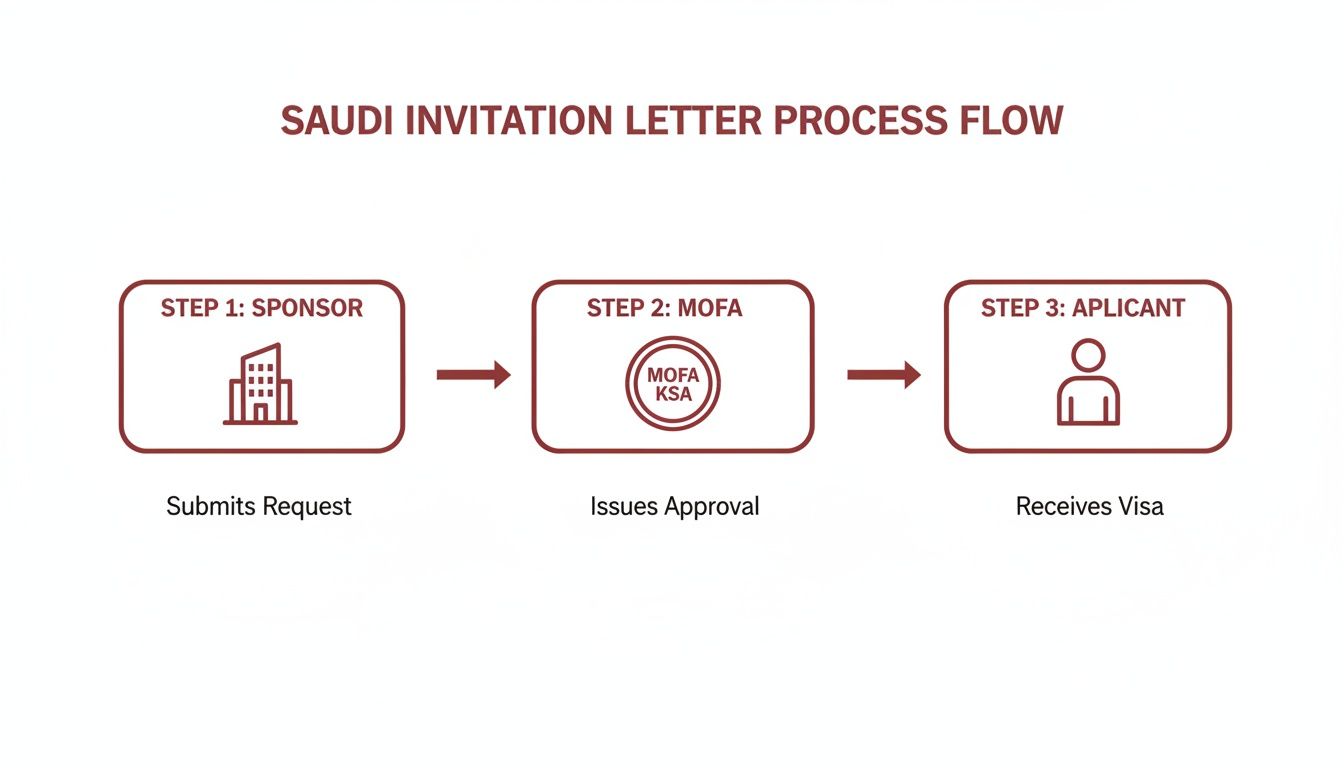
Flowchart illustrating the Saudi invitation letter process, detailing sponsor request, MOFA approval, and applicant receiving visa.

As you can see, the process is sponsor-led from the beginning. They need to get the green light from the Saudi Ministry of Foreign Affairs (MOFA) before a single document comes your way.

Choosing Your Application Pathway

Going directly through an official centre like VFS TasHeel is the standard approach. This involves booking an appointment online, showing up in person to submit your paperwork, and giving your biometric data (fingerprints and a photo). It's a direct route, but it can feel a bit impersonal, and you're on your own if there are any issues.

The alternative is to use a reputable visa agency. This can be a real lifesaver, especially for busy executives or those with complex travel plans. A good agent will pre-check every single one of your documents, catching the small but critical errors that often lead to a flat-out rejection. They handle the entire submission for you, acting as a buffer between you and the bureaucracy.

Expert Insight: Yes, an agency charges a service fee, but its real value is in mitigating risk. A rejected application costs more than just the visa fee—it can jeopardise a crucial business deal because of delays. Think of an agency's expertise as an insurance policy against preventable mistakes.

Understanding Realistic Timelines and Bottlenecks

Processing times for a Saudi business visa can be a bit of a moving target. While a clean, straightforward application might be turned around in 5-10 working days, this is by no means a guarantee. And remember, that clock only starts ticking after you've successfully submitted your biometrics at the centre.

Several factors can throw a spanner in the works:

  • Public Holidays: All processing grinds to a halt during both UK and Saudi public holidays. Always check the calendars for both countries when mapping out your timeline.
  • Consular Backlogs: Consulates can get swamped during peak travel seasons, leading to longer queues and delays.
  • Requests for More Information: If the consulate sees anything ambiguous in your application, they might put it on hold and ask for clarification, pausing the process indefinitely until you provide what they need.

Increased Scrutiny on UK Applicants

It's also worth noting the current climate. There's a sharp contrast in recent visa approval trends. While Saudi nationals enjoy a 97% approval rate for UK visitor visas, British executives are facing tougher checks for Saudi business visas.

We've seen refusal rates climb, especially for people who travel frequently with only short gaps between their trips. This is partly because Saudi sponsors are now under pressure to maintain good compliance ratings on government platforms like Qiwa and MOFA. A poor rating can trigger an automatic rejection of the visa application they're sponsoring. You can see the official figures in the full UK government statistics report.

Getting through this process successfully comes down to meticulous planning, a flawless application, and a real-world understanding of the potential hurdles. Choosing the right submission method and building in a buffer for delays are key to getting your business visa for Saudi without throwing your plans into chaos.

The Second UK Passport: A Strategic Tool for Business Continuity

For any serious international professional, managing travel logistics can feel like a constant battle against delays, red tape, and unexpected hurdles. A simple administrative hold-up—like your passport being stuck at an embassy for weeks—can derail a multi-million-pound deal. This is precisely where a second UK passport stops being a mere convenience and becomes an essential tool for Operational Continuity.
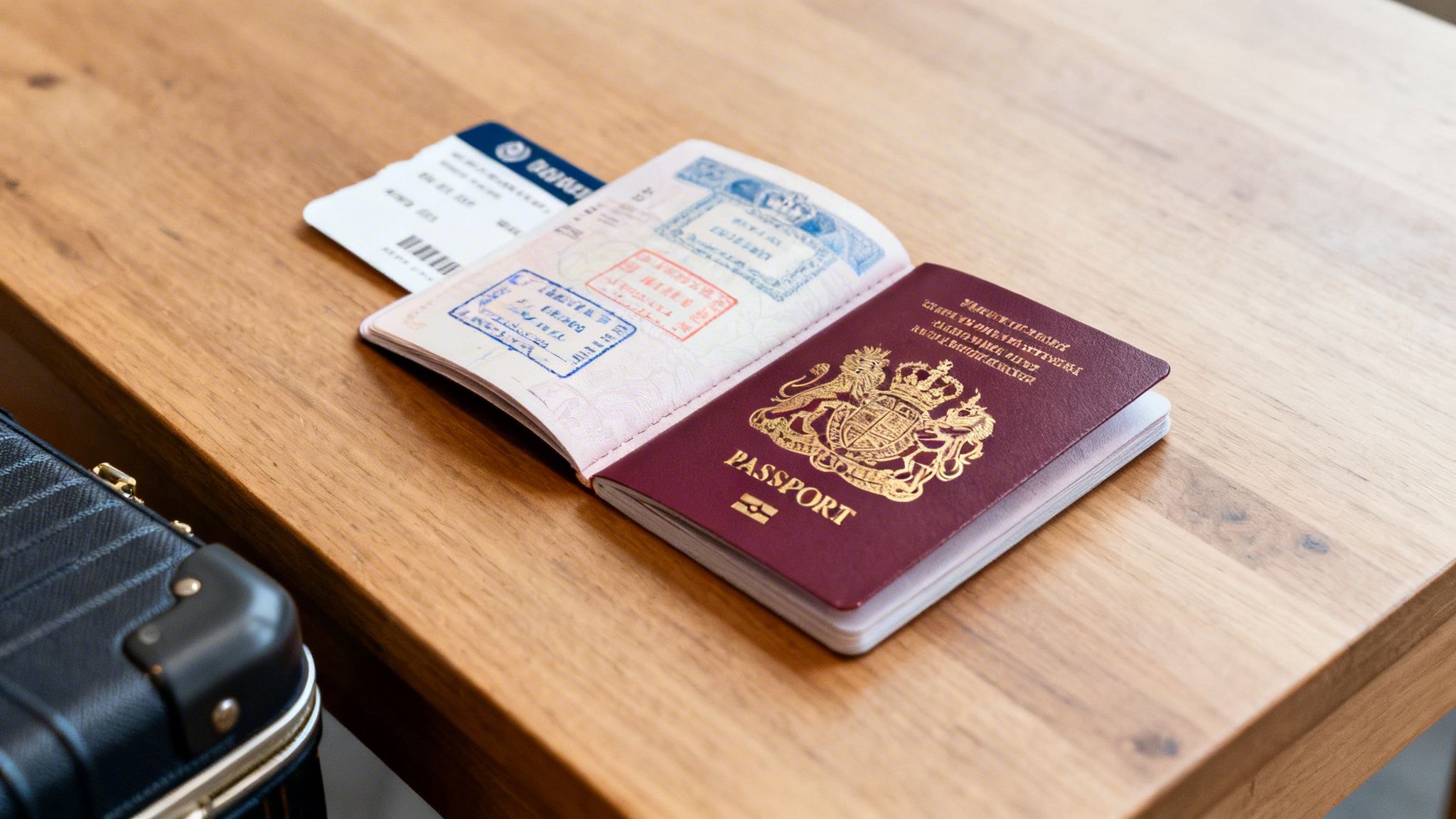
An open British passport with visa stamps and a boarding pass on a wooden table, next to a suitcase.

Think of it as a proactive "Plan B" or "Insurance Policy." It allows you to navigate the complex demands of international business without losing momentum. This is not a workaround; it's a fully legitimate service provided by Her Majesty’s Passport Office (HMPO) for British citizens who can prove a genuine need.

Escaping the Overlapping Visa Trap

The most common "genuine need" is escaping the "Overlapping Visa Trap." Imagine your main passport is with the Chinese embassy for several weeks. Suddenly, a critical, time-sensitive opportunity arises in Riyadh, requiring a business visa for Saudi Arabia now. With only one passport, you're completely stuck.

This isn’t a hypothetical problem—it's a daily reality for executives, engineers, and sales professionals across the UK. A second passport is the only practical solution, allowing you to run visa applications in parallel. You can submit one passport to get your Saudi visa while using the other for immediate travel.

This strategic separation of documents ensures your business operations are never held hostage by consular processing times. It’s the difference between seizing an opportunity and having to explain to your board why a key meeting was missed.

To see just how powerful this can be, you can explore the full scope of how a second UK passport provides a vital advantage for frequent travellers.

Navigating Politically Sensitive Travel

Another critical "genuine need" that HMPO recognises involves dealing with incompatible entry stamps. Some countries will deny entry if your passport shows travel to a nation they have political conflicts with, a major issue for anyone doing business across the Middle East.

  • The Israel-Saudi Challenge: While diplomatic relations are evolving, a passport containing an Israeli stamp still carries a high risk of rejection for a Saudi visa application.
  • Ensuring Operational Continuity: A second passport allows you to completely isolate your travel histories. One passport can be used for trips to Israel, while the other remains 'clean' for seamless entry into Saudi Arabia and other GCC countries.
  • Risk Mitigation: This tactic removes the ambiguity and the real risk of being denied boarding or turned away at immigration—a risk no business can afford. It is standard practice for seasoned corporate travellers and rotational workers in the energy and humanitarian sectors.

This approach gives you certainty, ensuring your access to key markets is never compromised by your travel history.

An Essential Asset for Specific Professions

For certain professions, a second passport is an Operational Essential. Rotational Workers in the oil and gas sector are constantly flying to visa-heavy regions on tight schedules. Their passports fill up with stamps quickly, and a second document is the only way to avoid running out of pages mid-rotation.

Similarly, for Airline Crew, a second passport is key to maintaining flight rotations. If their primary passport is held for visa renewal, a backup allows them to continue working without disruption, keeping airline operations on track.

Obtaining a second passport requires strong justification, typically a formal employer support letter on corporate letterhead. This letter must clearly outline the business need, feature a wet-ink signature, and explain why a single passport is insufficient for your professional duties. It is this proof of necessity that underpins the legitimate application process.

The table below breaks down common travel headaches and shows how a second passport resolves them.

Primary Passport vs. Second Passport Scenarios

Travel Challenge Impact with One Passport Solution with a Second Passport
Concurrent Visa Needs All travel stops while the passport is held by an embassy, causing delays and missed opportunities. Apply for one visa with the primary passport while continuing to travel or apply for another visa with the second.
Incompatible Entry Stamps Risk of visa refusal or being denied entry at the border due to a politically sensitive travel history. Dedicate one passport for specific regions, keeping the other 'clean' for unrestricted access to sensitive countries.
Passport Nearing Full Frequent travel is halted to renew the passport, causing downtime for rotational or field staff. Continue travelling on the primary passport while the second is processed, or use the second as an immediate backup.
Emergency Travel Required Unable to respond to an urgent international business need if the passport is away for visa processing. The second passport is always ready for immediate, unplanned travel, ensuring business agility.

As you can see, for a certain type of professional, a second passport isn't a luxury—it's a fundamental part of their toolkit, ensuring they can be where they need to be, when they need to be there.

Your Saudi Business Visa Questions Answered

When you're preparing for business travel to Saudi Arabia, it's the practical, nitty-gritty questions that often pop up last minute. Let's run through some of the most common queries we hear from UK business travellers to make sure your application goes smoothly.

How Long Is a Saudi Business Visa Actually Valid For?

There’s no single answer here; the visa’s validity period is decided by the Saudi consulate, and it hinges almost entirely on the invitation letter from your Saudi sponsor. Typically, you'll see visas issued for 30, 90, or 180 days, with either single or multiple-entry options.

The golden rule is consistency. Your Saudi sponsor needs to clearly state the duration and number of entries they're requesting for you. Then, your UK employer's support letter has to mirror that request word for word. Any discrepancy, and the consulate will likely play it safe and grant the shorter duration, or they might even knock a multiple-entry request down to a single entry if the justification isn't strong enough. If you travel there a lot, you can't afford any ambiguity.

What are the Most Common Reasons for a Visa Rejection?

Nine times out of ten, a visa refusal isn't about your business case—it’s down to simple paperwork errors. Being meticulous is your best defence against the hassle and expense of a rejection.

Here are the most common pitfalls we see:

  • Mismatched Information: If your job title, purpose of visit, or requested visa length doesn't line up perfectly across the invitation, the UK support letter, and your online application form, that’s an immediate red flag.
  • A Weak Sponsor: An invitation from a company with a poor Nitaqat rating (the official Saudization program) is a huge liability and often leads to an instant rejection.
  • Incorrect Attestation: The sponsor's invitation letter isn't just a letter; it must be officially stamped and attested by the Saudi Chamber of Commerce. A standard company letterhead won't cut it.
  • Vague Justification: Stating your purpose as just "business meetings" is too generic and won't convince anyone. You need to be specific—mention project kick-offs, contract negotiations, or technical site surveys.
  • Previous Immigration Issues: It goes without saying, but if you've ever overstayed a previous Saudi visa, you can pretty much guarantee a refusal.

Can I Get a Saudi Visa with an Israeli Stamp in My Passport?

Officially, policies can and do change, but the reality on the ground is that a passport containing an Israeli stamp carries a very high risk of your visa being denied or being turned away at the border. It's a well-known stumbling block for international business travellers.

This is precisely the kind of problem a second UK passport is designed to solve. It’s not some sneaky workaround; it’s a perfectly legitimate strategy that Her Majesty’s Passport Office (HMPO) provides for professionals with a genuine business need.

With a second passport, you eliminate the risk entirely. You can keep one passport 'clean' for travel to Saudi Arabia and other GCC countries, while the other is used for travel to Israel. It’s standard practice for seasoned corporate travellers who operate in the region.

My Passport is Stuck at Another Embassy. How Can a Second Passport Help?

This is easily the most common and pressing reason professionals come to us. Your only passport is tied up for weeks at an embassy processing a US or Chinese visa, and suddenly, all other international travel grinds to a halt. This "visa trap" can scupper deals and throw critical project timelines into chaos.

A second UK passport is the definitive solution to this logistical nightmare. It lets you work in parallel. While your main passport is out of action, you can use your new, valid second passport to apply for that urgent business visa for Saudi without missing a beat.

It means no more costly disruptions to your schedule. What was a major bottleneck becomes a non-issue, keeping your business moving forward.


At Second UK Passports, we specialise in helping frequent travellers and corporate clients secure this vital business asset. If your travel is being hampered by visa processing times or sensitive entry stamp issues, we can help.

Check your eligibility and start your application for a second UK passport today.
Singapore Visa for UK Citizens: A 2026 Guide

For most short trips to Singapore, British citizens do not need a visa and are granted visa-free entry for up to 90 days for tourism and most business activities. This visa-free arrangement streamlines travel, but all UK passport holders must complete the mandatory SG Arrival Card online before travel and ensure their passport has at least six months' validity. For frequent corporate travellers facing complex itineraries, a second UK passport is a strategic asset for maintaining operational continuity.

Your Essential Checklist for Entering Singapore

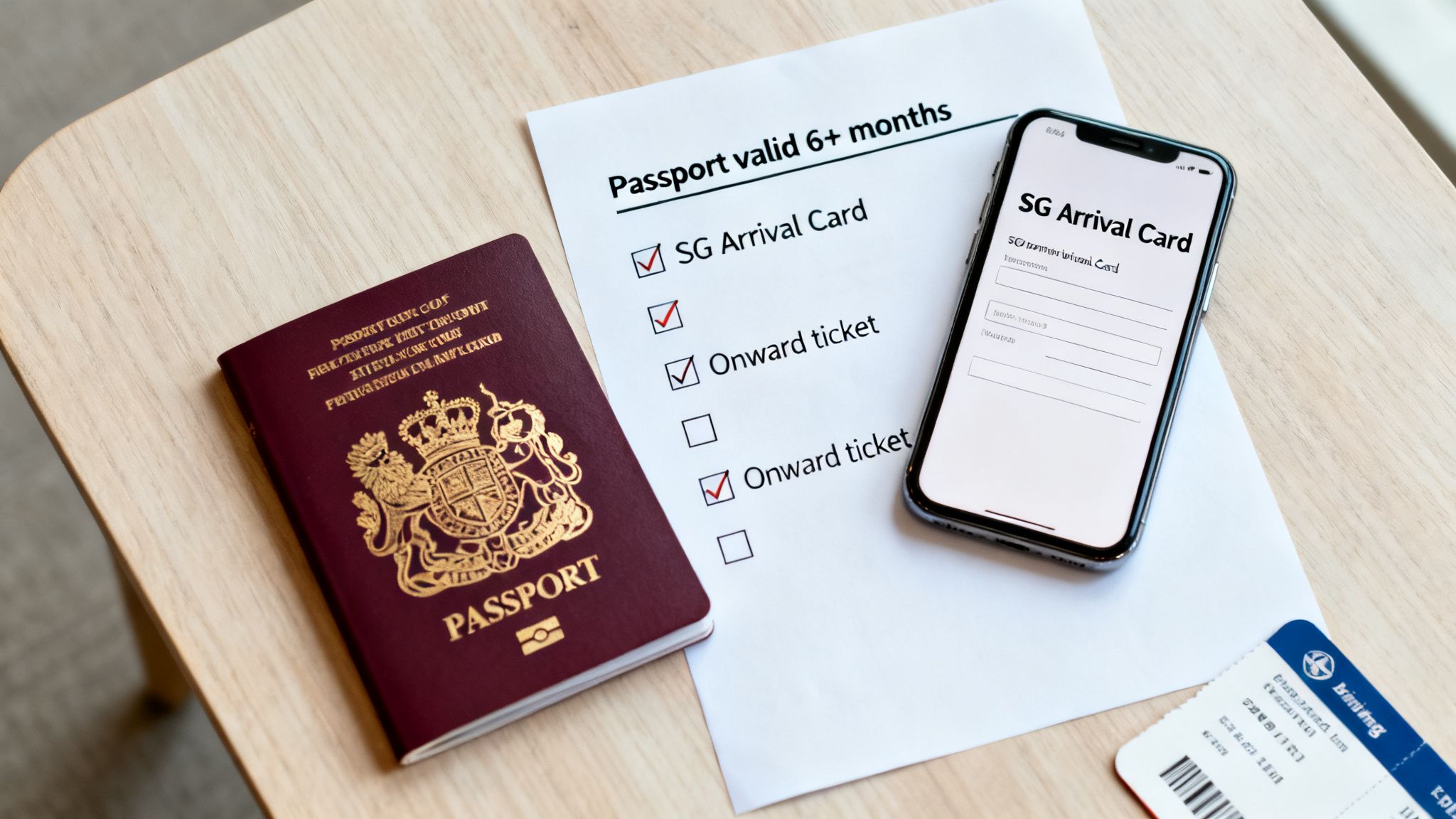
A UK passport, a travel checklist with checked items for Singapore, and a phone displaying an SG Arrival Card.

Even though a visa is not typically required, planning a trip to Singapore demands professional attention to detail. For corporate travel managers and frequent flyers, confirming every entry requirement is the first step towards a smooth, hassle-free journey. This process should be approached with the same diligence as a full visa application to mitigate any risk of travel disruption.

This pre-flight checklist provides a clear, actionable rundown of the essential requirements for any UK citizen travelling to Singapore. Adhering to these basics prevents delays at immigration and allows professionals to focus on the purpose of their visit.

Key Entry Requirements at a Glance

For short stays such as business meetings, conferences, or tourism, Singapore’s entry rules are straightforward but strictly enforced. Immigration officers expect all travellers to present the correct documentation upon arrival. This is not merely administrative paperwork; it is your permit for seamless entry.

It is important to note that the SG Arrival Card is not a visa. It is a mandatory digital declaration required for all individuals entering the country, replacing the legacy paper-based landing cards. You must complete this online within the three days immediately preceding your arrival.

The table below summarises each requirement with a practical tip based on extensive travel experience. For professionals managing complex travel schedules or simultaneous visa applications, it may be beneficial to explore the advantages a second UK passport can provide.

Singapore Entry Requirements for UK Citizens on Short-Term Visits

Here is a summary of the key requirements for UK citizens travelling to Singapore for tourism or short-term business purposes.

Requirement Details Expert Travel Tip
Visa-Free Period UK citizens can enter Singapore without a visa for up to 90 days for tourism, social visits, or business meetings. Do not mistake this for a right to work. If you plan to undertake paid employment, even on a short-term basis, you must secure the appropriate work pass.
Passport Validity Your British biometric passport must have at least six months' validity remaining from your date of entry into Singapore. Verify your passport's expiry date at the start of your travel planning. If it is approaching the six-month threshold, renew it immediately to avoid being denied boarding by your airline.
SG Arrival Card (SGAC) This is a mandatory electronic health and travel declaration. You must submit it online via the official ICA website within three days prior to your arrival. Complete this on a mobile device or laptop before leaving for the airport. The submission is free on the official government site—be cautious of third-party websites that charge a fee.
Proof of Onward Travel Immigration officers may request to see a confirmed flight ticket proving your intention to depart Singapore. Always have a copy of your flight itinerary—either digital or printed—readily accessible. This confirms your intent to leave within the permitted 90-day period.

Adherence to these guidelines will ensure your arrival in Singapore is straightforward, allowing you to proceed with your business or holiday without interruption.

Singapore's Visa-Free Entry: What UK Passport Holders Need to Know

For UK passport holders, entry into Singapore for short-term visits is remarkably efficient. As a British citizen, you are permitted to enter without a visa and stay for up to 90 days. This arrangement makes Singapore a convenient destination for tourism and business travel, reflecting the strong bilateral relationship between the two nations.

However, this 90-day entry permission is granted for specific short-term purposes. Overstaying or engaging in unauthorised activities constitutes a serious violation of Singapore's immigration laws. It is a visitor's pass, not an implicit approval for work or residency.

What You Can (and Can't) Do on a Visa-Free Stay

The 90-day visa exemption is designed for visits where you are not being paid by a Singaporean employer. A wide range of activities fall under this provision.

Here’s what’s typically allowed:

  • Tourism and Leisure: Sightseeing, visiting friends and family, and general tourism are fully permitted.
  • Business Meetings and Negotiations: Attending client meetings, negotiating contracts, or participating in conferences are standard and acceptable business visitor activities.
  • Short-Term Training: Attending a professional seminar or corporate training course is generally permissible, provided it is not a long-term, structured educational program.

The definitive restriction is local employment. If you intend to accept a job with a Singapore-based company, the visa-free entry route is not applicable. This requires a formal work pass, a separate and distinct application process.

The Mandatory SG Arrival Card

One critical step that can be overlooked is the mandatory SG Arrival Card (SGAC). To be clear: this is not a visa.

The SG Arrival Card functions as a digital landing card. It is an administrative tool used by Singapore's immigration and health authorities to pre-screen arrivals and does not confer any special permissions.

You must complete the SGAC online within the three days prior to your arrival in Singapore. It is only valid if submitted within this timeframe. The official Immigration & Checkpoints Authority (ICA) website is the sole platform for this submission, and it is entirely free. Avoid third-party sites that request payment.

How to Fill Out the SG Arrival Card

The process is efficient and takes only a few minutes with your travel details on hand.

  1. Navigate to the Official Website: Go directly to the official ICA portal for the SG Arrival Card.
  2. Enter Passport Details: Provide your personal information—name, date of birth, nationality—exactly as it appears in your biometric passport.
  3. Add Trip Information: Input your flight details, date of arrival, and the address of your accommodation in Singapore.
  4. Make a Health Declaration: Answer a few standard questions regarding your recent travel history and health status.
  5. Review and Submit: Double-check all information for accuracy, then submit the form. You will receive an email confirmation; keep this accessible on your phone to present to an immigration officer if requested.

When a Visa Is Required for Your Trip to Singapore

The 90-day visa-free arrangement is ideal for tourism and short business trips but is not suitable for all circumstances. If your plans involve employment, long-term study, or establishing residency, you must obtain a specific pass or visa.

Understanding this distinction is critical for both individual travellers and the corporate managers coordinating their assignments. Attempting to work or study on a short-term visit pass is a serious violation of Singapore's immigration laws and can result in severe penalties. Securing the correct documentation in advance is non-negotiable for any long-term stay.

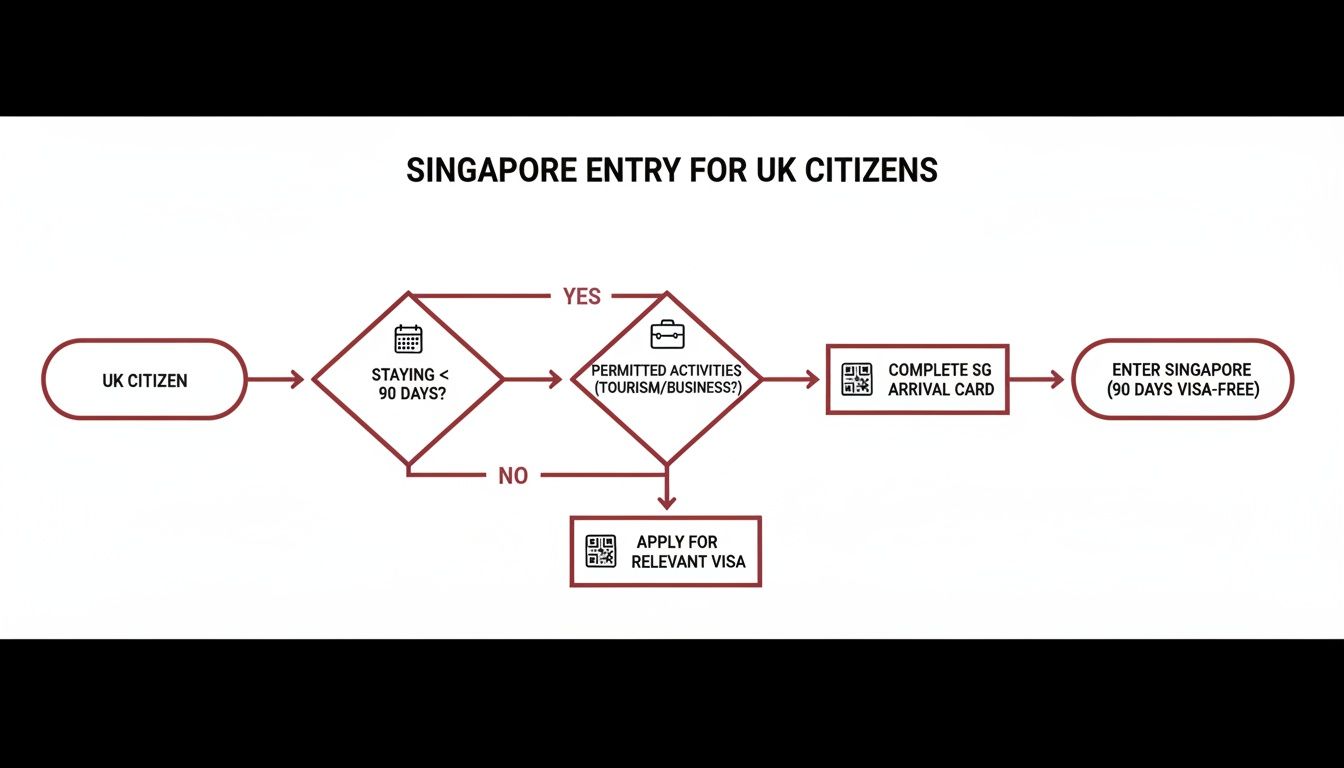
This flowchart provides a visual guide to help determine if your travel plans align with the visa-free model or require a formal application.

Flowchart detailing Singapore entry requirements for UK citizens, including visa-free eligibility conditions and visa application steps.

The primary factors are the duration and purpose of your stay. The one universal requirement for all travellers remains the SG Arrival Card.

Navigating Work Passes for Professionals

For a UK citizen with a job offer in Singapore, securing the correct work pass is the first priority. Singapore’s Ministry of Manpower (MOM) operates a structured, tiered system designed to attract global talent.

The most common work passes include:

  • Employment Pass (EP): The standard pass for foreign professionals, managers, and executives. Eligibility is based on qualifications and a minimum salary threshold, which varies by age and industry.
  • S Pass: Designed for mid-level skilled technicians, the S Pass has a lower salary requirement than the EP. Employers are subject to a quota and must pay a monthly levy for each S Pass holder.
  • Personalised Employment Pass (PEP): A premium option for high-earning EP holders or elite overseas professionals. It offers greater flexibility as it is not tied to a single employer, allowing the holder to switch jobs without reapplying for a new pass.

A critical point to remember: your employer is required to apply for the work pass on your behalf before you can legally commence employment. You cannot apply for these passes independently; a local sponsor (your employer) is mandatory.

The professional ties between the UK and Singapore are well-established. Data from 2013 shows an estimated 40,000 Singaporean nationals resided in the UK, demonstrating a strong, two-way flow of talent. Historical visa data from 2010-2014 reveals a consistent number of Singaporeans arriving under skilled work and study schemes, reflecting the mutual mobility UK professionals benefit from today. You can explore further visa statistics on the official ONS site for more detailed trends.

Securing a Student's Pass for Education

If you are a UK citizen enrolling in a full-time course at an accredited institution in Singapore, you must apply for a Student's Pass. This is required for all programmes, from university degrees to intensive language courses.

The application process is managed through Singapore's Immigration & Checkpoints Authority (ICA), initiated by your educational institution. A formal letter of acceptance is a prerequisite.

The process typically involves these steps:

  1. Receive Your Offer: Upon acceptance, the institution registers you in the ICA’s online portal, the Student's Pass On-Line Application & Registration (SOLAR) system.
  2. Submit Your Application: The institution provides you with the registration details needed to log in and complete your application online.
  3. Receive In-Principle Approval (IPA): Successful applicants receive an IPA letter, which also serves as a single-entry visa to travel to Singapore.
  4. Complete Formalities: After arriving, you will attend a scheduled appointment at the ICA to finalise the process and collect your official Student's Pass.

Your Student's Pass is tied to your specific course. Changing your course or institution necessitates a new application.

Breaking the Overlapping Visa Trap with a Second UK Passport

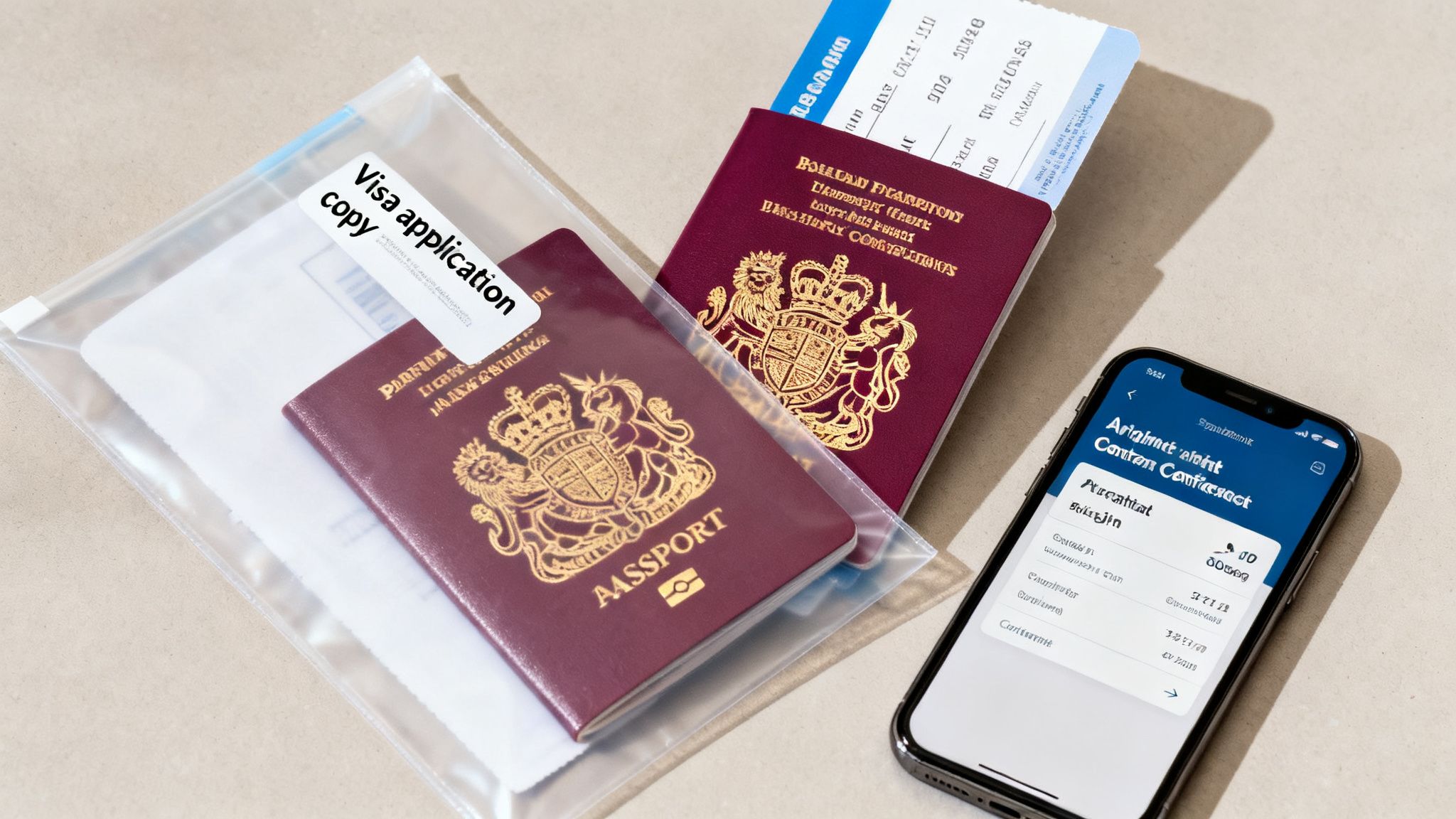
Close-up of UK passports, a visa application copy, a boarding pass, and a smartphone with a travel app.

Frequent business travellers often encounter a common logistical challenge. Your passport is submitted for a long-term Singapore work visa application, a process that takes weeks. Suddenly, an urgent, non-negotiable client meeting is scheduled in Dubai for the following week.

This is the "Overlapping Visa Trap." Your primary travel document is held by an embassy, effectively grounding you when you need to be mobile. This is more than an inconvenience; it directly impacts business outcomes. Every day your passport is unavailable represents lost revenue, stalled projects, and missed opportunities.

A second UK passport is the hidden solution—a vital tool for Operational Continuity. It is not a luxury but a strategic business asset, a legitimate "Plan B" sanctioned by Her Majesty’s Passport Office (HMPO) for those with a genuine need.

How a Second Passport Provides a Strategic Advantage

A project manager leading a major infrastructure project in Southeast Asia, using Singapore as a regional base, requires a Singapore Employment Pass. This requires submitting her passport for processing.

While the application is pending, she must fly to the Middle East to secure a critical supply chain deal. Without her passport, she is grounded. She faces an impossible choice: delay the supplier meeting or postpone her essential deployment to Singapore. Both options result in costly business setbacks. This is precisely the gridlock a second passport is designed to overcome. It is an insurance policy against travel downtime.

The Second Passport as a Solution

A second UK passport resolves this deadlock. HMPO provides this official service for individuals who can prove a genuine need for concurrent travel and visa applications.

Here is how it functions in practice:

  1. Primary Passport for Visa: She submits her primary passport to the Singaporean authorities for her Employment Pass application.
  2. Second Passport for Immediate Travel: She uses her second, equally valid British passport to fly to Dubai for the supplier meeting, maintaining business momentum.
  3. Seamless Continuity: Once the Singapore visa is issued and her primary passport is returned, she continues her travel schedule without having ever been constrained.

This two-passport strategy ensures long-term strategic goals, like securing a work pass, do not paralyse essential short-term operational tasks.

The concept is simple: a second passport allows you to be in two places at once, bureaucratically. One document can be processing in a visa application queue while the other remains with you, ready for immediate travel.

Proving Genuine Need: The Employer Letter

Securing a second passport requires proving a genuine professional need. The cornerstone of a successful application is a formal employer letter that meets strict HMPO requirements. This letter is the primary evidence used to justify your request.

The letter must be on official company letterhead, clearly state why a single passport is insufficient for your role, detail your frequent travel schedule, and highlight the need for simultaneous visa applications. Crucially, it must be signed with a "wet-ink signature" by a senior manager. Digital signatures are a frequent cause of rejection. For more information on the process for obtaining a second UK passport, consult our detailed guides.

Navigating Complex Itineraries and Conflicting Entry Stamps

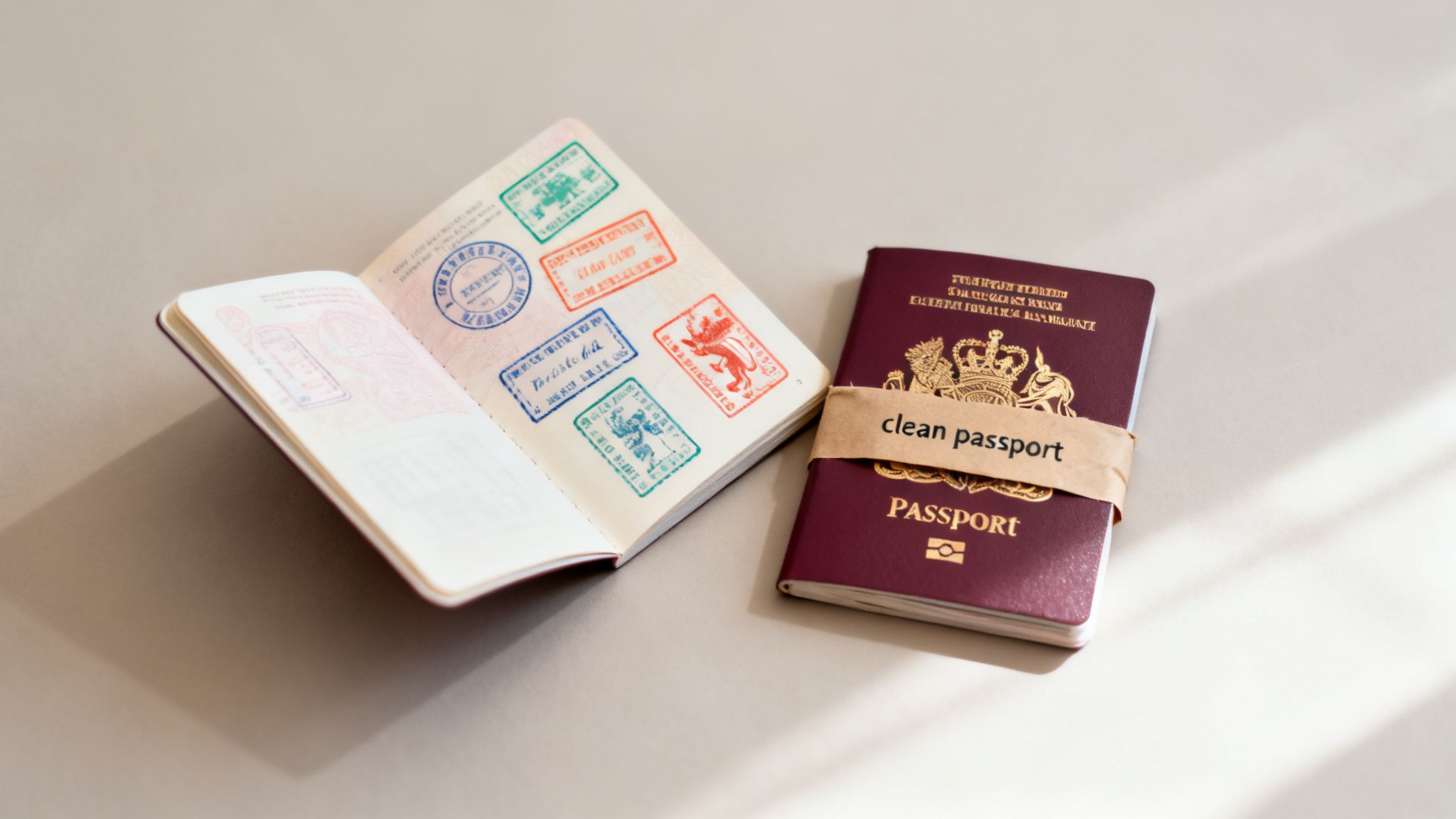
Two passports on a light surface, one open with colorful visa stamps, the other closed labeled "clean passport."

For professionals in sectors such as energy, humanitarian aid, or aviation, international travel often involves complex itineraries between countries with sensitive political relationships. An entry stamp from one nation can result in significant scrutiny—or an outright entry ban—at the next border. In these situations, a passport becomes a logistical liability.

For instance, an entry stamp from Israel can lead to denial of entry in certain other Middle Eastern countries. This is a serious operational risk that can derail critical missions and compromise personal safety. For these professionals, managing their travel history is a core component of their job.

A second UK passport is an essential tool for Risk Mitigation. This legitimate option, provided by Her Majesty’s Passport Office (HMPO), allows you to strategically separate your travel histories, ensuring operational continuity regardless of itinerary complexity.

The Strategic Value of a 'Clean' Passport

Holding two passports allows you to designate one for travel to regions that may result in politically sensitive entry stamps, while keeping the other 'clean' for seamless entry into major business hubs like Singapore.

This separation of travel history transforms your approach from reactive problem-solving to proactive risk management. Instead of facing uncertainty at immigration, you can plan complex multi-leg journeys with confidence, knowing you have the appropriate document for each destination.

A second passport functions as a geopolitical firewall. It ensures that travel to one sensitive region does not compromise your access to another, providing seamless mobility and an essential layer of personal security.

This is an official provision for UK citizens who can demonstrate a genuine need, such as rotational workers in the energy sector or NGO staff operating in volatile zones.

Ensuring Smooth Entry into Singapore and Beyond

Singapore's immigration officers are thorough. While your UK passport grants visa-free access, your travel history will be reviewed. A passport containing stamps from politically sensitive regions can trigger additional questions and cause unnecessary delays.

By presenting a 'clean' biometric passport—one used for travel to destinations like Europe, North America, and other parts of Asia—your arrival in Singapore is streamlined. It removes potential ambiguity and allows for a swift entry process. Your entry as a UK citizen is resolved quickly with the standard 90-day visa-free allowance. If this solution fits your travel profile, it is worth investigating the specific criteria for second passport eligibility.

The 2026 Legal Landscape: A New Urgency for UK Entry

Travel rules are constantly evolving. As of February 25, 2026, UK entry rules have been tightened. Dual nationals can no longer use a foreign passport alone to enter the UK; they must present a valid British passport or a digital Certificate of Entitlement (COE) to avoid being denied boarding by carriers. Furthermore, British citizens are ineligible for the UK's new Electronic Travel Authorisation (ETA) system, making possession of a valid British passport the only seamless method for entering the country.

Your Questions Answered: Singapore Travel for UK Citizens

Here we address common practical questions from UK travellers and corporate travel managers. Consider this a final pre-flight check to resolve any remaining uncertainties.

Can I Extend My 90-Day Stay in Singapore?

Yes, an extension is technically possible, but it is not guaranteed. If you require a stay beyond the initial 90-day visa-free period, you must apply for an extension of your Short-Term Visit Pass (STVP) through Singapore's Immigration & Checkpoints Authority (ICA).

A compelling reason, such as a medical issue or family emergency, is required. The application must be submitted online via the ICA's portal before your current pass expires. Approvals are granted on a strict case-by-case basis.

What Happens if I Overstay My Visa in Singapore?

Do not overstay. Overstaying is a serious offence in Singapore with severe penalties. The immigration laws are strictly enforced, and violations can impact your future travel eligibility worldwide.

Potential consequences include:

  • Significant Fines: Financial penalties can be substantial.
  • Imprisonment: For serious overstays, a jail sentence is a possibility.
  • Deportation and Ban: You will be removed from the country and may be banned from re-entering Singapore, potentially for life.

Always depart on or before the date stamped in your passport.

Do I Need Proof of a Return Ticket to Enter?

While immigration officers may not always ask to see it, they are entitled to. It is highly advisable to have it ready.

A confirmed flight itinerary showing departure from Singapore within the 90-day window is the clearest proof of your intent to comply with immigration rules. It simplifies the arrival process and preempts any challenging questions.

Failure to provide proof upon request could lead to further questioning or, in a worst-case scenario, denial of entry.

The 2026 Rule Change and Dual Nationals

As of February 25, 2026, UK entry rules require all British citizens, including dual nationals, to present a valid British passport or a digital Certificate of Entitlement (COE) to their carrier to enter the UK. Using a foreign passport alone is no longer sufficient and will likely result in being denied boarding. Additionally, British citizens are not eligible for the UK's Electronic Travel Authorisation (ETA) system. A valid British passport is therefore essential for seamless entry into the UK.


At Second UK Passports, we specialise in helping frequent travellers and corporate clients secure this essential travel asset. A second passport is the definitive solution to ensure your global mobility is never compromised by visa processing delays, conflicting stamps, or emergencies.

Check your eligibility and start your application today.

Do You Need a Visa for Malaysia? A 2026 UK Traveller’s Guide

For most trips, the answer is a straightforward no—British citizens do not need a visa for Malaysia if they're visiting for tourism or business for up to 90 days. This makes planning a trip feel refreshingly simple, but knowing the specifics is what separates a smooth arrival from a stressful one. This guide explains the current entry rules and why a second UK passport is a hidden solution for frequent travellers facing logistical challenges.

Your Guide to UK Travel to Malaysia

The question "do you need a visa for Malaysia?" is common for UK-based professionals mapping out business trips. Thankfully, Malaysia's generous visa-free arrangement means you can focus more on your itinerary and less on tedious paperwork.

However, 'visa-free' doesn't mean 'requirement-free'. There are non-negotiable conditions you must meet to be waved through immigration. Getting these right is key to avoiding last-minute hitches that could jeopardise your entire trip.

Essential Entry Conditions for British Citizens

Before booking flights, check your travel documents. The Malaysian authorities are clear about their requirements, and meeting them is essential for a hassle-free entry.

Think of it as a pre-flight checklist:

  • Passport Validity: Your British biometric passport must have at least six months of validity remaining from the day you plan to enter Malaysia.
  • Blank Passport Pages: You'll need at least one clean, blank page for immigration stamps.
  • Malaysia Digital Arrival Card (MDAC): This is a mandatory online registration you must complete within the three days leading up to your arrival.

This visa-free access for trips up to 90 days has been in place for years and is re-confirmed in the UK government's official travel advice for 2026. This means you can arrive with your valid passport and MDAC confirmation, making Malaysia an incredibly accessible destination. You can always verify the latest details on the GOV.UK travel advice page for Malaysia.

To make this even clearer, here’s a quick-glance checklist for a smooth entry.

UK Citizen Visa-Free Entry Checklist for Malaysia

This table summarises exactly what you need to have in order before you travel.

Requirement Details and Official Source Key Traveler Note
Visa-Free Period Up to 90 days for tourism or business. You cannot work or study on this entry. For longer stays or other purposes, a visa is required.
Passport Validity Must be valid for at least 6 months from your date of entry. Check your passport's expiry date now. It's the most common reason for being denied boarding.
Digital Arrival Card Mandatory MDAC must be completed online within 3 days of arrival. Keep the confirmation email handy on your phone. Some airlines ask to see it at check-in.
Proof of Onward Travel A confirmed ticket to leave Malaysia (within the 90 days). Immigration officers may ask to see your return or onward flight booking as proof you intend to leave.

Having these four items sorted gives you the best chance of walking through Malaysian immigration without a single issue.

The Challenge for Frequent Global Travellers

While Malaysia's rules are straightforward, a classic problem catches many seasoned professionals out: the "Overlapping Visa Trap." Imagine you need to be in Kuala Lumpur for a vital meeting, but your only passport is stuck at an embassy for a complex visa application for another country. This scenario can grind your business travel to a complete halt.

This is precisely where a second UK passport becomes a business asset for "Operational Continuity" and "Risk Mitigation." It's a fully legitimate service offered by Her Majesty’s Passport Office (HMPO) that allows one passport to be tied up in a lengthy visa process while your other one is free for immediate, visa-free trips to countries like Malaysia. Think of it as your strategic "Plan B" or "Insurance Policy" to eliminate travel downtime.

Navigating Malaysia's Visa-Free Entry Rules

So, do you need a visa for Malaysia? For British citizens on a short trip, the answer is usually no, but you must follow a clear set of rules. Getting these details right is crucial for any business traveller looking to avoid headaches at the border.

Your Passport: The Non-Negotiable Basics

The first and most important hurdle is your passport's validity. As highlighted by GOV.UK, Malaysian immigration is firm: your British passport must be valid for at least six months from the day you land. This is a strict requirement and a common reason people get turned away by their airline before they even leave the UK.

You’ll also need at least one completely blank page for the entry and exit stamps. This might sound minor, but for frequent flyers whose passports are a mosaic of stamps, it can be a real issue. A second passport often becomes an operational essential to ensure you're always ready to travel.

Don't Forget the Malaysia Digital Arrival Card (MDAC)

A crucial part of your pre-flight checklist is the Malaysia Digital Arrival Card (MDAC). This isn't a visa, but it is a mandatory online form that you must complete within three days of your arrival.

Once you’ve submitted it, you'll get a confirmation email. Have a screenshot of this on your phone, as airline staff and immigration officers will likely ask to see it. Forgetting to do this can lead to unnecessary delays when you land.

At the Immigration Counter

Even with the right passport and your MDAC sorted, the final decision rests with the border official. They need to be confident that you’ll leave the country within your permitted 90-day visa-free window.

Be ready to show them:

  • A confirmed return or onward flight ticket: This is the clearest proof you have a plan to exit Malaysia on time.
  • Proof of sufficient funds: They don't always ask, but you might need to show you can support yourself during your stay.

Having these documents ready will make for a smooth and professional arrival. For busy professionals juggling multiple trips, knowing these fine details is key. You can learn more about how a second passport provides vital travel flexibility in our detailed overview.

The 2026 UK Entry Rules for Dual Nationals

As of February 25, 2026, UK entry rules have tightened. Dual nationals can no longer use a foreign passport alone to enter the UK; they must present a valid British passport or a digital Certificate of Entitlement (COE) to avoid being denied boarding by carriers. Furthermore, British citizens are ineligible for the new Electronic Travel Authorisation (ETA) system, making possession of a valid British passport the only seamless way to enter the UK.

When You Absolutely Need a Malaysian Visa

The 90-day visa-free arrangement is a fantastic perk for UK citizens, but it’s crucial to understand its limits. The moment your plans involve work or study, the answer to "do you need a visa for Malaysia?" becomes a firm "yes."

Trying to work or enrol in a course on a tourist stamp is a serious breach of Malaysian immigration law. The authorities are strict, and getting caught can lead to hefty fines, detention, and being barred from re-entering the country. For anyone planning a long-term assignment, getting the right paperwork sorted from the beginning is non-negotiable.

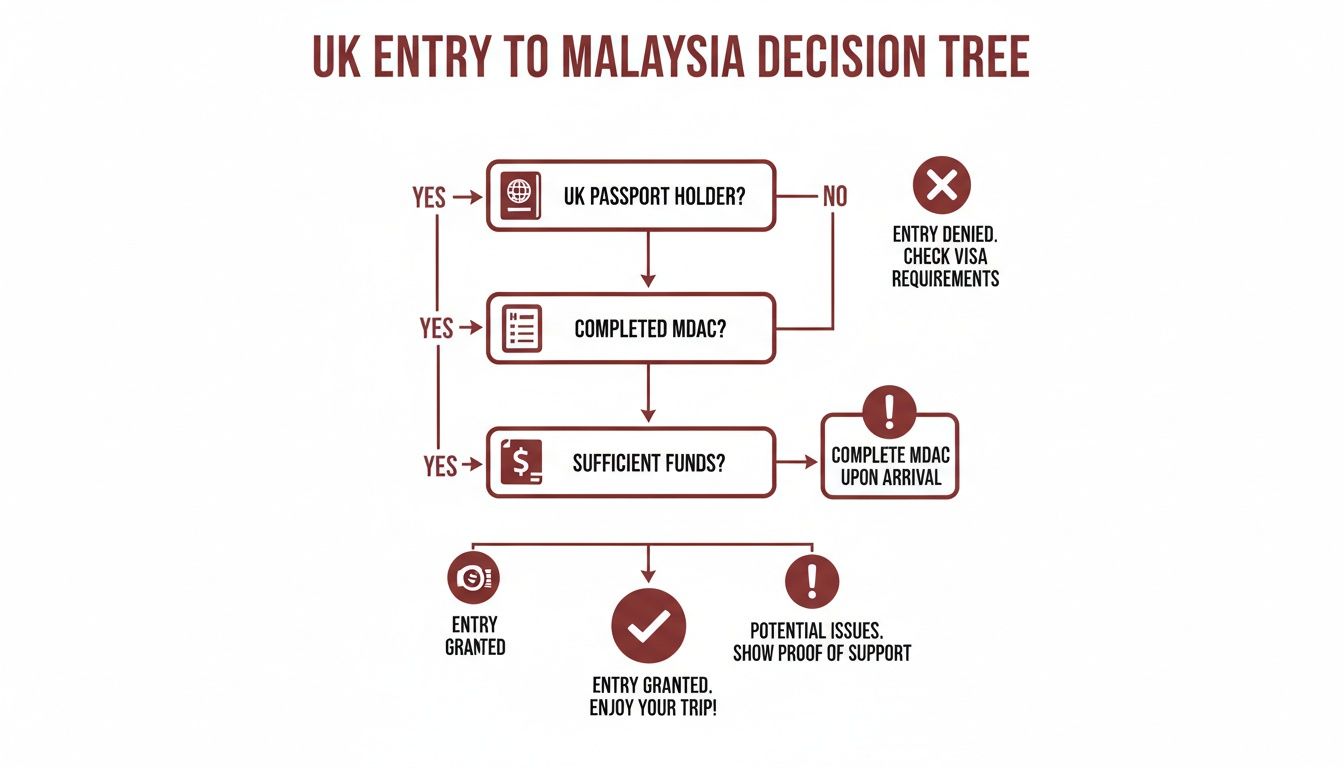
This handy infographic lays out the essentials for a standard visa-free entry from the UK.

A decision tree flow chart outlining UK entry requirements for Malaysia, including passport, MDAC, and sufficient funds.

As you can see, the visa-free route is straightforward for tourism. But if your plans don't fit into that box, you’ll need to apply for a proper visa or pass.

Scenarios Demanding a Formal Visa Application

If your reason for travelling fits one of the descriptions below, you must secure the correct pass before you fly. You cannot just arrive on a tourist stamp and hope to change it later.

  • Long-Term Employment: Landed a job with a Malaysian company? You'll need an Employment Pass. Your employer sponsors this and handles the initial application.
  • Higher Education: If you're enrolling at a Malaysian university, a Student Pass is essential. Your educational institution kicks off this process.
  • Specialised Professional Visits: For foreign experts brought in for specific, highly skilled projects, the Professional Visit Pass (PVP) is the correct route.
  • Dependants of Pass Holders: If your spouse or parent holds an Employment Pass, you'll need a Dependant Pass to legally live with them in Malaysia.

It all boils down to your intent. The 90-day visa-free entry is for temporary visitors. A long-stay permit like an Employment Pass signals a deeper commitment to living and working in Malaysia, which involves a much more thorough application process.

Understanding the Application Process

Securing a long-stay pass for Malaysia is a multi-stage affair requiring a stack of documents and is nearly always initiated by your sponsor in Malaysia. The requirement for a formal employer support letter on corporate letterhead featuring a "wet-ink signature" is strict to avoid application rejection.

Here’s a simplified breakdown of the steps:

  1. Sponsor Application: Your Malaysian employer or university submits the main application to the Immigration Department of Malaysia.
  2. Visa with Reference (VDR): Once approved, you get a VDR approval letter. This is a crucial document, but it’s not your final visa.
  3. Embassy Endorsement: You take the VDR letter to the Malaysian Embassy or High Commission in your home country to get a single-entry visa sticker in your passport.
  4. Arrival and Final Endorsement: You travel to Malaysia on this single-entry visa, where the Immigration Department will endorse your passport with the final long-term pass sticker.

This entire chain of events can easily take several weeks. For busy professionals who can't afford to have their passport tied up, this is where a second UK passport proves invaluable. It allows you to submit one passport for the lengthy visa process while you continue travelling on the second. To see how this works, have a look at our in-depth guide on acquiring a second passport.

What Happens When Your Passport is Stuck at an Embassy?

For any frequent traveller, time is everything. Asking "do you need a visa for Malaysia?" is simple for a one-off holiday. But what if you're a professional juggling a hectic international schedule? Suddenly, a visa-free trip can become a massive headache.

Picture this: you have a vital client meeting in Kuala Lumpur, relying on Malaysia's 90-day visa-free entry. The problem? Your only passport is tied up at an embassy, waiting weeks for a visa to be processed for another trip.

This is the classic 'Overlapping Visa Trap'. It’s a common scenario that grounds key personnel, jeopardises deals, and brings business to a screeching halt. A single, slow visa application can block all other international travel.

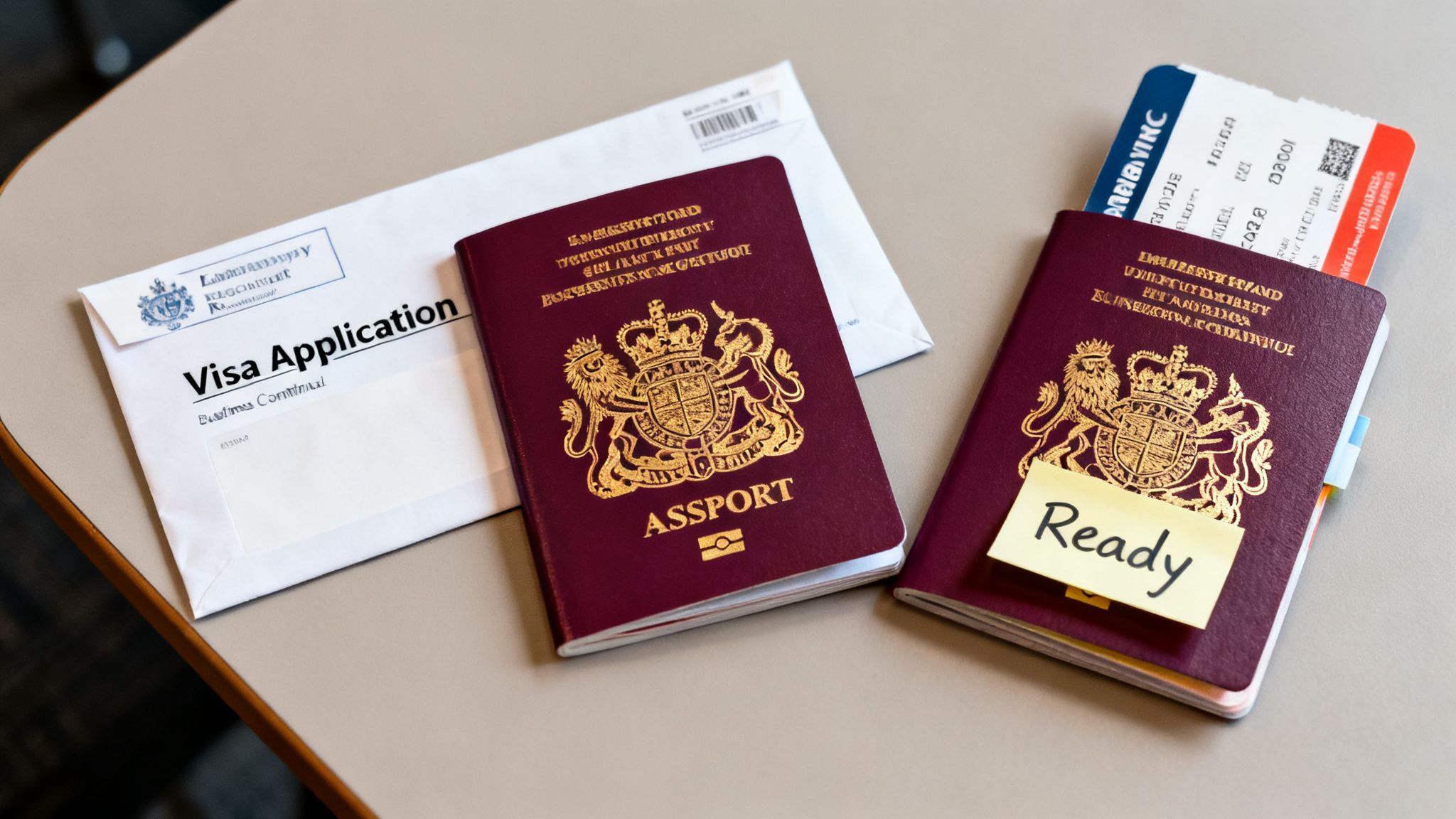
Two British passports, a visa application envelope, and a plane ticket on a table, signifying travel preparation.

Your Secret Weapon: The Second UK Passport

This is exactly where a second UK passport becomes an essential tool for "Operational Continuity." This isn't some back-alley trick; it's a fully legitimate service offered by Her Majesty’s Passport Office (HMPO) for British citizens who can demonstrate a "genuine need" for simultaneous travel.

Holding two valid biometric passports means you can sidestep the Overlapping Visa Trap entirely.

Think of it as the ultimate "Insurance Policy" for your travel schedule. You can submit one passport for a visa application that might take weeks, while your second passport stays with you, ready for immediate, visa-free trips to places like Malaysia. Your mobility is never compromised.

A second UK passport is the definitive answer for maintaining operational continuity. It allows professionals to handle simultaneous visa applications and travel plans without conflict, turning a logistical mess into a seamless process.

This service is specifically for people whose jobs demand this kind of flexibility, a recognition that for certain roles, a single passport isn't fit for purpose.

Who Actually Needs This? Real-World Examples

The "genuine need" for a second passport is clearest in industries where constant international travel is the norm, such as aviation and energy.

The Airline Crew Imperative

For pilots and cabin crew, flight schedules are planned down to the minute. The Overlapping Visa Trap is a direct threat to their ability to do their jobs.

  • Juggling Rotations: A pilot might need a visa for China while being scheduled for flights to the Middle East and a visa-free stopover in Kuala Lumpur.
  • Avoiding Being Grounded: If they submit their only passport for the Chinese visa, they are instantly grounded for all other international duties, throwing rosters into chaos.
  • The Smart Solution: A second passport is an "Operational Essential." It lets them apply for the long-winded visa while using the other to continue flying their full international schedule.

For airlines, ensuring UK-based crews have second passports is smart risk management, preventing visa paperwork from interfering with flight operations.

The Rotational Worker Lifeline

Professionals in the energy sector, especially "Rotational Workers" in oil and gas or NGO staff, face similar challenges. Their work often sends them to visa-intensive or sensitive regions.

  • Back-to-Back Assignments: An engineer could finish a rotation in West Africa and need to fly immediately to a project briefing in Malaysia.
  • Conflicting Timelines: The visa for their next assignment might require their passport for several weeks, overlapping directly with their travel to Malaysia.
  • Eliminating Costly Downtime: With a second passport, they can leave one document with the visa agent and use the other for their immediate trip. This ensures they can move between projects without delay.

In both of these scenarios, the second passport isn't a luxury. It's a fundamental tool that keeps people working and projects on track.

When Your Passport Becomes a Political Minefield

An innocent-looking entry stamp from one country can cause a world of trouble when you try to enter another, especially if the two nations have a rocky political relationship. Suddenly, your passport isn't just a travel document; it's a political diary that border officials are ready to read carefully.

Imagine your work takes you to a country that Malaysia, or another nation on your itinerary, has a sensitive history with. The evidence of that visit, stamped in your passport, could trigger suspicion, intense questioning, and long delays at immigration.

The Challenge of a 'Marked' Passport

Certain entry stamps act like red flags for immigration officials. This forces an impossible choice: cancel a critical business trip to one place, or risk being turned away from the next? For any company operating on a global scale, that's a serious operational constraint.

This is precisely where a second UK passport goes from being a handy backup to an essential tool for "Risk Mitigation". It lets you segregate your travel, making sure the history in one passport doesn't cause problems for the journeys you take with the other.

A second passport offers a clean solution. You can dedicate one passport for travel to a specific group of politically sensitive countries, while the other remains "clean." This is a legitimate strategy, fully supported by Her Majesty’s Passport Office (HMPO) for individuals who can prove a "genuine need."

A Smart Solution for the Global Professional

For diplomats, foreign correspondents, and NGO workers, using a second passport to manage incompatible entry stamps is standard operating procedure. It’s a proactive step that ensures you can move smoothly through immigration, no matter where your work takes you.

Consider these real-world scenarios:

  • Humanitarian Missions: An aid worker might need to cross between two neighbouring countries with hostile relations. A second passport is often the only practical way to move between them.
  • International Business: A sales executive could have key clients in regions with conflicting political allegiances. Using separate passports prevents one business trip from derailing the next.
  • Energy Sector Rotations: Rotational workers in the oil and gas industry or NGO staff often visit sensitive regions requiring isolated entry stamps for security. A second passport keeps this travel history separate, preventing awkward questions.

By planning with this strategy, your ability to enter a country like Malaysia is no longer at the mercy of a border agent’s interpretation of your travel history. You present a passport perfectly suited for your destination, guaranteeing a professional and uncomplicated entry.

The High Cost of Overstaying Your Welcome

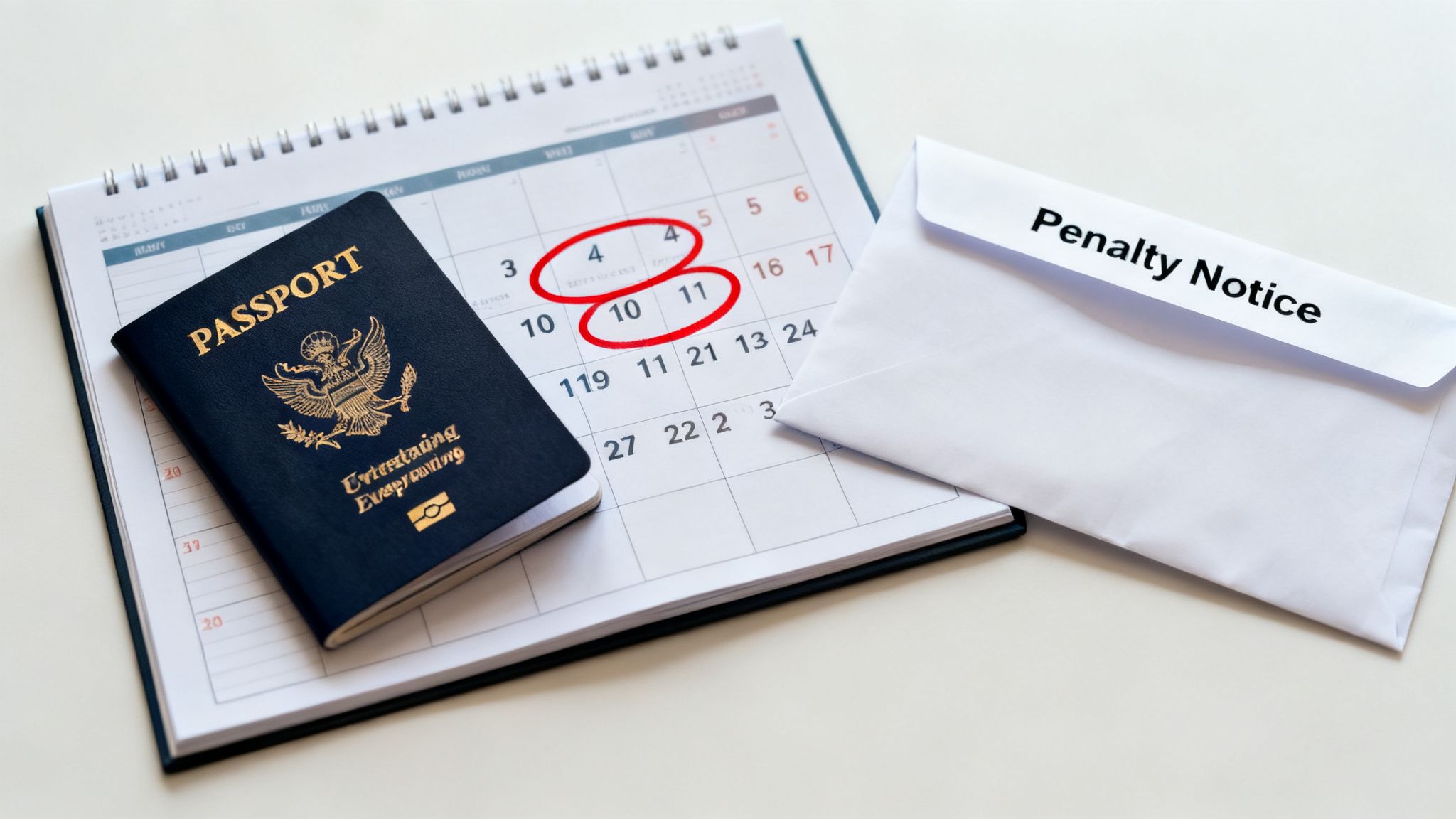
A US passport on a calendar with circled dates, next to a 'Penalty Notice' envelope.

While you don't need a visa for a 90-day trip to Malaysia, the authorities take that 90-day limit very seriously. They enforce a strict, zero-tolerance policy for anyone who stays even a day too long.

Overstaying can kick off a chain reaction of penalties that are expensive, stressful, and incredibly difficult to untangle. For any professional traveller, the damage to your travel record is not worth the risk.

Understanding the Penalties

The GOV.UK guidance is clear: the consequences for overstaying are severe. If you’re caught, you should expect to face:

  • Hefty Fines: These are the most common penalty, designed as a powerful deterrent.
  • Detention: You could be held in an immigration facility while your case is processed.
  • Deportation: Once fines are paid and detention is served, you’ll be deported at your own cost.
  • Blacklisting: A re-entry ban is almost certain, often lasting for several years.

The numbers speak for themselves. Fines for overstaying typically fall between 5,000-10,000 MYR (£850-£1,700), often with a five-year re-entry ban. Malaysian Immigration prosecuted 28,000 overstay cases in 2024 alone, a 12% jump from the previous year. You can get more details on Malaysia's entry rules directly from the official immigration portal.

How a Second Passport Provides a Safety Net

Careful planning is your best defence. But what if your passport is lost or stolen a few days before you're scheduled to fly home? Getting an emergency travel document isn't instant, and the delay could easily push you over your 90-day limit.

This is precisely where a second UK passport becomes an indispensable "Insurance Policy". If you keep it stored securely and separately, it's an immediate backup. You can use it to leave the country legally and on schedule, sorting out the replacement for your lost passport from the safety of home.

It’s a simple, proactive step that shields you from the serious fallout of an accidental overstay, proving its worth as a vital tool for any serious traveller.

Your Top Questions About Malaysia Visas Answered

Here are straightforward answers to the most common questions we hear about UK citizens travelling to Malaysia, especially when juggling complex itineraries.

How long can I stay in Malaysia as a UK citizen without a visa?

As a British citizen, you can enter Malaysia for tourism or business and stay for up to 90 days without a visa.

This is strictly for short-term visits. If you're planning to take up a job or enrol in a study course, you'll need to secure the right type of visa before you fly.

Is the Malaysia Digital Arrival Card the same as a visa?

No, it's not a visa. The Malaysia Digital Arrival Card (MDAC) is a mandatory pre-arrival registration form.

All foreign visitors, including those from the UK, must complete it online within three days of arriving. It’s a border control formality, not a permit to stay.

Can I work in Malaysia while I'm there on the 90-day visa-free entry?

That’s a firm no. The 90-day visa-free period is purely for tourism and brief business activities like attending conferences or meetings.

It absolutely does not permit you to take up formal employment. To work legally in Malaysia, your employer must sponsor an Employment Pass for you before you enter the country.

How would a second UK passport help with a trip to Malaysia?

While you don't need a visa for a short trip to Malaysia, a second passport is an incredibly useful tool for ensuring your travel plans never grind to a halt.

Imagine your main passport is tied up at an embassy for weeks, waiting for a visa to another country. With a second passport in hand, you can still fly to Malaysia without any disruption. It's a simple, legitimate strategy that prevents one administrative bottleneck from derailing your entire schedule. You can find out more in our guide to getting a second UK passport.


At Second UK Passports, we specialise in helping frequent travellers get the documents they need to stay mobile. If logistical hurdles are holding you back, we know how to help.

Check your eligibility for a second UK passport today

Applying for a Second UK Passport from Abroad: The Definitive Guide

Navigating international travel as a frequent flyer or corporate professional often presents a significant logistical challenge: your British passport is tied up in a visa application, but you need to travel now. Many mistakenly believe holding two passports is illegal, but the reality is that a second UK passport is a legitimate, official service from Her Majesty’s Passport Office (HMPO), designed as a hidden solution for those with a genuine need. It acts as a critical business asset, ensuring operational continuity and mitigating the risk of costly travel downtime.

This guide explains how to secure this vital travel tool, especially for British citizens applying from outside the UK.

The Strategic Advantage of a Second UK Passport

For professionals whose work involves constant international movement, a single passport is a single point of failure. A second passport isn't a luxury; it's a fundamental tool for risk mitigation, allowing you to manage complex travel schedules without interruption. It functions as your "Plan B" or "insurance policy," ensuring your ability to travel is never compromised by bureaucratic delays.

The core value lies in its ability to solve the "Overlapping Visa Trap." This common scenario occurs when one passport is submitted to an embassy for a lengthy visa process, effectively grounding you. With a second passport, you can continue to travel for other business commitments while the first visa is being processed.

Who Qualifies? Proving a "Genuine Need"

Approval for a second biometric passport hinges on proving a genuine and demonstrable need. HMPO does not issue them lightly. You must provide compelling evidence that your professional or personal circumstances necessitate a second travel document.

Key scenarios that establish a "genuine need" include:

  • Frequent Business Travel: You need to travel to one country while your primary passport is being held by an embassy for a visa to another country.
  • Politically Sensitive Destinations: You travel to countries with conflicting diplomatic relations (e.g., Israel and certain Arab nations), where an entry stamp from one can result in being denied entry to the other. A second passport allows you to isolate these stamps.
  • Urgent Unplanned Travel: Your role requires immediate, unplanned international travel for business emergencies or personal matters while your other passport is unavailable.

How to Apply for a Second UK Passport from Abroad

The application process from overseas is similar to a standard renewal but requires a significantly higher level of documentation to justify your request. The key to a successful application is a meticulously prepared case supported by irrefutable evidence.

Core Documentation Requirements

Every application must include the standard documents, but the supporting evidence is what makes or breaks your case.

  • Completed Application Form: Use the standard overseas application form, clearly indicating it is for an additional passport.
  • Current British Passport: You will need to submit your current passport.
  • Passport Photos: Two identical, recent photos that meet HMPO's strict specifications.
  • The Crucial Employer Letter: This is the most critical component of your application.

The Employer Support Letter: Your Key to Approval

Your application will almost certainly be rejected without a strong, formal letter of support from your employer. This document must be printed on official company letterhead and, critically, feature a wet-ink signature from a senior manager or director. Digital signatures are often refused.

The letter must explicitly:

  1. State Your Role: Clearly define your position and the international nature of your responsibilities.
  2. Justify the Need: Detail why a second passport is essential for your role. Provide specific examples of upcoming trips or conflicting visa requirements.
  3. Confirm Travel Plans: Include a forward-looking itinerary that demonstrates the overlapping travel or visa needs.
  4. Acknowledge Responsibility: The company should state it supports the application and understands the regulations surrounding the use of a second passport.

This letter serves as the primary evidence for your "genuine need" claim.

Navigating the 2026 UK Entry Rules: Why a Second Passport is More Important Than Ever

The legal landscape for British citizens, particularly dual nationals, has fundamentally changed. As of February 25, 2026, UK entry rules have tightened, making possession of a valid British passport an operational necessity, not just a convenience.

Previously, some dual-national British citizens could enter the UK using their foreign passport. This is no longer the case. Under the new regulations, airlines are mandated to deny boarding to British citizens who cannot present either a valid British passport or a digital Certificate of Entitlement (COE) linked to their foreign passport.

The ETA System and British Citizens

Furthermore, the UK's new Electronic Travel Authorisation (ETA) system, similar to the US ESTA, complicates matters for dual nationals. It is crucial to understand that British citizens are ineligible to apply for an ETA. The system is designed for visa-exempt foreign nationals.

This means attempting to enter the UK on a foreign passport without a COE will result in being blocked at check-in, as you cannot get an ETA. A valid British passport is the only document that guarantees seamless entry. For a professional with one passport stuck in a visa process, a second passport becomes the only reliable tool to ensure you can always return to the UK without issue.

Industry-Specific Use Cases

The need for a second passport is particularly acute in certain professional sectors where international travel is constant and complex.

Two passports, a flight ticket, and a calendar on a wooden table, one passport is 'in process' and 'rejected'.

Corporate & Aviation Sectors

For corporate executives and airline crew, the "Overlapping Visa Trap" is a constant operational threat. A flight attendant or pilot cannot afford to have their passport held by an embassy for weeks; it would disrupt flight rotations and staffing schedules. For airline crew, a second passport is an "Operational Essential" to maintain their flight duties while securing visas for future routes.

Energy & Humanitarian Fields

"Rotational Workers" in the oil and gas industry or NGO staff frequently travel to politically sensitive regions. A second passport is a vital security tool, allowing them to use one passport for travel to a specific region while keeping the other "clean" for entry into countries that might scrutinize their travel history. This mitigates risks and ensures safe passage across conflicting borders.


Managing the complexities of global travel requires proactive planning and the right tools. A second UK passport is a fully legitimate solution that provides the flexibility and security needed to maintain professional momentum in an interconnected world. By understanding the official requirements and presenting a well-documented case, you can secure this invaluable asset.

Check your eligibility for a second passport and maintain your operational continuity

Passport Running Out of Pages? Your Guide to Renewal and Second Passports

For any professional who lives out of a suitcase, the sight of a passport running out of pages isn't just a travel headache—it's a genuine business risk that threatens operational continuity. You have two choices: renew early and be grounded for weeks, or apply for a second UK passport—a fully legitimate, strategic solution that many professionals don't even know is available. Let’s break down how to mitigate travel downtime and keep your business moving when the stamps start to pile up.

Why a Full Passport Can Derail Your Business

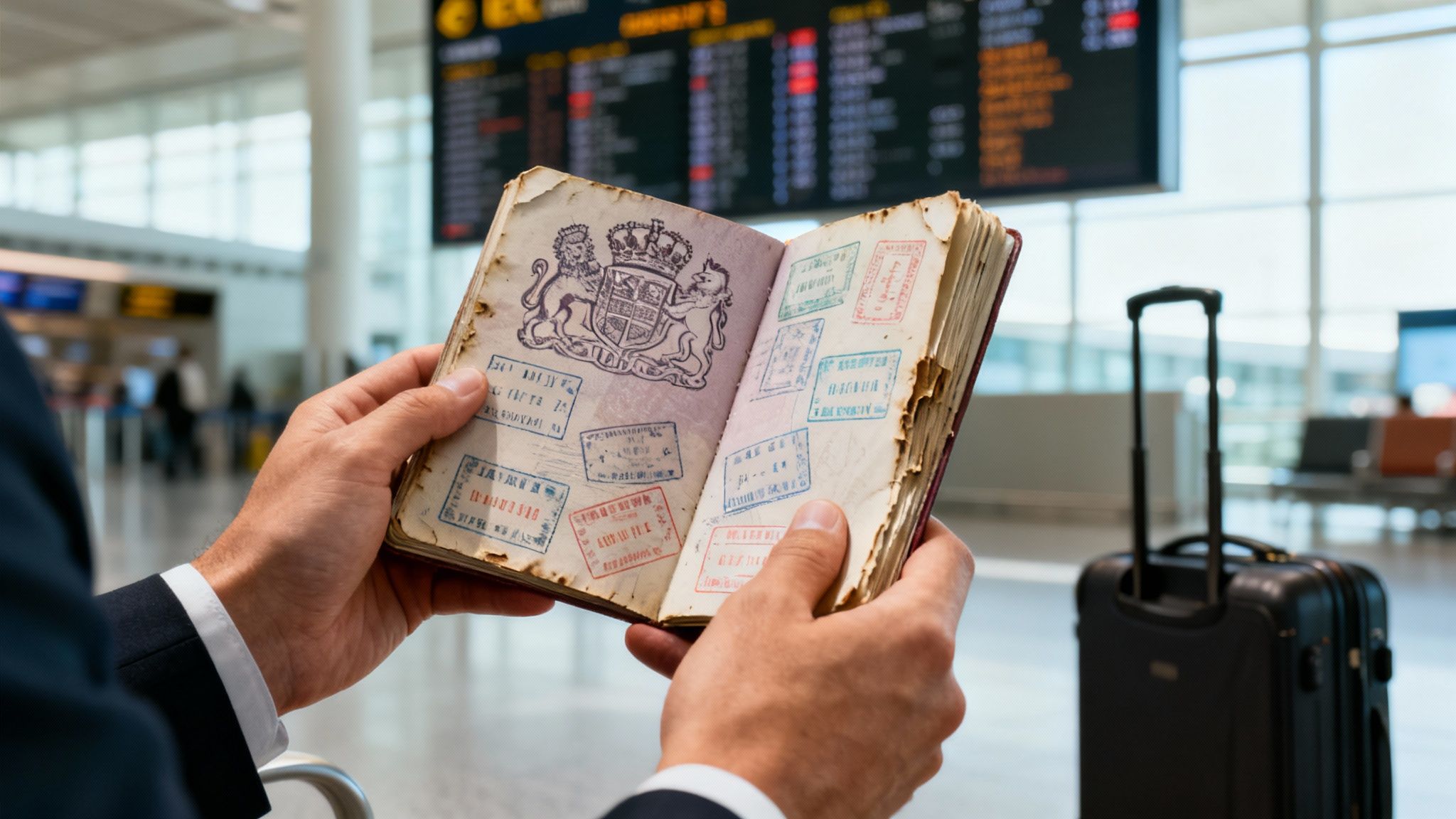
A person holds an open, well-traveled passport full of stamps in an airport lounge, with a black suitcase nearby.

For airline crew, energy sector rotational workers, or executives juggling global contracts, a full passport isn't a future problem—it's an imminent one that can stop operations dead in their tracks. The culprits are usually the bulky, full-page visa stickers and the endless entry and exit stamps that chew through pages far quicker than you’d expect.

While a British passport is a powerful tool, the standard 34-page booklets often don't cut it for frequent travellers. Her Majesty’s Passport Office (HMPO) recognised this issue years ago. When they introduced the Series B passports in 2015, they bumped up the standard page count from 32 to 34 and replaced the old 48-page business version with a heftier 50-page 'jumbo' passport. The reason was clear: professionals were constantly running out of space.

Think of a logistics manager whose team bounces between Europe, the Middle East, and Asia. A single trip requiring visas for countries with political tensions can easily consume 5-10 pages—a common scenario for corporate travel managers. For a deeper dive into how our passports have evolved, the history of British passport specifications on Wikipedia offers some interesting context.

A Business Continuity Blind Spot

A passport maxed out with stamps isn't a personal inconvenience; it's a direct threat to business continuity.

Imagine an engineer is urgently needed for a site visit in a region that demands a visa. If their passport doesn't have enough completely blank pages (many countries require two or more), the visa application is dead on arrival. This leads to project delays, missed deadlines, and even potential contractual penalties. That one administrative snag suddenly creates a costly ripple effect across the entire business.

Then there's the geopolitical chess game. An entry stamp from one country can get you flat-out denied entry to another. A single passport makes navigating back-to-back trips between certain nations incredibly difficult, forcing you into a logistical corner.

A passport running low on pages is more than an administrative hurdle; it's a direct risk to your ability to conduct international business. Proactive management is the only way to ensure operational readiness.

The key is to understand your options before you're in a jam. A standard renewal seems like the obvious path, but it means surrendering your current passport—along with any valid, long-term visas inside it—and being unable to travel for weeks.

The Overlooked Strategic Solution: The Second Passport

There's a better way: securing a second UK passport. This is not some back-alley trick; it's a legitimate, official service offered by HMPO for anyone who can prove a "genuine need." Many people wrongly assume holding two passports is illegal, but it's a recognized provision for professionals. It’s your travel insurance policy, giving you the power to send one passport off for a lengthy visa application while you continue travelling internationally on the other.

For professionals in aviation, energy, or global sales, it’s not a luxury—it’s an operational essential. It provides the flexibility to navigate complex schedules and visa requirements without ever being grounded. Simply put, it's the ultimate Plan B against travel downtime.

At-a-Glance: Your Options When Pages Are Low

Solution Best For Key Consideration
Standard Renewal Infrequent travellers or those who can afford several weeks of downtime. You must surrender your current passport, losing access to valid visas.
Second Passport Frequent international travellers, professionals needing simultaneous visas, or those visiting politically sensitive regions. Requires proving a "genuine need" and submitting a formal application to HMPO.
Emergency Document Urgent, one-off trips for compassionate reasons or when your primary passport is lost/stolen abroad. Highly restrictive, single-use, and not a solution for business travel.

Choosing the right path depends entirely on your travel patterns and urgency. For any serious business traveller, however, the second passport is often the only option that truly keeps you in the game.

Don't Get Caught Short: A Strategic Look at Your Passport Pages

Letting your passport run low on pages is a classic rookie mistake for any serious traveller. The smart approach isn't just flicking through and counting what's left; it's about a proper, strategic audit of your travel commitments. You have to start thinking like a corporate travel manager, even if it's just for your own schedule.

This means pulling up your calendar and looking at your likely travel for the next 12 to 18 months. You need to map out the specific entry requirements for every single destination on that list. It's easy to forget that many countries, particularly across Asia and Africa, are incredibly strict about having at least two completely blank, consecutive pages for their stamps and visas. Get this wrong, and you won't even make it past the airline check-in desk.

The Dreaded Overlapping Visa Trap

For any busy professional, one of the most common—and frustrating—passport emergencies is the Overlapping Visa Trap. It happens when your only passport is stuck at an embassy for a visa application, a process that can take weeks, just as an urgent, unexpected trip to another country crops up. Your passport, your key to the world, is effectively held hostage, grounding you completely.

This isn't just an inconvenience; it can throw a real spanner in the works. Imagine a sales director missing a make-or-break client meeting in Dubai because their passport is tied up getting a visa for Nigeria. That's a scenario that can directly impact business relationships and cost real money. It perfectly illustrates why having a single point of failure in your travel toolkit is a massive risk. For airline crew, a second passport is an operational essential to maintain flight rotations and avoid this very trap.

How to Audit Your Travel Needs and Page Usage

To sidestep this trap, you need to conduct a thorough audit of your own travel patterns. Start by looking back: how many pages did you actually use in the last year? Once you have that baseline, project forward, keeping these crucial points in mind:

  • Visa-Heavy Itineraries: If your work takes you to countries that require full-page sticker visas, like China or Russia, you'll burn through your passport far quicker than someone hopping around the EU.
  • Back-to-Back Trips: Do you often find yourself juggling trips to regions with tricky political entry requirements? A single passport can become a genuine liability in these situations.
  • Airline and Border Policies: Don't just assume. Always check the latest rules on the official GOV.UK foreign travel advice website before you book anything. The airline staff are the gatekeepers, and they will turn you away if your passport doesn't meet the destination's criteria.

This kind of forward planning shifts passport management from a last-minute panic to a core part of your professional strategy. It’s about making sure you have the documents you need, right when you need them.

Thinking ahead has never been more important. Passport demand is high, and more professionals are hitting the 'out of pages' wall. Your standard 34-page biometric passport can fill up astonishingly fast, especially when juggling multiple visa applications.

Take rotational workers in the energy sector or NGO staff who visit sensitive regions. They often require isolated entry stamps for security, making a second passport a vital tool. To get a sense of the current demand, it's worth looking at the latest government passport issuance data.

The Obvious Choice: Renewing Your Passport Early

When you start running out of passport pages, the first thought is usually the simplest: just get it renewed. It's the standard path most people take, and for a good reason. The online application process on GOV.UK is fairly slick, and it’s what everyone knows. But if you travel for a living, this "simple" solution can cause a world of headaches.

The process itself is straightforward enough. You fill out the form online, upload a compliant digital photo, and pay the fee. Then comes the instruction from Her Majesty’s Passport Office (HMPO) to post them your current passport. And that’s the deal-breaker.

The second your passport goes in the post, you’re grounded. No ifs, no buts. You can't travel internationally without it. This enforced downtime can drag on for weeks, creating a serious block on any business travel.

The Real Cost of Being Without Your Passport

For busy professionals and the companies they work for, the biggest issue with a standard renewal is having to surrender your current passport. It's not just about cancelled trips; it's about the very real risk of losing the valuable visas stamped inside.

Think about it. Any valid, long-term visas you've secured—like a 10-year US B1/B2 visa or a multi-entry Schengen visa—are physically stuck in that booklet. While some countries might let you present the old passport alongside your new one, it’s never a guarantee. More often than not, it involves a bureaucratic nightmare with the issuing embassy. In the worst-case scenario, those expensive, hard-won visas are simply cancelled along with your old passport.

For a business, the cost of having a key team member grounded for weeks, plus the potential loss of expensive visas, can be huge. It's a direct hit to your ability to operate, and it far outweighs the passport renewal fee.

This is the calculation every corporate travel manager and frequent flyer needs to make. Is the simplicity of a standard renewal worth derailing a project, missing a vital meeting, or having to re-apply for costly visas all over again? For anyone who travels regularly, the answer is almost always a resounding 'no'.

Getting to Grips with the Renewal Timeline

Before you even think about renewing, you need to check the official GOV.UK website for the latest processing times. These can change dramatically depending on the time of year and demand. While HMPO sometimes turns passports around faster than their official guidance, you absolutely have to plan for the worst-case scenario.

Let's break down what you're really looking at:

  • Getting Started: The online form is quick, but getting a digital photo that passes the automated checks can be fiddly and take a few tries.
  • Postage Time: You have to factor in the time for your old passport to get to HMPO safely and for the new one to be couriered back to you.
  • The Big Wait: This is the main chunk of time when your application is being processed, printed, and sent out. It can be anywhere from three to ten weeks, and sometimes even longer during the summer rush.

This creates a massive window of uncertainty. If an urgent client issue crops up or a new opportunity appears, you're powerless to act. For people like offshore energy workers on rotation or flight crew with tight schedules, being out of action for that long just isn't an option. It really shows the weakness of relying on a single passport and pushes many to find a better way.

The Strategic Solution: Applying for a Second UK Passport

The idea of having two passports often conjures images of spies and international intrigue. But the reality is far more practical. Getting a second, fully valid biometric passport is a completely legitimate service from Her Majesty’s Passport Office (HMPO), and for many professionals, it's an absolute necessity.

This isn't a hidden loophole. It’s an official provision designed for frequent travellers who run into very specific, and very real, logistical roadblocks. Forget the myth that holding two UK passports is illegal. Instead, think of it as a vital business asset—an essential tool for keeping things moving and avoiding the risks that come with a demanding international schedule.

When you're running out of pages, this decision tree can help you figure out if renewing early or getting a second passport is the right move for you.

A flowchart guiding passport renewal or obtaining a second passport based on available pages.

As you can see, while an early renewal is simple enough, the need for non-stop travel or juggling multiple visa applications at once often makes a second passport the only logical choice for a busy professional.

Defining the 'Genuine Need' for a Second Passport

Getting approval for a second passport all comes down to proving you have a genuine need. HMPO isn't interested in convenience; they need to see clear, compelling evidence that your single passport is actively stopping you from doing your job.

There are a few classic scenarios that HMPO recognises as valid reasons. If your situation fits one of these, you’re already on the right track to building a successful case.

These qualifying circumstances usually fall into a few key categories:

  • Navigating Incompatible Entry Stamps: Your job might require you to travel between countries with political tensions. For example, having an Israeli stamp in your passport can get you turned away at the border of several other nations. A second passport lets you keep these conflicting stamps separate, ensuring you can travel smoothly between regions.
  • Managing the Overlapping Visa Trap: This is a common nightmare for global business travellers. You’ve sent your passport off to an embassy for a visa application, a process that can take weeks, but suddenly you need to fly to another country. A second passport completely solves this problem, allowing you to travel with one while the other is being processed.
  • Supporting High-Frequency and Rotational Travel: Think of airline crew, offshore oil and gas workers, or NGO staff who are constantly on the move. Their passports can fill up with stamps and visas at an incredible speed. A second passport acts as a critical backup, making sure they’re never grounded simply because they ran out of blank pages.

The Employer Support Letter: Your Make-or-Break Document

Without a doubt, the single most critical piece of your application is the formal support letter from your employer. This is the bedrock of your case, giving HMPO the official justification they need to approve your request. A vague or poorly written letter is the quickest route to rejection.

This letter absolutely must be on official company letterhead and, crucially, feature a "wet-ink signature" from a senior manager or director. Digital signatures and photocopies are a non-starter. The letter has to spell out exactly why a second passport is essential, detailing your role, your typical travel patterns, and the specific, business-critical reasons you need it.

Your employer's letter isn't just a box-ticking exercise; it's the primary evidence HMPO uses to validate your 'genuine need'. It has to be precise, authoritative, and leave no room for doubt that a second passport is an operational necessity for your job.

The letter needs to build a solid business case. For instance, something like: "Ms. Jones is required for monthly project oversight in both our Tel Aviv and Dubai offices. Due to entry restrictions, this is operationally impossible with a single passport." That kind of specific detail is what separates a successful application from a failed one. For more detailed advice, you can find helpful information on preparing for your application for a second UK passport.

Renewing vs. Getting a Second Passport: Which Is Right for You?

For frequent travellers facing a full passport, the choice isn't always straightforward. Do you renew early and lose the remaining validity on your current passport, or do you apply for an additional one? This comparison should help you weigh up the pros and cons based on your specific travel needs.

Feature Early Renewal Second Passport
Primary Use Case Passport is full or expiring, but no overlapping travel or visa needs. Frequent, complex travel, visa applications, and travel to conflicting countries.
Travel Continuity Requires you to surrender your old passport, creating a travel "blackout." Allows you to keep your existing passport and travel while applying.
Visa Management All existing visas are invalidated when the old passport is cancelled. Preserves all valid visas in your original passport.
Cost Standard passport fee. Standard passport fee plus potential agency fees for assistance.
Application Complexity Straightforward online or paper application process. More complex; requires a strong justification and a detailed employer letter.
Validity Up to 10 years. Validity is discretionary, determined by HMPO based on need (often 2-5 years).

Ultimately, if your travel schedule can't afford any downtime and you're constantly juggling visa applications, a second passport is almost certainly the superior strategic choice.

Positioning the Second Passport as a Business Asset

At the end of the day, a second passport is far more than a travel document—it's a risk management tool. In a world of ever-changing travel rules and lengthy visa queues, relying on a single passport is a serious business vulnerability. Having a key employee grounded can mean lost revenue, delayed projects, and unhappy clients.

The cost of applying for a second passport is tiny compared to the potential financial and operational fallout from travel disruption. It’s an insurance policy against logistical headaches, giving you the flexibility and resilience to operate effectively on a global scale. By investing in a second passport for key staff, a company isn't just solving a travel problem—it's protecting its operational agility. It turns a reactive issue, like a full passport, into a proactive strategy for international success.

Why You Absolutely Need Your British Passport to Get Back Home

A maroon passport and 'United Kingdom' boarding pass on a table, with a blurred airplane outside a window.

For anyone who travels regularly, the need to have your British passport ready to go has become more critical than ever before. Recent changes to UK entry rules have slammed the door on old workarounds, making your maroon passport an absolute must-have for getting back into the country.

This isn't just about preference anymore; it's a legal requirement. The shift directly affects anyone whose passport is full, lost, or stuck in a renewal queue. That old trick of using another passport if you're a dual national? It's gone. This creates a serious risk of being stranded abroad, all because your primary travel document isn't in your hand.

Understanding the 2026 Rule Change

As of February 25, 2026, the regulations for entering the UK have tightened. British citizens who also hold another nationality can no longer use a foreign passport alone to enter the country.

This is a massive change. In the past, you might have been able to board a flight to the UK using your second passport without any fuss. Not anymore. Airlines are now under strict orders to refuse boarding to any British citizen who can't produce either a valid British passport or a digital Certificate of Entitlement (COE) to prove their right of abode.

This new rule closes a loophole that many dual nationals have relied on for years. For a frequent traveller, this means if your only British passport is with Her Majesty’s Passport Office (HMPO) for renewal, you can be legally and correctly denied boarding on a flight back to your own country.

This isn't just a theoretical headache; it's a real-world scenario that turns a routine renewal into a potential lockout. It is arguably the single strongest argument for getting a second British passport, which acts as the perfect insurance policy against this very problem.

The UK ETA System is Not Your Backup Plan

To complicate things further, the UK has rolled out its new Electronic Travel Authorisation (ETA) system. This digital permit is mandatory for many foreign nationals visiting the UK, but—and this is the crucial part—British citizens are ineligible to apply.

It’s vital to get your head around this:

  • Who is it for? The ETA is designed for visitors, not citizens.
  • What does it do? It's a pre-screening tool for people who are not British.
  • The bottom line for you: You cannot apply for an ETA to enter the UK, even if you’re travelling on a foreign passport. The system will recognise you as a British citizen and block the application.

This rule solidifies the British passport as your only seamless way to get home. Without it, you’re left dealing with the COE process, which isn't meant for regular travel and just adds layers of complexity and delay when you least need them.

The takeaway is simple. The combination of the 2026 rule change and the new ETA system means having your valid British passport with you is non-negotiable for re-entry. For any professional running out of pages, the choice between renewing—and risking being stranded—or securing a second passport for uninterrupted travel has never been clearer. It's no longer a matter of convenience; it’s about making sure you can always get home.

Your Passport Page Questions, Answered

When you’re constantly on the move, your passport is your most critical tool. But what happens when you start running out of pages? The rules can seem a bit murky, especially with a tight travel schedule looming. Let's clear up some of the most common questions we hear from professionals and frequent flyers.

Can I Just Get More Pages Added to My UK Passport?

This is easily one of the most frequent questions we get, and it's an understandable one. Unfortunately, the answer is a simple no. Her Majesty's Passport Office (HMPO) scrapped the service for adding extra pages several years ago.

So, if you're running low on space, you have two paths forward: a full renewal or applying for a second passport, assuming you meet the criteria. My advice for anyone who travels regularly? Always opt for the larger 50-page passport when you renew. It’s a simple choice that can save you a lot of hassle down the line.

How Many Blank Pages Do I Really Need to Travel?

The old "two-blank-page" rule is a decent rule of thumb, but relying on it blindly is a mistake. The truth is, it all comes down to the specific entry requirements of the country you're flying to.

Some destinations are happy with just one blank page for an entry stamp. Many others, especially across Africa, the Middle East, and parts of Asia, are incredibly strict and require at least two consecutive blank pages. This isn't just a suggestion; it's a hard rule. Airlines act as the gatekeepers here and will flat-out deny you boarding if your passport doesn't meet the standard. Before any trip, make it a habit to check the official GOV.UK foreign travel advice for your destination.

What Happens to My Visas If I Renew My Passport?

This is a massive point of concern, and rightly so. When you renew, your old passport is cancelled, and the fate of any valid visas inside it rests with the country that issued them, not the UK.

  • Some countries are pragmatic. The US, for instance, typically lets you travel with your new passport alongside your old one that holds your valid 10-year B1/B2 visa.
  • Others make you jump through hoops. You might have to go through a formal, often lengthy and expensive, process to transfer the visa to your new passport.
  • And in the worst-case scenario, the visa is simply invalidated when the passport is cancelled. You’re back to square one, having to re-apply from scratch.

This is precisely why a second passport is such a powerful tool for serious travellers. It lets you keep your original passport with all its valuable, long-term visas safe and sound, while you use the second one for new stamps and visa applications.

Can I Keep Travelling While My Second Passport Application Is In?

Yes, absolutely. This is perhaps the biggest single advantage of the second passport route. A standard renewal means handing over your passport and being grounded for weeks. For a second passport, however, the application is typically processed using certified, full-colour copies of your original.

This means zero travel downtime. You can carry on with your international schedule using your main passport while HMPO processes the application for your second one.

For anyone working in sectors like aviation, energy, or global finance where travel is non-negotiable, this is a game-changer. It’s the practical solution to the classic "overlapping visa trap" and ensures you're always ready to go.

Is a Second Passport Valid for a Full 10 Years?

Usually not. A standard passport renewal gets you up to ten years, but a second passport is different. Its validity is granted at the discretion of HMPO and is directly tied to the need you demonstrate in your application.

Expect a shorter term—often between two and five years. The goal here isn't to give you an identical spare; it's to provide a practical solution to the specific travel challenges you've outlined.


When your career is built on international travel, running out of passport pages isn't an inconvenience—it's a critical business risk. Second UK Passports provides a compliant, time-sensitive solution to keep you moving without interruption. If you need to manage simultaneous visa applications or travel between conflicting countries, check your eligibility for a second passport.

Start your application for a second UK passport

Powered by the Outrank tool

Applying for a Second UK Passport from Abroad: The Authoritative Guide

Applying for a British passport from overseas is a different challenge compared to a UK-based application. For British nationals living abroad, securing a UK passport application from overseas can be a lengthy process, often taking double the time due to international courier reliance and the absence of fast-track services. This is a critical issue for frequent travellers whose mobility is essential.

This guide provides a professional roadmap, framing the second UK passport as a hidden solution for ensuring operational continuity and mitigating travel risks.

The Hidden Solution for Frequent Travellers: A Second Passport

For professionals, business owners, and anyone who travels constantly, these delays aren't just an annoyance—they can genuinely disrupt your work and life. This is precisely why the second UK passport is such a game-changer, though surprisingly few people know it's a fully legitimate, official service offered by Her Majesty’s Passport Office (HMPO).

Many mistakenly believe holding two passports is illegal. In reality, it is an established service for citizens who can demonstrate a "genuine need." For the right individual, it acts as a business asset—a vital tool for operational continuity and risk mitigation.

Here’s why it’s so invaluable:

  • Operational Continuity: Travel on one passport while the other is submitted for a long-term visa application, eliminating downtime.
  • Risk Mitigation: If your primary passport is lost, stolen, or damaged abroad, a second passport is your insurance policy, your "Plan B" to get home.
  • Navigating Political Hurdles: A second passport allows you to manage incompatible entry stamps between politically conflicting regions, a common issue for rotational workers in energy or humanitarian sectors.

This guide will not only cover a standard renewal but also detail the specialised process for securing a second passport—an essential strategy for anyone who needs to maintain global mobility.

Eligibility and Application Types for Overseas Applicants

Before starting any paperwork, your first step is to identify the correct application type for your UK passport application from overseas. Her Majesty’s Passport Office (HMPO) has distinct requirements for renewals, first-time applications, and replacements for lost or stolen passports. Selecting the wrong path is a common cause of significant delays.

A simple adult renewal is the most straightforward process. A first-time application, however, requires you to prove your British nationality from scratch, while replacing a lost passport involves additional security verifications. This decision tree simplifies the initial choice.

Your answer to whether this is your first British passport dictates the entire process, including the specific documents and verification steps you will need to follow.

The Special Case: Securing a Second UK Passport

Beyond standard applications lies the specialised service for a second UK passport—a vital asset for frequent international travellers. This is a legitimate HMPO service, but approval is not guaranteed. You must prove a genuine need for it.

This is not about convenience; it is about building a robust case to demonstrate that a second passport is an operational necessity. The burden of proof is entirely on you to convince HMPO that a single passport is insufficient for your professional requirements.

What Constitutes "Genuine Need"? Professional Scenarios

HMPO’s assessment is rigorous. You must provide concrete evidence that a second passport is essential. Vague justifications will lead to immediate rejection.

Here are real-world scenarios that meet the strict criteria for approval:

  • The Overlapping Visa Trap: A professional must submit their passport for a multi-week visa application but has an urgent business trip to another country. A second passport is the only solution for maintaining business continuity.
  • Navigating Incompatible Entry Stamps: Rotational workers in the energy sector or NGO staff often travel between politically sensitive countries. An entry stamp from one nation can result in being denied entry to another. A second passport isolates travel histories, ensuring access and security.
  • Operational Essential for Airline Crew: For airline crew, a second biometric passport is an operational essential. Their primary passport is often held for crew visa purposes, making a second one necessary to maintain flight rotations and for personal travel.
  • High-Volume Travel: A sales director flying internationally every week may fill passport pages with stamps long before expiration. A second passport provides the necessary space and acts as a critical backup.

In these instances, the second passport is not a luxury; it is a critical business asset. It functions as an insurance policy against costly downtime and logistical failures that can derail international operations.

Your success depends on presenting a clear, logical, and well-documented case. Applying for a second passport from overseas requires meticulous preparation, especially a formal employer support letter.

The Overseas Application Process: What to Expect

A laptop with a travel form, a passport, boarding pass, and smartphone on a white desk.

Applying for a UK passport from overseas is a distinct process managed entirely online and through international couriers. Unlike in the UK, premium or in-person services are unavailable. Success hinges on precise execution from the start.

The entire process, from renewals to first-time applications, begins online. Be prepared for a procedure that requires patience and scrupulous attention to detail, as every document is scrutinised from afar.

Starting Your Application: The Online Form and Digital Photo

Your first port of call is the GOV.UK online portal. This digital-first process requires you to complete the application online and provide a compliant digital photo. HMPO is notoriously strict about photo requirements, as they form the basis of your secure biometric passport.

Your digital photo must be:

  • Taken within the last month.
  • Clear, in focus, and in full colour, with no filters.
  • Set against a plain, light-coloured background.
  • Free of shadows on your face or behind you.
  • Your expression must be neutral with both eyes open and visible.

A rejected photo is a common reason for application delays. Using a professional photo service that provides a digital image or code is the most reliable way to meet HMPO’s technical specifications and avoid this pitfall.

The 2026 Rule Change: A Critical Update for Dual Nationals

For British dual nationals, a valid UK passport is now more critical than ever due to a significant change in UK entry rules.

As of February 25, 2026, UK entry rules have tightened. Dual nationals can no longer use a foreign passport alone to enter the country. Airlines will be mandated to deny boarding to any British dual citizen who cannot present a valid British passport or a digital Certificate of Entitlement (COE).

This is linked to the new Electronic Travel Authorisation (ETA) system. Crucially, British citizens are ineligible for an ETA. Your British passport is the only seamless way to enter the UK.

This impending deadline makes renewing your UK passport an urgent necessity to guarantee your right of entry. Procrastination risks denied boarding and severe travel disruption.

Secure Document Submission and Return

After completing the online form and payment, you will be instructed where to send your supporting documents. This step highlights the logistical challenges of an overseas application.

It is imperative to use a reliable, tracked international courier service for two reasons:

  1. Security: It minimises the risk of your sensitive documents, including your old passport, being lost in transit.
  2. Accountability: It provides proof of delivery, offering peace of mind that your application has been safely received.

The courier fee is an additional but necessary expense. HMPO will also use a secure courier to return your new passport and supporting documents, ensuring their safe arrival anywhere in the world.

Perfecting Your Documentation for Guaranteed Success

A document with a man's photo, signature, a fountain pen, a checklist, and a UK passport, suggesting an application.

The success of your UK passport application from overseas depends on flawless documentation. Minor errors, such as a missing signature or an improperly formatted letter, are common causes of lengthy delays. The rule is simple: follow all instructions precisely and verify that every document is current, clear, and correct.

For all application types, you must send your current or most recently issued passport. This is non-negotiable. Her Majesty’s Passport Office (HMPO) must physically receive and cancel it before issuing a new one, making a tracked courier service essential.

For first-time passports or other specific cases, you must provide original documents, such as your full birth certificate or naturalisation certificate. Photocopies are never accepted; only send originals or official copies issued by the relevant authority.

The Employer Support Letter: The Cornerstone of Your Application

For a second passport application, the employer support letter is the single most important document. It is not a formality; it is the core evidence used to prove your "genuine need." A weak or poorly written letter is the primary reason for rejection.

This letter must function as a formal business case. It needs to convince HMPO that a second passport is a vital tool for your employer's operations. It must be printed on official company letterhead and, critically, feature a wet-ink signature from a senior manager or director. Digital signatures will result in automatic rejection.

The content must be specific and persuasive. Vague statements like "travels frequently" are insufficient. You must explain why a single passport creates an operational bottleneck.

How to Build a Justification HMPO Will Accept

Your employer’s letter must clearly outline scenarios that HMPO officially recognises as valid justifications. The goal is to demonstrate that a second passport is an operational necessity.

Here are examples of effective justifications:

  • Political Travel Conflicts: "Our employee manages projects requiring travel between Israel and several GCC countries. An Israeli entry stamp would result in denial of entry to key markets, causing project delays and financial loss. A second passport is essential to isolate travel histories and ensure operational continuity."
  • The Overlapping Visa Trap: "Our employee requires a six-week visa for an assignment in China. During this period, they must also attend mandatory meetings in the United States. A second passport is the only way to facilitate this concurrent travel and visa application, preventing significant business disruption."
  • Mobility for Rotational Workers: "As an engineer in the energy sector, our employee works a 28/28 rotation in West Africa. Their passport is frequently held by embassies for work permit processing. A second passport acts as a necessary 'Plan B' to prevent them from being grounded, which would halt critical infrastructure maintenance."

A strong support letter elevates your application from a request to a compelling business case. It proves that the absence of a second passport poses a tangible risk to business operations.

Remember, your application is only as strong as its documentation. Ensuring your employer letter is perfect dramatically increases your chances of a successful outcome.

Timelines, Fees, and Common Pitfalls to Avoid

Understanding the timelines and fees associated with an overseas UK passport application is crucial for managing expectations. A little planning can prevent a lot of stress.

Official fees are published by Her Majesty’s Passport Office (HMPO). Always check the latest rates on the GOV.UK website before starting. The total cost includes the application fee, professional photos, and secure international courier charges.

Overseas vs UK Passport Application Timelines At a Glance

This table breaks down the key differences in processing times and services between applying from overseas and applying from within the United Kingdom.

Application Factor Overseas Application UK-Based Application
Standard Renewal Time 3-4 weeks (often longer) 2-3 weeks (often faster)
First Adult Passport 6+ weeks 3-6 weeks
Fast-Track Service Not Available 1-week service available
Premium Service Not Available 1-day service available
Document Submission International Courier Royal Mail / In-person
Delivery Method Secure International Courier Secure UK Courier

As you can see, being abroad puts you at a distinct disadvantage when it comes to speed and convenience. This is where planning ahead becomes absolutely critical.

Common Mistakes That Cause Major Delays

Many delays are not caused by HMPO but by small, avoidable errors in the application. Getting everything right the first time is the secret to a swift process.

Here are the most common slip-ups to avoid:

  • Incorrect Digital Photo: A rejected photo is the number one cause of delays. HMPO's rules on background, expression, and quality are strict. Using a photo service that provides a digital code is the safest option.
  • A Weak "Genuine Need" Letter: For second passport applications, a vague letter is a death knell. It must present a rock-solid business case explaining why a second passport is an operational necessity.
  • Using a Digital Signature: The employer support letter must have a wet-ink signature. A scanned or digital signature will lead to immediate rejection.
  • Missing or Incorrect Documents: Forgetting to include your current passport, sending a photocopy instead of an original, or omitting a required birth certificate will halt your application.

The most effective action you can take is to triple-check your application against this list before submission. A final review can save you weeks of waiting.

After You Apply: Tracking and Receiving Your Passport

Hand holding a phone showing package tracking 'In transit' next to a brown delivery box on a desk.

Once your documents are submitted, you can monitor the progress of your UK passport application from overseas through the official tracking system.

When you submit your online form, you receive an application reference number (usually starting with 'PEX'). Use this number on the tracking portal on the GOV.UK website to see your application's status, from "Documents received" to "Passport printed and sent."

Understanding Status Updates

The tracking system uses specific terminology. "Documents received" confirms safe arrival. "Being processed" means an examiner is reviewing your file. This status may persist for some time during peak seasons. The final, positive update is "Passport printed and sent."

Receiving Your New Passport: Final Steps

For security, your new passport and supporting documents are returned in separate, tracked deliveries that require a signature.

Once your new biometric passport arrives, complete these final steps:

  • Sign It: Your passport is not valid for travel until it is signed.
  • Verify Details: Check the personal information page for any errors in your name, date of birth, or photo. Correcting mistakes later is a major hassle.
  • Store Your Old Passport: Your cancelled passport will be returned (usually with a corner clipped). Keep it in a safe place as proof of identity and nationality.

Completing these steps ensures you are ready for travel, which is especially important given the 2026 rule changes for dual nationals.

Navigating the overseas application process requires meticulous attention to detail. If you prefer expert guidance, we can manage the complexities for you. You can check your eligibility for a second passport and let us ensure a smooth process.

Frequently Asked Questions

Here are answers to common questions about securing a UK passport while living abroad, particularly for frequent travellers and dual nationals.

Can I Legally Hold Two UK Passports?

Yes, it is completely legal to hold a second UK passport. It is an official service provided by Her Majesty’s Passport Office (HMPO) for citizens who can prove a genuine professional need. It is designed to facilitate business for those whose work is impacted by visa processing delays or travel to politically sensitive regions.

Why is the Employer Letter So Important?

The employer letter is the single most critical document in a second passport application because it provides the evidence for your "genuine need." It must be on official company letterhead, present a clear business case, and, most importantly, have a "wet-ink signature" from a senior company official. A weak or improperly signed letter is the leading cause of rejection.

What Happens if I Try to Enter the UK on a Non-British Passport?

As a British citizen, you must use your British passport to enter the UK. From February 25, 2026, airlines will be required to deny boarding to British citizens who cannot present a valid British passport or a Certificate of Entitlement. British citizens are not eligible for the UK's Electronic Travel Authorisation (ETA) system, making your British passport non-negotiable for entry.

HMPO is currently handling record application volumes, which is extending renewal times. Official statistics on the GOV.UK website confirm these trends, highlighting the need to apply early.


Ready to eliminate travel downtime and secure your second UK passport? Our service has a 99% success rate in helping professionals like you.

Start your application with us today.

Published via Outrank tool