
TL;DR: How to get a duplicate UK passport starts with proving a legitimate business need to Her Majesty’s Passport Office (HMPO). For eligible British citizens, the route is established: specialist agencies report a 99% success rate across over 1,000 second passport cases when applicants meet the criteria and provide the right employer-backed evidence, including a letter covering at least six countries with overlapping visa requirements (British Passports UK second passport guidance).
If your passport is sitting with an embassy while your travel calendar keeps moving, you don’t have a paperwork problem. You have an operational continuity problem.
That’s the primary reason second passports exist. They aren’t a loophole for collectors or a workaround for ordinary travel admin. They’re an official solution for British citizens whose work requires one passport to be tied up in visa processing while the holder still needs to travel, or whose itinerary creates conflicts between destinations and entry stamps.
Your Passport, Your Business Asset The Case for a Second UK Passport
A single passport is a single point of failure.
That becomes obvious the moment an embassy keeps your passport for a visa application and a new trip lands in your diary. Airline crew, multinational executives, logistics specialists, energy workers and NGO staff run into this constantly. One document gets locked into one process, and every other trip behind it starts to wobble.

Why a second passport is a business tool
The most useful way to think about a duplicate passport is not “extra travel document”. It’s redundancy.
Businesses already build redundancy into systems that matter. They back up devices, duplicate key credentials and create contingency plans for travel disruption. A second UK passport serves the same purpose for people whose work depends on uninterrupted mobility. It protects movement when visa processing, politically sensitive routes, or a lost document would otherwise stop travel altogether.
Official transaction data also gives context for why redundancy matters. HM Passport Office data reflects the volume of lost and stolen passports in the system, and replacement of a lost or stolen passport costs £102 online or £115.50 via paper application through the Post Office (HM Passport Office transaction data). For a high-travel professional, waiting until something goes wrong is the expensive way to solve a continuity issue.
Practical rule: If one passport being unavailable would cancel a trip, delay a visa, or interrupt a rotation, you’re already in the risk zone where a second passport becomes a sensible planning measure.
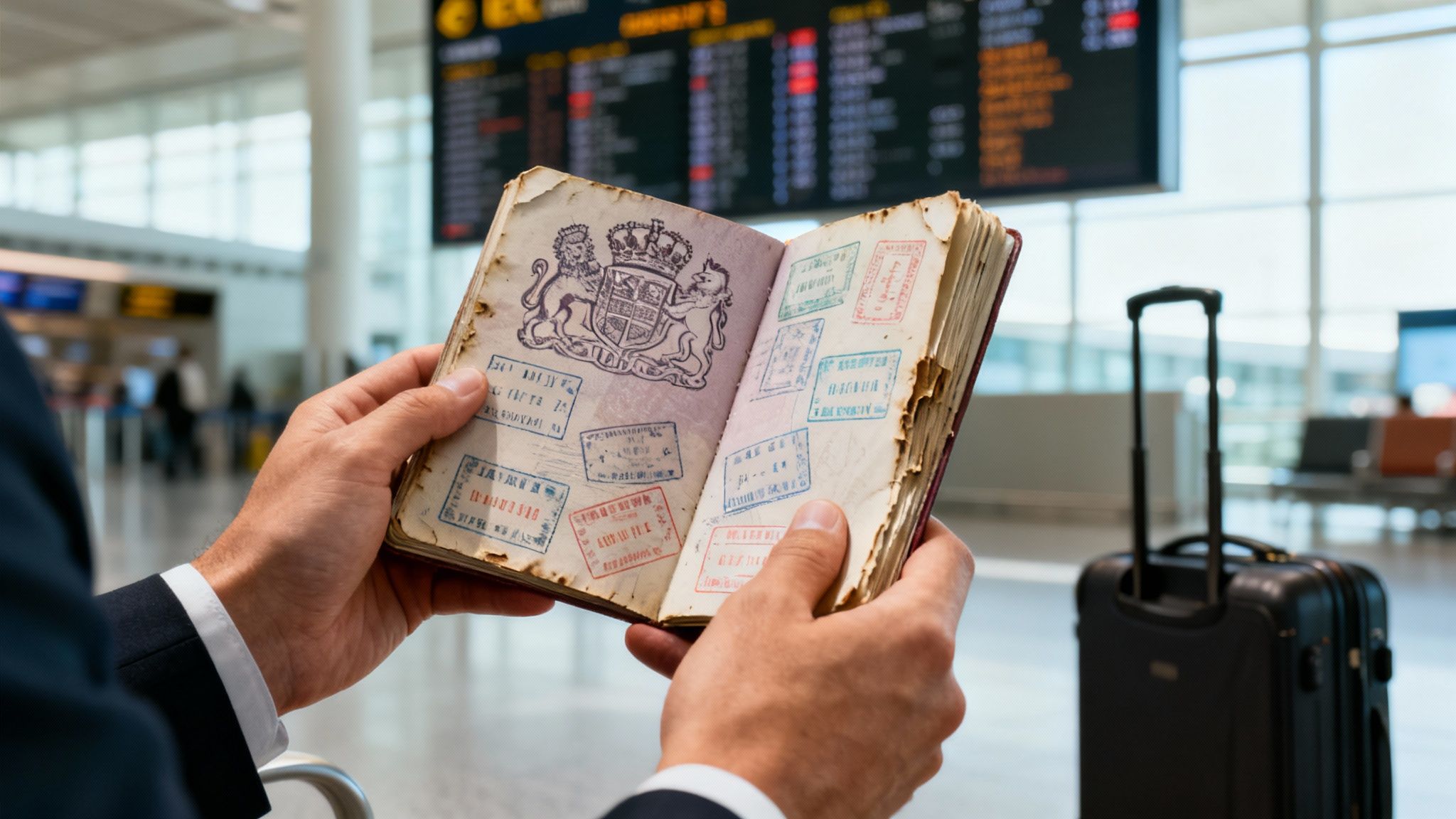
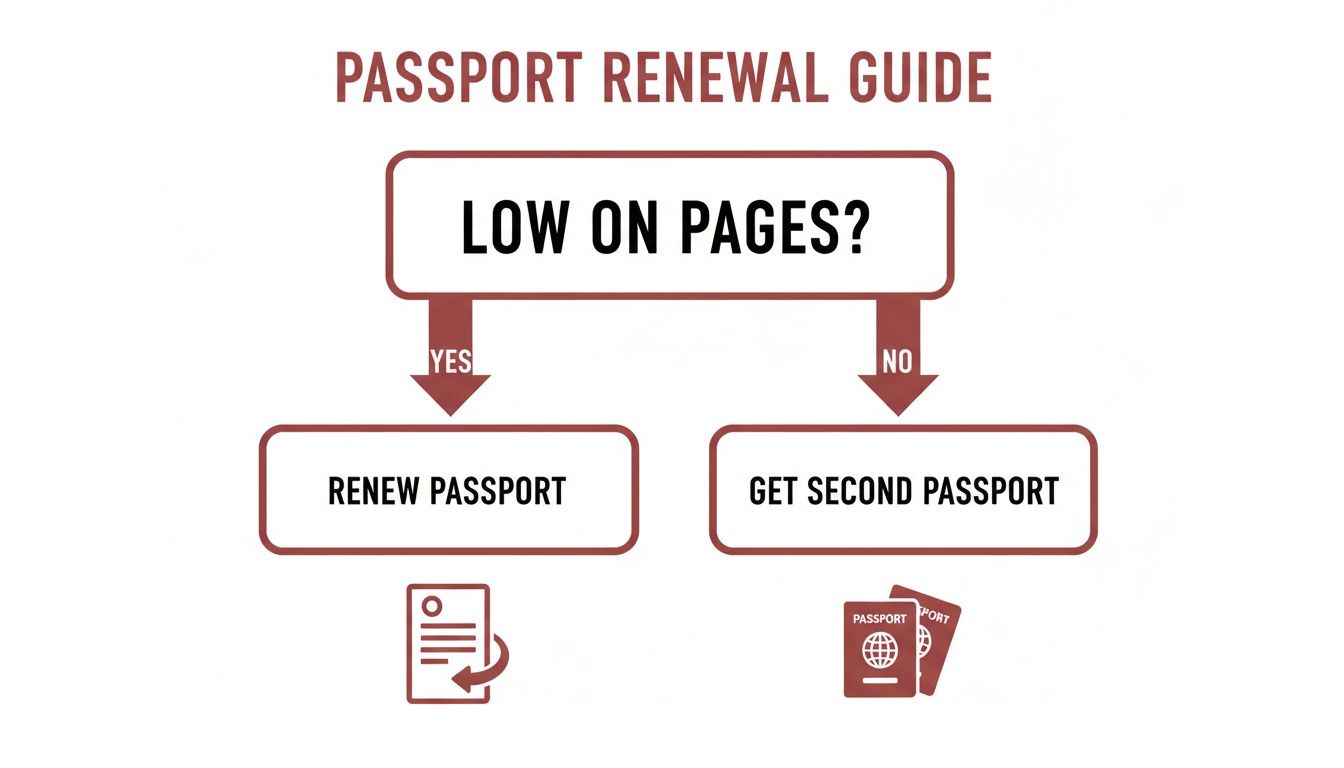
A second passport also solves another common problem. Frequent travellers can run out of usable visa space faster than expected. If that’s starting to happen, it’s worth reviewing what a passport running out of pages does to travel planning before it turns into a timing problem.
Why this matters more under tighter UK travel rules
The wider border environment has become less forgiving. Carriers and border systems are increasingly strict about document alignment, and British travellers benefit from having a current British passport ready for use rather than relying on improvisation at check-in.
For dual nationals in particular, tighter 2026 entry rules make valid British travel documentation even more important in practice. That doesn’t make a second passport suitable for everyone. It does mean regular international travellers should stop viewing passport availability as a minor admin issue.
Use the same standard a good operations team would use. If a document is mission-critical, build resilience around it.
Defining Genuine Need for a Second Passport
A genuine need has to survive file review. Caseworkers are looking for a clear operational reason, supported by documents that match the travel pattern and the employer’s explanation.
HMPO does not issue a second passport because regular travel feels inconvenient. It issues one where a British citizen can show that a single passport creates a real business problem, usually because the passport must be submitted for a visa while travel still has to continue, or because the itinerary creates a documented conflict that one passport cannot manage cleanly.

What HMPO is really looking for
The working standard is straightforward. You need to show that your main passport being unavailable would interrupt a defined work function, or that your travel schedule creates a document conflict that cannot be handled properly with one passport.
That usually appears in a few familiar forms:
Concurrent visa processing
Your passport has to stay with an embassy, consulate, or visa centre, but your role still requires travel to another country during that period.Politically sensitive routing
You travel between destinations where certain stamps, visas, or entry histories create extra scrutiny or practical difficulty.High-frequency commercial travel
Crew, logistics managers, energy contractors, consultants, and regional directors often work on schedules that do not allow a passport to disappear into a visa process for several weeks.Formal business continuity planning
Some employers treat passport availability as part of operational continuity. If one document going offline would delay site access, handovers, project mobilisation, or revenue-critical meetings, the business case is easier to defend.
This matters more in practice as 2026 travel rule changes tighten document expectations for British nationals and dual nationals. A second passport is not a loophole. It is a controlled resilience measure for roles where document downtime creates business risk.
The employer letter usually decides the outcome
In well-prepared cases, the employer letter does most of the heavy lifting.
HMPO wants to see that the need comes from real business activity, not personal preference. A useful letter explains the applicant’s role, the countries involved, why travel overlaps with visa processing, and what business function stops if the only passport is unavailable. If the explanation is thin, the case weakens quickly.
What usually improves an employer letter:
Company letterhead
The request should come from the employer in a formal corporate format.A specific travel pattern
Name the countries and explain the overlap. “Frequent international travel” is too vague to carry the file on its own.An operational consequence
Explain the actual disruption. Missed vessel boarding, delayed client deployment, blocked project entry, or interrupted regional coverage are far better than generic statements about flexibility.An original signature where required
Scanned shortcuts often create avoidable friction. If timing is already tight, review the evidence standard before relying on an emergency passport appointment process.
A strong letter reads like an internal business record. It should sound as if the company has identified a document dependency and is asking HMPO to remove it.
Weak reasons and strong reasons
Applications usually stand or fall on how the need is framed.
Weak wording focuses on convenience. It says the applicant travels often, wants flexibility, or would prefer a spare passport in case something takes longer than expected. That does not show necessity.
Strong wording ties the request to operational continuity. For example:
- one passport must remain in a visa process
- travel to other destinations must continue during that same period
- the countries involved require separate handling because of visa or stamp sensitivity
- the employer supports the request because one unavailable passport would interrupt a defined business activity
The practical test
Use the same question I use when reviewing whether a case is ready to file. What stops if HMPO refuses the second passport?
If the answer is vague, the justification needs more work. If the answer identifies a specific operational failure, such as an engineer missing site mobilisation while the main passport is held for a visa, the case is usually much easier to present clearly.
Good second passport applications are disciplined. The strongest ones explain the commercial need in plain language, match that need with evidence, and show that the second passport is there to protect continuity, not to create convenience.
Navigating the Second Passport Application Process
Once eligibility is clear, the process becomes a document-control exercise. Most delays come from preventable mistakes, not from obscure rules.
The core requirement is meticulous preparation. Specialist guidance on second UK passport applications says a successful file typically includes a standard adult passport form, two new photos with one countersigned, full colour photocopies of the current passport, and a strong employer letter carrying a wet-ink signature. The same guidance notes that incomplete employer letters and non-compliant photos account for a large share of initial DIY rejections (CIBT Visas second UK passport guidance).

Start with the document pack
This isn’t the stage for assumptions. Build the file exactly, not approximately.
The standard pack usually includes:
A completed adult passport form
Use the standard form and complete it carefully. Small inconsistencies create outsized delays.Two new identical photos
One should be countersigned where required. Photos must be current and compliant.Full colour copies of every page of your current passport
This is one of the most useful practical points. It allows the original passport to remain available for parallel travel or visa use while the application is assessed.Employer support letter
This is the backbone of the application and should already be final before submission.Authority paperwork if using a third-party agency
If someone is assisting with submission or document handling, make sure that authority is documented properly.
Submission is straightforward. Precision isn't optional.
The official route commonly involves booking through Her Majesty’s Passport Office (HMPO), attending with originals for verification, and paying the relevant fee upfront.
A good case file does three things before it ever reaches a decision-maker:
- it states the need clearly
- it matches every claim with a document
- it removes easy reasons for delay
Case manager’s note: The strongest applications read like an operations file. Dates line up, destinations are consistent, signatures are original, and nothing important is left for HMPO to infer.
If you’re considering a faster in-person route, it helps to understand how an emergency passport appointment differs from a standard application workflow. The appointment itself doesn’t rescue a weak file. It only accelerates a well-prepared one.
Common failure points
DIY applicants usually stumble in the same places.
Employer letters that are too vague
If the letter doesn’t explain the business need in concrete terms, the file weakens immediately.Photos that don’t meet requirements
Photo errors are boring, but they still delay applications.Partial passport copying
“Most pages” isn’t enough. Copy all current passport pages in full colour.Signature problems
Where an original signature is expected, give an original signature.Inconsistent story across documents
If the form, letter and supporting material describe the travel need differently, the application starts to look improvised.
UK Second Passport Application Routes Compared 2026
| Method | Typical Timeline | Support Level | Best For |
|---|---|---|---|
| Standard application route | Varies by case and appointment availability | Low | Applicants with a simple, well-documented file who are comfortable managing the process themselves |
| Fast Track style in-person route | Faster when appointments are available | Medium | Time-sensitive applicants who already have complete documents and need quicker handling |
| Specialist agency-assisted route | Agencies cite 7 to 10 working days post-submission in well-prepared UK cases | High | Professionals with overlapping visas, employer coordination issues, or no room for document errors |
The trade-off is simple. The more complex your travel pattern, the less sense it makes to treat the application as ordinary admin.
What usually works best
For straightforward renewals, many people are comfortable handling things themselves. A second passport is different because HMPO expects a reasoned exception, not a routine replacement.
That means the successful approach is usually:
- write the employer letter first
- build the supporting documents around that logic
- review the file as one package
- only submit once every discrepancy has been removed
Some applicants focus too much on speed and too little on coherence. That’s backwards. A coherent application often moves more smoothly than a rushed one.
Securing Your Second Passport While Living Overseas
Applying from abroad is perfectly possible, but it’s less forgiving.
The overseas process introduces extra friction around digital photos, scanned documents, referees, courier logistics and where the finished passport can be sent. For British nationals working overseas, those details matter because the need for a second passport is often urgent precisely when local admin is hardest to coordinate.

What changes when you apply from overseas
Overseas applicants generally use the online passport service and frame the case through that route, while making clear that the need is for a second passport rather than a standard replacement or renewal.
The main practical differences are:
Digital submission quality matters more
Poor scans and weak photos are harder to recover from when you’re not handling the file in person.Your referee needs to be credible and suitable
It helps when the referee has clear professional standing and identifiable UK ties.Original logistics become part of the case
Mailing documents to a designated processing centre needs planning, especially if your current passport is still active for travel.Delivery planning matters
A secure UK delivery address is often the cleanest option for final courier return.
Where overseas cases usually go wrong
Overseas applications face distinct risks. Guidance aimed at British nationals abroad notes typical processing of 4 to 6 weeks, with photo non-compliance causing around 15% of issues and vague employer letters contributing to around 35% of failures in those cases (expert analysis on replacing a UK passport from abroad). Those numbers line up with what case managers often see in practice. Distance magnifies small weaknesses.
The biggest errors tend to be:
Using a casual digital photo
Phone-camera convenience often creates compliance trouble.Submitting a generic employer letter
Abroad cases need even more specificity, not less.Sending incomplete scans
Missing passport pages or low-quality colour scans slow everything.Failing to plan for secure return delivery
Delivery assumptions create avoidable risk at the end of the process.
If you’re applying from overseas, treat the digital file as if the decision-maker will never have a chance to “fill in the gaps”. Because they usually won’t.
A tighter way to run the overseas process
The best overseas applications are assembled in this order:
Draft the business justification first
Don’t begin with forms. Begin with the reason.Get the employer letter finalised properly
It should be detailed, signed correctly and fully aligned with your travel reality.Produce a high-quality digital photo
Use a proper setup, not a rushed image taken for convenience.Create complete colour scans of the current passport
Check every page before upload or dispatch.Decide early where the finished passport should be delivered
Secure handling at the end matters as much as good paperwork at the start.
For a fuller look at practical overseas filing issues, see this guide on UK passport application from overseas. The mechanics differ from a UK-based file, but the core principle stays the same. Precision wins.
Operational Best Practices for Dual Passport Holders
Holding two valid British passports only helps if you manage them deliberately.
Many applicants focus intensely on getting the second passport approved, then treat the two-document setup casually afterwards. That’s a mistake. Once issued, the second passport becomes part of a working travel system. If you don’t control that system, you lose much of the value.
Build a document-use policy for yourself
Individual travellers should decide early which passport is used for what.
For example, one passport may become the “embassy passport” used for visa-heavy submissions, while the other remains the “live travel passport” used for active movement. That split reduces confusion and makes it easier to track where each document is at any given moment.
A simple operating routine helps:
Log every visa submission
Record which passport is with which embassy, visa centre or agent.Track stamps and destination sensitivities
If your travel includes politically sensitive routes, don’t leave this to memory.Store scans of both passports securely
Full colour copies are useful before application and still useful after issue.Review validity before major travel cycles
Don’t assume both documents expire on a timetable that suits your work calendar.
Why corporate travel teams should care
For employers, the second passport question is rarely about the application fee alone. The bigger issue is whether the business treats uninterrupted mobility as a managed risk.
Current public guidance leaves a clear gap here. It explains the application fees, but it doesn’t quantify the wider cost-benefit case around agency support, avoided disruption, or productivity protection. That means travel managers and finance teams often need to justify the expense internally as a risk mitigation investment, not as a routine travel perk (GOV.UK adult passport renewal guidance).
That framing is usually the right one.
A second passport can support:
- Continuity of client travel
- Protection of flight or rotation schedules
- Reduced disruption when visas overlap
- Lower dependency on one physical document
The cleanest internal justification is operational. One employee’s unavailable passport can delay meetings, site access, cargo movement, or crew allocation. The second passport reduces that exposure.
The 2026 practical urgency
The travel environment is tightening around document compliance. From 25 February 2026, dual nationals face stricter expectations around entering the UK, and British citizens can’t rely on the Electronic Travel Authorisation system as a substitute for proper British documentation. In practical terms, that means a valid British passport becomes more important, not less, for unhindered carrier acceptance and UK entry.
That doesn’t mean every dual national needs a second passport. It does mean businesses should stop treating passport resilience as an afterthought for internationally mobile staff.
Don’t treat the second passport as a free-for-all
A second passport is not a licence to become disorganised.
Use it for a defined purpose. Keep both documents traceable. Align each journey, visa plan and internal travel record to the correct passport. If your company has a travel desk or mobility team, make sure they know which passport is active for each itinerary.
The professionals who get the best value from dual passport holding aren’t the ones with the most complex travel. They’re the ones with the cleanest process.
Frequently Asked Questions about Duplicate UK Passports
Is it legal to hold a duplicate UK passport
Yes, in the right circumstances. A second UK passport is an official HMPO route for British citizens who can prove a genuine need, usually tied to business travel, overlapping visa processing or conflicting travel patterns.
It isn’t a general entitlement. You need a case, not just a preference.
Who is most likely to qualify
Applicants with employer-backed business travel needs are usually in the strongest position.
That often includes airline crew, logistics professionals, diplomats, multinational executives, rotational workers, and others whose passport may be tied up in visa processing while work travel still has to continue.
Do I have to surrender my current passport when applying
Not necessarily in the way many people assume. A common practical step is providing full colour photocopies of all current passport pages so the original can remain available for ongoing use while the application is processed, provided the file is prepared correctly and the route supports that handling.
That point matters a lot for active travellers. It’s one of the main reasons the process is useful.
What is the single most important document in the application
The employer letter.
If that letter is vague, generic, or badly signed, the entire case becomes harder. It should explain the business reason clearly, identify the travel pattern, and support the need for two passports with enough detail that HMPO doesn’t have to guess.
Does frequent travel on its own count as genuine need
Usually not by itself.
Heavy travel can support the case, but the stronger argument is that one passport cannot support your travel pattern without causing operational problems. Frequency helps. Necessity decides.
What should the employer letter include
At minimum, it should clearly support the business need and identify the destinations involved. The verified guidance used by specialist second passport providers states that the letter should cover at least six countries requiring visas and should carry a wet-ink signature.
That combination does two jobs. It shows the travel demand is real, and it shows the employer stands behind the request.
Can I apply from outside the UK
Yes. British nationals abroad can apply, but overseas cases are less forgiving on photo quality, document scans, referee suitability and delivery planning.
If you’re overseas, take extra care with digital photo compliance and the wording of the employer letter. Those are the two areas where weak files often start to unravel.
Is a second passport the same as replacing a lost passport
No. They solve different problems.
A replacement passport is reactive. It deals with a document that has already been lost or stolen. A second passport is proactive. It helps maintain operational continuity before a disruption stops travel or while one passport is committed elsewhere.
How long does it take
Timing depends on the route, the quality of the documents, and whether the case is handled domestically or from overseas.
Where applicants often go wrong is asking “how fast?” before asking “how complete is my file?” In second passport work, a coherent application is usually more valuable than a rushed submission.
Is this worth it for employers to fund
For some roles, yes. Especially where travel interruption carries a real business cost.
The public guidance doesn’t provide a full cost-benefit model, so employers usually need to justify support internally as a continuity and risk control measure. That’s often the most accurate way to evaluate it.
If your travel schedule can’t pause every time a passport goes into visa processing, it’s worth getting a proper eligibility check before you submit anything. Second UK Passports helps British professionals and employer-backed applicants assess genuine need, prepare compliant documents, and start the application with fewer avoidable risks.