
Rapid Passports

Secure American Business Visas: UK Citizen Guide 2026

An executive’s passport is sitting at a US consulate for visa processing. Then a separate trip lands on the desk. It might be a client meeting in Dubai, a supplier issue in Tel Aviv, or a crew rotation that can’t move. That’s where american business visas stop being a paperwork issue and become an operational continuity issue.

For HR and travel managers, the primary risk isn’t choosing a visa label. It’s avoiding downtime, refused boarding, missed meetings, and a stranded traveller whose only passport is unavailable at the worst possible moment.

Navigating American Business Visas for UK Professionals

A professional man sits at a desk while booking a trip online using a laptop computer.

UK professionals usually encounter US entry rules in two very different situations. The first is a short business visit for meetings, negotiations, conferences, or site visits. The second is a longer-term move involving a transfer, investment plan, or structured work authorisation.

Both require planning. Only one gets planned properly.

The primary problem is often logistics, not eligibility

Many business travellers qualify for the right US route on paper. What causes disruption is the collision between visa processing and a live travel schedule. A passport submitted for one application can block another journey.

That matters more than many teams realise. In FY 2024, US consulates processed 40,031 B-1 business visitor visa applications, and the 21.2% refusal rate often stemmed from insufficient proof of ties to the home country, which raises the stakes for UK applicants and makes clean preparation essential, as noted in these FY 2024 US visa statistics.

For HR managers, that means two things:

  • Category choice matters: A traveller using the wrong route can face questioning at the border or a refused application.
  • Document control matters: Even a valid business purpose becomes hard to execute if the passport is tied up at the wrong time.

Where business trips go wrong

In practice, the failure points are rarely dramatic. They’re often ordinary planning errors:

  • Wrong travel permission: A traveller assumes an ESTA covers activities that need a B-1 visa.
  • Weak application pack: The individual doesn’t present strong enough evidence of UK ties, role, and return plans.
  • Single-passport dependency: The passport is unavailable while another urgent itinerary is still moving.

Practical rule: Treat US business travel as a continuity risk, not just an immigration task.

That’s especially true for senior executives, airline crew, logistics teams, rotational workers, researchers, and British nationals based abroad. These travellers often have overlapping visa requirements, politically sensitive routes, or fixed travel windows that can’t wait for consular convenience.

What good planning looks like

The strongest corporate approach is simple:

  1. Match the activity to the visa route
  2. Prepare documents around business purpose and home ties
  3. Plan for passport unavailability before it becomes a crisis

That third point is the one most firms miss. A second UK passport is a legitimate HM Passport Office route for people with a genuine need, and in the US visa context it can remove a major bottleneck. Not because it changes US eligibility, but because it allows travel and parallel visa handling to continue when one passport would otherwise stop everything.

B-1 Visa vs ESTA The First Decision for Short Trips

For short US trips, most UK travellers start with the same question. Can this person travel under the Visa Waiver Program, or do they need a B-1 business visa?

That decision shouldn’t be made casually. A bad assumption here creates avoidable compliance risk.

ESTA vs B-1 Business Visa At a Glance

Feature ESTA (Visa Waiver Program) B-1 Business Visa
Purpose Short business visits within permitted VWP activities Short business visits requiring a formal visa application
Typical use Meetings, conferences, limited business discussions Meetings, consultations, negotiations, conferences, other legitimate business visitor activity
Application route Online travel authorisation DS-160 application, fee payment, interview scheduling, consular decision
Passport handling Usually no passport surrender for visa stamping Passport may be needed for interview and visa issuance process
Risk focus Misusing ESTA for activities that go beyond visitor business Failing to prove business purpose and intent to return home
Best fit Lower-complexity short trips with clean itineraries Higher-scrutiny trips, complex travel histories, or where ESTA isn’t suitable

When ESTA is usually enough

ESTA works well for straightforward visits. Typical examples include:

  • Conference attendance: A UK employee attends an industry event and returns home after the programme.
  • Internal meetings: A regional leader visits a US office for planning sessions.
  • Commercial discussions: A sales director meets a distributor or customer for negotiations.

What it doesn’t do is convert a business visitor into a worker. If the person is effectively filling a US role, delivering hands-on productive labour in the United States, or treating the trip like local employment, ESTA is the wrong tool.

When the B-1 is the safer route

A B-1 often makes more sense when the trip is legitimate business travel but the facts need to be explained more clearly to a consular officer. That can happen if the itinerary is unusual, the traveller has a heavy history of international movement, or the business purpose needs a more formal record.

The B-1 fact sheet is useful because it frames the category around recognised business visitor activities, including consultations and conference-related travel, in the official US B-1 visa fact sheet.

A practical distinction helps:

  • ESTA is convenience-driven
  • B-1 is explanation-driven

If your traveller’s trip is simple, ESTA may be appropriate. If the circumstances invite scrutiny, the B-1 often gives the cleaner compliance position.

Border officers don’t judge the traveller’s job title. They judge the activities planned in the United States.

What HR teams should ask before approving travel

Before booking anything, ask four blunt questions:

  • What exactly will the traveller do in the US? Avoid vague descriptions like “support” or “help with launch”.
  • Who pays them and where is the employment anchored? The more the role looks UK-based and temporary, the clearer the visitor case.
  • Will they produce work in the US or only conduct business discussions? That line matters.
  • Is there any reason ESTA could invite extra questions? Past refusals, complex travel, or a tight sequence of international trips can change the risk profile.

What doesn’t work

Two habits cause recurring trouble.

First, companies under-document the purpose of travel. Second, travellers describe their visit too loosely at the airport. “I’m here to work with the team” sounds harmless in a boardroom, but it can sound very different at a US port of entry.

For short trips, precision beats optimism. If there’s any doubt, get immigration advice early and build the file around the true activities, not the shorthand used internally.

Beyond Short Stays Work Transfer and Investor Visas

Once the trip moves beyond meetings and short business visits, the visa strategy changes. At that point, the question isn’t whether the traveller can visit. It’s whether the company has a lawful route for transfer, treaty-based business activity, or investment-led presence in the US.

A professional woman in a suit overlooking the New York City skyline during a bright sunrise.

L-1 for intra-company transfers

The L-1 category is built for multinational businesses moving people within the same corporate structure. In practical terms, it suits managers, executives, and specialist staff transferring from a UK entity to a related US one.

This route is strongest when the company can document:

  • A demonstrable corporate relationship between the UK and US entities
  • A genuine transfer role, not an improvised title
  • A credible business need for that employee in the United States

L-1 planning often fails when firms treat it like a generic relocation permission. It isn’t. The petition needs a coherent company story and a role that makes sense inside it.

E-1 and E-2 for treaty traders and investors

The E-1 and E-2 categories are often relevant where there is sustained trade with the US or a genuine investment in a US enterprise. These routes tend to suit founders, owner-managers, expansion teams, and key personnel supporting that commercial activity.

What works here is substance. Consular staff want to see a genuine operating business rationale, not a paper structure assembled for visa purposes.

A useful rule for HR and founders is this:

  • Use L-1 when you’re moving someone inside an existing multinational framework.
  • Use E-1 or E-2 when the business case is built around treaty trade or active investment.

Why long-term categories are feeling slower

Even where a company chooses the right category, scheduling pressure can still disrupt planning. The broader US system is under heavy strain. 780,884 applications were filed for 85,000 H-1B visas in FY2024, and that pressure contributes to wider backlogs affecting non-immigrant visa processing at busy posts, including categories such as L-1 and E-2, as detailed by the US Chamber immigration data centre.

That doesn’t mean every case is delayed in the same way. It does mean HR teams should stop assuming that a correct filing automatically produces a smooth timetable.

If the role is commercially critical, the visa category and the travel logistics need to be planned together.

TN for context

UK nationals don’t use TN status, but it’s worth knowing because North American hiring discussions often reference it. TN is designed for qualifying Canadian and Mexican professionals in listed occupations.

For UK-based HR teams, TN mainly matters as a comparison point. It explains why internal stakeholders may assume that a fast cross-border work route exists for everyone. It doesn’t.

Structuring the corporate decision

When deciding among longer-term american business visas and related work routes, I’d narrow the issue to three questions:

  1. Is this a temporary visitor activity or actual work authorisation?
  2. Is the employee moving inside a group company, building trade, or supporting investment?
  3. Can the business tolerate passport downtime during processing?

That third question gets ignored too often. The legal route may be sound, but the travel plan still breaks if the person needs to keep moving while documentation is pending.

For teams dealing with parallel jurisdictions, similar issues also arise outside the US context. Companies facing multiple mobility channels often run into the same sequencing problems seen in UK to Canada work permit planning.

The Visa Application Process Demystified

A US visa application is manageable when the steps are sequenced properly. It becomes messy when travellers rush the form, finance teams delay payment, or interview booking happens before the supporting documents are ready.

An infographic illustrating the seven-step process for applying for a US business visa.

The seven stages that matter

Most non-immigrant US business visa cases follow the same broad path:

  1. Identify the right category
    Don’t start with forms. Start with the traveller’s actual purpose.

  2. Assemble the document pack
    This usually includes identity documents, employer support material, travel context, and evidence that supports the application narrative.

  3. Complete the DS-160
    Accuracy matters more than speed. Inconsistencies create interview problems later.

  4. Pay the relevant fee
    Internal delay here often causes avoidable appointment delay.

  5. Book the interview
    The appointment strategy should reflect business urgency, not just the first available date.

  6. Attend the interview
    The traveller needs concise, consistent answers that match the paperwork.

  7. Wait for decision and passport return
    This is the stage many companies underestimate because the passport may be unavailable during all or part of the process.

What strong preparation looks like

The best files are coherent. Every document should support the same simple story.

That usually means making sure the traveller can prove:

  • Why they’re going
  • Why the trip fits the visa category
  • Why they’ll leave the US after the visit or assignment stage
  • Why the employer supports the application

A weak file often contains individually acceptable documents that don’t connect. A strong file reads like one consistent explanation from start to finish.

Timelines in Practice

There isn’t a universal timetable you can safely apply across all posts and categories. Consular workload, interview availability, document quality, and administrative processing all affect timing.

For corporate planning, the practical approach is:

  • Treat interview availability as variable
  • Assume document collection takes longer than the traveller expects
  • Build for the possibility that the passport won’t be immediately available

Related passport readiness then becomes part of visa readiness. If the underlying British passport position is weak or close to expiry, resolve that before the US process starts. For urgent travel teams, it’s also worth understanding how urgent UK passport renewal options fit into the wider schedule.

A rushed DS-160 can create more delay than waiting an extra day to review it properly.

Interview discipline matters

The interview is not the place to improvise. Travellers should avoid over-explaining, freelancing job descriptions, or using internal company jargon that sounds like employment in the US.

Good interview answers are usually:

  • Short
  • Specific
  • Consistent with the application
  • Anchored in a legitimate business purpose

If the trip is for meetings, say meetings. If it is for a conference, say that. If the person is consulting with a US affiliate, describe the consultation clearly and stop there.

The process issue nobody budgets for

The most disruptive part of the process is often passport control, not form filling. When the passport is tied up, unrelated travel plans can stall. Airline crew can lose rotations. Executives can miss board meetings. Field staff can’t move to another region while one government holds the document.

That’s why smart HR teams now map the application sequence and the passport sequence separately. They aren’t the same thing.

Solving the Overlapping Visa Trap with a Second UK Passport

A common failure point looks like this. An employee’s passport is sitting with a consulate for a US visa case, then a client meeting in Dubai, Lagos, or Frankfurt appears with three days’ notice. The traveller may still be fully eligible for both trips, but the business cannot move because the document is unavailable.

That is the overlapping visa trap. For HR and mobility teams, it is a document-control problem with operational consequences.

A person holding a vintage red United Kingdom passport and a new dark blue British passport over a map.

A second UK passport is a lawful operational tool

A second UK passport is a legitimate HM Passport Office option for British citizens who can show genuine need. In practice, that usually means frequent travel, overlapping visa submissions, or travel patterns involving countries that create stamp or routing complications.

HR should treat this as a controlled continuity measure. I advise clients to put it in the same category as contingency booking rules or key-person travel protocols. It does not make a weak US visa case stronger. It does let the company keep one passport in a visa process while the employee continues travelling on the other.

That distinction matters.

Where it solves real business disruption

The value is easiest to see in roles where travel cannot pause without commercial or operational cost:

  • Senior executives: one passport can remain with a consulate while the other supports live board, investor, or customer travel
  • Airline and logistics personnel: rota integrity is easier to protect when one document is unavailable
  • Energy, maritime, NGO, and field teams: deployment schedules are less exposed to consular hold times
  • Travellers with politically sensitive itineraries: separate passport histories can reduce unnecessary friction with visas, stamps, and border questioning

For UK professionals dealing with American business visas, this is the overlooked connection. The visa strategy may be sound, but a single-passport setup still creates avoidable downtime.

What HMPO usually needs to see

Second passport applications are strongest when the employer explains the operational problem clearly. Generic wording about “frequent international travel” often falls short because it does not show why one passport is inadequate.

A useful employer letter should cover:

  • the traveller’s role and why international movement is part of it
  • how often overlapping visa applications or urgent trips arise
  • what business disruption occurs when the only passport is unavailable
  • why the request is tied to the role, not personal convenience

I usually recommend company letterhead and a signed original where practical. That approach helps where HMPO wants clear evidence that the request is genuine and business-led.

The second passport also helps with incompatible travel patterns

US visa planning rarely happens in isolation. Some employees need a US visa in process while also travelling to countries with longer consular handling times, stricter entry controls, or politically awkward stamp histories. A second UK passport can reduce those conflicts lawfully.

This is particularly useful for regional leadership, technical specialists, and project staff whose travel spans the US, the Middle East, Africa, or parts of Asia within the same quarter. One passport can be tied up with an application. The other remains available for active travel.

Timing matters more than urgency

The right time to raise a second passport request is before the first clash, not after a passport has already disappeared into a visa workflow.

Escalate early where the traveller has back-to-back visa-dependent itineraries, works across sensitive jurisdictions, or holds a role where cancelled travel creates knock-on costs for teams, clients, or regulated operations. If the business is already close to disruption, teams often end up relying on urgent emergency passport appointment options as a recovery measure. That can help in a pinch, but it is still recovery, not planning.

A second UK passport works best when it is set up before the pressure starts.

Avoiding Common Pitfalls in Visa Applications and Travel

Most visa problems are predictable. They start with a mismatch between what the traveller intends to do, what the paperwork says, and what the officer hears.

For HR teams, the goal isn’t just to get approval. It’s to keep the traveller compliant from application through to arrival.

The refusal pattern that catches applicants out

For visitor categories, a common issue is failure to show convincing ties outside the US. If the officer isn’t satisfied that the person will return home after the permitted activity, the case can collapse even where the business purpose is legitimate.

That’s why supporting evidence should never be assembled as an afterthought. Employment status, travel purpose, return plans, and the business reason for the visit need to align cleanly.

Common errors I see in corporate cases

  • Overbroad job descriptions: Internal language like “support the US team” can sound like local employment.
  • Weak traveller briefing: The employee turns up for interview or border inspection without a clear explanation of the trip.
  • Inconsistent dates: Travel plans, letters, and application forms don’t match.
  • Poor passport planning: The company focuses on visa eligibility and ignores document availability.

B-1 as a bridge only when the activity is allowed

An emerging challenge for UK businesses is the high denial pressure affecting H-1B pathways for STEM professionals from smaller firms. That makes it more important to use B-1 visas correctly for permissible activities during long waits, rather than stretching them into unauthorised work, as discussed in the CSIS analysis on practical H-1B reforms.

Companies can get themselves into trouble in this situation. A B-1 can support legitimate business visitor activity. It cannot be treated as a casual substitute for a proper work-authorised route.

The safest internal question is not “Can we get them in quickly?” It’s “What can they lawfully do once they arrive?”

Port-of-entry discipline

Approval of a visa doesn’t end the compliance analysis. The traveller still has to present the trip properly on arrival.

Train employees to carry a concise support pack, which may include:

  • Employer letter: Confirming role, business purpose, and expected duration
  • Itinerary evidence: Meetings, conference registration, or site visit schedule
  • Return framework: Evidence of onward or return travel where appropriate
  • Role context: Enough to explain the UK-based employment position clearly

The 2026 UK carrier rule should be in your travel policy

Many HR teams still treat UK re-entry as automatic for British-connected travellers. That assumption is becoming dangerous. From 25 February 2026, dual nationals must hold a valid British passport or digital Certificate of Entitlement for UK travel, and British citizens can’t rely on ETA as a workaround.

That should trigger a policy update now. Passport validity and passport availability both need to sit inside corporate travel approval, not outside it.

What works better

The firms that manage this well do three things consistently:

  1. They define the permitted activity before booking travel.
  2. They standardise traveller briefing before interview and arrival.
  3. They treat passport logistics as part of compliance, not admin.

That combination reduces refusals, avoids border confusion, and keeps business travel moving when schedules tighten.

Your Strategic Next Steps for US Business Travel

If you manage frequent travellers, the correct approach is straightforward.

First, decide whether the trip is a short business visit or a longer-term work, transfer, or investment case. Second, build the file around the traveller’s true activity, not internal shorthand. Third, map passport availability as carefully as you map visa timing.

A practical checklist for HR managers

  • Confirm the purpose: Visitor activity, transfer, or work-authorised assignment
  • Review the documents: Employer support, itinerary, and identity records
  • Check the passport plan: Can the traveller continue moving if one passport is in process?
  • Update UK re-entry policy: Make sure the 2026 British passport rule is reflected internally

The companies that handle american business visas well don’t rely on luck. They use category discipline, document discipline, and contingency planning.

If one of your travellers regularly faces overlapping visa submissions, urgent international trips, or politically sensitive routing, check their eligibility for a second passport before the next conflict appears, not after it.

Frequently Asked Questions About American Business Visas

Can a UK employee use a B-1 or ESTA to look for a job in the US

Treat that as high risk. A short business visit should match permitted visitor activity, such as meetings or conferences. If the true purpose is taking up work or functioning as part of the US labour market, the company needs a proper work-authorised route.

Can one passport be used for a US visa while the other is used for travel

Yes, that is one of the clearest operational advantages of a legitimate second UK passport. It allows one passport to remain in visa processing while the traveller continues moving on the other, assuming the itinerary and destination rules support that use.

Why do politically incompatible destinations matter so much

Because one passport can become awkward or unusable for certain routes once it contains particular visas or entry stamps. For executives, crew, field staff, and regional managers, separate passports can reduce disruption where travel spans Israel and parts of the Middle East, or other sensitive combinations.

Does the employer letter for a second passport need a wet-ink signature

In practice, that’s the safer standard. A formal letter on company letterhead with an original signature helps demonstrate that the request is genuine, role-based, and supported by the employer. Weak, generic letters are one of the easiest ways to undermine an otherwise legitimate application.

What is the single biggest mistake corporate travellers make

They describe the trip too loosely. “I’m working in the US” may sound harmless inside the business, but it can create problems at interview or at the border. The activity should always be described in terms that match the visa route and the supporting documents.


If your travellers face overlapping visa applications, urgent international schedules, or politically sensitive routes, Second UK Passports can help you assess eligibility for a lawful second British passport and keep travel moving without unnecessary downtime.

Passport UK Fast Track: Your 2026 Guide to Urgent Renewal

A passport problem usually lands at the worst possible moment. A visa is already in process, a board meeting is booked, or a dual national now needs a valid British passport for smooth UK travel under the tighter carrier checks taking effect from 25 February 2026, when dual British citizens are expected to present a valid British passport or a digital Certificate of Entitlement rather than rely on a foreign passport alone, according to the Home Office’s ETA factsheet for April 2026.

For anyone searching for passport uk fast track, the practical answer is simple. If you are in the UK and eligible, Her Majesty’s Passport Office (HMPO) offers two urgent routes: a 1-week Fast Track service and a 1-day Premium service. The challenge is not just knowing they exist. It is choosing the right route, qualifying correctly, and avoiding the mistakes that turn an urgent case into a delayed one.

Your Essential Guide to Urgent UK Passport Services in 2026

A finance director is due in Singapore on Monday. Their current British passport is sitting in a consulate with a visa application, and the travel team has realised too late that a standard renewal will not solve the problem. In cases like this, urgent passport work sits inside business continuity, traveller compliance, and document strategy all at once.

In my experience, clients searching for passport uk fast track options usually fall into three categories. Their passport expires too close to departure. Their current passport is unavailable because it is held for a visa or immigration process. Or they need a second British passport to keep travel moving across overlapping trips, restricted destinations, or ongoing consular submissions. For corporate travel managers and executive assistants, the issue is rarely just speed. It is whether the traveller can stay deployable without creating a compliance problem.

Why urgency matters more in 2026

The pressure is sharper in 2026 because dual British nationals face closer carrier checks and cannot assume a foreign passport will carry them through UK travel arrangements without issue. As noted earlier, that raises the stakes for anyone who has postponed a renewal or let a second passport requirement drift.

A passport that looked usable last quarter can become the document blocking the trip.

That is especially true for internationally mobile staff. One board meeting, one visa run, or one route change through the UK can expose a gap that had been sitting in the travel programme.

Where fast track fits

HMPO’s urgent services are useful, but they only work well when the case has been set up properly. Fast track helps with time. It does not fix poor eligibility, missing evidence, or the wrong application type.

For urgent corporate and second passport cases, the decision usually turns on three points:

  • Application objective. Renewal, replacement, and second passport requests do not carry the same evidential burden.
  • Document availability. If the existing passport is tied up elsewhere, the file must be built around that reality from the start.
  • Travel continuity risk. Some applicants need the quickest outcome. Others need a lawful way to keep one passport available while another supports visa processing.

Practical view: The earliest appointment is not always the right appointment. A well-prepared file submitted on the correct route is usually faster than a rushed booking that triggers queries.

Second passport work deserves special attention here. HMPO may issue a second passport where there is a clear business need, often because frequent travel or concurrent visa applications make a single passport impractical. Such situations benefit from agency-level handling. The case has to show operational necessity, not mere convenience, and the supporting letter needs to reflect how the traveller works. For businesses weighing that option against a standard urgent renewal, our guide to a same-day emergency passport for UK business travel helps clarify where each route fits.

Choosing Your Fast Track Service 1-Week vs 1-Day

The first decision is structural. Pick the wrong service and you lose time before you even reach the appointment stage.

HMPO’s urgent options differ on cost, eligibility, appointment style, and what happens to the current passport. According to GOV.UK’s urgent passport service guidance, the 1-week Fast Track costs £192 for an adult passport or £206 for a 54-page frequent traveller passport, plus £156.50 for a child passport or £170.50 for a 54-page child version. The 1-day Premium service costs £239.50 for an adult renewal or £253.50 for a 54-page frequent traveller passport.

UK Fast Track Passport Services at a Glance (2026)

Feature 1-Week Fast Track 1-Day Premium
Who can use it Broader urgent cases, including adult and child applications Adult renewals only, where the passport was issued after 31 December 2001
Adult fee £192 £239.50
54-page adult fee £206 £253.50
Child fee £156.50 Not available for child applications
Appointment timing Bookable up to 3 weeks in advance Appointments can be available as early as 2 days after application
What happens after appointment New passport delivered by courier one week after appointment Passport ready for collection 4 hours after appointment
Old passport Submitted as part of the process Must be handed over

When the 1-week service is the better choice

The 1-week route is usually the more flexible option.

It suits applicants who are not eligible for the 1-day Premium service, families handling child applications, and professionals who need urgent processing but still want a route that covers a wider range of passport scenarios. It is also the route most often used where the application needs more careful documentary support.

When the 1-day service is worth it

The 1-day Premium service is narrower but powerful when it fits.

If you are renewing an adult passport issued after 31 December 2001, and speed is the only variable, this is the closest thing HMPO offers to a true emergency service. If you need a same-day style route, the practical issues around appointments and eligibility are similar to those discussed in this guide to a same day emergency passport.

Trade-offs corporate clients should not ignore

A faster service is not always the better service.

For executives and frequent travellers, the primary question is often whether surrendering the current passport creates a knock-on problem. If that passport is needed for immediate travel, active identification requirements, or a live visa process, the 1-day route can create friction even though it is faster on paper.

Key takeaway: Choose by operational impact, not just turnaround. In urgent corporate cases, preserving travel continuity can matter more than shaving off a few days.

Navigating the 1-Week Fast Track Application Process

A typical corporate problem looks like this. An employee has confirmed travel next week, the current passport is close to expiry or tied up in another process, and someone in HR assumes the 1-week service is just a faster version of the standard application. It is not. The timetable is short, but the primary pressure point is file quality.

Infographic

The 1-week route works well when the applicant reaches the appointment with the right evidence, a usable digital photo, and no gaps that force HMPO to pause the case. In agency work, that is the difference between a routine urgent application and a preventable delay.

How the process works in practice

The application starts online with an eligibility check. If the case qualifies for Fast Track, the system issues a reference and allows the applicant to look for an appointment while progressing through the form.

Speed matters at that stage. Appointment availability can change quickly, especially around school holidays, major travel periods, and Monday morning booking spikes. For corporate teams, that means getting internal approvals, payment authority, and supporting letters ready before anyone starts clicking through the portal.

The working sequence is usually:

  1. Complete the online eligibility check
    Confirm the application type and basic details so the system can assess whether Fast Track is available.

  2. Secure an appointment
    Choose a slot as soon as a suitable office and date appear. Delays here often create more problems than the form itself.

  3. Finish the digital application carefully
    Enter personal details, passport history, and upload the photo. Small inconsistencies often lead to larger questions later.

  4. Assemble the supporting documents
    Bring the current or expired passport and any extra evidence needed for identity, nationality, name changes, or status.

  5. Attend the appointment in person
    HMPO staff check the application and supporting documents against the case type.

  6. Wait for issue and delivery
    Once accepted, the passport is produced and sent by courier.

Where urgent files usually break down

Photo failure is still one of the most common avoidable problems. A photo can look perfectly acceptable to the applicant and still fail for lighting, framing, background, facial position, or recency. Before submission, it helps to check the technical rules against this guide to UK passport photo size.

The second weak point is hesitation. An applicant starts the process, then stops to ask the employer for a letter, to find an old passport, or to confirm travel dates. By the time those points are resolved, the best appointment options may be gone.

The third issue is documentary under-preparation. I see this most often in second passport cases, child renewals with extra complexity, and applications where the passport record does not tell the whole story. A brief supporting note rarely fixes that. HMPO wants documents that answer the obvious questions at first review.

What a caseworker wants to see

A strong 1-week application is clear, consistent, and easy to approve.

Names match across documents. The photo passes first time. The reason for urgency is reflected in the file, especially where business travel, overlapping visa demands, or a second passport request sit behind the application. For corporate applicants, a precise employer letter often carries more weight than a vague covering note because it explains the operational need in terms HMPO can assess.

That is the practical trade-off. The 1-week service gives more flexibility than the 1-day route, but it also leaves more room for documentary mistakes. In urgent business cases, the safest approach is to prepare the application as if a caseworker will question every gap, because that is how delays start.

Second Passports and Corporate Application Strategies

A second British passport is not a loophole. It is an official solution for applicants who can show a genuine need.

That point matters because many corporate travellers still assume that holding two British passports is somehow improper. In practice, HMPO can issue a second passport where the applicant can demonstrate a legitimate operational reason, especially when one passport needs to be free for travel while the other is tied up elsewhere.

A business professional in a suit reviewing a United Kingdom passport with a digital globe hologram nearby.

The business case HMPO understands

The strongest second passport applications are practical, specific, and evidenced.

Common examples include:

  • The overlapping visa trap
    An executive’s passport is lodged with a consulate for a long-term visa, but travel to another country cannot pause.

  • Politically incompatible travel
    Some travellers need to separate travel histories because entry stamps or visa records can complicate later travel in other regions.

  • Airline and logistics operations
    Crew and transport professionals often need a passport to stay in rotation while another document is committed elsewhere.

  • Rotational and humanitarian work
    Energy staff, contractors, and NGO personnel may need to isolate certain travel patterns for operational or security reasons.

The employer letter is not a formality

A proper employer support letter should be on company letterhead, explain the genuine need clearly, and carry a wet-ink signature from an authorised signatory. Failure to do so often weakens otherwise valid cases. So does a letter that reads like a generic HR reference rather than a business necessity statement.

The strongest letters usually state:

  • Why one passport is not enough
  • Why the travel cannot be postponed
  • What type of travel conflict exists
  • Why the arrangement is necessary for the employee’s role

Why appointment competition changes strategy

Corporate applicants often assume that urgent services mean easy access. They do not.

HMPO faced major post-COVID demand pressures, with over 5 million delayed applications during restrictions and 9.5 million projected in 2022, while staffing was increased to over 4,000 and hours were extended, according to the government update on passport processing times and unprecedented demand. Even with that expansion, peak-season appointments remain highly competitive.

That is why time-poor applicants often use a specialist process rather than trying to assemble the case reactively. One option in this area is Second UK Passports, which handles second passport applications with eligibility checks, document pre-checks, employer letter support, appointment booking, and submission management.

Practical view: For corporate travel teams, a second passport is usually best treated as risk mitigation. It is a contingency asset that keeps travel, visas, and role-critical movement from colliding.

Attending Your Appointment and Tracking Delivery

The appointment itself is usually more routine than applicants expect. The stress tends to come from what led up to it.

For the 1-week Fast Track route, expect a more involved check-in and document review. In the business cases I see, the smoothest appointments happen when the applicant arrives with the passport, supporting paperwork, and any photo contingency already organised.

A man at a service desk speaking with a receptionist at a UK passport fast track office.

What to expect on the day

The 1-week appointment is typically long enough for staff to review documents, verify identity, and test any points that are not obvious from the paperwork. If the case involves citizenship evidence or a more complex history, questions can be more detailed.

The 1-day Premium route is much shorter. As summarised in the background guidance from WithTap’s review of the service, the appointment is about 10 minutes, focused on biometric scans and document verification, with the old passport surrendered, and if approved the new passport is issued within 24 hours for courier delivery in that service description at WithTap’s fast track passport overview.

Bring the right things, not just the obvious ones

A clean appointment pack usually includes:

  • Current passport. This is essential for renewal or replacement-based urgent work.
  • Supporting originals. Birth, citizenship, or status evidence where required.
  • Application details. Keep your booking and reference information accessible.
  • Photo backup if needed. Digital upload is standard, but contingency planning helps.

After the appointment

Once the appointment is complete, the case moves into processing and dispatch.

For 1-week Fast Track, the passport is sent by courier after processing. That sounds minor, but it matters. Someone needs to be available to receive it, because delivery is part of the chain of control. In urgent business travel cases, failed delivery can be as disruptive as a weak application.

Common Pitfalls and Solutions for Overseas Applicants

The hardest urgent cases are often not the most complex on paper. They are the cases where the applicant is outside the UK and assumes fast-track access works globally.

It does not. Official fast-track services exclude overseas applicants, leaving them with standard waits that can extend for an extended period, while private firms step in through remote document handling and direct HMPO lodgements for the 5.7 million UK expats referenced in the summary at Wise’s guide to fast track passport options.

Problems that repeatedly derail urgent applications

Some failures are administrative. Others are strategic.

The avoidable mistakes

  • Weak photo compliance
    Applicants focus on urgency and forget that image rejection stops the file cold.

  • Incomplete supporting evidence
    This is especially common when nationality, name history, or second passport need is not laid out clearly.

  • Late appointment chasing
    Waiting until travel is imminent reduces room to recover from any issue.

The overseas obstacle

British nationals abroad cannot log into a local equivalent of UK fast track and book an emergency slot. There is no overseas urgent HMPO route in the same format. That leaves expats, international staff, and business travellers abroad exposed when a passport issue becomes time-sensitive.

What works instead

When the applicant is overseas, the route usually shifts from public self-service to managed handling.

That can involve:

  • Remote document review before anything is lodged
  • UK-based coordination for supporting paperwork and delivery logistics
  • Employer-backed applications where the business case needs to be presented cleanly
  • Proxy-style case management so the applicant does not have to improvise from another country

This is particularly relevant where one passport supports immediate travel and the other supports a second passport application or related documentation process.

Tip: Overseas applicants should treat timing, document transfer, and employer support as one project. Splitting them across different teams causes most of the avoidable delay.

A specialist agency becomes useful when the core issue is not just speed, but control. That applies to expats, airline crew, rotational workers, and any business traveller trying to resolve a UK passport problem from outside the country.

Frequently Asked Questions about UK Fast Track Passports

What happens if a fast-track application is rejected

The first task is to identify whether the problem was eligibility, evidence, or document quality. Most repeat failures come from resubmitting the same weak file. Fix the underlying issue before trying again.

Who should sign the employer letter for a second passport case

Use an authorised person who can speak for the business need. In practice, that is often HR, a senior manager, a director, or a travel function with authority. The letter should be on company letterhead and signed in wet ink.

Can a child get a fast-track passport

Yes, the 1-week Fast Track route can cover child applications. The 1-day Premium service is for eligible adult renewals only.

Can a second passport application be urgent

Yes, but urgency does not replace the need to prove genuine need. The supporting rationale still needs to be coherent, especially where the application depends on business travel, overlapping visas, or conflicting-country travel requirements.


If you need a second passport for operational travel, overlapping visa applications, or urgent UK entry planning, check your eligibility with Second UK Passports. A specialist case review can help confirm the right route, the supporting documents HMPO will expect, and whether your employer letter is strong enough before you submit.

Navigating Business Visas for Saudi Arabia: A 2026 Guide

Securing business visas for Saudi Arabia from the UK requires a precise understanding of the visa that aligns with your intended activities in the Kingdom. Misinterpreting the visa categories is a common pitfall leading to delays or rejection. The two most frequently confused options are the Business Visit Visa and the Commercial Visit Visa.

While they sound similar, they are distinctly different in the eyes of Saudi authorities. Understanding this distinction is the first step toward a successful application.

Your Gateway to the Kingdom

Businessman holds a British passport and boarding passes, gazing at the Riyadh skyline from an airport.

As Saudi Arabia's Vision 2030 initiative accelerates, the opportunities for UK businesses are expanding rapidly. This has elevated the importance of a correct and compliant visa application for all corporate travel. The process is not a mere formality but a foundational element of your business strategy.

The entire application hinges on the nature of your trip and, crucially, the entity that invites you. Let's clarify the two primary visa types to ensure you begin correctly.

The All-Important Visa Distinction: Business vs. Commercial

Countless applications are delayed because the applicant selects the wrong category. The distinction is simple yet absolute.

  • Business Visit Visa: This visa is for internal corporate activities. You need this if you are visiting your own company's Saudi-based branch or subsidiary. It is intended for internal meetings, team training, or intra-company project collaboration. The key requirement is that your own Saudi-registered entity must issue the invitation.

  • Commercial Visit Visa: This visa is for external business activities. It is your required visa for engaging with other Saudi companies. Use this if you are traveling to meet potential clients, negotiate a contract with a new partner, or attend a trade fair. The invitation letter must originate from the external Saudi company you plan to meet.

Expert Tip: The deciding factor is the source of the invitation. If the invitation is from your company's own Saudi office, you need a Business Visit Visa. If it is from a Saudi client or partner, you require a Commercial Visit Visa. Confusing these two is the most common pitfall.

To provide further clarity, here is a comparison of the main options for UK applicants.

Comparing Saudi Business Visa Types for UK Applicants

This table breaks down the main business visa categories, outlining their intended use, typical validity, and sponsorship requirements to help you choose the correct one.

Visa Type Primary Purpose Typical Validity and Entries Sponsorship Notes
Business Visit Visa Internal company meetings, training, and workshops. Single or multiple entry, valid for 6-12 months. Each stay up to 90 days. Invitation must come from your own company's registered entity in Saudi Arabia.
Commercial Visit Visa Meeting Saudi clients, negotiating contracts, attending trade shows. Single or multiple entry, valid for 6-12 months. Each stay up to 90 days. Requires an official invitation from a separate, Saudi-based company.
Work Visit Visa Short-term, hands-on technical or professional work. Single entry, valid for 30-90 days. Stricter sponsorship; requires an approved 'block visa' from the Saudi Ministry of Labour.
e-Visa (for business) Short business meetings, negotiations, and events. Multiple entry, valid for 1 year. Each stay up to 90 days. No direct Saudi sponsor needed. Available to UK passport holders online.

Choosing the correct visa from this table at the outset will prevent significant complications later.

Single vs. Multiple Entry: How Much Flexibility Do You Need?

After determining the correct visa type, you must decide how many entries you require.

A single-entry visa permits one trip, typically for a stay of up to 90 days. It is ideal for a one-off objective, such as signing a major contract or attending a single conference. The visa is considered used the moment you depart Saudi Arabia, regardless of any remaining validity.

For professionals with established interests or ongoing projects, the multiple-entry visa is an operational essential. It usually grants unlimited entries for a period of six to twelve months (or one year for the e-visa). While each stay is capped at 90 days, it provides the flexibility for frequent travel. This is the clear choice for senior managers, rotational workers, and project leads. To secure it, you must demonstrate a clear, ongoing business need for regular visits.

Why Securing a Saudi Business Visa Has Become More Stringent

Hands of two people at a counter with documents, a passport, and a visa application form.

If you have found securing business visas for Saudi Arabia more challenging recently, you are correct. As of 2026, Saudi authorities are scrutinising applications from UK professionals with increased diligence. This is not intended to block legitimate business but to enforce the critical distinction between a short business visit and unauthorised work.

This tightening of regulations is a direct consequence of the Kingdom’s ambitious Vision 2030 plan. As the economy rapidly diversifies, immigration policies are being refined to protect the local labour market and ensure all foreign activity is correctly categorised. The days of using a business visa for any short-term activity are over.

The Crackdown on Visa Misuse

The core issue is the misuse of business visit visas for activities that require a work visa. A business visit visa is designed for short, non-productive trips—such as attending meetings, negotiating contracts, or visiting a conference. It strictly prohibits hands-on work, on-site project management, or any form of employment.

Saudi officials now actively search for patterns suggesting an applicant might be engaging in unauthorised work. This includes identifying frequent, back-to-back trips or extended stays that are inconsistent with simply attending meetings. This is particularly true for technical specialists, engineers, or consultants, whose roles can easily blur the line between advisory services and performing work.

Immigration experts have confirmed a significant increase in rejections for business visas for Saudi Arabia among UK professionals in 2026. As one analysis points out, there's a clear rise in refusals for technical specialists and repeat visitors. Authorities are reinforcing the message: a visit visa cannot be used to perform work that requires a full employment visa.

Red Flags That Can Trigger Application Rejection

To maximise your application's chance of success, you must understand what raises suspicion with a consular officer. Awareness of these common pitfalls allows you to proactively address them in your documentation.

  • Vague Justifications: An invitation letter stating "for business meetings" is no longer sufficient. It must detail the specific agenda, the purpose of the meetings, and the attendees.
  • A Pattern of Frequent Trips: An individual making multiple trips every few months on a business visa may be flagged. This pattern resembles a rotational work schedule, which necessitates a proper work visa.
  • Mismatched Job Title and Purpose: If your job title is "Field Service Engineer" but your application claims you are only attending commercial meetings, it creates a credibility issue.
  • Previous Overstays or Compliance Issues: Any history of overstaying a visa, even by a single day, guarantees your application will face extreme scrutiny and will almost certainly be rejected.

A Crucial Takeaway: The burden of proof rests entirely on you and your employer. You must construct a transparent and convincing case that your trip is strictly for activities permitted under a business visit visa. Always assume your entire travel history will be reviewed and ensure your justification is solid.

How Saudisation Affects Business Travel

The national policy of "Saudisation," which prioritises the employment of Saudi nationals in the private sector, is a key factor. While its primary focus is on long-term employment, its influence extends to the business visa process.

Authorities are now more likely to question why a foreign national is needed for tasks a local employee could potentially perform. This makes the justification in your employer’s support letter and the host company’s invitation more critical than ever. Your application must articulate why your specific expertise is required for the planned meetings, framing it as a collaboration, not a replacement for local talent.

Your Document Checklist for a Flawless Saudi Business Visa Application

Correct paperwork is paramount when applying for a business visa to Saudi Arabia. With an average processing time of 3-6 weeks, there is little room for error. This checklist serves as your roadmap to a successful first-time application.

Each document plays a vital role in building a credible case for your visit, proving to Saudi authorities that you are a legitimate business traveller.

Core Documents Every Applicant Needs

While specific requirements can vary between a Business Visit Visa and a Commercial Visit Visa, these documents form the foundation of every application.

  • A Valid British Passport: It must have at least six months of validity remaining from your planned entry date into Saudi Arabia. Critically, it also needs two blank, facing pages for the visa stamp.
  • The Completed Application Form: This must be filled out on the official EnjazIT platform. Meticulously check that every detail entered perfectly matches your passport.
  • Passport-Sized Photographs: You will need two recent, identical photos taken against a pure white background. For compliance, refer to our guide on UK passport photo requirements.
  • An Invitation Letter from Your Saudi Sponsor: This is a critical component. The letter must be issued by the Saudi company you are visiting and be officially registered with the Saudi Ministry of Foreign Affairs (MOFA). It must state your name, company, passport details, purpose of visit, and whether you are requesting a single or multiple-entry visa.

This process has become more challenging. The six-month passport validity rule is strictly enforced. With Saudi Arabia hosting millions of expatriates under Vision 2030, all applications receive careful scrutiny.

The Most Important Document: Your Employer's Support Letter

The Employer Support Letter is where many applications fail. This is not merely a letter of introduction; it is your company's official guarantee to the Saudi government, confirming you are a valued employee on legitimate business.

The letter must be on official company letterhead and, this is non-negotiable, it must bear a "wet-ink signature" from a senior manager or director. A digital or stamped signature will result in a guaranteed rejection.

Insider Tip: Do not attempt to use a photocopied or digital signature. Consular staff are trained to identify them. A fresh ink signature signifies a genuine, recently approved business trip and is a detail they consistently verify.

Your letter must contain the following details without exception:

  • Your full name and job title
  • Your passport number, including its issue and expiry dates
  • The nature of your company's business in the UK
  • A clear, specific description of your purpose for visiting Saudi Arabia
  • The full name and address of the Saudi company you are visiting
  • A financial guarantee stating your UK employer will cover all expenses
  • A clear statement that you will respect and abide by the laws of the Kingdom

Submitting an incomplete or poorly drafted letter is the fastest way to have your application refused.

Navigating the Saudi Visa Application Process

Once you have compiled all necessary documents, you can begin the application itself. The process involves multiple official websites and third-party agencies, so understanding the workflow is key.

Your first step is the Enjazit platform, the Saudi Ministry of Foreign Affairs' official portal for visa applications. Here you will complete the main application form. Meticulous accuracy is essential; any mismatch between the information you enter on Enjazit and your passport will halt the process.

After submitting the Enjazit form and paying the fee online, you will receive a completed form with a unique reference number. This is required for the next stage.

From Online Submission to In-Person Appointment

With your Enjazit form complete, you must book an appointment with a visa processing agency. For applicants in the UK, this is VFS TasHeel. They act as the intermediary for the Saudi Embassy, handling document collection and your mandatory biometric enrolment.

You cannot submit your application directly to the embassy. VFS TasHeel’s role is to verify your entire application pack—passport, signed employer letter, Enjazit form, and all other documents—before it reaches a consular officer.

This flowchart summarises the foundational documents of your application.

Infographic illustrating the Saudi visa document process in three steps: Passport, Authorization Letter, and Applicant Photo.

As illustrated, having your biometric passport, a correctly authorised letter, and a regulation-compliant photo are the three non-negotiable pillars of your application.

Biometrics and Final Processing

During your appointment at VFS TasHeel, your fingerprints and a digital photograph will be taken. This biometric data is a mandatory part of the process for all applicants.

A key piece of planning advice: The process begins the moment you have every correct document ready, not when you submit the online form.

After your appointment, VFS TasHeel couriers your passport and application to the Saudi Embassy in London. The final decision is made here, and if approved, the visa sticker is affixed to your passport, which is then returned to you.

Realistic Timelines for Your Application

Managing expectations is crucial. While some agents may promise rapid turnarounds, it is wiser to plan with a conservative schedule. The entire process for obtaining business visas for Saudi Arabia can be broken down as follows:

  • Document Gathering and Attestation: This can often be the most time-consuming phase, easily taking 1-3 weeks, depending on your sponsor and certification requirements.
  • Online Application and Appointment Booking: Completing the Enjazit submission and securing an appointment at VFS TasHeel typically takes 2-3 working days.
  • Final Visa Stamping: Once your application is at the embassy, the final review and stamping process usually takes another 5-10 working days.

In total, you should budget for a processing time of 3 to 6 weeks. It is a useful reminder that each country has its own unique system. For instance, applying for a Singapore visa as a UK citizen involves an entirely different set of rules and portals.

The Second Passport: Your Tool for Operational Continuity

A person holds a British passport at an airport, with another passport, laptop, and boarding pass on the table.

UK professionals managing business in the Middle East often encounter the "Overlapping Visa Trap": the 3 to 6-week wait for a Saudi business visa, during which your passport is held by the embassy. This freezes all other international travel, causing costly delays and missed opportunities.

A second UK passport is the hidden solution to this problem. Far from being an illicit workaround, holding two valid British passports is a fully legitimate service offered by Her Majesty’s Passport Office (HMPO) for individuals with a "genuine need." For frequent travellers, it is a business asset for ensuring Operational Continuity.

A second passport allows you to submit one for a time-consuming visa application while using the other for urgent travel. It serves as a Plan B, eliminating travel downtime and providing vital risk mitigation.

Who Qualifies for This Hidden Solution?

Approval for a second British passport is not automatic. HMPO requires you to prove a clear and pressing professional need, backed by solid evidence. This almost always requires a formal employer support letter with a mandatory wet-ink signature.

Common scenarios that constitute a "genuine need" include:

  • Concurrent Visa Applications: You must process your business visa for Saudi Arabia while simultaneously traveling to another country or applying for a different visa.
  • Navigating Incompatible Entry Stamps: Your work requires travel to politically sensitive regions. A second passport allows you to isolate certain entry stamps, mitigating risks at border control. This is an essential security measure for rotational workers in energy or NGO staff.
  • Emergency Backup (Risk Mitigation): For those whose roles demand constant travel, a second passport is an insurance policy against loss, theft, or damage to your primary one.

A second passport is a business tool for managing risk and ensuring operational continuity. It is the only official way to legally bypass the "Overlapping Visa Trap" and maintain travel capability while another visa is being processed.

The Employer's Role: Nailing the Support Letter

The success of your second passport application depends on a compelling support letter from your employer. This document must be on company letterhead and meticulously detail why a second passport is essential for your job, framing it as a business necessity.

The letter must prove you have a real need due to back-to-back travel or conflicting visa timetables. Vague justifications will lead to rejection. If you are a British national working abroad, the process remains available; our guide on applying for a UK passport from overseas offers further guidance.

The need for robust travel documents is becoming even more critical. In the year ending June 2024, UK visitor visa grants to Saudi nationals fell by 119,107 compared to 2019, largely due to the UK's new visa waiver programme for Saudi citizens. This shift places more pressure on UK professionals to secure solid business visas for Saudi Arabia. As UK firms increase their involvement in Vision 2030, Saudi authorities will scrutinise the need for multiple-entry visas. You can read more in the UK visa statistics from Smith Stone Walters.

This landscape underscores why a flexible solution like a second passport is more important than ever.

Frequently Asked Questions About Saudi Business Visas

Here are straightforward answers to common questions about securing a Saudi business visa.

Can I Work in Saudi Arabia on a Business Visa?

The answer is an unequivocal no. A business visa is strictly for pre-commercial or non-transactional activities like meetings, negotiations, or conferences. It is not a permit for hands-on, paid work.

Saudi authorities are extremely strict on this. Engaging in unauthorised work can lead to severe consequences, including immediate deportation, heavy fines for you and your sponsor, and a potential ban from future entry into the Kingdom. Ensure your activities are firmly within the "visit" category.

What Is the Difference Between a Business Visa and a Commercial Visa?

The key difference is your relationship with the inviting company in Saudi Arabia.

  • A Business Visit Visa is for internal company business. You apply for this when visiting your own firm's registered branch in Saudi Arabia for internal meetings or training. The invitation must come from your Saudi office.
  • A Commercial Visit Visa is for external business. This is required when meeting a separate Saudi company—a client, supplier, or partner—to negotiate a contract or explore a venture. The invitation must come from that external Saudi company.

The source of the invitation letter dictates the visa type you need.

Why Now? The 2026 UK Entry Rules and Their Impact

As of February 25, 2026, UK entry rules have tightened significantly. British dual nationals can no longer use a foreign passport alone to enter the UK. They must now present either a valid British passport or a digital Certificate of Entitlement (COE) to their airline to avoid being denied boarding.

Furthermore, British citizens are ineligible for the UK's new Electronic Travel Authorisation (ETA) system. This makes possession of a valid British passport the only seamless way to guarantee entry into the UK. This change makes having a primary (and secondary) British passport more critical than ever for ensuring smooth international travel and return journeys.

How Can a Second UK Passport Help?

The "visa trap" is a major operational problem. The Saudi visa process can take 3-6 weeks, during which the embassy holds your passport, grounding you.

A second UK passport is a fully legal tool issued by Her Majesty’s Passport Office (HMPO) to professionals with a genuine need. It allows you to submit one passport for a lengthy visa process while using the other for other business commitments.

It is the ultimate solution for maintaining operational continuity. While one biometric passport is at an embassy, the other keeps you mobile. For any professional in a global role, it is an essential tool for mitigating risk and keeping business moving.


At Second UK Passports, we specialise in helping frequent travellers and corporate clients secure a second passport as a tool for operational continuity. If your business requires uninterrupted international travel, a second passport is your most valuable asset.

Check your eligibility and start your application today.

Your Essential Guide to the Business Visa for Saudi Arabia for UK Citizens

Securing a business visa for Saudi Arabia is a meticulous process, not a simple box-ticking exercise, particularly for UK professionals. Your entire application hinges on a critical document: a valid invitation from a Saudi sponsor. This isn't a mere formality but the official green light from the Kingdom's authorities, making it essential to get right.

Navigating The Saudi Business Visa Framework

For UK professionals in sectors like energy, finance, or logistics, the process of securing a business visa for Saudi can seem daunting. Unlike a straightforward tourist e-visa, business travel is scrutinised far more closely, and every document submitted carries significant weight. Understanding the landscape from the outset is fundamental to success. Let’s walk through the core requirements.

The Sponsor Is Your Cornerstone

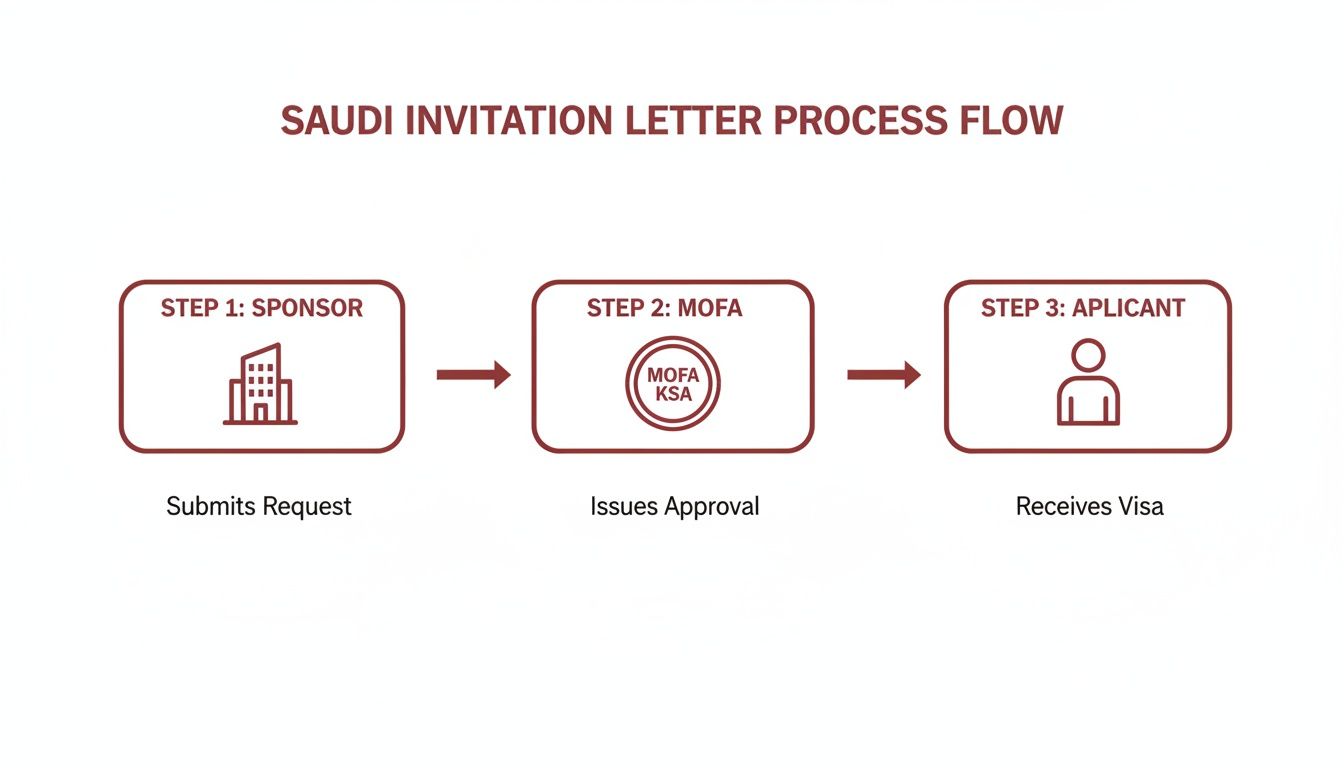
Everything begins and ends with your sponsor in Saudi Arabia. This entity—be it a client, partner company, or local subsidiary—is responsible for formally inviting you through the Saudi Ministry of Foreign Affairs (MOFA). This is not a simple letter but a formally registered document that officially authorises your business visit.

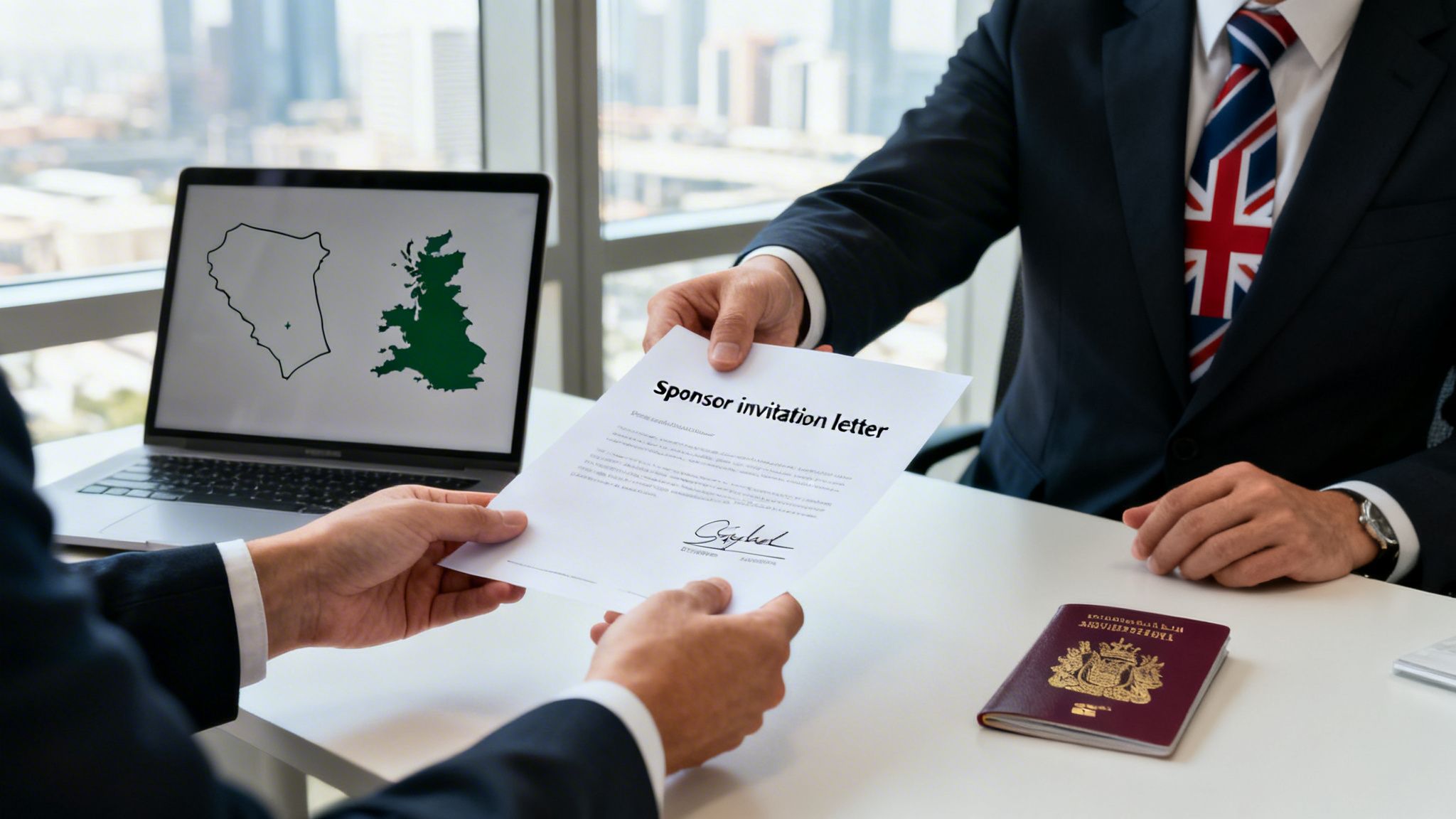
Two businessmen exchanging a sponsor invitation letter for a UK visa, with a passport and maps on the table.

The standing of your sponsor within Saudi Arabia is paramount. While the Kingdom issues over 50,000 'Investor Visitor' visas annually, checks on sponsor companies have tightened. As a British applicant, you must be invited by a Saudi company in good standing with the Nitaqat (Saudization) programme. If your sponsor holds a 'Yellow' or 'Red' status, your visa is almost certain to be denied. We've observed a sharp increase in rejections for this very reason. You can find more insights about UK visa statistics and their implications for travellers.

Key Takeaway: Your visa application's strength is directly tied to your Saudi sponsor. Before gathering any documents, discreetly confirm their Nitaqat status to avoid an immediate—and costly—rejection.

To help you get organised, here's a quick summary of the main requirements.

Saudi Business Visa Key Requirements at a Glance

Requirement Description Critical Importance
UK Passport Must be valid for at least 6 months beyond your intended stay with two blank pages. High
Saudi Sponsor A registered Saudi company in good Nitaqat standing to provide the invitation. Highest
MOFA Invitation Letter The official invitation issued by your sponsor via the Saudi Ministry of Foreign Affairs. Highest
UK Employer Letter A letter from your UK company confirming employment, role, and travel purpose. High
Completed Application The visa application form, filled out accurately and completely. High

Getting these core elements right from the start will streamline the rest of the process significantly.

The Challenge of Concurrent Travel: The Overlapping Visa Trap

A common problem that catches out many frequent flyers is the "Overlapping Visa Trap." When applying for a visa, an embassy can hold your passport for weeks, completely freezing your ability to travel elsewhere. This creates a logistical nightmare for professionals with back-to-back international commitments.

This is precisely where a second UK passport becomes an indispensable tool for maintaining Operational Continuity. It is a fully legitimate "hidden solution" offered by Her Majesty’s Passport Office (HMPO) for professionals who can demonstrate a genuine need. With a second passport, you can submit one for a lengthy visa process (like the business visa for Saudi) while using the other for immediate travel needs. It's a smart strategy for Risk Mitigation that prevents administrative delays from derailing your professional schedule.

Getting Your Documents Right: The Make-or-Break Checklist

When it comes to a Saudi business visa, your paperwork is everything. Countless applications stall or are rejected over minor details. Getting every document perfectly in order from the start is the only way to ensure a smooth process.

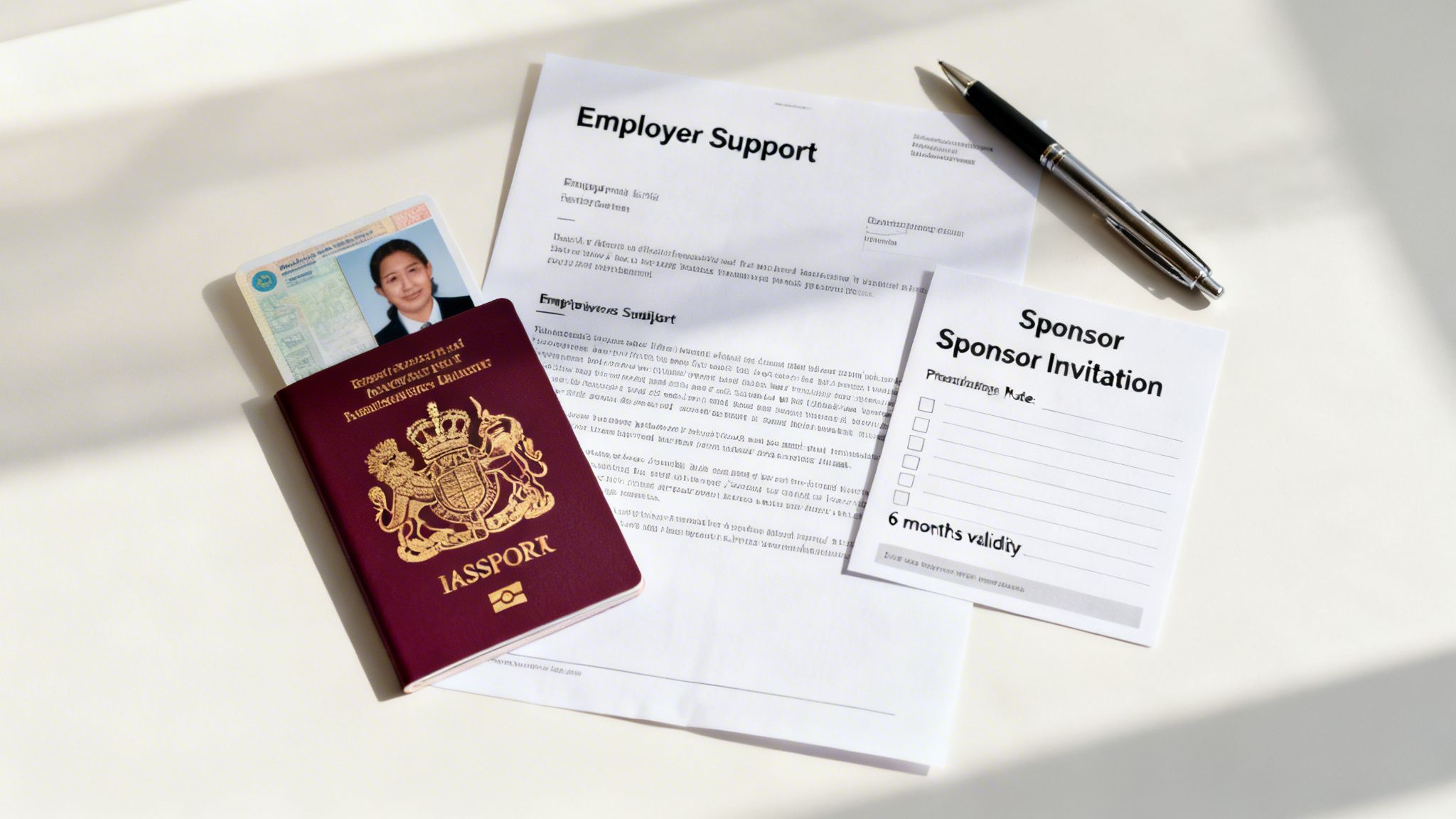
A passport with an ID card, employer support letter, sponsor invitation, and pen on a table.

Let's go through each requirement piece by piece, highlighting the common pitfalls that trip people up time and again.

Your British Passport: The First Hurdle

Your passport is the first item an official examines, and it's an easy place to fail before you've even begun. Before proceeding, check your biometric passport against these non-negotiable rules:

  • Six Months' Validity (From Entry!): Your passport must be valid for at least six months from your planned date of entry into Saudi Arabia, not your application date.
  • Two Blank, Consecutive Pages: You need at least two completely empty, side-by-side visa pages. Pages with any stamps or markings, even those titled 'Amendments', do not count.
  • No Israeli Stamps: An Israeli entry or exit stamp is a major red flag and can lead to immediate rejection. This is a primary reason why a second UK passport is so valuable, as it allows you to isolate travel histories between politically conflicting regions.

Crucially, as of February 25, 2026, UK entry rules have tightened. British dual nationals can no longer use a foreign passport to enter the UK; they must present a valid British passport or a digital Certificate of Entitlement (COE) to avoid being denied boarding. Since British citizens are ineligible for the new Electronic Travel Authorisation (ETA) system, a valid British passport is the only seamless way to enter the UK.

The ENJAZIT Form and Your Photos

The online application, typically completed via the ENJAZIT platform, demands absolute accuracy. Every field is cross-referenced with your supporting documents. A common mistake, such as a slight variation in job title between the form and your employer letter, is enough to trigger a denial.

Your photos are subject to equally strict requirements. They must be recent (within the last three months), in colour, and set against a plain white background. No glasses or headwear (unless for religious reasons) are permitted, and a neutral expression is mandatory.

The Two Letters That Must Be Perfect

While every document is important, the heart of your application lies in two letters: the support letter from your UK employer and the invitation from your Saudi sponsor. These documents must be perfectly synchronised.

I can't stress this enough: a mismatch between the visa validity your employer requests and what your sponsor has been approved for is a primary reason for rejection. If your company letter asks for a 12-month, multiple-entry visa but the Saudi invitation is only for a 90-day single entry, it's a guaranteed problem.

1. UK Employer Support Letter: This must be on official company letterhead with a genuine "wet-ink signature" from a senior company figure. A digital or scanned signature will be rejected. The letter must confirm your role, detail the exact purpose of your visit, and formally state that your company is covering all travel expenses.

2. Saudi Sponsor Invitation Letter: This is the cornerstone. Your Saudi partner obtains this for you through their Ministry of Foreign Affairs (MOFA), and it must be officially stamped by the Saudi Chamber of Commerce. This document dictates the terms of your visa—validity, number of entries, and purpose.

Think of these two letters as two halves of a whole. Your job title, stated purpose of the trip, and requested visa duration must be identical on both. Any difference creates doubt, and doubt leads to rejection of your business visa for Saudi application.

Understanding the Saudi Invitation Letter

Let’s be clear: the invitation letter from your Saudi sponsor isn't just a formality. It’s the absolute foundation of your business visa application. Think of it as your official endorsement within the Kingdom, a government-registered document that vouches for you. Without a perfectly executed invitation, your application is dead on arrival.

This letter is generated by your Saudi partner company through their portal with the Ministry of Foreign Affairs (MOFA). It then has to be officially attested by the Saudi Chamber of Commerce. This crucial step formalises the request and tells the Saudi authorities that your sponsor is taking responsibility for your visit.

Why Your Sponsor's 'Nitaqat' Status Matters

Before your Saudi partner even thinks about drafting the invitation, their own company's standing is under the microscope. Saudi Arabia has a nationalisation scheme called Nitaqat, which grades companies based on how many Saudi nationals they employ. This is a critical detail that many applicants miss.

If your sponsor has a high compliance level—'Platinum' or 'Green'—it signals to the authorities that they are a reputable business. On the flip side, an invitation from a company with a 'Yellow' or 'Red' Nitaqat status is a major red flag.

I’ve seen it happen time and again: a perfectly good visa application gets rejected out of hand because the sponsoring company had a poor Nitaqat rating. The Saudi authorities simply won't accept an endorsement from a business they consider non-compliant.

It’s well worth having a candid conversation with your Saudi hosts about their Nitaqat status before they start the process. It’s a simple question that could save you a world of time, money, and hassle.

What A Valid Invitation Must Include

The invitation has to be precise. Any mistake, no matter how small, can cause serious delays or even get your application thrown out. Make sure your sponsor includes these details, exactly as they appear in your other documents:

  • Your Full Name and Nationality: This must be an exact match to what’s in your passport. No abbreviations or variations.
  • Your Job Title: This needs to align perfectly with the job title mentioned in your UK employer’s support letter.
  • Your Passport Number: Get them to double- and triple-check this for accuracy. A single wrong digit will derail everything.
  • Sponsor's Full Company Name and Address: As officially registered in Saudi Arabia.
  • Sponsor's Commercial Registration (CR) Number: This is their unique 10-digit business ID in the Kingdom.
  • Visa Type, Validity, and Entries: The letter must be specific. Does it request a single or multiple-entry visa? For what duration—90 days, 180 days? Leave no room for ambiguity.

The purpose of your visit also needs to be explained with real business clarity. Vague phrases like "for business meetings" just won't cut it. A much better, more specific description would be something like, "To attend technical project meetings and conduct contract negotiations regarding the Riyadh Metro expansion project."

A Quick Checklist for Your Saudi Sponsor

To help your Saudi partner get it right the first time, you can share this simple checklist with them. It covers the essentials the consulate will be looking for and is a key step towards getting your business visa for Saudi.

  1. Confirm Nitaqat Status: First things first, is your company’s Nitaqat rating 'Green' or higher?
  2. Verify Applicant Details: Have you checked the applicant's name, passport number, and job title against the documents they sent you?
  3. Specify Visa Terms: Does the invitation clearly state the correct visa type (single/multiple entry) and the duration we agreed upon?
  4. Detail the Purpose: Is the reason for the visit explained in specific, commercial terms, not just generic phrases?
  5. Include CR Number: Is your 10-digit Commercial Registration number clearly visible on the letter?
  6. Secure Attestation: Finally, has the letter been processed through MOFA and officially stamped by the Chamber of Commerce?

Getting these details right from the start dramatically boosts the chances of the invitation being accepted, setting you up for a smooth and successful visa application.

Navigating The Visa Application And Submission Process

Once you’ve gathered all your documents and double-checked everything, you’re ready to get the application submitted. For UK business travellers heading to Saudi, there isn't just one way to do this. You have a couple of distinct choices, and each comes with its own pros and cons regarding speed, cost, and how much hands-on support you get.

The two main routes are applying directly through an official processing centre, like VFS TasHeel, or handing the whole thing over to a specialist visa agency. Knowing the practical differences between them is crucial for picking the path that aligns with your schedule and business objectives.

Before you can even start your side of the application, remember that your Saudi sponsor has to kick things off by securing that all-important invitation letter.

Flowchart illustrating the Saudi invitation letter process, detailing sponsor request, MOFA approval, and applicant receiving visa.

As you can see, the process is sponsor-led from the beginning. They need to get the green light from the Saudi Ministry of Foreign Affairs (MOFA) before a single document comes your way.

Choosing Your Application Pathway

Going directly through an official centre like VFS TasHeel is the standard approach. This involves booking an appointment online, showing up in person to submit your paperwork, and giving your biometric data (fingerprints and a photo). It's a direct route, but it can feel a bit impersonal, and you're on your own if there are any issues.

The alternative is to use a reputable visa agency. This can be a real lifesaver, especially for busy executives or those with complex travel plans. A good agent will pre-check every single one of your documents, catching the small but critical errors that often lead to a flat-out rejection. They handle the entire submission for you, acting as a buffer between you and the bureaucracy.

Expert Insight: Yes, an agency charges a service fee, but its real value is in mitigating risk. A rejected application costs more than just the visa fee—it can jeopardise a crucial business deal because of delays. Think of an agency's expertise as an insurance policy against preventable mistakes.

Understanding Realistic Timelines and Bottlenecks

Processing times for a Saudi business visa can be a bit of a moving target. While a clean, straightforward application might be turned around in 5-10 working days, this is by no means a guarantee. And remember, that clock only starts ticking after you've successfully submitted your biometrics at the centre.

Several factors can throw a spanner in the works:

  • Public Holidays: All processing grinds to a halt during both UK and Saudi public holidays. Always check the calendars for both countries when mapping out your timeline.
  • Consular Backlogs: Consulates can get swamped during peak travel seasons, leading to longer queues and delays.
  • Requests for More Information: If the consulate sees anything ambiguous in your application, they might put it on hold and ask for clarification, pausing the process indefinitely until you provide what they need.

Increased Scrutiny on UK Applicants

It's also worth noting the current climate. There's a sharp contrast in recent visa approval trends. While Saudi nationals enjoy a 97% approval rate for UK visitor visas, British executives are facing tougher checks for Saudi business visas.

We've seen refusal rates climb, especially for people who travel frequently with only short gaps between their trips. This is partly because Saudi sponsors are now under pressure to maintain good compliance ratings on government platforms like Qiwa and MOFA. A poor rating can trigger an automatic rejection of the visa application they're sponsoring. You can see the official figures in the full UK government statistics report.

Getting through this process successfully comes down to meticulous planning, a flawless application, and a real-world understanding of the potential hurdles. Choosing the right submission method and building in a buffer for delays are key to getting your business visa for Saudi without throwing your plans into chaos.

The Second UK Passport: A Strategic Tool for Business Continuity

For any serious international professional, managing travel logistics can feel like a constant battle against delays, red tape, and unexpected hurdles. A simple administrative hold-up—like your passport being stuck at an embassy for weeks—can derail a multi-million-pound deal. This is precisely where a second UK passport stops being a mere convenience and becomes an essential tool for Operational Continuity.

An open British passport with visa stamps and a boarding pass on a wooden table, next to a suitcase.

Think of it as a proactive "Plan B" or "Insurance Policy." It allows you to navigate the complex demands of international business without losing momentum. This is not a workaround; it's a fully legitimate service provided by Her Majesty’s Passport Office (HMPO) for British citizens who can prove a genuine need.

Escaping the Overlapping Visa Trap

The most common "genuine need" is escaping the "Overlapping Visa Trap." Imagine your main passport is with the Chinese embassy for several weeks. Suddenly, a critical, time-sensitive opportunity arises in Riyadh, requiring a business visa for Saudi Arabia now. With only one passport, you're completely stuck.

This isn’t a hypothetical problem—it's a daily reality for executives, engineers, and sales professionals across the UK. A second passport is the only practical solution, allowing you to run visa applications in parallel. You can submit one passport to get your Saudi visa while using the other for immediate travel.

This strategic separation of documents ensures your business operations are never held hostage by consular processing times. It’s the difference between seizing an opportunity and having to explain to your board why a key meeting was missed.

To see just how powerful this can be, you can explore the full scope of how a second UK passport provides a vital advantage for frequent travellers.

Navigating Politically Sensitive Travel

Another critical "genuine need" that HMPO recognises involves dealing with incompatible entry stamps. Some countries will deny entry if your passport shows travel to a nation they have political conflicts with, a major issue for anyone doing business across the Middle East.

  • The Israel-Saudi Challenge: While diplomatic relations are evolving, a passport containing an Israeli stamp still carries a high risk of rejection for a Saudi visa application.
  • Ensuring Operational Continuity: A second passport allows you to completely isolate your travel histories. One passport can be used for trips to Israel, while the other remains 'clean' for seamless entry into Saudi Arabia and other GCC countries.
  • Risk Mitigation: This tactic removes the ambiguity and the real risk of being denied boarding or turned away at immigration—a risk no business can afford. It is standard practice for seasoned corporate travellers and rotational workers in the energy and humanitarian sectors.

This approach gives you certainty, ensuring your access to key markets is never compromised by your travel history.

An Essential Asset for Specific Professions

For certain professions, a second passport is an Operational Essential. Rotational Workers in the oil and gas sector are constantly flying to visa-heavy regions on tight schedules. Their passports fill up with stamps quickly, and a second document is the only way to avoid running out of pages mid-rotation.

Similarly, for Airline Crew, a second passport is key to maintaining flight rotations. If their primary passport is held for visa renewal, a backup allows them to continue working without disruption, keeping airline operations on track.

Obtaining a second passport requires strong justification, typically a formal employer support letter on corporate letterhead. This letter must clearly outline the business need, feature a wet-ink signature, and explain why a single passport is insufficient for your professional duties. It is this proof of necessity that underpins the legitimate application process.

The table below breaks down common travel headaches and shows how a second passport resolves them.

Primary Passport vs. Second Passport Scenarios

Travel Challenge Impact with One Passport Solution with a Second Passport
Concurrent Visa Needs All travel stops while the passport is held by an embassy, causing delays and missed opportunities. Apply for one visa with the primary passport while continuing to travel or apply for another visa with the second.
Incompatible Entry Stamps Risk of visa refusal or being denied entry at the border due to a politically sensitive travel history. Dedicate one passport for specific regions, keeping the other 'clean' for unrestricted access to sensitive countries.
Passport Nearing Full Frequent travel is halted to renew the passport, causing downtime for rotational or field staff. Continue travelling on the primary passport while the second is processed, or use the second as an immediate backup.
Emergency Travel Required Unable to respond to an urgent international business need if the passport is away for visa processing. The second passport is always ready for immediate, unplanned travel, ensuring business agility.

As you can see, for a certain type of professional, a second passport isn't a luxury—it's a fundamental part of their toolkit, ensuring they can be where they need to be, when they need to be there.

Your Saudi Business Visa Questions Answered

When you're preparing for business travel to Saudi Arabia, it's the practical, nitty-gritty questions that often pop up last minute. Let's run through some of the most common queries we hear from UK business travellers to make sure your application goes smoothly.

How Long Is a Saudi Business Visa Actually Valid For?

There’s no single answer here; the visa’s validity period is decided by the Saudi consulate, and it hinges almost entirely on the invitation letter from your Saudi sponsor. Typically, you'll see visas issued for 30, 90, or 180 days, with either single or multiple-entry options.

The golden rule is consistency. Your Saudi sponsor needs to clearly state the duration and number of entries they're requesting for you. Then, your UK employer's support letter has to mirror that request word for word. Any discrepancy, and the consulate will likely play it safe and grant the shorter duration, or they might even knock a multiple-entry request down to a single entry if the justification isn't strong enough. If you travel there a lot, you can't afford any ambiguity.

What are the Most Common Reasons for a Visa Rejection?

Nine times out of ten, a visa refusal isn't about your business case—it’s down to simple paperwork errors. Being meticulous is your best defence against the hassle and expense of a rejection.

Here are the most common pitfalls we see:

  • Mismatched Information: If your job title, purpose of visit, or requested visa length doesn't line up perfectly across the invitation, the UK support letter, and your online application form, that’s an immediate red flag.
  • A Weak Sponsor: An invitation from a company with a poor Nitaqat rating (the official Saudization program) is a huge liability and often leads to an instant rejection.
  • Incorrect Attestation: The sponsor's invitation letter isn't just a letter; it must be officially stamped and attested by the Saudi Chamber of Commerce. A standard company letterhead won't cut it.
  • Vague Justification: Stating your purpose as just "business meetings" is too generic and won't convince anyone. You need to be specific—mention project kick-offs, contract negotiations, or technical site surveys.
  • Previous Immigration Issues: It goes without saying, but if you've ever overstayed a previous Saudi visa, you can pretty much guarantee a refusal.

Can I Get a Saudi Visa with an Israeli Stamp in My Passport?

Officially, policies can and do change, but the reality on the ground is that a passport containing an Israeli stamp carries a very high risk of your visa being denied or being turned away at the border. It's a well-known stumbling block for international business travellers.

This is precisely the kind of problem a second UK passport is designed to solve. It’s not some sneaky workaround; it’s a perfectly legitimate strategy that Her Majesty’s Passport Office (HMPO) provides for professionals with a genuine business need.

With a second passport, you eliminate the risk entirely. You can keep one passport 'clean' for travel to Saudi Arabia and other GCC countries, while the other is used for travel to Israel. It’s standard practice for seasoned corporate travellers who operate in the region.

My Passport is Stuck at Another Embassy. How Can a Second Passport Help?

This is easily the most common and pressing reason professionals come to us. Your only passport is tied up for weeks at an embassy processing a US or Chinese visa, and suddenly, all other international travel grinds to a halt. This "visa trap" can scupper deals and throw critical project timelines into chaos.

A second UK passport is the definitive solution to this logistical nightmare. It lets you work in parallel. While your main passport is out of action, you can use your new, valid second passport to apply for that urgent business visa for Saudi without missing a beat.

It means no more costly disruptions to your schedule. What was a major bottleneck becomes a non-issue, keeping your business moving forward.


At Second UK Passports, we specialise in helping frequent travellers and corporate clients secure this vital business asset. If your travel is being hampered by visa processing times or sensitive entry stamp issues, we can help.

Check your eligibility and start your application for a second UK passport today.