
Rapid Passports

Your Essential Guide to the Business Visa Saudi Application

Securing the correct business visa for Saudi Arabia is a critical first step for any UK professional, and a misstep can lead to immediate rejection. Before gathering any documents, you must identify whether you need a Commercial Visit Visa or a Work Visit Visa. Understanding this distinction is the foundation of a successful application and ensures your operational continuity in a key global market.

Navigating Your Saudi Business Visa Options

Businessman on a balcony overlooking a city skyline at sunset, holding passports, tickets, and a smartphone.

As Saudi Arabia's Vision 2030 project transforms its economy, the Kingdom has become a top-tier destination for UK businesses. This economic boom means travel documentation is under more scrutiny than ever. Selecting the wrong visa is not merely an administrative error; if your in-country activities do not align with your visa's permissions, you risk facing serious legal consequences.

For frequent travelers, the process of obtaining a business visa for Saudi Arabia presents a significant logistical challenge. The primary issue is the requirement to surrender your passport for weeks, a situation known as the "Overlapping Visa Trap." This can halt all other international travel, derail separate visa applications, and disrupt critical business operations, creating a need for a reliable Plan B.

Understanding Visa Types for UK Applicants

For UK citizens, the choice boils down to two main categories, each designed for distinct business activities.

  • Commercial Visit Visa: This visa is intended for "non-productive" activities. It is ideal for attending meetings, negotiating contracts, exploring business opportunities, or speaking at conferences. The core rule is that you cannot receive payment from a Saudi Arabian company.

  • Work Visit Visa: If you plan to engage in hands-on, project-based work, this is the required visa. It permits you to perform technical or operational tasks for a limited duration. It is a temporary visa, distinct from a long-term residency and work permit (Iqama).

Making the correct choice is vital. Many applications fail because an individual attempts to perform technical work on a commercial visa. As business ties between the UK and Saudi Arabia strengthen—reflected in the latest shifting UK immigration trends—compliant travel has never been more critical. For professionals in sectors like energy, finance, or technology, this constant need for a readily available passport is a major operational hurdle.

Comparing Saudi Business Visa Types for UK Applicants

This table provides a clear comparison to help you select the appropriate visa for your trip.

Visa Type Primary Purpose Typical Validity Best For
Commercial Visit Meetings, negotiations, conferences, and non-productive business discussions. Single or multiple-entry, often up to 2 years with stays of 90 days. Executives, sales teams, consultants attending initial client meetings.
Work Visit Short-term, hands-on, productive work on a specific project. Usually single-entry, tied to the project duration (e.g., 30, 60, or 90 days). Engineers, IT specialists, technicians, project managers.
Business eVisa Attending business events, meetings, and some commercial activities. Multiple-entry, valid for one year, allowing stays up to 90 days. Professionals from eligible countries needing quick, straightforward access for non-work purposes.

Always verify the latest regulations with the Saudi Ministry of Foreign Affairs or a trusted visa service, as rules can change.

The Second Passport as a Strategic Business Asset

For rotational workers in oil and gas, airline crew, and senior executives, visa processing time is more than an inconvenience—it is a significant operational risk. This is where a second UK passport becomes an indispensable business asset. It is a fully legitimate "hidden solution" offered by Her Majesty’s Passport Office (HMPO) for professionals with a genuine need.

Think of a second passport as your "Plan B" or an insurance policy against travel downtime. It allows you to submit one passport for a lengthy Saudi visa application while keeping the other free for urgent travel or concurrent visa applications. It is the definitive solution to the "Overlapping Visa Trap" and a key tool for risk mitigation.

A second valid passport ensures you are never grounded. You can maintain flight rotations, attend back-to-back international meetings, and manage a complex travel itinerary without interruption, turning a logistical nightmare into a manageable process. For airline crew, a second passport is an operational essential.

Getting Your Paperwork in Order: The Essential Document Checklist

A British passport, an ID card with two photos, and various official documents for a business visa on a wooden desk.

A successful Saudi business visa application hinges on meticulous attention to detail. A single missing document or minor error can halt the process, causing frustrating delays. Getting this checklist right from the start is the most effective way to ensure a smooth outcome.

Your application package must present a coherent and legitimate case for your travel. Every document—from your passport to your support letters—must align perfectly. Saudi consular officials are trained to spot inconsistencies, making precision your most critical tool.

Your British Passport: The First Hurdle

Before proceeding, examine your biometric passport. The Saudi authorities enforce strict, non-negotiable rules.

Verify these two points immediately:

  • Validity: It must be valid for at least six months after your planned date of entry into Saudi Arabia. There are no exceptions.
  • Blank Pages: You need a minimum of two blank pages facing each other. This specific arrangement is required for the visa sticker and stamps; scattered single pages are not sufficient.

For frequent travelers, the blank page rule is a common obstacle. If your passport is filling up, a second passport is a strategic solution. We cover this in our guide on what to do when your passport is running out of pages.

The Core Application Documents

Once you confirm your passport's compliance, assemble the following documents, adhering to all requirements precisely.

Here is what you will need:

  • Completed Application Form: Fill out every field on the ENJAZIT portal or other official channel. The information must match your passport and support letters exactly.
  • Passport-Sized Photographs: These must be recent, professional-quality photos with a plain white background, meeting official standards similar to those of Her Majesty’s Passport Office (HMPO).
  • Official Invitation Letter: This is the cornerstone of your application. It must be issued by your Saudi sponsor company and attested by the Saudi Chamber of Commerce and Industry. It must clearly state your name, nationality, job title, and the purpose of your visit.
  • UK Employer Support Letter: Your UK company must provide a formal letter on corporate letterhead. It should confirm your employment, explain the trip's purpose, and guarantee full financial responsibility. Critically, this letter requires a "wet-ink signature"—digital signatures will lead to rejection.

Your invitation and employer letters will receive the most scrutiny. They must be perfectly synchronized. If one lists your job title as "Sales Director" and the other as "Head of Sales," this discrepancy is a major red flag for the consulate.

Completing these documents correctly is about building a convincing case for why you should be granted entry.

Nailing the Invitation and Employer Support Letters

The supporting letters for your Saudi business visa are the most scrutinized documents in your application. A minor error, vague phrase, or mismatch between the two is the fastest route to rejection. More applications fail due to letter discrepancies than almost any other reason.

These letters must tell a perfectly synchronized story, confirming your identity, your purpose for travel, and your corporate backing. Consular officials are experts at spotting inconsistencies, and any difference between your invitation and your employer's letter will raise an immediate red flag.

The Saudi Invitation Letter: Your Official Welcome

The letter from your Saudi sponsor is the foundation of your application. It must be an official document, registered and stamped by the Saudi Chamber of Commerce and Industry. Without this attestation, the document is invalid, and your application will be denied.

This document demands absolute precision, with every detail matching your passport and other application materials.

It must include:

  • The Official Stamp: Attestation by the Saudi Chamber of Commerce is non-negotiable.
  • Your Exact Details: Your full name (as it appears on your passport), nationality, and specific job title.
  • Sponsor's Details: The full name and Commercial Registration (CR) number of the sponsoring Saudi company.
  • Reason for Visiting: A clear, concise description using standard business terms like "to attend commercial meetings" or "for contract negotiations."

The information here dictates the requirements for all other documents. The job title on this invitation must be identical to the one on your UK employer's letter.

The UK Employer Support Letter: Your Company's Guarantee

Your UK employer provides this support letter as an official endorsement of your trip, offering critical guarantees to the Saudi authorities. It must be on official company letterhead and, most importantly, bear a genuine "wet-ink signature" from a senior manager. A scanned or printed signature will result in an instant rejection.

This letter must make two specific commitments clear:

  1. Financial Responsibility: Your UK employer must state they are covering all expenses, including flights and accommodation.
  2. Promise of Return: The letter must guarantee your return to the UK upon the conclusion of your business.

A compliant, authoritative sentence should read: "We confirm that [Company Name] will bear all financial responsibility for [Applicant's Name] during their stay in Saudi Arabia and guarantee their return to the United Kingdom upon the conclusion of their business."

This direct, unambiguous language is precisely what consular officials look for, leaving no room for doubt about your intentions or financial standing. These letters have the power to make or break your business visa Saudi application.

Choosing the Right Application Pathway for Your Saudi Visa

Determining how to apply for your business visa for Saudi Arabia is a critical decision that impacts processing time, cost, and stress. The options include the modern eVisa, the traditional embassy route, or a specialised agency. Each pathway is designed for different needs, so understanding the pros and cons is essential.

The Saudi eVisa system is a significant advancement, offering a fast, digital option for many travelers. However, its use is limited to short-term commercial trips, such as attending conferences or meetings. If your visit involves hands-on or project-based work, you must use a more traditional route.

The Traditional Saudi Embassy Application

Applying directly through the Saudi Embassy or its designated service centres is the established method for securing a business visa, and it is mandatory for complex types like the Work Visit Visa. While thorough, this process is known for being slow.

The entire process typically takes three to six weeks. This includes document attestation, submission queues, and internal processing by the Saudi Ministry of Foreign Affairs (MOFA). The most significant drawback for frequent travelers is the requirement to surrender your passport for the entire duration.

This decision tree illustrates the critical first steps in preparing your support letters, the backbone of any application.

Flowchart showing decision path for invitation and support letters, including attestation, compliance checks, and revision steps before application.

As shown, ensuring your documents are compliant and correctly attested from the outset is essential for a successful application.

The Strategic Edge of a Visa Agency and a Second Passport

For busy professionals, engaging a specialised visa agency is the most efficient approach. These experts understand consular regulations and ensure your application is perfected before submission, managing logistics and often accelerating the process.

The ultimate strategy, however, is combining an agency's expertise with a second UK passport. This pairing is the definitive solution to the "Overlapping Visa Trap." You submit your second passport for the Saudi visa application while your primary passport remains with you, allowing you to travel to other countries or apply for another visa simultaneously.

A second UK passport transforms the visa process from a major roadblock into a background task. It provides "Operational Continuity," enabling you to manage global commitments without being grounded by a single, lengthy application.

This approach is more critical than ever. The UK-Saudi trade relationship is booming, with total trade reaching £17.3 billion in the four quarters to Q3 2025. UK talent is in high demand, and the ability to manage parallel visa needs is a necessity, not a luxury.

Comparing Saudi Visa Application Methods

Application Method Best For Average Processing Time Key Advantage Potential Drawback
eVisa Short trips, conferences, meetings (for eligible nationalities) 5-30 minutes Extremely fast and simple Strict limitations on work type and duration
Direct to Consulate Complex visas (e.g., Work Visit) when time is not critical 3-6 weeks The most established and official route Your passport is tied up for the entire period
Visa Agency Frequent travellers, urgent applications, complex cases 1-3 weeks (expedited) Expert guidance, error prevention, faster processing Higher cost due to service fees

With Saudi processing taking 3-6 weeks, securing a second British passport is a strategic investment in keeping your business moving. Learn more in our complete guide to securing a business visa for Saudi.

How to Sidestep Common Visa Rejection Traps

A rejection of your business visa for Saudi Arabia can derail important deadlines, incur financial loss, and disrupt your entire travel schedule. However, most rejections are not caused by insurmountable issues but by small, avoidable errors. Understanding common pitfalls allows you to build a watertight application.

From a consular official's perspective, their role is to identify any inconsistencies. A blurry photograph or a slight variation in a job title between two letters are immediate red flags. Precision is your most powerful tool.

Mismatched Supporting Letters

This is the leading cause of application rejection. The support letter from your UK employer and the invitation from your Saudi sponsor must be perfectly synchronized, telling the exact same story. Any discrepancy will trigger scrutiny or an outright denial.

Common mistakes include:

  • Conflicting Job Titles: Your UK letter states "Senior Project Manager," but the Saudi invitation lists "Technical Consultant."
  • Varying Purpose of Visit: One document mentions "contract negotiations," while the other says "technical training."
  • Different Durations: The proposed length of stay must match perfectly across all documents.

The solution is careful coordination. Before finalizing, share drafts of the letters between your company and the Saudi sponsor to ensure every detail is identical.

Incomplete or Shoddy Paperwork

Consular staff lack the time to chase missing documents or decipher poor-quality scans. Your application must be complete and professional upon submission.

A classic error is the passport photo. A low-quality, poorly lit, or incorrectly sized photo is a guaranteed way to have your application returned. It must meet strict official standards, similar to those for a new UK passport. See our guide on China visa photo requirements for comparable standards.

Review every document. Is the "wet-ink signature" on the employer letter genuine? Is the copy of your passport's bio-data page perfectly clear? These details demonstrate professionalism and facilitate the official's work.

The 'Complicated' Travel History Problem

Stamps in your passport can create unexpected roadblocks. Certain entry stamps are politically sensitive and can cause delays or rejection. It is widely known that evidence of travel to Israel poses a risk when applying for visas to many Middle Eastern nations.

While official policies may evolve, the decision often rests with the individual official reviewing your file. A conflicting stamp may lead to a denial simply to avoid potential issues, forcing frequent travelers to make difficult choices about which opportunities to pursue.

This is precisely where a second UK passport becomes a game-changing risk mitigation tool. By submitting a 'clean' passport for your Saudi application, you remove any stamps that could cause concern. This isolates your travel to politically sensitive regions, ensuring your business visa Saudi application is judged solely on its merits and turning a potential rejection into a non-issue.

Your Saudi Business Visa Questions Answered

When arranging a business visa for Saudi, you will encounter specific, practical questions. Securing the correct answers is key to a smooth application and a successful trip. Here, we address the most common queries from UK professionals with advice based on current GOV.UK regulations and real-world experience.

How Long Does It Take to Get a Business Visa for Saudi Arabia from the UK?

The processing time for a Saudi business visa varies significantly depending on the application route.

If you are eligible for the Saudi eVisa system, the process is remarkably fast, with approval often granted within hours.

However, for a more complex Work Visit Visa through the consulate, the timeline is much longer. A standard application typically takes three to six weeks after submission. This period covers document verification, processing by the Saudi Ministry of Foreign Affairs (MOFA), and final visa stamping. This lengthy wait is the primary cause of the "Overlapping Visa Trap." A second UK passport, a legitimate service from Her Majesty’s Passport Office (HMPO), is an operational lifesaver in these situations.

Can I Apply for a Saudi Business Visa with an Israeli Stamp in My Passport?

This is a critical and sensitive issue. While official Saudi policies are evolving, an Israeli entry or exit stamp in your passport remains a significant red flag that can lead to delays or outright rejection. The decision rests with the discretion of the consular official.

To eliminate this risk, the strongest advice is to submit a ‘clean’ passport for your Saudi visa application. A second UK passport is the ideal tool for this, allowing you to segregate travel to politically sensitive regions and present a conflict-free document.

What Is the Difference Between a Business Visit Visa and a Work Visa?

Understanding this distinction is crucial for compliance. Using the wrong visa can result in serious penalties, including fines and future travel bans.

Here is the breakdown:

  • Business Visit Visa: For short-term, "non-productive" commercial activities like meetings, negotiations, or conferences. You are strictly forbidden from earning a salary from a Saudi company.
  • Work Visa: A long-term permit that grants the right to be legally employed and reside in Saudi Arabia, leading to a residency permit (Iqama). The application is far more rigorous.

My Passport Has Limited Blank Pages Can I Still Apply?

The Saudi consulate has a strict, non-negotiable rule: your passport must have at least two completely blank pages directly opposite each other.

A few single blank pages scattered throughout your passport are not sufficient and will lead to an immediate rejection. Renewing your passport is often impractical due to the need to transfer existing valid visas.

The most effective solution is to acquire a second UK passport. This provides a fresh, empty biometric passport ready for the Saudi visa, while your original passport—with all its existing visas—remains valid and in your possession, eliminating travel downtime.

Why Is My British Passport Crucial for UK Entry After 2026?

As of February 25, 2026, UK entry rules have tightened significantly. Dual nationals can no longer use a foreign passport alone to enter the UK. You must present either a valid British passport or a digital Certificate of Entitlement (COE) to your airline to avoid being denied boarding. Furthermore, British citizens are ineligible for the UK's new Electronic Travel Authorisation (ETA) system, making possession of a valid British passport the only seamless method of entry.


Are frequent visa processing delays disrupting your business operations? Second UK Passport can help you secure a second British passport, providing the flexibility and operational continuity your business needs. Check your eligibility and start your application today.

Your Essential Guide to the Business Visa for Saudi Arabia for UK Citizens

Securing a business visa for Saudi Arabia is a meticulous process, not a simple box-ticking exercise, particularly for UK professionals. Your entire application hinges on a critical document: a valid invitation from a Saudi sponsor. This isn't a mere formality but the official green light from the Kingdom's authorities, making it essential to get right.

Navigating The Saudi Business Visa Framework

For UK professionals in sectors like energy, finance, or logistics, the process of securing a business visa for Saudi can seem daunting. Unlike a straightforward tourist e-visa, business travel is scrutinised far more closely, and every document submitted carries significant weight. Understanding the landscape from the outset is fundamental to success. Let’s walk through the core requirements.

The Sponsor Is Your Cornerstone

Everything begins and ends with your sponsor in Saudi Arabia. This entity—be it a client, partner company, or local subsidiary—is responsible for formally inviting you through the Saudi Ministry of Foreign Affairs (MOFA). This is not a simple letter but a formally registered document that officially authorises your business visit.

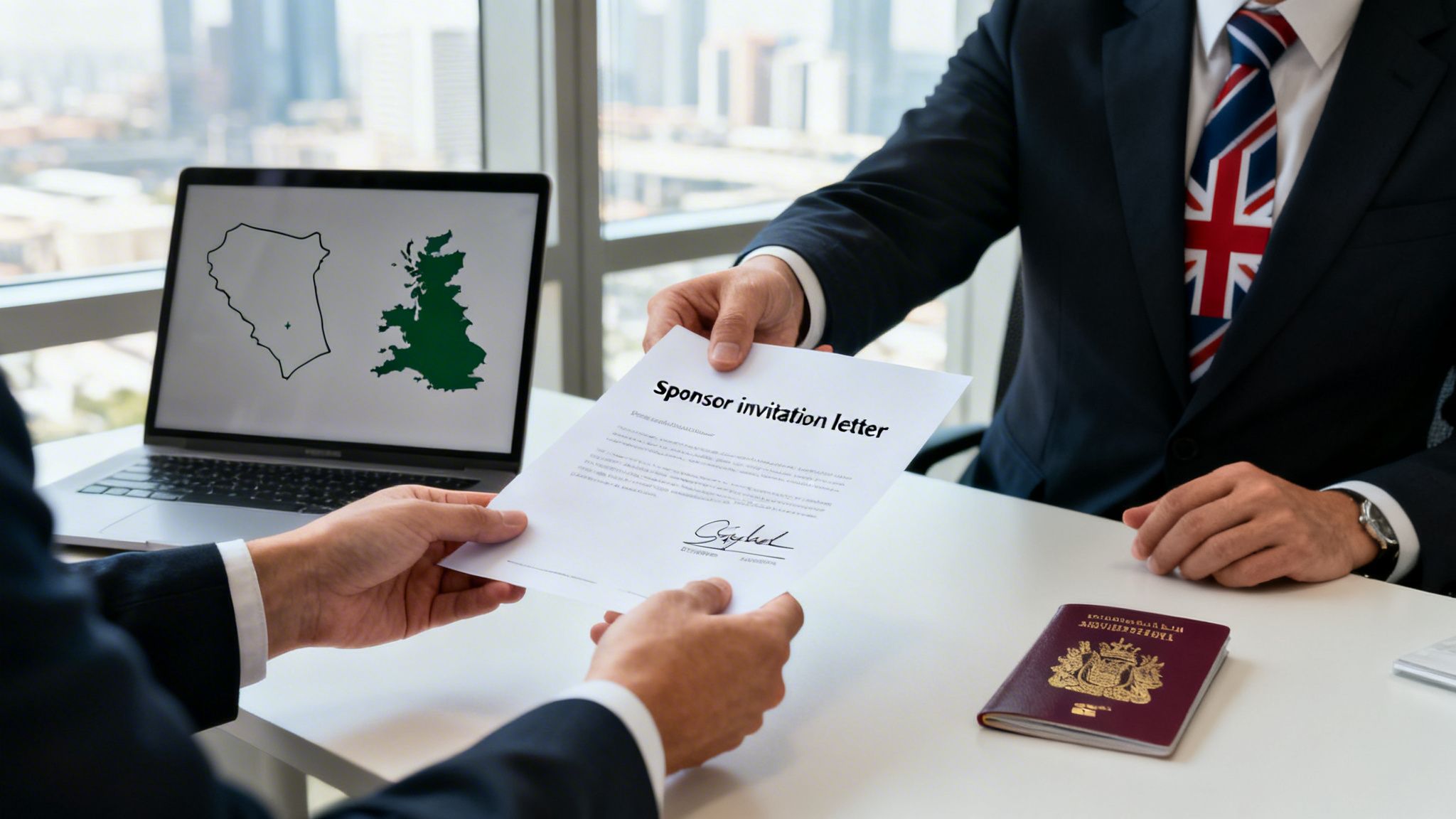
Two businessmen exchanging a sponsor invitation letter for a UK visa, with a passport and maps on the table.

The standing of your sponsor within Saudi Arabia is paramount. While the Kingdom issues over 50,000 'Investor Visitor' visas annually, checks on sponsor companies have tightened. As a British applicant, you must be invited by a Saudi company in good standing with the Nitaqat (Saudization) programme. If your sponsor holds a 'Yellow' or 'Red' status, your visa is almost certain to be denied. We've observed a sharp increase in rejections for this very reason. You can find more insights about UK visa statistics and their implications for travellers.

Key Takeaway: Your visa application's strength is directly tied to your Saudi sponsor. Before gathering any documents, discreetly confirm their Nitaqat status to avoid an immediate—and costly—rejection.

To help you get organised, here's a quick summary of the main requirements.

Saudi Business Visa Key Requirements at a Glance

Requirement Description Critical Importance
UK Passport Must be valid for at least 6 months beyond your intended stay with two blank pages. High
Saudi Sponsor A registered Saudi company in good Nitaqat standing to provide the invitation. Highest
MOFA Invitation Letter The official invitation issued by your sponsor via the Saudi Ministry of Foreign Affairs. Highest
UK Employer Letter A letter from your UK company confirming employment, role, and travel purpose. High
Completed Application The visa application form, filled out accurately and completely. High

Getting these core elements right from the start will streamline the rest of the process significantly.

The Challenge of Concurrent Travel: The Overlapping Visa Trap

A common problem that catches out many frequent flyers is the "Overlapping Visa Trap." When applying for a visa, an embassy can hold your passport for weeks, completely freezing your ability to travel elsewhere. This creates a logistical nightmare for professionals with back-to-back international commitments.

This is precisely where a second UK passport becomes an indispensable tool for maintaining Operational Continuity. It is a fully legitimate "hidden solution" offered by Her Majesty’s Passport Office (HMPO) for professionals who can demonstrate a genuine need. With a second passport, you can submit one for a lengthy visa process (like the business visa for Saudi) while using the other for immediate travel needs. It's a smart strategy for Risk Mitigation that prevents administrative delays from derailing your professional schedule.

Getting Your Documents Right: The Make-or-Break Checklist

When it comes to a Saudi business visa, your paperwork is everything. Countless applications stall or are rejected over minor details. Getting every document perfectly in order from the start is the only way to ensure a smooth process.

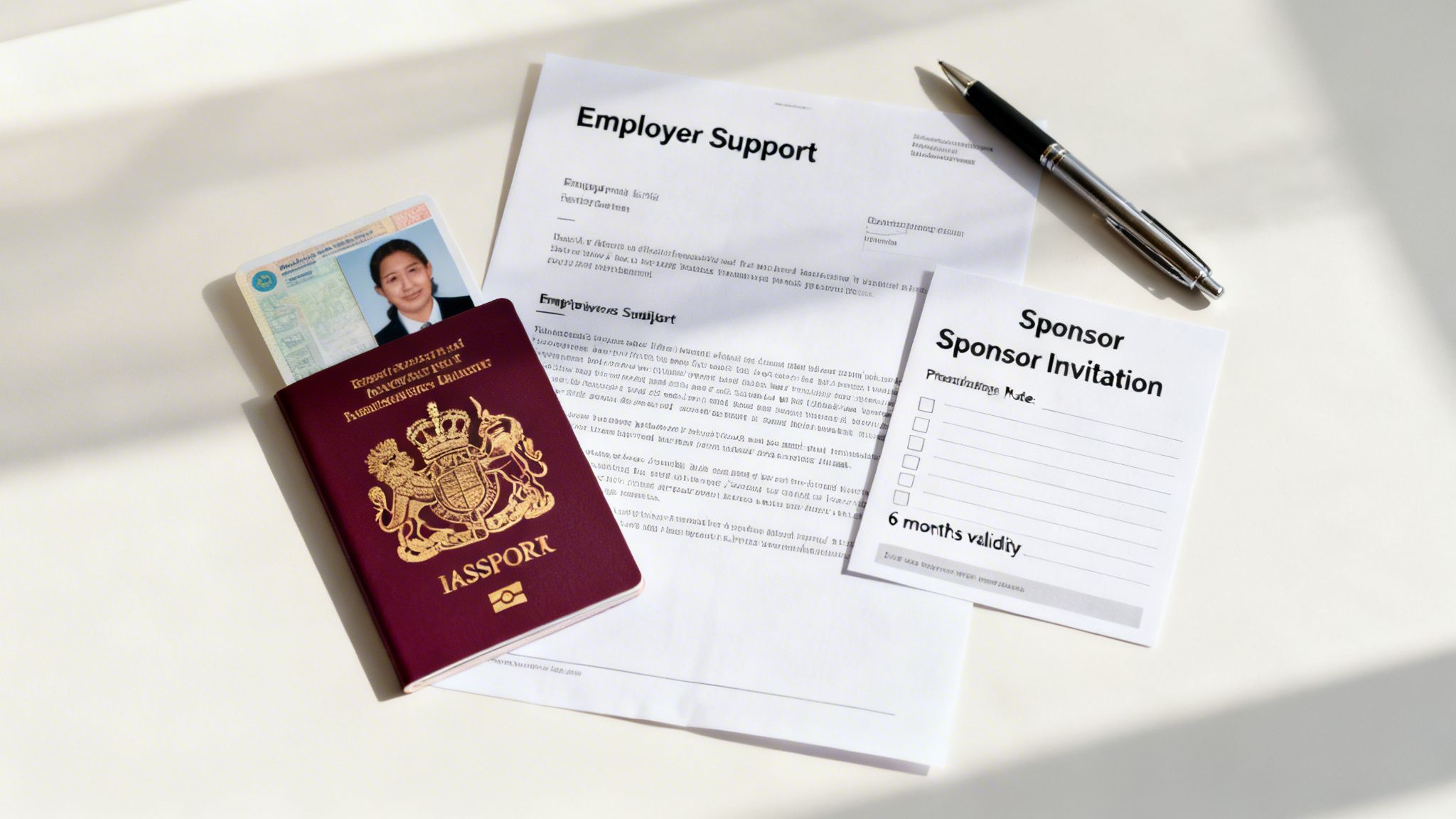
A passport with an ID card, employer support letter, sponsor invitation, and pen on a table.

Let's go through each requirement piece by piece, highlighting the common pitfalls that trip people up time and again.

Your British Passport: The First Hurdle

Your passport is the first item an official examines, and it's an easy place to fail before you've even begun. Before proceeding, check your biometric passport against these non-negotiable rules:

  • Six Months' Validity (From Entry!): Your passport must be valid for at least six months from your planned date of entry into Saudi Arabia, not your application date.
  • Two Blank, Consecutive Pages: You need at least two completely empty, side-by-side visa pages. Pages with any stamps or markings, even those titled 'Amendments', do not count.
  • No Israeli Stamps: An Israeli entry or exit stamp is a major red flag and can lead to immediate rejection. This is a primary reason why a second UK passport is so valuable, as it allows you to isolate travel histories between politically conflicting regions.

Crucially, as of February 25, 2026, UK entry rules have tightened. British dual nationals can no longer use a foreign passport to enter the UK; they must present a valid British passport or a digital Certificate of Entitlement (COE) to avoid being denied boarding. Since British citizens are ineligible for the new Electronic Travel Authorisation (ETA) system, a valid British passport is the only seamless way to enter the UK.

The ENJAZIT Form and Your Photos

The online application, typically completed via the ENJAZIT platform, demands absolute accuracy. Every field is cross-referenced with your supporting documents. A common mistake, such as a slight variation in job title between the form and your employer letter, is enough to trigger a denial.

Your photos are subject to equally strict requirements. They must be recent (within the last three months), in colour, and set against a plain white background. No glasses or headwear (unless for religious reasons) are permitted, and a neutral expression is mandatory.

The Two Letters That Must Be Perfect

While every document is important, the heart of your application lies in two letters: the support letter from your UK employer and the invitation from your Saudi sponsor. These documents must be perfectly synchronised.

I can't stress this enough: a mismatch between the visa validity your employer requests and what your sponsor has been approved for is a primary reason for rejection. If your company letter asks for a 12-month, multiple-entry visa but the Saudi invitation is only for a 90-day single entry, it's a guaranteed problem.

1. UK Employer Support Letter: This must be on official company letterhead with a genuine "wet-ink signature" from a senior company figure. A digital or scanned signature will be rejected. The letter must confirm your role, detail the exact purpose of your visit, and formally state that your company is covering all travel expenses.

2. Saudi Sponsor Invitation Letter: This is the cornerstone. Your Saudi partner obtains this for you through their Ministry of Foreign Affairs (MOFA), and it must be officially stamped by the Saudi Chamber of Commerce. This document dictates the terms of your visa—validity, number of entries, and purpose.

Think of these two letters as two halves of a whole. Your job title, stated purpose of the trip, and requested visa duration must be identical on both. Any difference creates doubt, and doubt leads to rejection of your business visa for Saudi application.

Understanding the Saudi Invitation Letter

Let’s be clear: the invitation letter from your Saudi sponsor isn't just a formality. It’s the absolute foundation of your business visa application. Think of it as your official endorsement within the Kingdom, a government-registered document that vouches for you. Without a perfectly executed invitation, your application is dead on arrival.

This letter is generated by your Saudi partner company through their portal with the Ministry of Foreign Affairs (MOFA). It then has to be officially attested by the Saudi Chamber of Commerce. This crucial step formalises the request and tells the Saudi authorities that your sponsor is taking responsibility for your visit.

Why Your Sponsor's 'Nitaqat' Status Matters

Before your Saudi partner even thinks about drafting the invitation, their own company's standing is under the microscope. Saudi Arabia has a nationalisation scheme called Nitaqat, which grades companies based on how many Saudi nationals they employ. This is a critical detail that many applicants miss.

If your sponsor has a high compliance level—'Platinum' or 'Green'—it signals to the authorities that they are a reputable business. On the flip side, an invitation from a company with a 'Yellow' or 'Red' Nitaqat status is a major red flag.

I’ve seen it happen time and again: a perfectly good visa application gets rejected out of hand because the sponsoring company had a poor Nitaqat rating. The Saudi authorities simply won't accept an endorsement from a business they consider non-compliant.

It’s well worth having a candid conversation with your Saudi hosts about their Nitaqat status before they start the process. It’s a simple question that could save you a world of time, money, and hassle.

What A Valid Invitation Must Include

The invitation has to be precise. Any mistake, no matter how small, can cause serious delays or even get your application thrown out. Make sure your sponsor includes these details, exactly as they appear in your other documents:

  • Your Full Name and Nationality: This must be an exact match to what’s in your passport. No abbreviations or variations.
  • Your Job Title: This needs to align perfectly with the job title mentioned in your UK employer’s support letter.
  • Your Passport Number: Get them to double- and triple-check this for accuracy. A single wrong digit will derail everything.
  • Sponsor's Full Company Name and Address: As officially registered in Saudi Arabia.
  • Sponsor's Commercial Registration (CR) Number: This is their unique 10-digit business ID in the Kingdom.
  • Visa Type, Validity, and Entries: The letter must be specific. Does it request a single or multiple-entry visa? For what duration—90 days, 180 days? Leave no room for ambiguity.

The purpose of your visit also needs to be explained with real business clarity. Vague phrases like "for business meetings" just won't cut it. A much better, more specific description would be something like, "To attend technical project meetings and conduct contract negotiations regarding the Riyadh Metro expansion project."

A Quick Checklist for Your Saudi Sponsor

To help your Saudi partner get it right the first time, you can share this simple checklist with them. It covers the essentials the consulate will be looking for and is a key step towards getting your business visa for Saudi.

  1. Confirm Nitaqat Status: First things first, is your company’s Nitaqat rating 'Green' or higher?
  2. Verify Applicant Details: Have you checked the applicant's name, passport number, and job title against the documents they sent you?
  3. Specify Visa Terms: Does the invitation clearly state the correct visa type (single/multiple entry) and the duration we agreed upon?
  4. Detail the Purpose: Is the reason for the visit explained in specific, commercial terms, not just generic phrases?
  5. Include CR Number: Is your 10-digit Commercial Registration number clearly visible on the letter?
  6. Secure Attestation: Finally, has the letter been processed through MOFA and officially stamped by the Chamber of Commerce?

Getting these details right from the start dramatically boosts the chances of the invitation being accepted, setting you up for a smooth and successful visa application.

Navigating The Visa Application And Submission Process

Once you’ve gathered all your documents and double-checked everything, you’re ready to get the application submitted. For UK business travellers heading to Saudi, there isn't just one way to do this. You have a couple of distinct choices, and each comes with its own pros and cons regarding speed, cost, and how much hands-on support you get.

The two main routes are applying directly through an official processing centre, like VFS TasHeel, or handing the whole thing over to a specialist visa agency. Knowing the practical differences between them is crucial for picking the path that aligns with your schedule and business objectives.

Before you can even start your side of the application, remember that your Saudi sponsor has to kick things off by securing that all-important invitation letter.

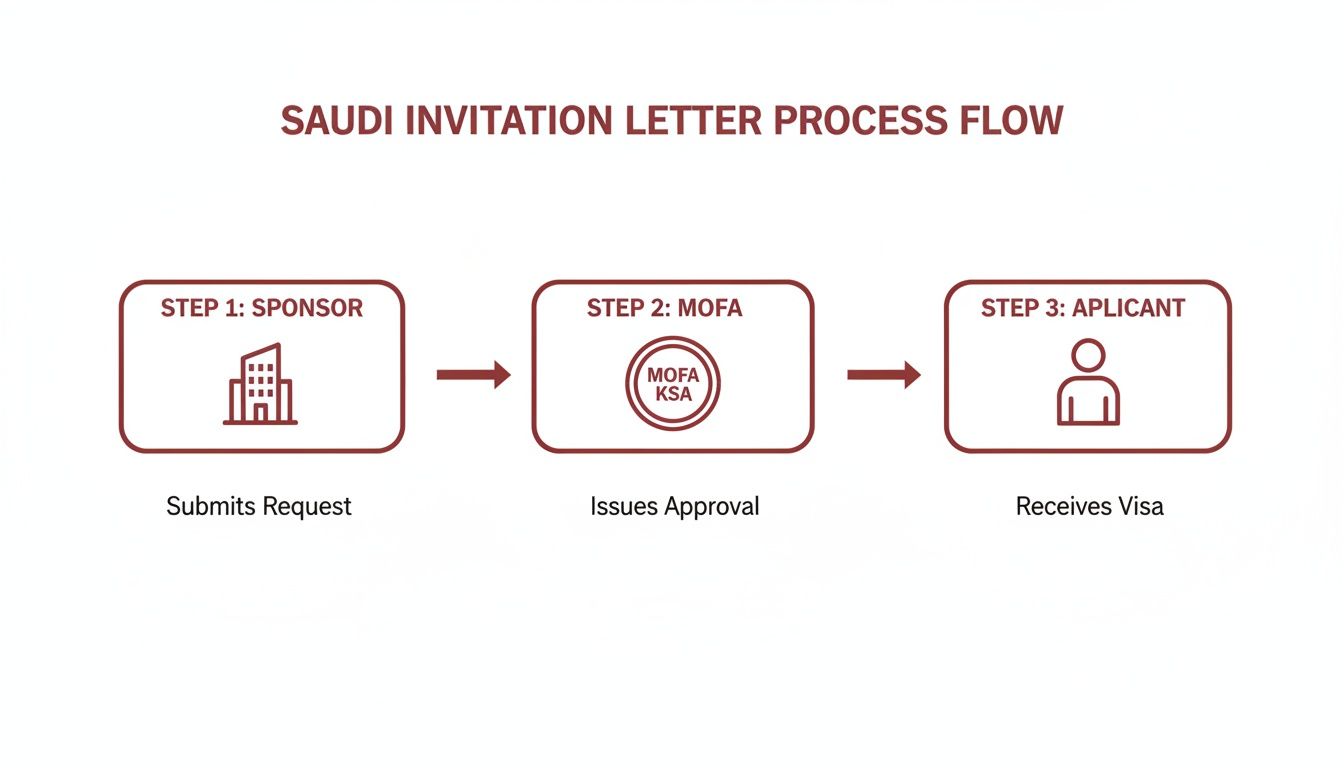
Flowchart illustrating the Saudi invitation letter process, detailing sponsor request, MOFA approval, and applicant receiving visa.

As you can see, the process is sponsor-led from the beginning. They need to get the green light from the Saudi Ministry of Foreign Affairs (MOFA) before a single document comes your way.

Choosing Your Application Pathway

Going directly through an official centre like VFS TasHeel is the standard approach. This involves booking an appointment online, showing up in person to submit your paperwork, and giving your biometric data (fingerprints and a photo). It's a direct route, but it can feel a bit impersonal, and you're on your own if there are any issues.

The alternative is to use a reputable visa agency. This can be a real lifesaver, especially for busy executives or those with complex travel plans. A good agent will pre-check every single one of your documents, catching the small but critical errors that often lead to a flat-out rejection. They handle the entire submission for you, acting as a buffer between you and the bureaucracy.

Expert Insight: Yes, an agency charges a service fee, but its real value is in mitigating risk. A rejected application costs more than just the visa fee—it can jeopardise a crucial business deal because of delays. Think of an agency's expertise as an insurance policy against preventable mistakes.

Understanding Realistic Timelines and Bottlenecks

Processing times for a Saudi business visa can be a bit of a moving target. While a clean, straightforward application might be turned around in 5-10 working days, this is by no means a guarantee. And remember, that clock only starts ticking after you've successfully submitted your biometrics at the centre.

Several factors can throw a spanner in the works:

  • Public Holidays: All processing grinds to a halt during both UK and Saudi public holidays. Always check the calendars for both countries when mapping out your timeline.
  • Consular Backlogs: Consulates can get swamped during peak travel seasons, leading to longer queues and delays.
  • Requests for More Information: If the consulate sees anything ambiguous in your application, they might put it on hold and ask for clarification, pausing the process indefinitely until you provide what they need.

Increased Scrutiny on UK Applicants

It's also worth noting the current climate. There's a sharp contrast in recent visa approval trends. While Saudi nationals enjoy a 97% approval rate for UK visitor visas, British executives are facing tougher checks for Saudi business visas.

We've seen refusal rates climb, especially for people who travel frequently with only short gaps between their trips. This is partly because Saudi sponsors are now under pressure to maintain good compliance ratings on government platforms like Qiwa and MOFA. A poor rating can trigger an automatic rejection of the visa application they're sponsoring. You can see the official figures in the full UK government statistics report.

Getting through this process successfully comes down to meticulous planning, a flawless application, and a real-world understanding of the potential hurdles. Choosing the right submission method and building in a buffer for delays are key to getting your business visa for Saudi without throwing your plans into chaos.

The Second UK Passport: A Strategic Tool for Business Continuity

For any serious international professional, managing travel logistics can feel like a constant battle against delays, red tape, and unexpected hurdles. A simple administrative hold-up—like your passport being stuck at an embassy for weeks—can derail a multi-million-pound deal. This is precisely where a second UK passport stops being a mere convenience and becomes an essential tool for Operational Continuity.

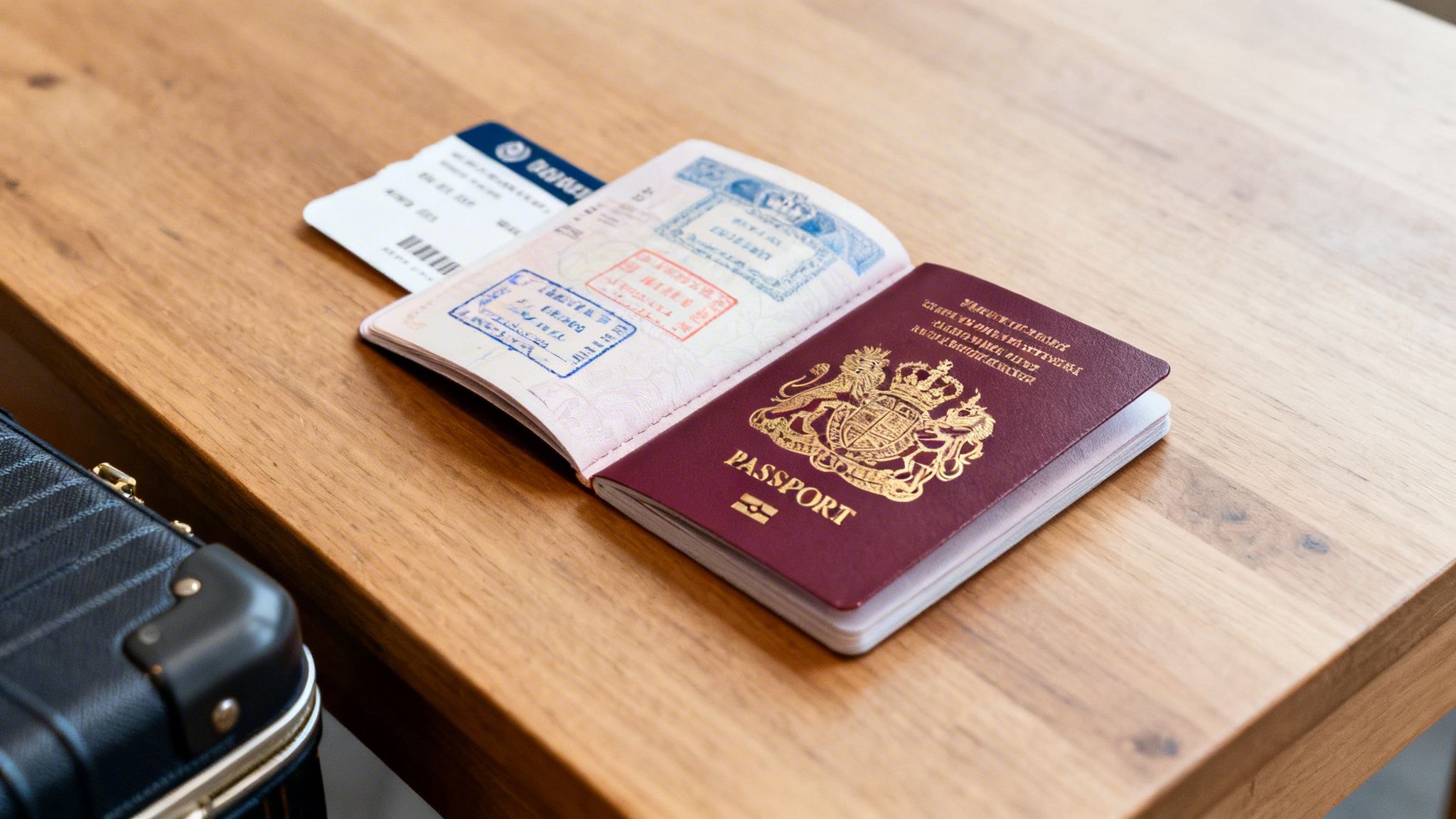
An open British passport with visa stamps and a boarding pass on a wooden table, next to a suitcase.

Think of it as a proactive "Plan B" or "Insurance Policy." It allows you to navigate the complex demands of international business without losing momentum. This is not a workaround; it's a fully legitimate service provided by Her Majesty’s Passport Office (HMPO) for British citizens who can prove a genuine need.

Escaping the Overlapping Visa Trap

The most common "genuine need" is escaping the "Overlapping Visa Trap." Imagine your main passport is with the Chinese embassy for several weeks. Suddenly, a critical, time-sensitive opportunity arises in Riyadh, requiring a business visa for Saudi Arabia now. With only one passport, you're completely stuck.

This isn’t a hypothetical problem—it's a daily reality for executives, engineers, and sales professionals across the UK. A second passport is the only practical solution, allowing you to run visa applications in parallel. You can submit one passport to get your Saudi visa while using the other for immediate travel.

This strategic separation of documents ensures your business operations are never held hostage by consular processing times. It’s the difference between seizing an opportunity and having to explain to your board why a key meeting was missed.

To see just how powerful this can be, you can explore the full scope of how a second UK passport provides a vital advantage for frequent travellers.

Navigating Politically Sensitive Travel

Another critical "genuine need" that HMPO recognises involves dealing with incompatible entry stamps. Some countries will deny entry if your passport shows travel to a nation they have political conflicts with, a major issue for anyone doing business across the Middle East.

  • The Israel-Saudi Challenge: While diplomatic relations are evolving, a passport containing an Israeli stamp still carries a high risk of rejection for a Saudi visa application.
  • Ensuring Operational Continuity: A second passport allows you to completely isolate your travel histories. One passport can be used for trips to Israel, while the other remains 'clean' for seamless entry into Saudi Arabia and other GCC countries.
  • Risk Mitigation: This tactic removes the ambiguity and the real risk of being denied boarding or turned away at immigration—a risk no business can afford. It is standard practice for seasoned corporate travellers and rotational workers in the energy and humanitarian sectors.

This approach gives you certainty, ensuring your access to key markets is never compromised by your travel history.

An Essential Asset for Specific Professions

For certain professions, a second passport is an Operational Essential. Rotational Workers in the oil and gas sector are constantly flying to visa-heavy regions on tight schedules. Their passports fill up with stamps quickly, and a second document is the only way to avoid running out of pages mid-rotation.

Similarly, for Airline Crew, a second passport is key to maintaining flight rotations. If their primary passport is held for visa renewal, a backup allows them to continue working without disruption, keeping airline operations on track.

Obtaining a second passport requires strong justification, typically a formal employer support letter on corporate letterhead. This letter must clearly outline the business need, feature a wet-ink signature, and explain why a single passport is insufficient for your professional duties. It is this proof of necessity that underpins the legitimate application process.

The table below breaks down common travel headaches and shows how a second passport resolves them.

Primary Passport vs. Second Passport Scenarios

Travel Challenge Impact with One Passport Solution with a Second Passport
Concurrent Visa Needs All travel stops while the passport is held by an embassy, causing delays and missed opportunities. Apply for one visa with the primary passport while continuing to travel or apply for another visa with the second.
Incompatible Entry Stamps Risk of visa refusal or being denied entry at the border due to a politically sensitive travel history. Dedicate one passport for specific regions, keeping the other 'clean' for unrestricted access to sensitive countries.
Passport Nearing Full Frequent travel is halted to renew the passport, causing downtime for rotational or field staff. Continue travelling on the primary passport while the second is processed, or use the second as an immediate backup.
Emergency Travel Required Unable to respond to an urgent international business need if the passport is away for visa processing. The second passport is always ready for immediate, unplanned travel, ensuring business agility.

As you can see, for a certain type of professional, a second passport isn't a luxury—it's a fundamental part of their toolkit, ensuring they can be where they need to be, when they need to be there.

Your Saudi Business Visa Questions Answered

When you're preparing for business travel to Saudi Arabia, it's the practical, nitty-gritty questions that often pop up last minute. Let's run through some of the most common queries we hear from UK business travellers to make sure your application goes smoothly.

How Long Is a Saudi Business Visa Actually Valid For?

There’s no single answer here; the visa’s validity period is decided by the Saudi consulate, and it hinges almost entirely on the invitation letter from your Saudi sponsor. Typically, you'll see visas issued for 30, 90, or 180 days, with either single or multiple-entry options.

The golden rule is consistency. Your Saudi sponsor needs to clearly state the duration and number of entries they're requesting for you. Then, your UK employer's support letter has to mirror that request word for word. Any discrepancy, and the consulate will likely play it safe and grant the shorter duration, or they might even knock a multiple-entry request down to a single entry if the justification isn't strong enough. If you travel there a lot, you can't afford any ambiguity.

What are the Most Common Reasons for a Visa Rejection?

Nine times out of ten, a visa refusal isn't about your business case—it’s down to simple paperwork errors. Being meticulous is your best defence against the hassle and expense of a rejection.

Here are the most common pitfalls we see:

  • Mismatched Information: If your job title, purpose of visit, or requested visa length doesn't line up perfectly across the invitation, the UK support letter, and your online application form, that’s an immediate red flag.
  • A Weak Sponsor: An invitation from a company with a poor Nitaqat rating (the official Saudization program) is a huge liability and often leads to an instant rejection.
  • Incorrect Attestation: The sponsor's invitation letter isn't just a letter; it must be officially stamped and attested by the Saudi Chamber of Commerce. A standard company letterhead won't cut it.
  • Vague Justification: Stating your purpose as just "business meetings" is too generic and won't convince anyone. You need to be specific—mention project kick-offs, contract negotiations, or technical site surveys.
  • Previous Immigration Issues: It goes without saying, but if you've ever overstayed a previous Saudi visa, you can pretty much guarantee a refusal.

Can I Get a Saudi Visa with an Israeli Stamp in My Passport?

Officially, policies can and do change, but the reality on the ground is that a passport containing an Israeli stamp carries a very high risk of your visa being denied or being turned away at the border. It's a well-known stumbling block for international business travellers.

This is precisely the kind of problem a second UK passport is designed to solve. It’s not some sneaky workaround; it’s a perfectly legitimate strategy that Her Majesty’s Passport Office (HMPO) provides for professionals with a genuine business need.

With a second passport, you eliminate the risk entirely. You can keep one passport 'clean' for travel to Saudi Arabia and other GCC countries, while the other is used for travel to Israel. It’s standard practice for seasoned corporate travellers who operate in the region.

My Passport is Stuck at Another Embassy. How Can a Second Passport Help?

This is easily the most common and pressing reason professionals come to us. Your only passport is tied up for weeks at an embassy processing a US or Chinese visa, and suddenly, all other international travel grinds to a halt. This "visa trap" can scupper deals and throw critical project timelines into chaos.

A second UK passport is the definitive solution to this logistical nightmare. It lets you work in parallel. While your main passport is out of action, you can use your new, valid second passport to apply for that urgent business visa for Saudi without missing a beat.

It means no more costly disruptions to your schedule. What was a major bottleneck becomes a non-issue, keeping your business moving forward.


At Second UK Passports, we specialise in helping frequent travellers and corporate clients secure this vital business asset. If your travel is being hampered by visa processing times or sensitive entry stamp issues, we can help.

Check your eligibility and start your application for a second UK passport today.