

For most trips, the answer is a straightforward no—British citizens do not need a visa for Malaysia if they're visiting for tourism or business for up to 90 days. This makes planning a trip feel refreshingly simple, but knowing the specifics is what separates a smooth arrival from a stressful one. This guide explains the current entry rules and why a second UK passport is a hidden solution for frequent travellers facing logistical challenges.
Your Guide to UK Travel to Malaysia
The question "do you need a visa for Malaysia?" is common for UK-based professionals mapping out business trips. Thankfully, Malaysia's generous visa-free arrangement means you can focus more on your itinerary and less on tedious paperwork.
However, 'visa-free' doesn't mean 'requirement-free'. There are non-negotiable conditions you must meet to be waved through immigration. Getting these right is key to avoiding last-minute hitches that could jeopardise your entire trip.
Essential Entry Conditions for British Citizens
Before booking flights, check your travel documents. The Malaysian authorities are clear about their requirements, and meeting them is essential for a hassle-free entry.
Think of it as a pre-flight checklist:
- Passport Validity: Your British biometric passport must have at least six months of validity remaining from the day you plan to enter Malaysia.
- Blank Passport Pages: You'll need at least one clean, blank page for immigration stamps.
- Malaysia Digital Arrival Card (MDAC): This is a mandatory online registration you must complete within the three days leading up to your arrival.
This visa-free access for trips up to 90 days has been in place for years and is re-confirmed in the UK government's official travel advice for 2026. This means you can arrive with your valid passport and MDAC confirmation, making Malaysia an incredibly accessible destination. You can always verify the latest details on the GOV.UK travel advice page for Malaysia.
To make this even clearer, here’s a quick-glance checklist for a smooth entry.
UK Citizen Visa-Free Entry Checklist for Malaysia
This table summarises exactly what you need to have in order before you travel.
| Requirement | Details and Official Source | Key Traveler Note |
|---|---|---|
| Visa-Free Period | Up to 90 days for tourism or business. | You cannot work or study on this entry. For longer stays or other purposes, a visa is required. |
| Passport Validity | Must be valid for at least 6 months from your date of entry. | Check your passport's expiry date now. It's the most common reason for being denied boarding. |
| Digital Arrival Card | Mandatory MDAC must be completed online within 3 days of arrival. | Keep the confirmation email handy on your phone. Some airlines ask to see it at check-in. |
| Proof of Onward Travel | A confirmed ticket to leave Malaysia (within the 90 days). | Immigration officers may ask to see your return or onward flight booking as proof you intend to leave. |
Having these four items sorted gives you the best chance of walking through Malaysian immigration without a single issue.
The Challenge for Frequent Global Travellers
While Malaysia's rules are straightforward, a classic problem catches many seasoned professionals out: the "Overlapping Visa Trap." Imagine you need to be in Kuala Lumpur for a vital meeting, but your only passport is stuck at an embassy for a complex visa application for another country. This scenario can grind your business travel to a complete halt.
This is precisely where a second UK passport becomes a business asset for "Operational Continuity" and "Risk Mitigation." It's a fully legitimate service offered by Her Majesty’s Passport Office (HMPO) that allows one passport to be tied up in a lengthy visa process while your other one is free for immediate, visa-free trips to countries like Malaysia. Think of it as your strategic "Plan B" or "Insurance Policy" to eliminate travel downtime.
Navigating Malaysia's Visa-Free Entry Rules
So, do you need a visa for Malaysia? For British citizens on a short trip, the answer is usually no, but you must follow a clear set of rules. Getting these details right is crucial for any business traveller looking to avoid headaches at the border.
Your Passport: The Non-Negotiable Basics
The first and most important hurdle is your passport's validity. As highlighted by GOV.UK, Malaysian immigration is firm: your British passport must be valid for at least six months from the day you land. This is a strict requirement and a common reason people get turned away by their airline before they even leave the UK.
You’ll also need at least one completely blank page for the entry and exit stamps. This might sound minor, but for frequent flyers whose passports are a mosaic of stamps, it can be a real issue. A second passport often becomes an operational essential to ensure you're always ready to travel.
Don't Forget the Malaysia Digital Arrival Card (MDAC)
A crucial part of your pre-flight checklist is the Malaysia Digital Arrival Card (MDAC). This isn't a visa, but it is a mandatory online form that you must complete within three days of your arrival.
Once you’ve submitted it, you'll get a confirmation email. Have a screenshot of this on your phone, as airline staff and immigration officers will likely ask to see it. Forgetting to do this can lead to unnecessary delays when you land.
At the Immigration Counter
Even with the right passport and your MDAC sorted, the final decision rests with the border official. They need to be confident that you’ll leave the country within your permitted 90-day visa-free window.
Be ready to show them:
- A confirmed return or onward flight ticket: This is the clearest proof you have a plan to exit Malaysia on time.
- Proof of sufficient funds: They don't always ask, but you might need to show you can support yourself during your stay.
Having these documents ready will make for a smooth and professional arrival. For busy professionals juggling multiple trips, knowing these fine details is key. You can learn more about how a second passport provides vital travel flexibility in our detailed overview.
The 2026 UK Entry Rules for Dual Nationals
As of February 25, 2026, UK entry rules have tightened. Dual nationals can no longer use a foreign passport alone to enter the UK; they must present a valid British passport or a digital Certificate of Entitlement (COE) to avoid being denied boarding by carriers. Furthermore, British citizens are ineligible for the new Electronic Travel Authorisation (ETA) system, making possession of a valid British passport the only seamless way to enter the UK.
When You Absolutely Need a Malaysian Visa
The 90-day visa-free arrangement is a fantastic perk for UK citizens, but it’s crucial to understand its limits. The moment your plans involve work or study, the answer to "do you need a visa for Malaysia?" becomes a firm "yes."
Trying to work or enrol in a course on a tourist stamp is a serious breach of Malaysian immigration law. The authorities are strict, and getting caught can lead to hefty fines, detention, and being barred from re-entering the country. For anyone planning a long-term assignment, getting the right paperwork sorted from the beginning is non-negotiable.
This handy infographic lays out the essentials for a standard visa-free entry from the UK.
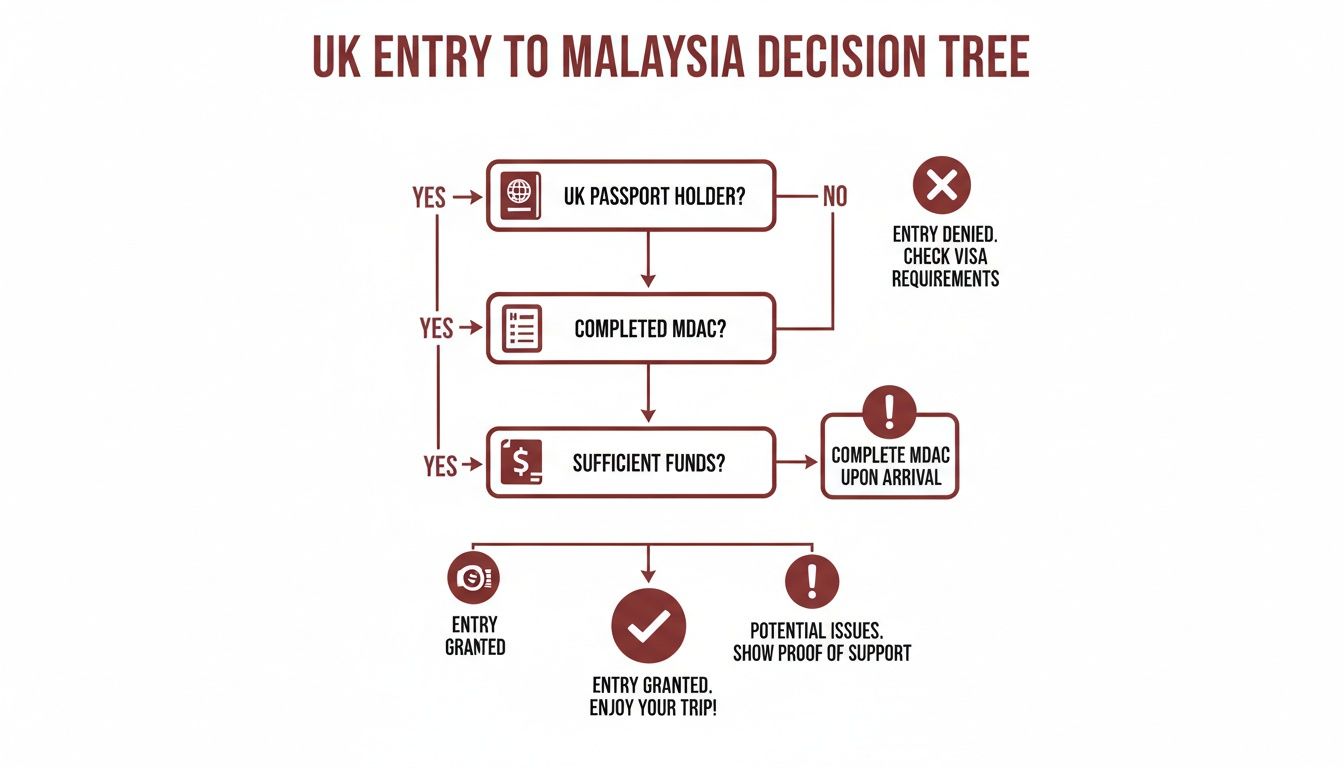
As you can see, the visa-free route is straightforward for tourism. But if your plans don't fit into that box, you’ll need to apply for a proper visa or pass.
Scenarios Demanding a Formal Visa Application
If your reason for travelling fits one of the descriptions below, you must secure the correct pass before you fly. You cannot just arrive on a tourist stamp and hope to change it later.
- Long-Term Employment: Landed a job with a Malaysian company? You'll need an Employment Pass. Your employer sponsors this and handles the initial application.
- Higher Education: If you're enrolling at a Malaysian university, a Student Pass is essential. Your educational institution kicks off this process.
- Specialised Professional Visits: For foreign experts brought in for specific, highly skilled projects, the Professional Visit Pass (PVP) is the correct route.
- Dependants of Pass Holders: If your spouse or parent holds an Employment Pass, you'll need a Dependant Pass to legally live with them in Malaysia.
It all boils down to your intent. The 90-day visa-free entry is for temporary visitors. A long-stay permit like an Employment Pass signals a deeper commitment to living and working in Malaysia, which involves a much more thorough application process.
Understanding the Application Process
Securing a long-stay pass for Malaysia is a multi-stage affair requiring a stack of documents and is nearly always initiated by your sponsor in Malaysia. The requirement for a formal employer support letter on corporate letterhead featuring a "wet-ink signature" is strict to avoid application rejection.
Here’s a simplified breakdown of the steps:
- Sponsor Application: Your Malaysian employer or university submits the main application to the Immigration Department of Malaysia.
- Visa with Reference (VDR): Once approved, you get a VDR approval letter. This is a crucial document, but it’s not your final visa.
- Embassy Endorsement: You take the VDR letter to the Malaysian Embassy or High Commission in your home country to get a single-entry visa sticker in your passport.
- Arrival and Final Endorsement: You travel to Malaysia on this single-entry visa, where the Immigration Department will endorse your passport with the final long-term pass sticker.
This entire chain of events can easily take several weeks. For busy professionals who can't afford to have their passport tied up, this is where a second UK passport proves invaluable. It allows you to submit one passport for the lengthy visa process while you continue travelling on the second. To see how this works, have a look at our in-depth guide on acquiring a second passport.
What Happens When Your Passport is Stuck at an Embassy?
For any frequent traveller, time is everything. Asking "do you need a visa for Malaysia?" is simple for a one-off holiday. But what if you're a professional juggling a hectic international schedule? Suddenly, a visa-free trip can become a massive headache.
Picture this: you have a vital client meeting in Kuala Lumpur, relying on Malaysia's 90-day visa-free entry. The problem? Your only passport is tied up at an embassy, waiting weeks for a visa to be processed for another trip.
This is the classic 'Overlapping Visa Trap'. It’s a common scenario that grounds key personnel, jeopardises deals, and brings business to a screeching halt. A single, slow visa application can block all other international travel.
Your Secret Weapon: The Second UK Passport
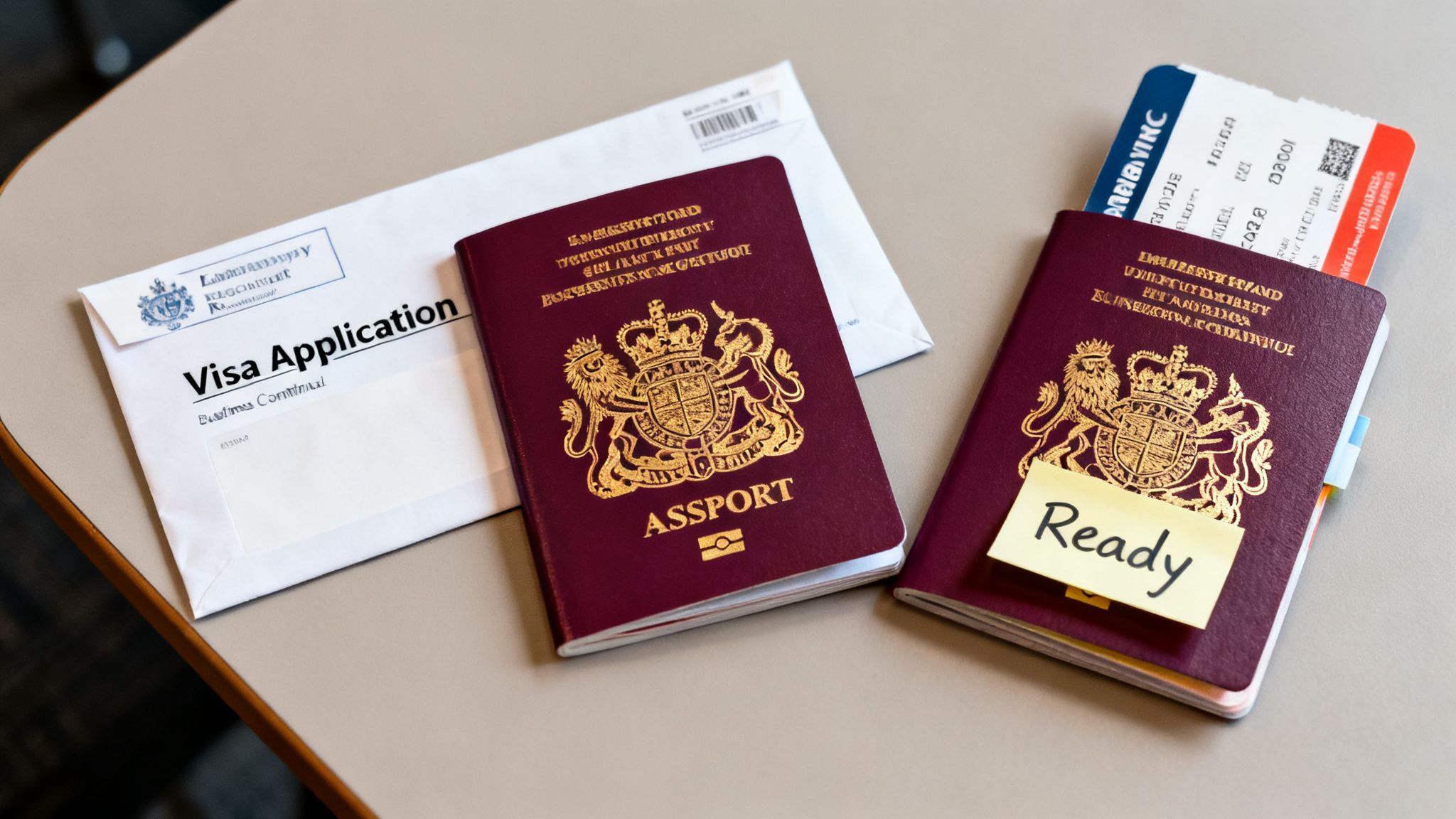
This is exactly where a second UK passport becomes an essential tool for "Operational Continuity." This isn't some back-alley trick; it's a fully legitimate service offered by Her Majesty’s Passport Office (HMPO) for British citizens who can demonstrate a "genuine need" for simultaneous travel.
Holding two valid biometric passports means you can sidestep the Overlapping Visa Trap entirely.
Think of it as the ultimate "Insurance Policy" for your travel schedule. You can submit one passport for a visa application that might take weeks, while your second passport stays with you, ready for immediate, visa-free trips to places like Malaysia. Your mobility is never compromised.
A second UK passport is the definitive answer for maintaining operational continuity. It allows professionals to handle simultaneous visa applications and travel plans without conflict, turning a logistical mess into a seamless process.
This service is specifically for people whose jobs demand this kind of flexibility, a recognition that for certain roles, a single passport isn't fit for purpose.
Who Actually Needs This? Real-World Examples
The "genuine need" for a second passport is clearest in industries where constant international travel is the norm, such as aviation and energy.
The Airline Crew Imperative
For pilots and cabin crew, flight schedules are planned down to the minute. The Overlapping Visa Trap is a direct threat to their ability to do their jobs.
- Juggling Rotations: A pilot might need a visa for China while being scheduled for flights to the Middle East and a visa-free stopover in Kuala Lumpur.
- Avoiding Being Grounded: If they submit their only passport for the Chinese visa, they are instantly grounded for all other international duties, throwing rosters into chaos.
- The Smart Solution: A second passport is an "Operational Essential." It lets them apply for the long-winded visa while using the other to continue flying their full international schedule.
For airlines, ensuring UK-based crews have second passports is smart risk management, preventing visa paperwork from interfering with flight operations.
The Rotational Worker Lifeline
Professionals in the energy sector, especially "Rotational Workers" in oil and gas or NGO staff, face similar challenges. Their work often sends them to visa-intensive or sensitive regions.
- Back-to-Back Assignments: An engineer could finish a rotation in West Africa and need to fly immediately to a project briefing in Malaysia.
- Conflicting Timelines: The visa for their next assignment might require their passport for several weeks, overlapping directly with their travel to Malaysia.
- Eliminating Costly Downtime: With a second passport, they can leave one document with the visa agent and use the other for their immediate trip. This ensures they can move between projects without delay.
In both of these scenarios, the second passport isn't a luxury. It's a fundamental tool that keeps people working and projects on track.
When Your Passport Becomes a Political Minefield
An innocent-looking entry stamp from one country can cause a world of trouble when you try to enter another, especially if the two nations have a rocky political relationship. Suddenly, your passport isn't just a travel document; it's a political diary that border officials are ready to read carefully.
Imagine your work takes you to a country that Malaysia, or another nation on your itinerary, has a sensitive history with. The evidence of that visit, stamped in your passport, could trigger suspicion, intense questioning, and long delays at immigration.
The Challenge of a 'Marked' Passport
Certain entry stamps act like red flags for immigration officials. This forces an impossible choice: cancel a critical business trip to one place, or risk being turned away from the next? For any company operating on a global scale, that's a serious operational constraint.
This is precisely where a second UK passport goes from being a handy backup to an essential tool for "Risk Mitigation". It lets you segregate your travel, making sure the history in one passport doesn't cause problems for the journeys you take with the other.
A second passport offers a clean solution. You can dedicate one passport for travel to a specific group of politically sensitive countries, while the other remains "clean." This is a legitimate strategy, fully supported by Her Majesty’s Passport Office (HMPO) for individuals who can prove a "genuine need."
A Smart Solution for the Global Professional
For diplomats, foreign correspondents, and NGO workers, using a second passport to manage incompatible entry stamps is standard operating procedure. It’s a proactive step that ensures you can move smoothly through immigration, no matter where your work takes you.
Consider these real-world scenarios:
- Humanitarian Missions: An aid worker might need to cross between two neighbouring countries with hostile relations. A second passport is often the only practical way to move between them.
- International Business: A sales executive could have key clients in regions with conflicting political allegiances. Using separate passports prevents one business trip from derailing the next.
- Energy Sector Rotations: Rotational workers in the oil and gas industry or NGO staff often visit sensitive regions requiring isolated entry stamps for security. A second passport keeps this travel history separate, preventing awkward questions.
By planning with this strategy, your ability to enter a country like Malaysia is no longer at the mercy of a border agent’s interpretation of your travel history. You present a passport perfectly suited for your destination, guaranteeing a professional and uncomplicated entry.
The High Cost of Overstaying Your Welcome

While you don't need a visa for a 90-day trip to Malaysia, the authorities take that 90-day limit very seriously. They enforce a strict, zero-tolerance policy for anyone who stays even a day too long.
Overstaying can kick off a chain reaction of penalties that are expensive, stressful, and incredibly difficult to untangle. For any professional traveller, the damage to your travel record is not worth the risk.
Understanding the Penalties
The GOV.UK guidance is clear: the consequences for overstaying are severe. If you’re caught, you should expect to face:
- Hefty Fines: These are the most common penalty, designed as a powerful deterrent.
- Detention: You could be held in an immigration facility while your case is processed.
- Deportation: Once fines are paid and detention is served, you’ll be deported at your own cost.
- Blacklisting: A re-entry ban is almost certain, often lasting for several years.
The numbers speak for themselves. Fines for overstaying typically fall between 5,000-10,000 MYR (£850-£1,700), often with a five-year re-entry ban. Malaysian Immigration prosecuted 28,000 overstay cases in 2024 alone, a 12% jump from the previous year. You can get more details on Malaysia's entry rules directly from the official immigration portal.
How a Second Passport Provides a Safety Net
Careful planning is your best defence. But what if your passport is lost or stolen a few days before you're scheduled to fly home? Getting an emergency travel document isn't instant, and the delay could easily push you over your 90-day limit.
This is precisely where a second UK passport becomes an indispensable "Insurance Policy". If you keep it stored securely and separately, it's an immediate backup. You can use it to leave the country legally and on schedule, sorting out the replacement for your lost passport from the safety of home.
It’s a simple, proactive step that shields you from the serious fallout of an accidental overstay, proving its worth as a vital tool for any serious traveller.
Your Top Questions About Malaysia Visas Answered
Here are straightforward answers to the most common questions we hear about UK citizens travelling to Malaysia, especially when juggling complex itineraries.
How long can I stay in Malaysia as a UK citizen without a visa?
As a British citizen, you can enter Malaysia for tourism or business and stay for up to 90 days without a visa.
This is strictly for short-term visits. If you're planning to take up a job or enrol in a study course, you'll need to secure the right type of visa before you fly.
Is the Malaysia Digital Arrival Card the same as a visa?
No, it's not a visa. The Malaysia Digital Arrival Card (MDAC) is a mandatory pre-arrival registration form.
All foreign visitors, including those from the UK, must complete it online within three days of arriving. It’s a border control formality, not a permit to stay.
Can I work in Malaysia while I'm there on the 90-day visa-free entry?
That’s a firm no. The 90-day visa-free period is purely for tourism and brief business activities like attending conferences or meetings.
It absolutely does not permit you to take up formal employment. To work legally in Malaysia, your employer must sponsor an Employment Pass for you before you enter the country.
How would a second UK passport help with a trip to Malaysia?
While you don't need a visa for a short trip to Malaysia, a second passport is an incredibly useful tool for ensuring your travel plans never grind to a halt.
Imagine your main passport is tied up at an embassy for weeks, waiting for a visa to another country. With a second passport in hand, you can still fly to Malaysia without any disruption. It's a simple, legitimate strategy that prevents one administrative bottleneck from derailing your entire schedule. You can find out more in our guide to getting a second UK passport.
At Second UK Passports, we specialise in helping frequent travellers get the documents they need to stay mobile. If logistical hurdles are holding you back, we know how to help.