
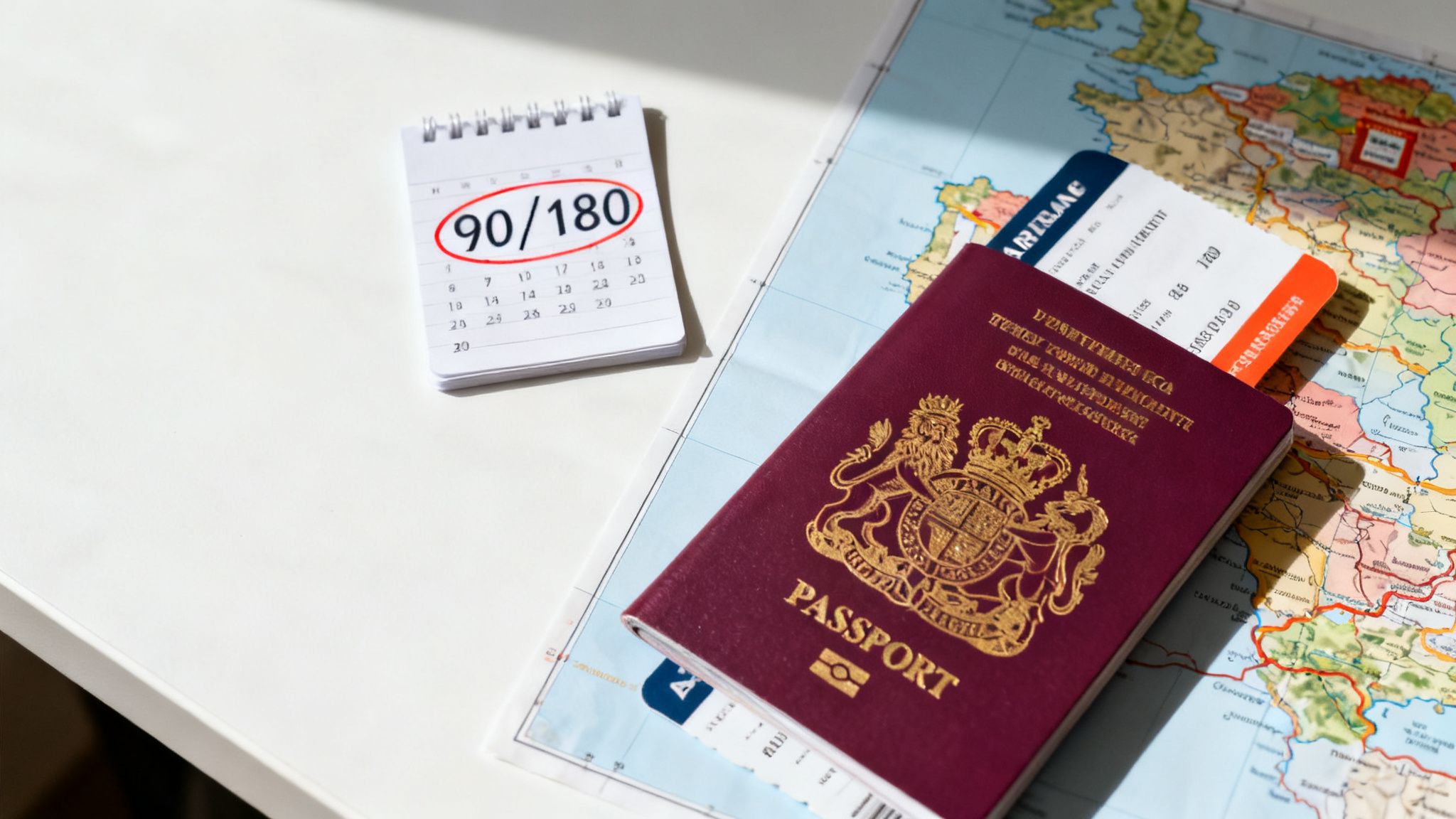
Since the UK's departure from the EU, the travel rules for British citizens visiting Spain have fundamentally changed. For short trips, such as holidays or brief business meetings, the process remains straightforward: you can visit Spain and other Schengen Area countries for up to 90 days within any 180-day period without a visa.
However, if your plans extend beyond this—for instance, to work, study, or reside in Spain—securing the correct visa before you travel is a mandatory legal requirement. This guide will walk you through the essential steps to ensure your application for a visa for Spain from UK is successful.
Do I Need a Spanish Visa? A Post-Brexit Guide for UK Citizens
The era of unrestricted movement has concluded. While short holidays are still simple, any activity resembling employment or establishing a longer-term residence now falls under strict Spanish immigration law. This makes a visa non-negotiable for such purposes.
Since the new regulations took effect on 1 January 2021, demand for Schengen visas to Spain has surged. Previously, UK citizens made over 17 million annual trips to Spain without visa concerns. Now, frequent travellers and long-stay planners face significant paperwork and potential delays.
When You Need a Visa and When You Don't
Understanding the distinction between visa-free travel and activities requiring a visa is critical. A misunderstanding can lead to serious consequences, including fines or being denied entry at the border.
To provide clarity, here is a summary of common travel scenarios.
UK Traveller to Spain Visa Requirements at a Glance
| Travel Purpose | Duration | Visa Required? | Key Considerations |
|---|---|---|---|
| Tourism & Holidays | Up to 90 days in any 180 | No | Your passport must be valid for at least 3 months after you plan to leave Spain. |
| Short Business Trips (e.g., meetings) | Up to 90 days in any 180 | No | This does not cover paid work. You can attend meetings but cannot be employed by a Spanish company. |
| Working for a Spanish Employer | Any duration | Yes | You must secure a National Visa (Type D) before you travel. You cannot start work on a tourist entry. |
| Studying at a Spanish Institution | More than 90 days | Yes | A student visa is mandatory. You’ll need proof of enrolment and financial self-sufficiency. |
| Family Reunification | More than 90 days | Yes | This applies when joining a family member who is a legal resident in Spain. |
| Living in Spain (Non-Lucrative) | More than 90 days | Yes | Ideal for retirees or individuals with sufficient savings to live in Spain without working. |
This table highlights the importance of your travel's purpose. If you are doing anything beyond short-term tourism or specific business activities, a visa is almost certainly required.
The Overlapping Visa Trap for Professionals
For professionals who travel frequently, a significant logistical challenge has emerged: the "overlapping visa trap." This is a critical issue that can halt business operations.
When applying for a Spanish long-stay visa, you must submit your passport. The consulate can hold this document for weeks, or even months, during processing. This leaves you grounded, unable to undertake any international travel.
For corporate travellers, airline crew, and rotational workers, this is not a mere inconvenience—it is a critical point of failure that disrupts projects and jeopardises international commitments. This is where a legitimate, government-issued second UK passport becomes an essential tool for risk mitigation.
A second passport is a fully legitimate service offered by Her Majesty’s Passport Office (HMPO) for those with a genuine need. It allows you to submit one passport for a long-term visa application while using the other for essential travel, ensuring operational continuity.
Picking the Right Spanish Visa for Your Trip
Selecting the correct visa type from the outset is absolutely critical. A high number of applications are rejected simply because the applicant chose the wrong category. This is a fundamental error that can cost you time and money. The Spanish authorities are precise, and your application must align perfectly with your stay's purpose and duration.
You must determine where your specific plans fit within their official framework. The primary decision is whether you need a short-stay Schengen visa or a long-stay National visa.
The Schengen Visa (Type C): For Stays Under 90 Days
The Schengen Visa (Type C) is required for any trip lasting up to 90 days within any 180-day period. While most UK passport holders do not need this for tourism, it applies if you have exhausted your 90-day allowance or are a non-UK national residing in the UK. The key principle is that your trip is temporary.
Consider these real-world examples:
The Business Traveller: A sales director travels to Barcelona for a three-day conference and client meetings. The trip is short, has a clear business purpose, and does not involve employment by a Spanish company. A Schengen (Business) visa is appropriate, supported by a conference invitation and a letter from their UK employer.
The Family Visit: A family plans a six-week visit to their daughter studying in Malaga. Their intent is purely tourism and visiting family. They would apply for a Schengen (Tourism/Family Visit) visa, providing a formal letter of invitation (carta de invitación) or confirmed accommodation bookings.
In both cases, the plan involves a short visit with a definite return to the UK.
The National Visa (Type D): For Moving to Spain
If your plans are more substantial—staying in Spain for over 90 days to work, study, or live—you will need a National Visa (Type D). This visa is the first step toward becoming a resident and obtaining a Spanish residency permit. The evidentiary requirements are significantly higher.
Here are two distinct situations requiring a National Visa:
The Master's Student: A UK graduate accepted into a one-year Master's programme in Madrid needs a Student Visa. They must provide an official acceptance letter, proof of financial support (currently around €600 per month), and comprehensive private health insurance.
The Relocating Professional: An engineer hired by a Spanish tech company in Valencia needs a Work Visa. The process begins in Spain with the employer securing work authorisation. The engineer then submits their signed employment contract, proof of qualifications, and a criminal record check that has been officially translated and apostilled.
The documentation for a National Visa is extensive. Each document is scrutinised to verify that your long-term plans are genuine, you are financially stable, and you meet every detail of Spanish immigration law. A minor error, such as an incorrect bank statement or uncertified document, can lead to immediate rejection.
How to Make the Right Choice
The decision boils down to one question: Are you staying for more than 90 days, and is the reason to work, study, or live there? If the answer is yes, the National visa is your only option.
Attempting to use a tourist visa to seek employment is a serious violation of immigration rules that will likely be discovered and will jeopardise future visa applications. Be transparent about your intentions from the start to ensure you are on the correct path for your visa for Spain from the UK.
Nailing Your Spanish Visa Application First Time
Your visa application should be viewed as a formal case you are presenting to Spanish consular officials. A single missing document or error can derail the entire process. These officials review thousands of applications; yours must be clear, complete, and unambiguous. Every document serves to prove your identity, financial capacity, and intent to return to the UK.
The Core Document Checklist
Mastering the basics is paramount. These are the foundational documents, and any mistake is a major red flag.
Here is what you must have:
- Valid Passport: Your passport must have been issued within the last 10 years. It needs at least three months of validity remaining after your planned departure from the Schengen Area. It must also contain at least two blank pages.
- Application Form: Complete this form fully and truthfully, ensuring all information is consistent across all your documents.
- Passport-Sized Photographs: These must meet strict biometric standards (typically 35mm x 45mm with a plain, light background). Professional visa photo services are recommended.
- Proof of Travel Insurance: You need comprehensive medical insurance covering the entire Schengen Area for a minimum of €30,000 for medical emergencies and repatriation.
A common error is assuming a standard annual travel policy is sufficient. You must provide the policy certificate explicitly stating the coverage amount and its validity across the Schengen zone.
Showing You Can Fund Your Trip
The Spanish consulate requires robust proof of financial self-sufficiency. They need assurance that you will not become a public burden.
Official, stamped bank statements covering the last three to six months are required. They look for a stable financial history, not a recent large deposit. For employees, recent payslips and a formal employer letter are also essential.
Why Your Employer Letter is So Important
For employed individuals, the letter from your company is a critical document, even for a holiday. It must be on official company letterhead and state your job title, salary, and length of employment.
Crucially, it must confirm your leave is approved and that you are expected to return to your job. This is also where the "overlapping visa trap" becomes a problem. Submitting your only passport for your visa for Spain from the UK application grounds you for weeks. For this reason, a second UK passport is an indispensable asset for maintaining operational continuity.
Common Reasons for Spanish Visa Rejection and How to Avoid Them
Understanding common rejection reasons is the best way to ensure your application succeeds. Most refusals are due to avoidable errors.
| Rejection Reason | What It Means | How to Avoid It |
|---|---|---|
| Justification for the trip was not provided | The purpose of your visit is unclear or lacks sufficient evidence. | Provide a clear daily itinerary, confirmed hotel bookings, and a cover letter explaining your plans. |
| Insufficient means of subsistence | The consulate is not convinced you have enough funds to cover your expenses. | Submit official, stamped bank statements showing a consistent, healthy balance. Avoid large, unexplained deposits before applying. |
| Passport not valid | Your passport does not meet the strict issue date or expiry date requirements. | Double-check your passport's issue and expiry dates before applying. Renew it if necessary. |
| Travel medical insurance is not adequate | Your policy does not meet the minimum coverage or does not cover the entire Schengen zone. | Obtain a policy certificate that explicitly states coverage of at least €30,000 for the entire Schengen area. |
By addressing these potential issues, you significantly improve your chances of approval. You can prepare for complex international travel arrangements with our detailed guides.
Bringing It All Together: The Visa Submission Process
After gathering and verifying your documents, you will navigate the submission process. In the UK, applications are managed by the Spanish Consulate General offices through designated visa application centres, typically VFS Global.
These centres act as administrative gateways. They collect your documents, capture your biometrics (fingerprints and photo), and process payments. They do not decide on your visa's outcome; they prepare your application for the Consulate.
Booking Your Slot and Submitting the Application
Securing an appointment can be challenging, especially during peak travel seasons. Appointment slots on the VFS website are released periodically and fill up quickly. It is advisable to start checking for appointments several weeks to months in advance.
Here’s what to expect:
- Fill Out the Form: Complete the Schengen visa application form online with total accuracy.
- Book the Appointment: Create an account on the visa centre's portal to find an available slot.
- Attend on the Day: Arrive on time with your original documents and a full set of photocopies. Your biometric data will be collected and stored in the Visa Information System (VIS) for 59 months.
- Pay the Fees: Pay the visa and service fees at the centre.
- Track Your Progress: Use the provided reference number to track your application's status online.
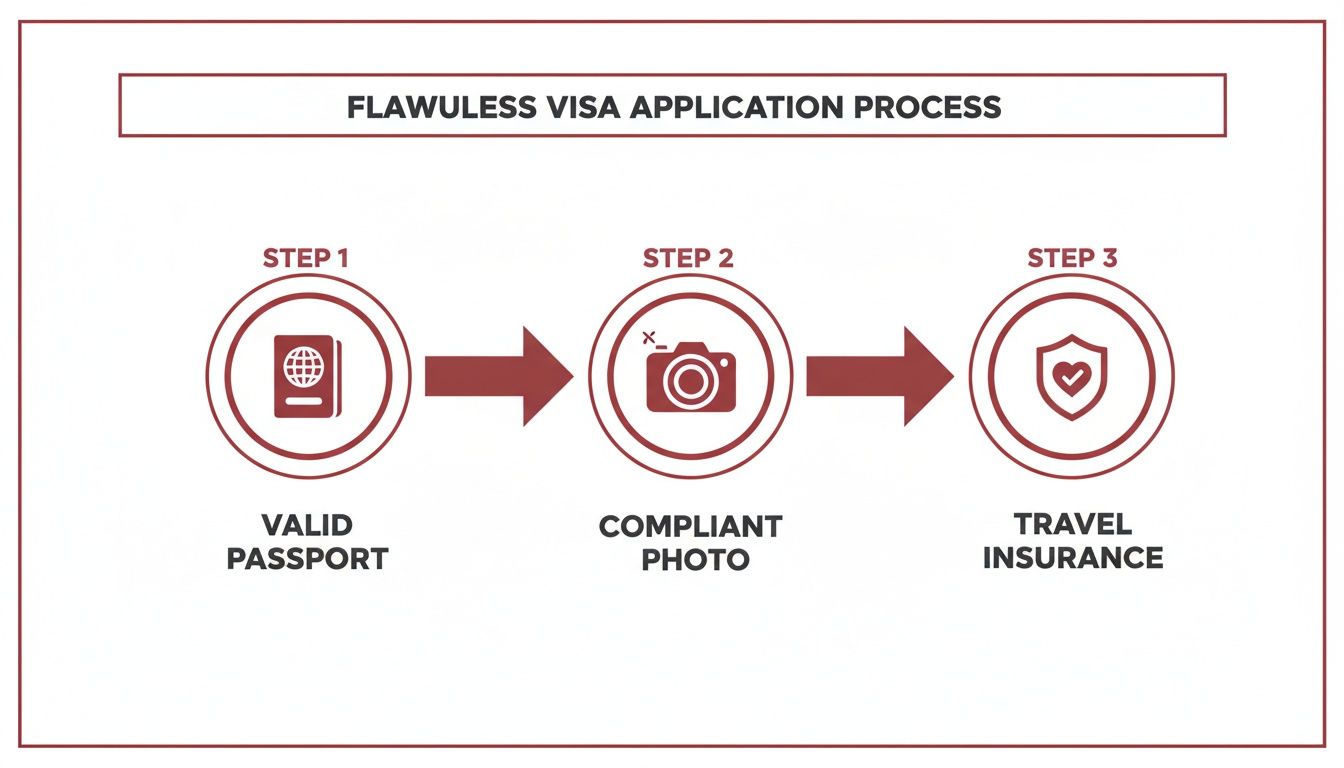
The image above highlights the three pillars of a successful application. Master these, and you will meet the Consulate's core requirements.
Understanding the Costs and Waiting Times
The standard Schengen visa fee is €80, payable in pounds sterling. The visa centre adds a service fee, so budget for a total of around £100–£120.
The official processing time for a visa for Spain from UK is 15 calendar days from when the Consulate receives your application. However, during busy periods, this can extend to 45 days. Apply at least four to six weeks before your trip.
The post-Brexit landscape has strained the system. Spain processed 1.6 million applications in a recent year, a significant increase from 483,469 in 2021. With a refusal rate of 15.7%, delays and intense scrutiny are common. You can find more data on these trends at the Migration Observatory.
This delay is precisely where frequent business travellers face operational paralysis. Being without a passport for weeks can halt international work. A second UK passport is the strategic solution to eliminate this risk.
A Smart Solution for Frequent Travellers
For business executives, airline crew, or rotational workers, time is a critical asset. Having your only passport held by a consulate for your visa for Spain from UK application is a serious risk to your operational continuity.
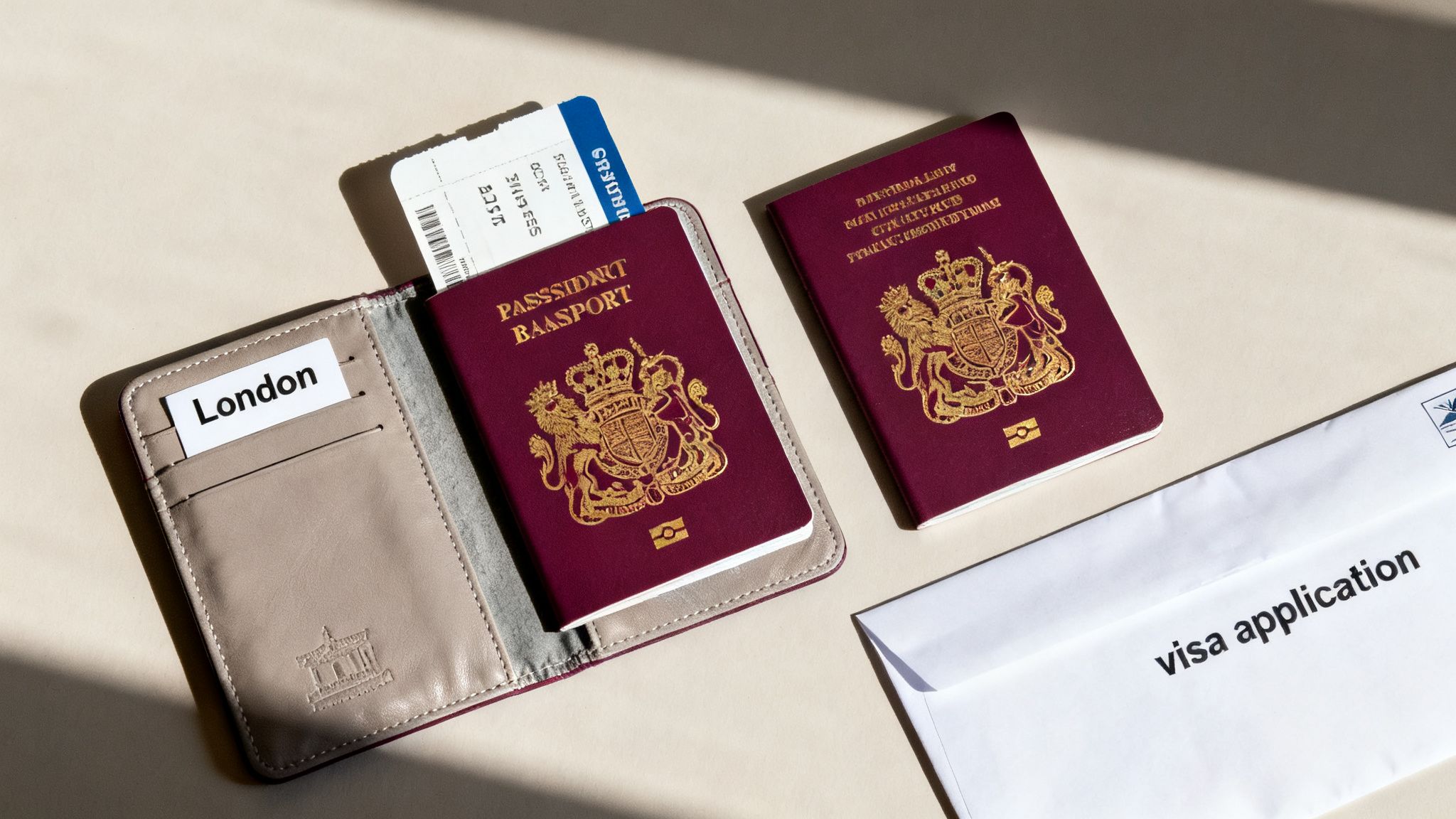
A second UK passport is a legitimate and powerful tool designed for professionals with a genuine need for constant travel. It is an official service offered by Her Majesty’s Passport Office (HMPO).
Keep Your Business Moving
The strategy is simple and effective. With two valid British passports, you can submit one for your Spanish visa application while using the other for urgent travel to non-Schengen countries, ensuring your work continues without interruption.
Imagine a critical client meeting in Dubai while your primary passport is with the Spanish consulate. A single passport forces cancellation. With a second passport, you travel to Dubai while the visa application proceeds.
A second passport transforms a travel crisis into a manageable plan. It serves as an insurance policy against bureaucratic delays, providing a crucial Plan B for maintaining business momentum.
As Spain phases out its Golden Visa program, professionals require alternative strategies. A second passport allows for parallel visa processing. To understand these shifts, you can discover more insights about Spain's visa landscape at IMI Daily.
The All-Important Employer Support Letter
Obtaining a second passport requires proof of genuine need, and the cornerstone of your application is a formal letter of support from your employer. This document must be precise and persuasive.
Printed on official company letterhead, the letter must include:
- A clear explanation of your role and travel responsibilities.
- Specific examples of past or future travel conflicts.
- Confirmation that the company requires you to hold two passports.
Crucially, HMPO requires the letter to have a "wet-ink signature" from a senior manager. A digital signature will result in an immediate rejection. This detail highlights the seriousness of the application.
Getting Expert Help for a Smooth Process
Navigating the detailed requirements for a second passport application can be complex. Professional assistance can streamline the process. An experienced agency can manage everything from eligibility checks and letter templates to booking an express HMPO appointment.
This comprehensive support ensures every detail is correct, minimising the risk of rejection. For busy professionals, this is a practical step to guarantee travel readiness. You can check your eligibility for a second UK passport and learn how this solution can benefit you.
Common Questions About Getting a Spain Visa from the UK
Here are answers to some of the most common questions from UK travellers to help you finalise your preparations.
How Long Does a Spanish Visa Really Take from the UK?
Officially, a Schengen visa for Spain takes 15 calendar days to process. However, this is a best-case scenario.
During peak travel seasons or for complex applications, the timeline can extend to 45 days. It is always advisable to apply at least four to six weeks before your planned travel date. Long-stay National (Type D) visas often take several months.
Can I Get a Multiple-Entry Visa for Spain?
While you can request a multiple-entry visa, the final decision rests with the Consulate. First-time applicants are typically granted a single-entry visa for their planned trip.
To improve your chances of receiving a multiple-entry visa, you must demonstrate a genuine need for frequent travel to Spain.
- For business: An employer letter outlining a schedule of future meetings or projects in Spain is essential.
- For personal reasons: Evidence such as property ownership or close family in Spain can support your application.
A strong travel history and a clear cover letter explaining your need for frequent visits are your best tools.
What Happens If My Spanish Visa Gets Rejected?
A visa rejection is not the end of the road. You will receive a formal refusal letter detailing the reasons for the decision.
Common reasons include insufficient funds, a vague itinerary, or doubts about your intent to return to the UK. You have two options:
- Appeal the Decision: You can file a formal appeal (recurso) within one month.
- Submit a New Application: You can correct the issues cited in the refusal letter and re-apply.
Rushing to re-apply without addressing the original problems will likely result in another rejection.
Do I Have to Hand Over My Passport During the Application?
Yes, your original passport must be submitted and will be held until a decision is made. This is a significant issue for regular travellers.
This is the classic "overlapping visa trap" that grounds frequent flyers. Your passport can be unavailable for weeks, preventing any other international travel.
A second UK passport is the definitive solution. Offered by His Majesty’s Passport Office (HMPO), it allows you to submit one passport for your visa for Spain from UK application while keeping the other for urgent travel, thereby ensuring business continuity.
For professionals who cannot afford to be grounded, our team at Rapid Passports specialises in securing this essential travel document. We have expert knowledge of HMPO requirements and can ensure your application is successful.
Find out more about securing a second UK passport today
Drafted with Outrank app