
For most short trips to Singapore, British citizens do not need a visa and are granted visa-free entry for up to 90 days for tourism and most business activities. This visa-free arrangement streamlines travel, but all UK passport holders must complete the mandatory SG Arrival Card online before travel and ensure their passport has at least six months' validity. For frequent corporate travellers facing complex itineraries, a second UK passport is a strategic asset for maintaining operational continuity.
Your Essential Checklist for Entering Singapore
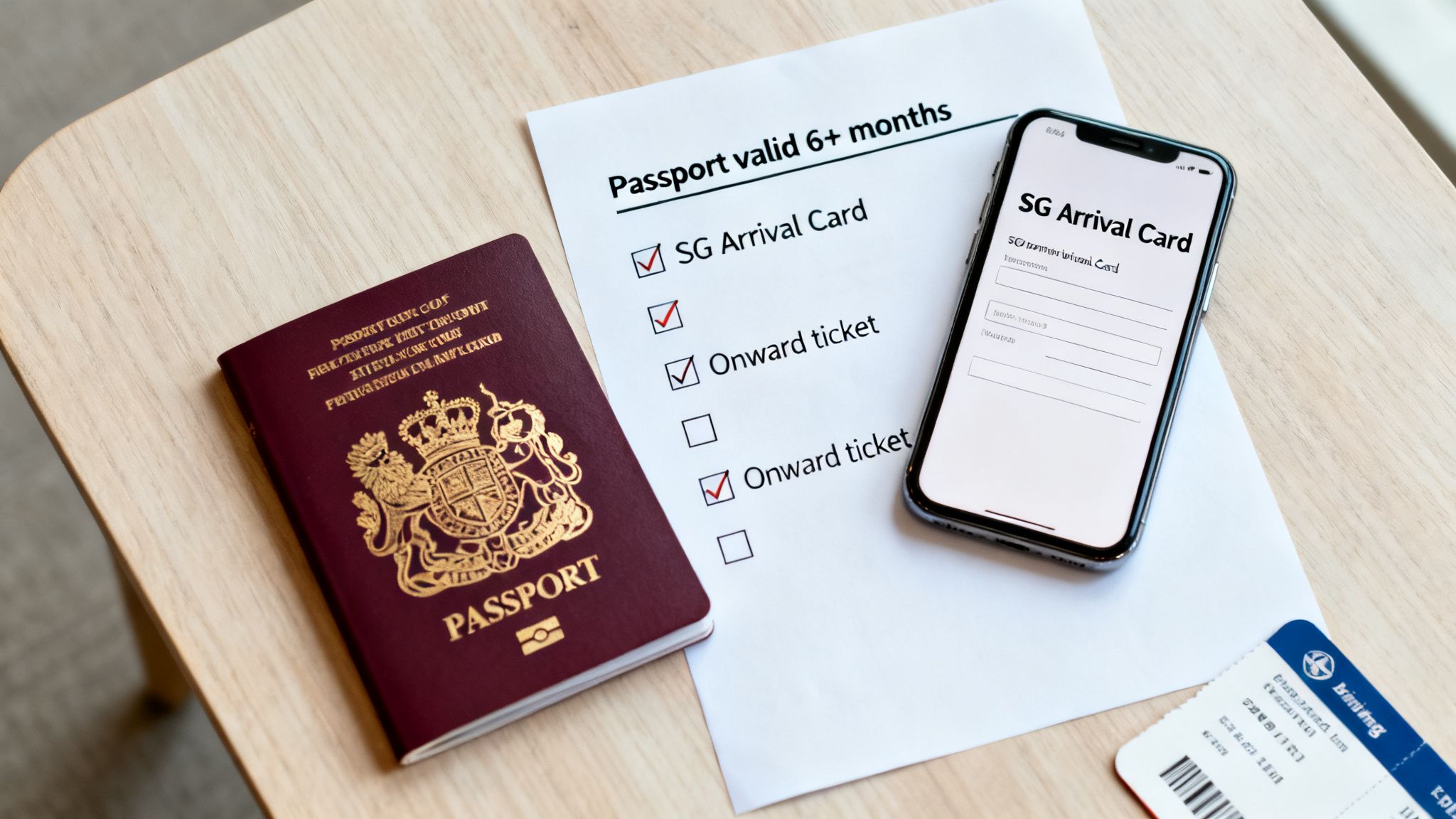
Even though a visa is not typically required, planning a trip to Singapore demands professional attention to detail. For corporate travel managers and frequent flyers, confirming every entry requirement is the first step towards a smooth, hassle-free journey. This process should be approached with the same diligence as a full visa application to mitigate any risk of travel disruption.
This pre-flight checklist provides a clear, actionable rundown of the essential requirements for any UK citizen travelling to Singapore. Adhering to these basics prevents delays at immigration and allows professionals to focus on the purpose of their visit.
Key Entry Requirements at a Glance
For short stays such as business meetings, conferences, or tourism, Singapore’s entry rules are straightforward but strictly enforced. Immigration officers expect all travellers to present the correct documentation upon arrival. This is not merely administrative paperwork; it is your permit for seamless entry.
It is important to note that the SG Arrival Card is not a visa. It is a mandatory digital declaration required for all individuals entering the country, replacing the legacy paper-based landing cards. You must complete this online within the three days immediately preceding your arrival.
The table below summarises each requirement with a practical tip based on extensive travel experience. For professionals managing complex travel schedules or simultaneous visa applications, it may be beneficial to explore the advantages a second UK passport can provide.
Singapore Entry Requirements for UK Citizens on Short-Term Visits
Here is a summary of the key requirements for UK citizens travelling to Singapore for tourism or short-term business purposes.
| Requirement | Details | Expert Travel Tip |
|---|---|---|
| Visa-Free Period | UK citizens can enter Singapore without a visa for up to 90 days for tourism, social visits, or business meetings. | Do not mistake this for a right to work. If you plan to undertake paid employment, even on a short-term basis, you must secure the appropriate work pass. |
| Passport Validity | Your British biometric passport must have at least six months' validity remaining from your date of entry into Singapore. | Verify your passport's expiry date at the start of your travel planning. If it is approaching the six-month threshold, renew it immediately to avoid being denied boarding by your airline. |
| SG Arrival Card (SGAC) | This is a mandatory electronic health and travel declaration. You must submit it online via the official ICA website within three days prior to your arrival. | Complete this on a mobile device or laptop before leaving for the airport. The submission is free on the official government site—be cautious of third-party websites that charge a fee. |
| Proof of Onward Travel | Immigration officers may request to see a confirmed flight ticket proving your intention to depart Singapore. | Always have a copy of your flight itinerary—either digital or printed—readily accessible. This confirms your intent to leave within the permitted 90-day period. |
Adherence to these guidelines will ensure your arrival in Singapore is straightforward, allowing you to proceed with your business or holiday without interruption.
Singapore's Visa-Free Entry: What UK Passport Holders Need to Know
For UK passport holders, entry into Singapore for short-term visits is remarkably efficient. As a British citizen, you are permitted to enter without a visa and stay for up to 90 days. This arrangement makes Singapore a convenient destination for tourism and business travel, reflecting the strong bilateral relationship between the two nations.
However, this 90-day entry permission is granted for specific short-term purposes. Overstaying or engaging in unauthorised activities constitutes a serious violation of Singapore's immigration laws. It is a visitor's pass, not an implicit approval for work or residency.
What You Can (and Can't) Do on a Visa-Free Stay
The 90-day visa exemption is designed for visits where you are not being paid by a Singaporean employer. A wide range of activities fall under this provision.
Here’s what’s typically allowed:
- Tourism and Leisure: Sightseeing, visiting friends and family, and general tourism are fully permitted.
- Business Meetings and Negotiations: Attending client meetings, negotiating contracts, or participating in conferences are standard and acceptable business visitor activities.
- Short-Term Training: Attending a professional seminar or corporate training course is generally permissible, provided it is not a long-term, structured educational program.
The definitive restriction is local employment. If you intend to accept a job with a Singapore-based company, the visa-free entry route is not applicable. This requires a formal work pass, a separate and distinct application process.
The Mandatory SG Arrival Card
One critical step that can be overlooked is the mandatory SG Arrival Card (SGAC). To be clear: this is not a visa.
The SG Arrival Card functions as a digital landing card. It is an administrative tool used by Singapore's immigration and health authorities to pre-screen arrivals and does not confer any special permissions.
You must complete the SGAC online within the three days prior to your arrival in Singapore. It is only valid if submitted within this timeframe. The official Immigration & Checkpoints Authority (ICA) website is the sole platform for this submission, and it is entirely free. Avoid third-party sites that request payment.
How to Fill Out the SG Arrival Card
The process is efficient and takes only a few minutes with your travel details on hand.
- Navigate to the Official Website: Go directly to the official ICA portal for the SG Arrival Card.
- Enter Passport Details: Provide your personal information—name, date of birth, nationality—exactly as it appears in your biometric passport.
- Add Trip Information: Input your flight details, date of arrival, and the address of your accommodation in Singapore.
- Make a Health Declaration: Answer a few standard questions regarding your recent travel history and health status.
- Review and Submit: Double-check all information for accuracy, then submit the form. You will receive an email confirmation; keep this accessible on your phone to present to an immigration officer if requested.
When a Visa Is Required for Your Trip to Singapore
The 90-day visa-free arrangement is ideal for tourism and short business trips but is not suitable for all circumstances. If your plans involve employment, long-term study, or establishing residency, you must obtain a specific pass or visa.
Understanding this distinction is critical for both individual travellers and the corporate managers coordinating their assignments. Attempting to work or study on a short-term visit pass is a serious violation of Singapore's immigration laws and can result in severe penalties. Securing the correct documentation in advance is non-negotiable for any long-term stay.
This flowchart provides a visual guide to help determine if your travel plans align with the visa-free model or require a formal application.
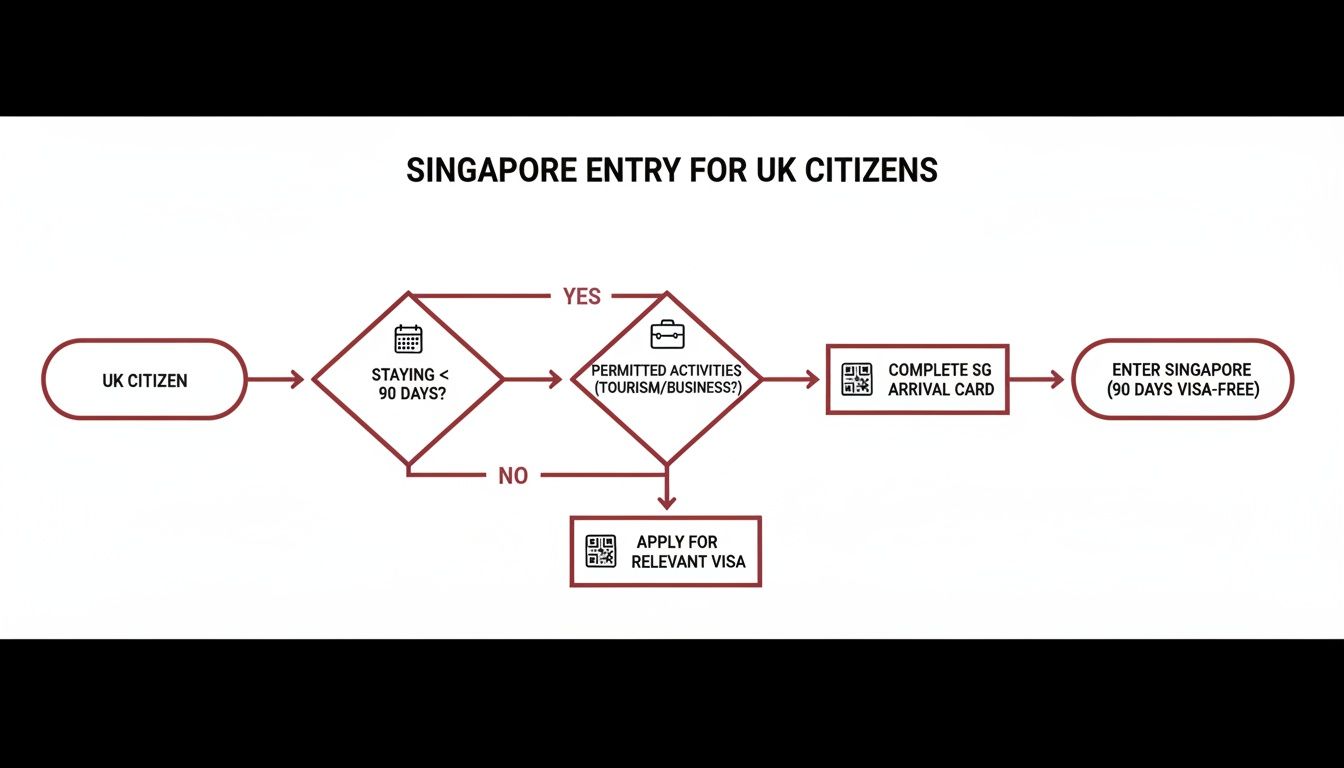
The primary factors are the duration and purpose of your stay. The one universal requirement for all travellers remains the SG Arrival Card.
Navigating Work Passes for Professionals
For a UK citizen with a job offer in Singapore, securing the correct work pass is the first priority. Singapore’s Ministry of Manpower (MOM) operates a structured, tiered system designed to attract global talent.
The most common work passes include:
- Employment Pass (EP): The standard pass for foreign professionals, managers, and executives. Eligibility is based on qualifications and a minimum salary threshold, which varies by age and industry.
- S Pass: Designed for mid-level skilled technicians, the S Pass has a lower salary requirement than the EP. Employers are subject to a quota and must pay a monthly levy for each S Pass holder.
- Personalised Employment Pass (PEP): A premium option for high-earning EP holders or elite overseas professionals. It offers greater flexibility as it is not tied to a single employer, allowing the holder to switch jobs without reapplying for a new pass.
A critical point to remember: your employer is required to apply for the work pass on your behalf before you can legally commence employment. You cannot apply for these passes independently; a local sponsor (your employer) is mandatory.
The professional ties between the UK and Singapore are well-established. Data from 2013 shows an estimated 40,000 Singaporean nationals resided in the UK, demonstrating a strong, two-way flow of talent. Historical visa data from 2010-2014 reveals a consistent number of Singaporeans arriving under skilled work and study schemes, reflecting the mutual mobility UK professionals benefit from today. You can explore further visa statistics on the official ONS site for more detailed trends.
Securing a Student's Pass for Education
If you are a UK citizen enrolling in a full-time course at an accredited institution in Singapore, you must apply for a Student's Pass. This is required for all programmes, from university degrees to intensive language courses.
The application process is managed through Singapore's Immigration & Checkpoints Authority (ICA), initiated by your educational institution. A formal letter of acceptance is a prerequisite.
The process typically involves these steps:
- Receive Your Offer: Upon acceptance, the institution registers you in the ICA’s online portal, the Student's Pass On-Line Application & Registration (SOLAR) system.
- Submit Your Application: The institution provides you with the registration details needed to log in and complete your application online.
- Receive In-Principle Approval (IPA): Successful applicants receive an IPA letter, which also serves as a single-entry visa to travel to Singapore.
- Complete Formalities: After arriving, you will attend a scheduled appointment at the ICA to finalise the process and collect your official Student's Pass.
Your Student's Pass is tied to your specific course. Changing your course or institution necessitates a new application.
Breaking the Overlapping Visa Trap with a Second UK Passport
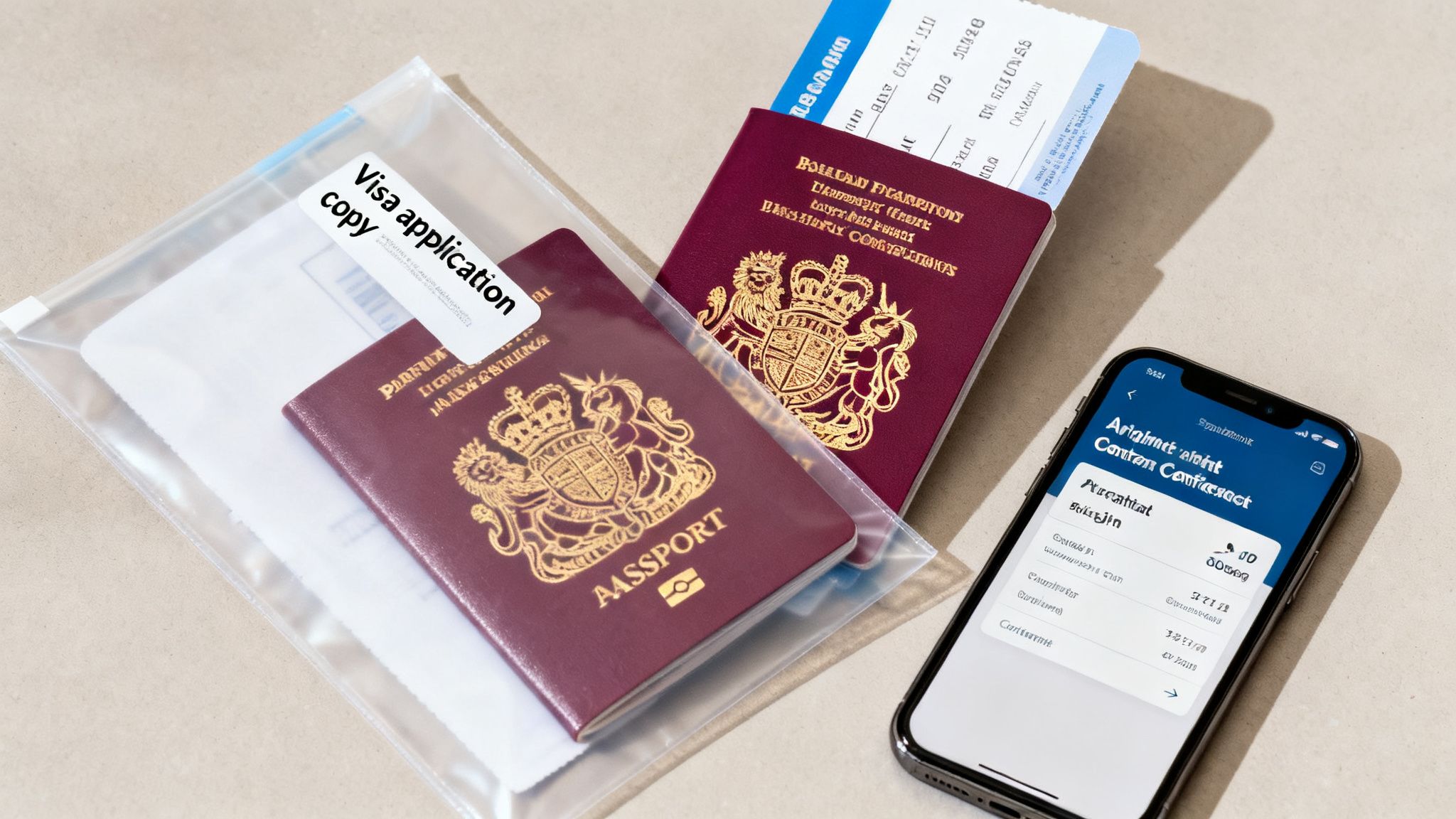
Frequent business travellers often encounter a common logistical challenge. Your passport is submitted for a long-term Singapore work visa application, a process that takes weeks. Suddenly, an urgent, non-negotiable client meeting is scheduled in Dubai for the following week.
This is the "Overlapping Visa Trap." Your primary travel document is held by an embassy, effectively grounding you when you need to be mobile. This is more than an inconvenience; it directly impacts business outcomes. Every day your passport is unavailable represents lost revenue, stalled projects, and missed opportunities.
A second UK passport is the hidden solution—a vital tool for Operational Continuity. It is not a luxury but a strategic business asset, a legitimate "Plan B" sanctioned by Her Majesty’s Passport Office (HMPO) for those with a genuine need.
How a Second Passport Provides a Strategic Advantage
A project manager leading a major infrastructure project in Southeast Asia, using Singapore as a regional base, requires a Singapore Employment Pass. This requires submitting her passport for processing.
While the application is pending, she must fly to the Middle East to secure a critical supply chain deal. Without her passport, she is grounded. She faces an impossible choice: delay the supplier meeting or postpone her essential deployment to Singapore. Both options result in costly business setbacks. This is precisely the gridlock a second passport is designed to overcome. It is an insurance policy against travel downtime.
The Second Passport as a Solution
A second UK passport resolves this deadlock. HMPO provides this official service for individuals who can prove a genuine need for concurrent travel and visa applications.
Here is how it functions in practice:
- Primary Passport for Visa: She submits her primary passport to the Singaporean authorities for her Employment Pass application.
- Second Passport for Immediate Travel: She uses her second, equally valid British passport to fly to Dubai for the supplier meeting, maintaining business momentum.
- Seamless Continuity: Once the Singapore visa is issued and her primary passport is returned, she continues her travel schedule without having ever been constrained.
This two-passport strategy ensures long-term strategic goals, like securing a work pass, do not paralyse essential short-term operational tasks.
The concept is simple: a second passport allows you to be in two places at once, bureaucratically. One document can be processing in a visa application queue while the other remains with you, ready for immediate travel.
Proving Genuine Need: The Employer Letter
Securing a second passport requires proving a genuine professional need. The cornerstone of a successful application is a formal employer letter that meets strict HMPO requirements. This letter is the primary evidence used to justify your request.
The letter must be on official company letterhead, clearly state why a single passport is insufficient for your role, detail your frequent travel schedule, and highlight the need for simultaneous visa applications. Crucially, it must be signed with a "wet-ink signature" by a senior manager. Digital signatures are a frequent cause of rejection. For more information on the process for obtaining a second UK passport, consult our detailed guides.
Navigating Complex Itineraries and Conflicting Entry Stamps
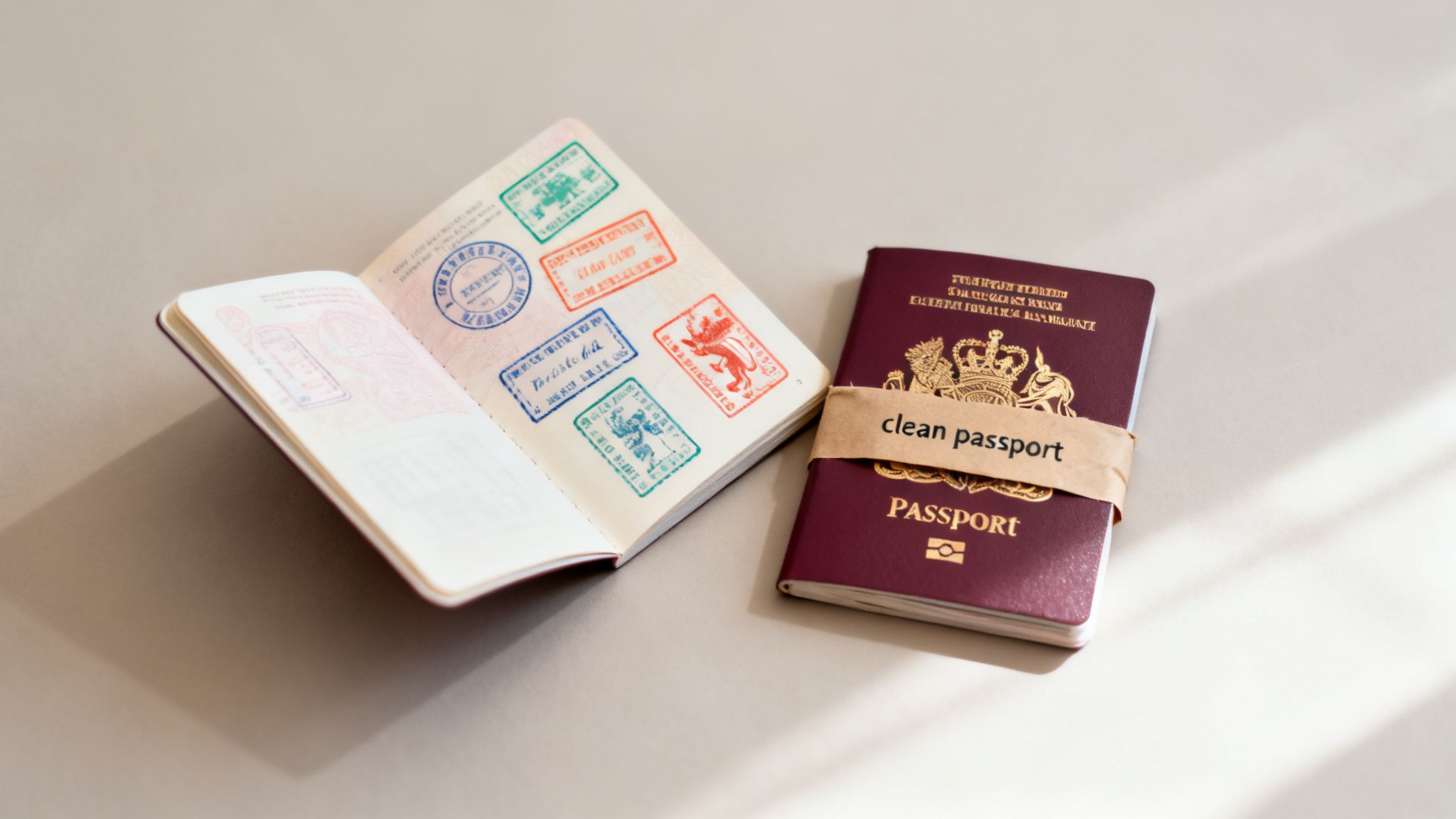
For professionals in sectors such as energy, humanitarian aid, or aviation, international travel often involves complex itineraries between countries with sensitive political relationships. An entry stamp from one nation can result in significant scrutiny—or an outright entry ban—at the next border. In these situations, a passport becomes a logistical liability.
For instance, an entry stamp from Israel can lead to denial of entry in certain other Middle Eastern countries. This is a serious operational risk that can derail critical missions and compromise personal safety. For these professionals, managing their travel history is a core component of their job.
A second UK passport is an essential tool for Risk Mitigation. This legitimate option, provided by Her Majesty’s Passport Office (HMPO), allows you to strategically separate your travel histories, ensuring operational continuity regardless of itinerary complexity.
The Strategic Value of a 'Clean' Passport
Holding two passports allows you to designate one for travel to regions that may result in politically sensitive entry stamps, while keeping the other 'clean' for seamless entry into major business hubs like Singapore.
This separation of travel history transforms your approach from reactive problem-solving to proactive risk management. Instead of facing uncertainty at immigration, you can plan complex multi-leg journeys with confidence, knowing you have the appropriate document for each destination.
A second passport functions as a geopolitical firewall. It ensures that travel to one sensitive region does not compromise your access to another, providing seamless mobility and an essential layer of personal security.
This is an official provision for UK citizens who can demonstrate a genuine need, such as rotational workers in the energy sector or NGO staff operating in volatile zones.
Ensuring Smooth Entry into Singapore and Beyond
Singapore's immigration officers are thorough. While your UK passport grants visa-free access, your travel history will be reviewed. A passport containing stamps from politically sensitive regions can trigger additional questions and cause unnecessary delays.
By presenting a 'clean' biometric passport—one used for travel to destinations like Europe, North America, and other parts of Asia—your arrival in Singapore is streamlined. It removes potential ambiguity and allows for a swift entry process. Your entry as a UK citizen is resolved quickly with the standard 90-day visa-free allowance. If this solution fits your travel profile, it is worth investigating the specific criteria for second passport eligibility.
The 2026 Legal Landscape: A New Urgency for UK Entry
Travel rules are constantly evolving. As of February 25, 2026, UK entry rules have been tightened. Dual nationals can no longer use a foreign passport alone to enter the UK; they must present a valid British passport or a digital Certificate of Entitlement (COE) to avoid being denied boarding by carriers. Furthermore, British citizens are ineligible for the UK's new Electronic Travel Authorisation (ETA) system, making possession of a valid British passport the only seamless method for entering the country.
Your Questions Answered: Singapore Travel for UK Citizens
Here we address common practical questions from UK travellers and corporate travel managers. Consider this a final pre-flight check to resolve any remaining uncertainties.
Can I Extend My 90-Day Stay in Singapore?
Yes, an extension is technically possible, but it is not guaranteed. If you require a stay beyond the initial 90-day visa-free period, you must apply for an extension of your Short-Term Visit Pass (STVP) through Singapore's Immigration & Checkpoints Authority (ICA).
A compelling reason, such as a medical issue or family emergency, is required. The application must be submitted online via the ICA's portal before your current pass expires. Approvals are granted on a strict case-by-case basis.
What Happens if I Overstay My Visa in Singapore?
Do not overstay. Overstaying is a serious offence in Singapore with severe penalties. The immigration laws are strictly enforced, and violations can impact your future travel eligibility worldwide.
Potential consequences include:
- Significant Fines: Financial penalties can be substantial.
- Imprisonment: For serious overstays, a jail sentence is a possibility.
- Deportation and Ban: You will be removed from the country and may be banned from re-entering Singapore, potentially for life.
Always depart on or before the date stamped in your passport.
Do I Need Proof of a Return Ticket to Enter?
While immigration officers may not always ask to see it, they are entitled to. It is highly advisable to have it ready.
A confirmed flight itinerary showing departure from Singapore within the 90-day window is the clearest proof of your intent to comply with immigration rules. It simplifies the arrival process and preempts any challenging questions.
Failure to provide proof upon request could lead to further questioning or, in a worst-case scenario, denial of entry.
The 2026 Rule Change and Dual Nationals
As of February 25, 2026, UK entry rules require all British citizens, including dual nationals, to present a valid British passport or a digital Certificate of Entitlement (COE) to their carrier to enter the UK. Using a foreign passport alone is no longer sufficient and will likely result in being denied boarding. Additionally, British citizens are not eligible for the UK's Electronic Travel Authorisation (ETA) system. A valid British passport is therefore essential for seamless entry into the UK.
At Second UK Passports, we specialise in helping frequent travellers and corporate clients secure this essential travel asset. A second passport is the definitive solution to ensure your global mobility is never compromised by visa processing delays, conflicting stamps, or emergencies.