
For any professional who lives out of a suitcase, the sight of a passport running out of pages isn't just a travel headache—it's a genuine business risk that threatens operational continuity. You have two choices: renew early and be grounded for weeks, or apply for a second UK passport—a fully legitimate, strategic solution that many professionals don't even know is available. Let’s break down how to mitigate travel downtime and keep your business moving when the stamps start to pile up.
Why a Full Passport Can Derail Your Business
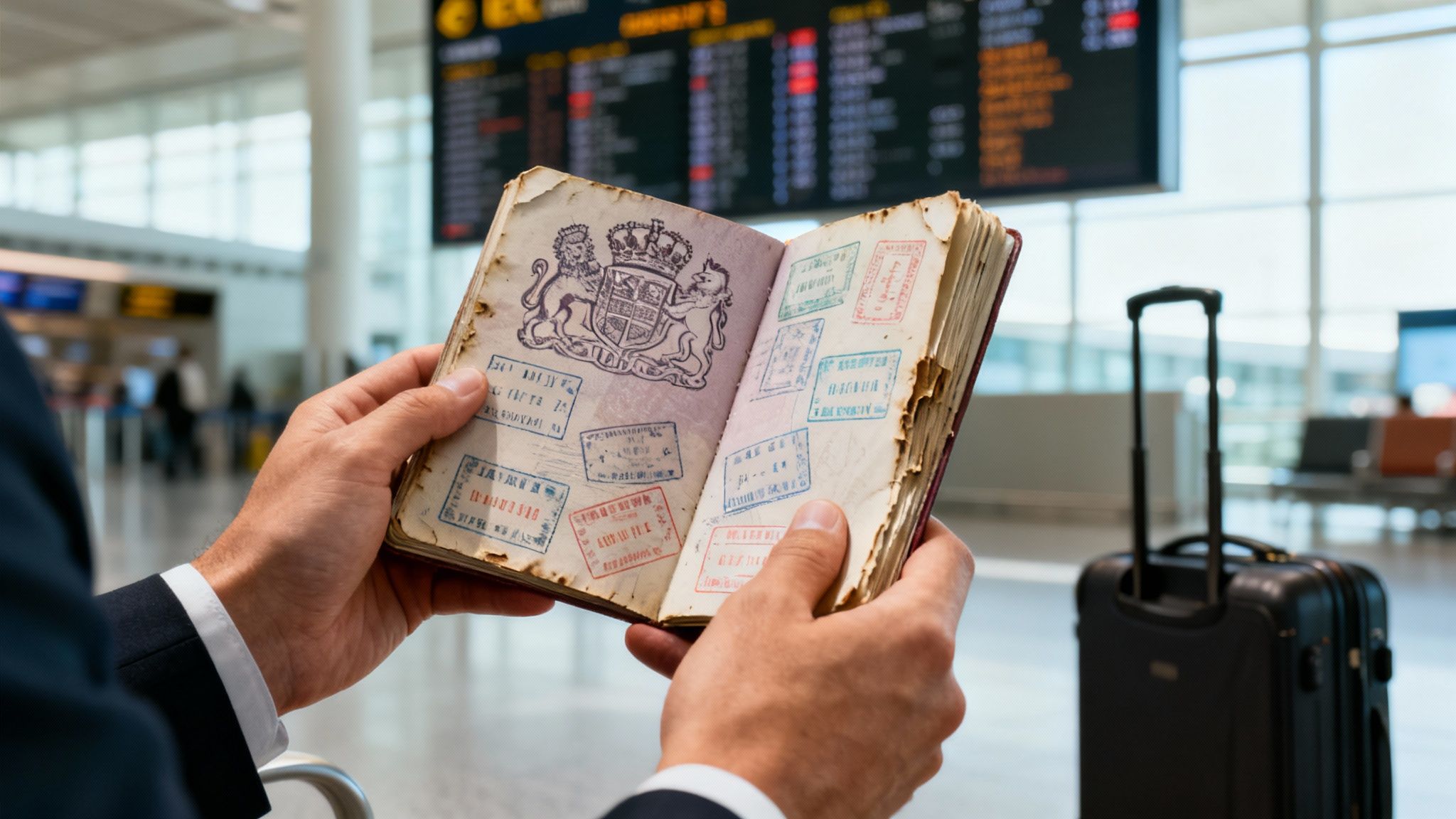
For airline crew, energy sector rotational workers, or executives juggling global contracts, a full passport isn't a future problem—it's an imminent one that can stop operations dead in their tracks. The culprits are usually the bulky, full-page visa stickers and the endless entry and exit stamps that chew through pages far quicker than you’d expect.
While a British passport is a powerful tool, the standard 34-page booklets often don't cut it for frequent travellers. Her Majesty’s Passport Office (HMPO) recognised this issue years ago. When they introduced the Series B passports in 2015, they bumped up the standard page count from 32 to 34 and replaced the old 48-page business version with a heftier 50-page 'jumbo' passport. The reason was clear: professionals were constantly running out of space.
Think of a logistics manager whose team bounces between Europe, the Middle East, and Asia. A single trip requiring visas for countries with political tensions can easily consume 5-10 pages—a common scenario for corporate travel managers. For a deeper dive into how our passports have evolved, the history of British passport specifications on Wikipedia offers some interesting context.
A Business Continuity Blind Spot
A passport maxed out with stamps isn't a personal inconvenience; it's a direct threat to business continuity.
Imagine an engineer is urgently needed for a site visit in a region that demands a visa. If their passport doesn't have enough completely blank pages (many countries require two or more), the visa application is dead on arrival. This leads to project delays, missed deadlines, and even potential contractual penalties. That one administrative snag suddenly creates a costly ripple effect across the entire business.
Then there's the geopolitical chess game. An entry stamp from one country can get you flat-out denied entry to another. A single passport makes navigating back-to-back trips between certain nations incredibly difficult, forcing you into a logistical corner.
A passport running low on pages is more than an administrative hurdle; it's a direct risk to your ability to conduct international business. Proactive management is the only way to ensure operational readiness.
The key is to understand your options before you're in a jam. A standard renewal seems like the obvious path, but it means surrendering your current passport—along with any valid, long-term visas inside it—and being unable to travel for weeks.
The Overlooked Strategic Solution: The Second Passport
There's a better way: securing a second UK passport. This is not some back-alley trick; it's a legitimate, official service offered by HMPO for anyone who can prove a "genuine need." Many people wrongly assume holding two passports is illegal, but it's a recognized provision for professionals. It’s your travel insurance policy, giving you the power to send one passport off for a lengthy visa application while you continue travelling internationally on the other.
For professionals in aviation, energy, or global sales, it’s not a luxury—it’s an operational essential. It provides the flexibility to navigate complex schedules and visa requirements without ever being grounded. Simply put, it's the ultimate Plan B against travel downtime.
At-a-Glance: Your Options When Pages Are Low
| Solution | Best For | Key Consideration |
|---|---|---|
| Standard Renewal | Infrequent travellers or those who can afford several weeks of downtime. | You must surrender your current passport, losing access to valid visas. |
| Second Passport | Frequent international travellers, professionals needing simultaneous visas, or those visiting politically sensitive regions. | Requires proving a "genuine need" and submitting a formal application to HMPO. |
| Emergency Document | Urgent, one-off trips for compassionate reasons or when your primary passport is lost/stolen abroad. | Highly restrictive, single-use, and not a solution for business travel. |
Choosing the right path depends entirely on your travel patterns and urgency. For any serious business traveller, however, the second passport is often the only option that truly keeps you in the game.
Don't Get Caught Short: A Strategic Look at Your Passport Pages
Letting your passport run low on pages is a classic rookie mistake for any serious traveller. The smart approach isn't just flicking through and counting what's left; it's about a proper, strategic audit of your travel commitments. You have to start thinking like a corporate travel manager, even if it's just for your own schedule.
This means pulling up your calendar and looking at your likely travel for the next 12 to 18 months. You need to map out the specific entry requirements for every single destination on that list. It's easy to forget that many countries, particularly across Asia and Africa, are incredibly strict about having at least two completely blank, consecutive pages for their stamps and visas. Get this wrong, and you won't even make it past the airline check-in desk.
The Dreaded Overlapping Visa Trap
For any busy professional, one of the most common—and frustrating—passport emergencies is the Overlapping Visa Trap. It happens when your only passport is stuck at an embassy for a visa application, a process that can take weeks, just as an urgent, unexpected trip to another country crops up. Your passport, your key to the world, is effectively held hostage, grounding you completely.
This isn't just an inconvenience; it can throw a real spanner in the works. Imagine a sales director missing a make-or-break client meeting in Dubai because their passport is tied up getting a visa for Nigeria. That's a scenario that can directly impact business relationships and cost real money. It perfectly illustrates why having a single point of failure in your travel toolkit is a massive risk. For airline crew, a second passport is an operational essential to maintain flight rotations and avoid this very trap.
How to Audit Your Travel Needs and Page Usage
To sidestep this trap, you need to conduct a thorough audit of your own travel patterns. Start by looking back: how many pages did you actually use in the last year? Once you have that baseline, project forward, keeping these crucial points in mind:
- Visa-Heavy Itineraries: If your work takes you to countries that require full-page sticker visas, like China or Russia, you'll burn through your passport far quicker than someone hopping around the EU.
- Back-to-Back Trips: Do you often find yourself juggling trips to regions with tricky political entry requirements? A single passport can become a genuine liability in these situations.
- Airline and Border Policies: Don't just assume. Always check the latest rules on the official GOV.UK foreign travel advice website before you book anything. The airline staff are the gatekeepers, and they will turn you away if your passport doesn't meet the destination's criteria.
This kind of forward planning shifts passport management from a last-minute panic to a core part of your professional strategy. It’s about making sure you have the documents you need, right when you need them.
Thinking ahead has never been more important. Passport demand is high, and more professionals are hitting the 'out of pages' wall. Your standard 34-page biometric passport can fill up astonishingly fast, especially when juggling multiple visa applications.
Take rotational workers in the energy sector or NGO staff who visit sensitive regions. They often require isolated entry stamps for security, making a second passport a vital tool. To get a sense of the current demand, it's worth looking at the latest government passport issuance data.
The Obvious Choice: Renewing Your Passport Early
When you start running out of passport pages, the first thought is usually the simplest: just get it renewed. It's the standard path most people take, and for a good reason. The online application process on GOV.UK is fairly slick, and it’s what everyone knows. But if you travel for a living, this "simple" solution can cause a world of headaches.
The process itself is straightforward enough. You fill out the form online, upload a compliant digital photo, and pay the fee. Then comes the instruction from Her Majesty’s Passport Office (HMPO) to post them your current passport. And that’s the deal-breaker.
The second your passport goes in the post, you’re grounded. No ifs, no buts. You can't travel internationally without it. This enforced downtime can drag on for weeks, creating a serious block on any business travel.
The Real Cost of Being Without Your Passport
For busy professionals and the companies they work for, the biggest issue with a standard renewal is having to surrender your current passport. It's not just about cancelled trips; it's about the very real risk of losing the valuable visas stamped inside.
Think about it. Any valid, long-term visas you've secured—like a 10-year US B1/B2 visa or a multi-entry Schengen visa—are physically stuck in that booklet. While some countries might let you present the old passport alongside your new one, it’s never a guarantee. More often than not, it involves a bureaucratic nightmare with the issuing embassy. In the worst-case scenario, those expensive, hard-won visas are simply cancelled along with your old passport.
For a business, the cost of having a key team member grounded for weeks, plus the potential loss of expensive visas, can be huge. It's a direct hit to your ability to operate, and it far outweighs the passport renewal fee.
This is the calculation every corporate travel manager and frequent flyer needs to make. Is the simplicity of a standard renewal worth derailing a project, missing a vital meeting, or having to re-apply for costly visas all over again? For anyone who travels regularly, the answer is almost always a resounding 'no'.
Getting to Grips with the Renewal Timeline
Before you even think about renewing, you need to check the official GOV.UK website for the latest processing times. These can change dramatically depending on the time of year and demand. While HMPO sometimes turns passports around faster than their official guidance, you absolutely have to plan for the worst-case scenario.
Let's break down what you're really looking at:
- Getting Started: The online form is quick, but getting a digital photo that passes the automated checks can be fiddly and take a few tries.
- Postage Time: You have to factor in the time for your old passport to get to HMPO safely and for the new one to be couriered back to you.
- The Big Wait: This is the main chunk of time when your application is being processed, printed, and sent out. It can be anywhere from three to ten weeks, and sometimes even longer during the summer rush.
This creates a massive window of uncertainty. If an urgent client issue crops up or a new opportunity appears, you're powerless to act. For people like offshore energy workers on rotation or flight crew with tight schedules, being out of action for that long just isn't an option. It really shows the weakness of relying on a single passport and pushes many to find a better way.
The Strategic Solution: Applying for a Second UK Passport
The idea of having two passports often conjures images of spies and international intrigue. But the reality is far more practical. Getting a second, fully valid biometric passport is a completely legitimate service from Her Majesty’s Passport Office (HMPO), and for many professionals, it's an absolute necessity.
This isn't a hidden loophole. It’s an official provision designed for frequent travellers who run into very specific, and very real, logistical roadblocks. Forget the myth that holding two UK passports is illegal. Instead, think of it as a vital business asset—an essential tool for keeping things moving and avoiding the risks that come with a demanding international schedule.
When you're running out of pages, this decision tree can help you figure out if renewing early or getting a second passport is the right move for you.
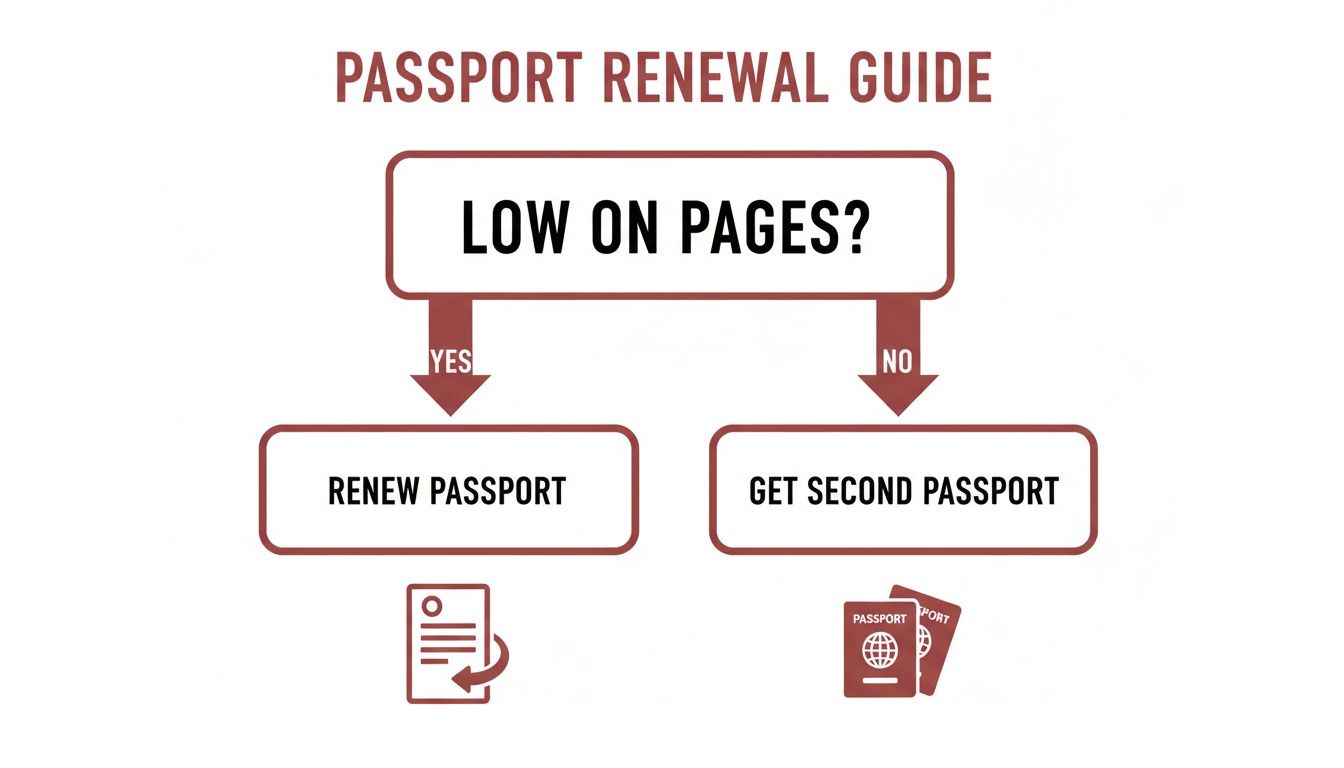
As you can see, while an early renewal is simple enough, the need for non-stop travel or juggling multiple visa applications at once often makes a second passport the only logical choice for a busy professional.
Defining the 'Genuine Need' for a Second Passport
Getting approval for a second passport all comes down to proving you have a genuine need. HMPO isn't interested in convenience; they need to see clear, compelling evidence that your single passport is actively stopping you from doing your job.
There are a few classic scenarios that HMPO recognises as valid reasons. If your situation fits one of these, you’re already on the right track to building a successful case.
These qualifying circumstances usually fall into a few key categories:
- Navigating Incompatible Entry Stamps: Your job might require you to travel between countries with political tensions. For example, having an Israeli stamp in your passport can get you turned away at the border of several other nations. A second passport lets you keep these conflicting stamps separate, ensuring you can travel smoothly between regions.
- Managing the Overlapping Visa Trap: This is a common nightmare for global business travellers. You’ve sent your passport off to an embassy for a visa application, a process that can take weeks, but suddenly you need to fly to another country. A second passport completely solves this problem, allowing you to travel with one while the other is being processed.
- Supporting High-Frequency and Rotational Travel: Think of airline crew, offshore oil and gas workers, or NGO staff who are constantly on the move. Their passports can fill up with stamps and visas at an incredible speed. A second passport acts as a critical backup, making sure they’re never grounded simply because they ran out of blank pages.
The Employer Support Letter: Your Make-or-Break Document
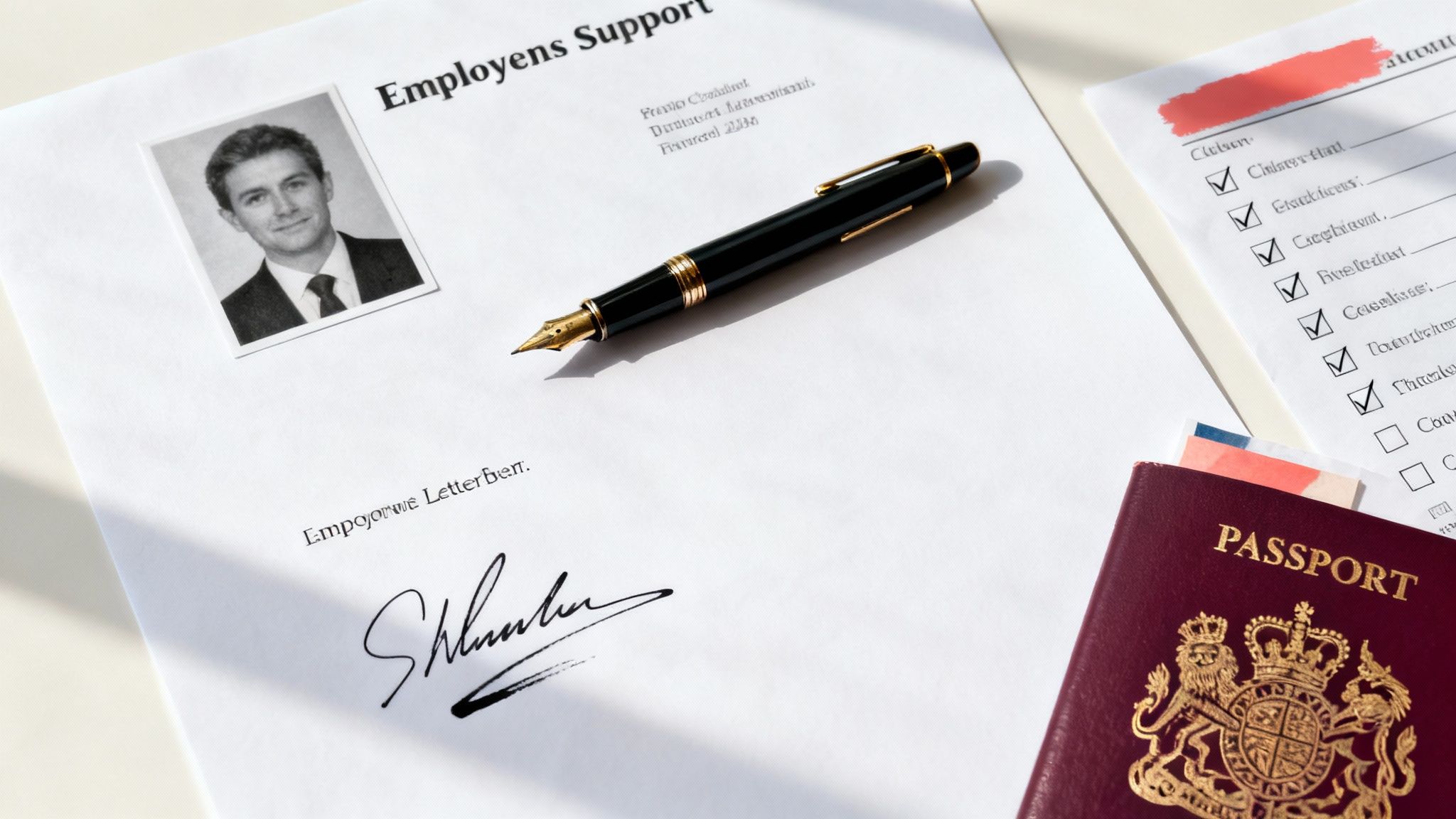
Without a doubt, the single most critical piece of your application is the formal support letter from your employer. This is the bedrock of your case, giving HMPO the official justification they need to approve your request. A vague or poorly written letter is the quickest route to rejection.
This letter absolutely must be on official company letterhead and, crucially, feature a "wet-ink signature" from a senior manager or director. Digital signatures and photocopies are a non-starter. The letter has to spell out exactly why a second passport is essential, detailing your role, your typical travel patterns, and the specific, business-critical reasons you need it.
Your employer's letter isn't just a box-ticking exercise; it's the primary evidence HMPO uses to validate your 'genuine need'. It has to be precise, authoritative, and leave no room for doubt that a second passport is an operational necessity for your job.
The letter needs to build a solid business case. For instance, something like: "Ms. Jones is required for monthly project oversight in both our Tel Aviv and Dubai offices. Due to entry restrictions, this is operationally impossible with a single passport." That kind of specific detail is what separates a successful application from a failed one. For more detailed advice, you can find helpful information on preparing for your application for a second UK passport.
Renewing vs. Getting a Second Passport: Which Is Right for You?
For frequent travellers facing a full passport, the choice isn't always straightforward. Do you renew early and lose the remaining validity on your current passport, or do you apply for an additional one? This comparison should help you weigh up the pros and cons based on your specific travel needs.
| Feature | Early Renewal | Second Passport |
|---|---|---|
| Primary Use Case | Passport is full or expiring, but no overlapping travel or visa needs. | Frequent, complex travel, visa applications, and travel to conflicting countries. |
| Travel Continuity | Requires you to surrender your old passport, creating a travel "blackout." | Allows you to keep your existing passport and travel while applying. |
| Visa Management | All existing visas are invalidated when the old passport is cancelled. | Preserves all valid visas in your original passport. |
| Cost | Standard passport fee. | Standard passport fee plus potential agency fees for assistance. |
| Application Complexity | Straightforward online or paper application process. | More complex; requires a strong justification and a detailed employer letter. |
| Validity | Up to 10 years. | Validity is discretionary, determined by HMPO based on need (often 2-5 years). |
Ultimately, if your travel schedule can't afford any downtime and you're constantly juggling visa applications, a second passport is almost certainly the superior strategic choice.
Positioning the Second Passport as a Business Asset
At the end of the day, a second passport is far more than a travel document—it's a risk management tool. In a world of ever-changing travel rules and lengthy visa queues, relying on a single passport is a serious business vulnerability. Having a key employee grounded can mean lost revenue, delayed projects, and unhappy clients.
The cost of applying for a second passport is tiny compared to the potential financial and operational fallout from travel disruption. It’s an insurance policy against logistical headaches, giving you the flexibility and resilience to operate effectively on a global scale. By investing in a second passport for key staff, a company isn't just solving a travel problem—it's protecting its operational agility. It turns a reactive issue, like a full passport, into a proactive strategy for international success.
Why You Absolutely Need Your British Passport to Get Back Home
For anyone who travels regularly, the need to have your British passport ready to go has become more critical than ever before. Recent changes to UK entry rules have slammed the door on old workarounds, making your maroon passport an absolute must-have for getting back into the country.
This isn't just about preference anymore; it's a legal requirement. The shift directly affects anyone whose passport is full, lost, or stuck in a renewal queue. That old trick of using another passport if you're a dual national? It's gone. This creates a serious risk of being stranded abroad, all because your primary travel document isn't in your hand.
Understanding the 2026 Rule Change
As of February 25, 2026, the regulations for entering the UK have tightened. British citizens who also hold another nationality can no longer use a foreign passport alone to enter the country.
This is a massive change. In the past, you might have been able to board a flight to the UK using your second passport without any fuss. Not anymore. Airlines are now under strict orders to refuse boarding to any British citizen who can't produce either a valid British passport or a digital Certificate of Entitlement (COE) to prove their right of abode.
This new rule closes a loophole that many dual nationals have relied on for years. For a frequent traveller, this means if your only British passport is with Her Majesty’s Passport Office (HMPO) for renewal, you can be legally and correctly denied boarding on a flight back to your own country.
This isn't just a theoretical headache; it's a real-world scenario that turns a routine renewal into a potential lockout. It is arguably the single strongest argument for getting a second British passport, which acts as the perfect insurance policy against this very problem.
The UK ETA System is Not Your Backup Plan
To complicate things further, the UK has rolled out its new Electronic Travel Authorisation (ETA) system. This digital permit is mandatory for many foreign nationals visiting the UK, but—and this is the crucial part—British citizens are ineligible to apply.
It’s vital to get your head around this:
- Who is it for? The ETA is designed for visitors, not citizens.
- What does it do? It's a pre-screening tool for people who are not British.
- The bottom line for you: You cannot apply for an ETA to enter the UK, even if you’re travelling on a foreign passport. The system will recognise you as a British citizen and block the application.
This rule solidifies the British passport as your only seamless way to get home. Without it, you’re left dealing with the COE process, which isn't meant for regular travel and just adds layers of complexity and delay when you least need them.
The takeaway is simple. The combination of the 2026 rule change and the new ETA system means having your valid British passport with you is non-negotiable for re-entry. For any professional running out of pages, the choice between renewing—and risking being stranded—or securing a second passport for uninterrupted travel has never been clearer. It's no longer a matter of convenience; it’s about making sure you can always get home.
Your Passport Page Questions, Answered
When you’re constantly on the move, your passport is your most critical tool. But what happens when you start running out of pages? The rules can seem a bit murky, especially with a tight travel schedule looming. Let's clear up some of the most common questions we hear from professionals and frequent flyers.
Can I Just Get More Pages Added to My UK Passport?
This is easily one of the most frequent questions we get, and it's an understandable one. Unfortunately, the answer is a simple no. Her Majesty's Passport Office (HMPO) scrapped the service for adding extra pages several years ago.
So, if you're running low on space, you have two paths forward: a full renewal or applying for a second passport, assuming you meet the criteria. My advice for anyone who travels regularly? Always opt for the larger 50-page passport when you renew. It’s a simple choice that can save you a lot of hassle down the line.
How Many Blank Pages Do I Really Need to Travel?
The old "two-blank-page" rule is a decent rule of thumb, but relying on it blindly is a mistake. The truth is, it all comes down to the specific entry requirements of the country you're flying to.
Some destinations are happy with just one blank page for an entry stamp. Many others, especially across Africa, the Middle East, and parts of Asia, are incredibly strict and require at least two consecutive blank pages. This isn't just a suggestion; it's a hard rule. Airlines act as the gatekeepers here and will flat-out deny you boarding if your passport doesn't meet the standard. Before any trip, make it a habit to check the official GOV.UK foreign travel advice for your destination.
What Happens to My Visas If I Renew My Passport?
This is a massive point of concern, and rightly so. When you renew, your old passport is cancelled, and the fate of any valid visas inside it rests with the country that issued them, not the UK.
- Some countries are pragmatic. The US, for instance, typically lets you travel with your new passport alongside your old one that holds your valid 10-year B1/B2 visa.
- Others make you jump through hoops. You might have to go through a formal, often lengthy and expensive, process to transfer the visa to your new passport.
- And in the worst-case scenario, the visa is simply invalidated when the passport is cancelled. You’re back to square one, having to re-apply from scratch.
This is precisely why a second passport is such a powerful tool for serious travellers. It lets you keep your original passport with all its valuable, long-term visas safe and sound, while you use the second one for new stamps and visa applications.
Can I Keep Travelling While My Second Passport Application Is In?
Yes, absolutely. This is perhaps the biggest single advantage of the second passport route. A standard renewal means handing over your passport and being grounded for weeks. For a second passport, however, the application is typically processed using certified, full-colour copies of your original.
This means zero travel downtime. You can carry on with your international schedule using your main passport while HMPO processes the application for your second one.
For anyone working in sectors like aviation, energy, or global finance where travel is non-negotiable, this is a game-changer. It’s the practical solution to the classic "overlapping visa trap" and ensures you're always ready to go.
Is a Second Passport Valid for a Full 10 Years?
Usually not. A standard passport renewal gets you up to ten years, but a second passport is different. Its validity is granted at the discretion of HMPO and is directly tied to the need you demonstrate in your application.
Expect a shorter term—often between two and five years. The goal here isn't to give you an identical spare; it's to provide a practical solution to the specific travel challenges you've outlined.
When your career is built on international travel, running out of passport pages isn't an inconvenience—it's a critical business risk. Second UK Passports provides a compliant, time-sensitive solution to keep you moving without interruption. If you need to manage simultaneous visa applications or travel between conflicting countries, check your eligibility for a second passport.
Start your application for a second UK passport
Powered by the Outrank tool