


So, what’s the magic number? How many citizenships can you have? The straightforward answer, which targets the user's main intent, is that there is no universal limit on how many nationalities a person can hold. The ability to hold multiple citizenships depends entirely on the laws of the specific countries involved. It’s less like a single, global rulebook and more like managing memberships to several different clubs, each with its own set of bylaws.
This guide explains the legal landscape, the difference between citizenship and passports, and how a second UK passport can serve as a critical business asset for "Operational Continuity" and "Risk Mitigation."
The Reality of Holding Multiple Citizenships
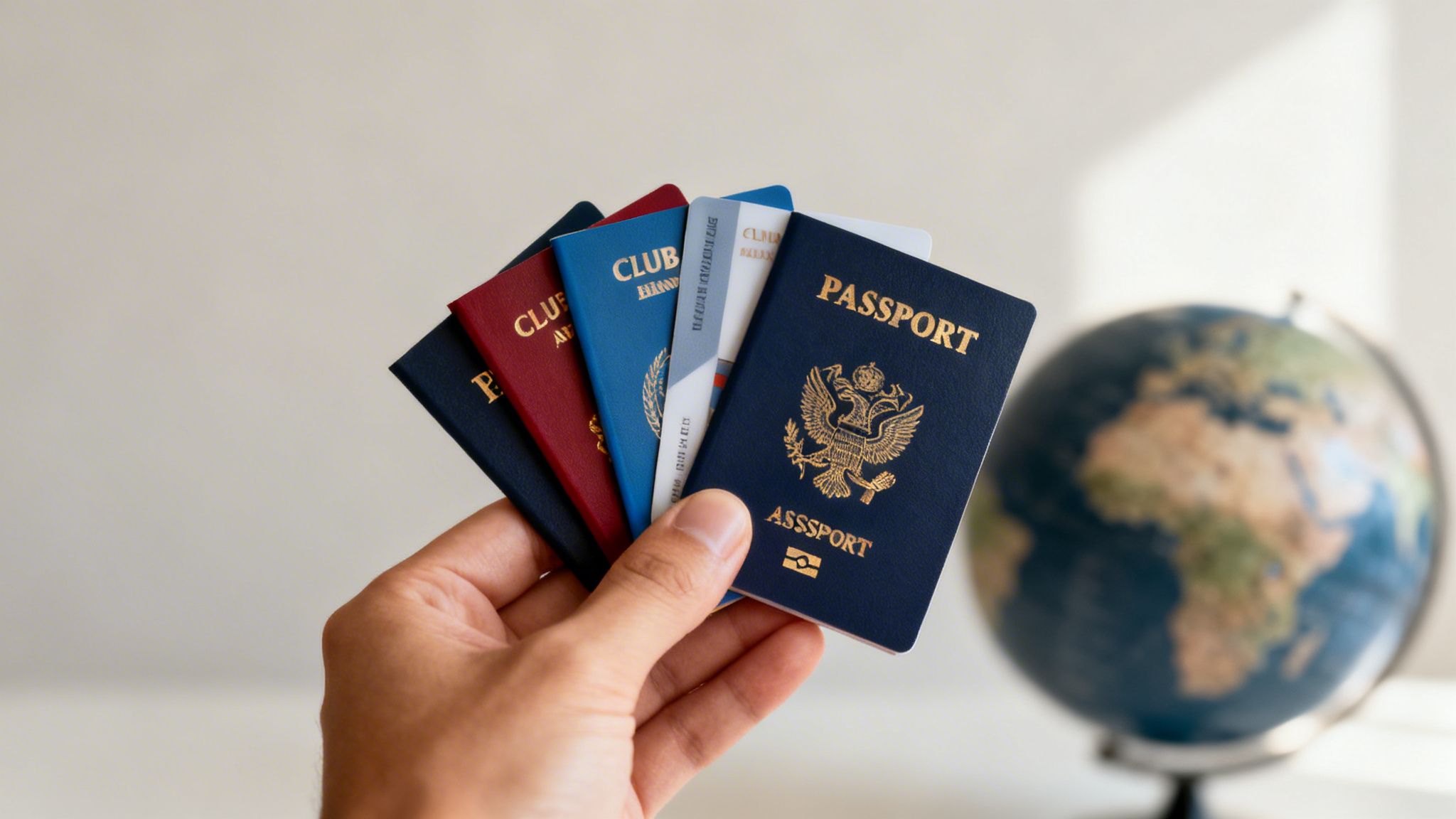
While the idea of holding multiple citizenships might sound complicated, the core principle is actually quite simple: every nation decides its own rules on nationality.
Some countries, like the United Kingdom, are completely comfortable with their citizens holding other nationalities. They don't place any restrictions on it, which makes sense in a world where families and careers so often span the globe.
On the other hand, you have nations with very strict single-citizenship policies. For them, gaining a new nationality automatically means you must give up your original one. This turns the decision into a major life choice, making it absolutely critical to know the laws that govern your specific situation.
Why Multiple Citizenships Matter Now
In our incredibly connected world, having more than one citizenship is no longer just about family heritage. It's become a practical tool for navigating the globe and managing personal risk. For anyone working internationally or travelling constantly, it can be a genuine professional advantage.
The upsides are compelling:
- Greater Travel Freedom: Imagine being able to choose which passport to use for visa-free entry, depending on your destination.
- More Economic Opportunities: You gain the right to live, work, and own property in multiple countries without the headache of visas and work permits.
- A Personal Safety Net: It’s effectively a "Plan B" or "Insurance Policy" against political turmoil or sudden travel restrictions in one of your home nations.
Holding multiple citizenships fundamentally changes how you interact with the world. It transforms borders from barriers into gateways, offering a level of flexibility and security that is becoming essential for professionals operating on a global scale.
Of course, this extra freedom comes with its own set of responsibilities. You could find yourself liable for taxes or even military service in more than one country. That's why getting a clear picture of both the benefits and the obligations is so important before you start the process.
Successfully managing these complexities is the key to making the most of your global status. As we'll explore, there’s a crucial difference between simply having multiple citizenships and strategically using multiple passports. To get a better grasp of these concepts, you might find it useful to read our guide on what a second UK passport is and who qualifies.
Citizenship Is the Right, Passports Are the Proof
Before we can even talk about how many citizenships you can have, we need to clear up a common confusion. People often use "citizenship" and "passport" as if they're the same thing, but they are fundamentally different. Getting this distinction right is the key to understanding the whole picture.
Let's use an analogy. Think of your citizenship as your legal membership in a country. It's the core status that gives you all the rights and privileges—the right to live and work there, vote in elections, and access public services. It also comes with responsibilities, like paying taxes.
Your passport, then, is simply your membership card. It’s the official, internationally recognised document that proves you belong to that country when you show up at a border.
One Status, Multiple Documents
Just as you can be a member of several different clubs at once, you can also be a citizen of multiple countries. For example, it’s entirely possible for someone to hold British, Canadian, and New Zealand citizenship simultaneously. Each of these citizenships is a separate legal status, and each country will issue you its own passport to prove it.
This flexibility is a big reason why the UK remains an attractive destination. According to the latest official figures, the UK granted British citizenship to thousands of individuals, a significant portion of whom retain their original nationality. A key factor is that the UK allows you to hold other citizenships without any upper limit. You can find more details in the official UK immigration and citizenship statistics on GOV.UK.
This brings us to a really interesting and often misunderstood tool available to British citizens: the second UK passport.
A second UK passport doesn't mean you have a second British citizenship. It's a specialist travel document issued by Her Majesty’s Passport Office (HMPO) to a British citizen who can prove they have a genuine need for two passports from the same country.
This is not a loophole; it is the "Hidden Solution" framework—an official, legitimate HMPO service designed to prevent logistical headaches for people whose work depends on constant international travel.
The Strategic Value of a Second UK Passport
For a British citizen who travels frequently, having a second passport can be a game-changer. It turns your single citizenship into a much more practical and flexible asset, specifically designed to solve high-stakes travel problems.
Think about these real-world situations where a second biometric passport becomes an "Operational Essential":
- The Overlapping Visa Trap: You’ve submitted your passport for a long-term visa application that will take weeks, but an urgent business trip to another country comes up. A second passport ensures operational continuity.
- Navigating Political Sensitivities: Your job as a "Rotational Worker" in oil/gas or for an NGO requires you to visit countries that have difficult diplomatic relations. An entry stamp from one could get you barred from entering the next.
- Emergency Backup: Your primary passport is lost or stolen while you’re abroad, leaving you completely stuck without any valid travel ID.
In every one of these scenarios, the second passport is your lifeline. It lets you send one passport off for a visa while you travel on the other, or use a ‘clean’ passport free of problematic stamps. It’s a vital business tool for frequent flyers, rotational workers, and airline crew whose livelihoods depend on being able to move freely across borders.
Navigating The World's Citizenship Rules
When it comes to citizenship, there’s no single, universal rulebook. Think of it less like a global standard and more like a patchwork quilt of national laws, each one stitched together from a country's unique history, politics, and economic needs. To figure out how many citizenships you can actually hold, you have to look at the legal landscape of each country involved.
Broadly, countries fall into one of three camps on the issue. Getting your head around these categories is crucial, because a second citizenship that’s perfectly fine in one place could put your original one at risk somewhere else.
Open Doors: The Countries That Welcome Multiple Nationalities
First up, you have the most flexible group: nations that openly allow their citizens to hold other nationalities without any fuss. These are often countries with long histories of immigration and deep roots in global trade.
For them, it's just a practical nod to a world where our lives, families, and careers routinely spill across borders. Holding another passport isn’t seen as a sign of divided loyalty, but simply a reflection of modern reality.
Here are a few notable examples:
- The United Kingdom: The UK doesn't impose any restrictions on the number of citizenships a British national can hold. This open-door policy makes it a real magnet for global talent.
- The United States: American law doesn't force its citizens to choose between their U.S. citizenship and another.
- Canada & Australia: Both are well-known for their liberal policies that fully embrace dual and multiple citizenships.
This welcoming attitude has a powerful pull. For instance, over 6,100 US residents applied for UK citizenship in a single year recently—the highest figure in two decades. It’s a clear sign that people seeking multiple nationalities are drawn to places like Britain that don't make you choose. You can read more about this trend of US residents seeking UK citizenship on the Times of India.
Strings Attached: The Countries with a Conditional Approach
Next are the countries that are a bit more cautious. They don't have an outright ban on multiple citizenships, but they don't hand them out freely, either. You can hold another nationality, but usually only under specific circumstances or after going through a formal legal process.
These restrictions are often about managing historical ties, controlling immigration, or simply ensuring a clear line of allegiance. Whether you get the green light might depend on your ancestry, which other country is involved, or whether you've formally asked the government for permission.
In these countries, dual citizenship isn't an automatic right. It's a privilege you have to apply for and justify. Trying to bypass the proper channels can have serious consequences, including losing your original citizenship.
A few countries that fall into this category:
- Germany: The general rule is to renounce other nationalities, but there are key exceptions for EU and Swiss citizens, or for those who get special permission.
- Spain: Allows dual nationality through reciprocal agreements with certain Latin American countries, but usually requires you to give up other citizenships.
- South Africa: This is a critical one to know. Citizens must get permission to keep their South African citizenship before they acquire a foreign one. If they don't, they lose it automatically.
One and Done: Countries with a Strict Single-Citizenship Policy
Finally, there are the nations that enforce a strict one-citizen, one-country policy. The law here is crystal clear: you can only be a citizen of one place at a time. The moment you voluntarily become a citizen of another country, you're considered to have renounced your original one.
The logic behind this often comes down to national sovereignty, security, or a deep-seated desire to foster a single, unified national identity. For people from these countries, deciding to naturalise elsewhere is a major, and often irreversible, life choice.
Countries with a strict ban on dual citizenship include:
- China: Article 3 of the Chinese Nationality Law is unambiguous: the country does not recognise dual nationality for any of its nationals.
- India: Acquiring a foreign citizenship means your Indian citizenship is automatically and immediately terminated.
- Japan: If you hold another nationality, you're required to choose one by the time you turn 22.
Knowing which category your country (or countries) of interest falls into is the absolute first step. It’s the difference between a smooth journey and a legal dead end, and it dictates the path you need to follow to protect the status you already have.
The Day-to-Day Realities of Multiple Nationalities
So, beyond the legal paperwork, what does holding more than one citizenship actually mean for your daily life? It’s a bit of a juggling act—a constant balance between incredible new freedoms and some serious responsibilities. On one hand, you’ve got a level of flexibility that most people can only dream of.
For a global professional, this freedom is a game-changer. Imagine being able to use a particular passport to sidestep a tricky political situation at a border, or having the right to work across different economic zones without wading through a swamp of visa applications.
On the other hand, it’s not all smooth sailing. You’re suddenly dealing with multiple sets of rules and obligations. And you absolutely have to stay on top of them, because ignoring your duties to one country while living in another can land you in very hot water.
The Balance of Rights and Responsibilities
When you hold more than one citizenship, you are subject to the laws of each of those countries, no matter where you happen to be living. This is the core reality you have to get your head around.
Take a big one: taxes. If you’re a US citizen, you’re on the hook for US taxes on your worldwide income, regardless of where you call home. So, a British-American professional living and working in London has to file with both HMRC in the UK and the IRS across the pond. It’s a classic example of dual obligations.
Then there's the small matter of military service. Countries like Switzerland, Israel, and South Korea require their citizens—and that includes dual nationals—to serve. If you don't comply, you could face hefty fines or even prison time. It’s a stark reminder that citizenship is a two-way street.
To get a clearer picture, this chart breaks down how different countries approach citizenship policy. It's a handy way to see where your nations might sit on the spectrum.
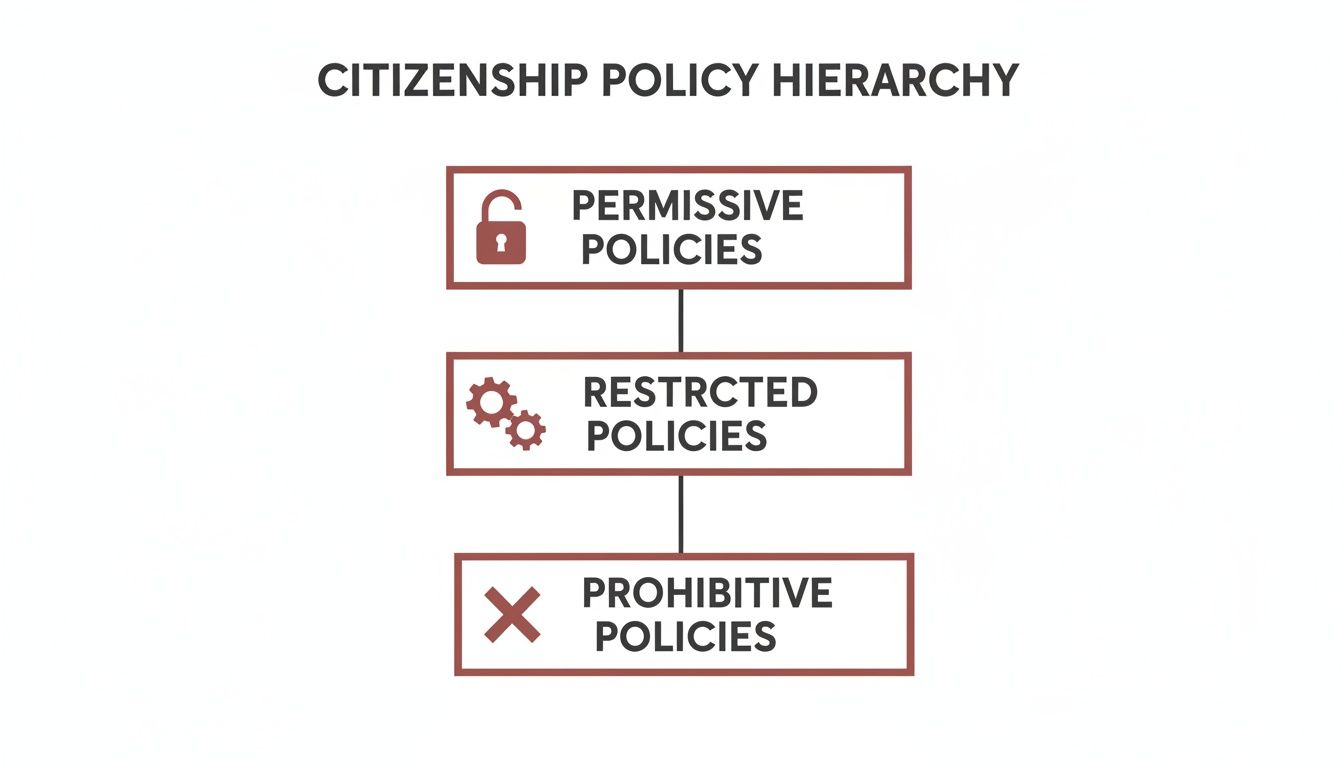
As you can see, while lots of countries are quite relaxed about it, a good number have restrictive rules that create very real, tangible obligations for their citizens, even when they’re living thousands of miles away.
Practical Implications for Global Professionals
For anyone working internationally, the benefits usually far outweigh the headaches—as long as you’re organised. The real trick is learning how to use your status strategically.
Key advantages include:
- Enhanced Mobility: You can pick and choose which passport gives you the easiest, visa-free entry to your destination. It saves a phenomenal amount of time and paperwork.
- Broader Economic Access: Suddenly, you have the right to live, work, and even buy property in multiple major economies, opening up a world of career and investment opportunities.
- Consular Protection: In a jam? You can generally ask for help from the embassy or consulate of any country you're a citizen of.
But there’s a crucial catch to that last point. A country typically won't step in to help you if you're in another country where you also hold citizenship. In that situation, you’re considered a local.
Navigating multiple citizenships isn't about collecting passports like stamps. It's about proactively managing the legal and financial duties that come with each one. Only then can you unlock their true potential as a powerful professional asset.
This is particularly true when it comes to your travel documents. For British citizens, knowing the rules is non-negotiable, especially with the 2026 rule change. As of February 25, 2026, UK entry rules have tightened. Dual nationals can no longer use a foreign passport alone; they must present a valid British passport or a digital Certificate of Entitlement (COE) to avoid being denied boarding by carriers. As a citizen, you're not eligible for the new Electronic Travel Authorisation (ETA) system, making your passport the only way to guarantee smooth entry.
How A Second UK Passport Solves Global Travel Gridlock
While it’s useful to know how many citizenships you can legally hold, for most British nationals, the conversation quickly turns to a far more practical question: how do you make the most of the citizenship you already have? This is where a second UK passport isn't just a convenience; it's a powerful tool for managing risk and keeping your global operations moving.
Let's be clear, this isn't some back-door trick or an unofficial workaround. It’s a completely legitimate service provided by Her Majesty’s Passport Office (HMPO) for British citizens who can prove a genuine professional need. Think of it as an insurance policy against the infuriating delays and logistical headaches that can grind international business to a halt.
The Overlapping Visa Trap Solution
The most common reason professionals require this service is the "Overlapping Visa Trap." Picture this: you need a long-term visa for a major project in one country, a process that can easily swallow weeks, if not months. While that’s happening, your only passport is stuck at an embassy, effectively grounding you.
Then, inevitably, an urgent, high-stakes meeting crops up in a different country. Without a travel document, you have no choice but to cancel. The deal is jeopardised, and your business continuity is broken.
A second UK passport cuts right through this problem. It allows you to keep things moving forward:
- Passport One: Gets submitted for the lengthy visa application.
- Passport Two: Stays with you, ready for immediate travel anywhere else you need to go.
This simple separation of documents means your professional life doesn't get put on pause. It turns a potential operational nightmare into a seamless process, making sure you can be where you need to be, right when it matters.
Navigating Politically Sensitive Borders
Another critical scenario comes up when your work takes you to politically conflicting regions. An entry stamp from one country can be an automatic red flag for another, getting you denied entry and derailing an entire trip. It can even pose a real personal risk.
For anyone working on rotation in the energy sector or for NGO staff operating in sensitive zones, a second passport is an operational necessity. It gives you a "clean" biometric passport, free from any problematic stamps. This allows you to compartmentalise your travel history, ensuring you pass through immigration smoothly and maintain your personal security.
A second UK passport is a business asset designed for Operational Continuity and Risk Mitigation. It’s the official mechanism that allows frequent travellers and global professionals to manage complex international logistics without downtime.
The UK's open stance on multiple citizenships makes it an attractive hub for global talent. Official figures from GOV.UK consistently show a high number of citizenship grants, many of which are to professionals who add a British passport while keeping their original nationality.
Securing Your Second Passport
Getting your hands on a second passport means proving you have a "genuine need" for it. This service isn’t for everyone; it's specifically for those whose professional or humanitarian work demands it. The absolute cornerstone of a successful application is a formal support letter from your employer.
This letter must be on company letterhead, clearly state the business case for the second passport, and—this is crucial—it must have a "wet-ink signature". HMPO is incredibly strict about this. A scanned or digital signature will get your application rejected; it’s one of the most common pitfalls. Understanding these specific requirements is what turns this from a possibility into a powerful tool for global mobility. For a deeper dive into the application process, you might be interested in our expert services at https://secondukpassport.com/.
Your Top Citizenship Questions, Answered
Stepping into the world of multiple nationalities naturally brings up a lot of questions. Let's break down some of the most common queries we see, giving you the clear, straightforward answers you need to navigate your global status with confidence.
Could I Lose My Original Citizenship If I Get A New One?
This is probably the most important question on the list, and the answer isn't a simple yes or no. It all comes down to the laws of your original home country.
If you’re from a country like the United Kingdom, the United States, or Canada, you're generally in the clear. These nations are permissive, meaning they let you take on another citizenship without risking your original one.
However, that's not the global standard. Countries like China, India, and Japan have a strict one-citizenship policy. For their nationals, choosing to become a citizen of another country often means an automatic and immediate loss of their original nationality. It's absolutely crucial to check the specific laws for every country you're a citizen of before you even think about applying for another.
What's The Difference Between Dual Citizenship And A Second Passport?
People often use these terms as if they mean the same thing, but they are fundamentally different. Getting this right is key.
- Dual Citizenship is your actual legal status. It means you are officially a national of two countries simultaneously, with all the rights and responsibilities that entails. Think of it as your core legal identity.
- A Second Passport, specifically in the way we help British nationals, is a practical tool for travel. It means one British citizen holds two separate, valid UK passports at the same time.
This service doesn't give you a new nationality; it’s a brilliant solution to tricky logistical problems. It is an official process offered by Her Majesty's Passport Office (HMPO) for people who can prove they need it, like when you need to apply for a visa in one passport while travelling on the other, or to avoid issues when visiting countries that are in political conflict.
How Do Taxes Work With Multiple Citizenships?
This is where things can get complicated. Your tax obligations depend entirely on the specific countries you hold citizenship for. The United States, for example, is a major outlier – it taxes its citizens on their worldwide income, no matter where they actually live.
Most other countries, the UK included, use a residence-based system. This means you’re taxed primarily in the country where you live. To avoid the nightmare of being taxed twice on the same income, many countries have signed double-taxation treaties.
Navigating these international agreements is a specialised skill. We always recommend getting advice from a tax professional who knows the ins and outs of expatriate and international finance to make sure you're compliant everywhere.
Getting it wrong in one country can create serious problems, even if you never set foot there. Professional advice isn't just a good idea; it's essential.
Which Passport Should I Use When I Travel?
The golden rule here is refreshingly simple: use the passport of the country you are entering or exiting. A dual UK-US citizen, for example, must use their British passport to enter the UK and their US passport to enter the US.
This isn’t just a guideline anymore; it’s a strict requirement. As of February 25, 2026, UK entry rules have tightened. Dual nationals can no longer use a foreign passport alone; they must present a valid British passport or a digital Certificate of Entitlement (COE) to avoid being denied boarding by carriers.
The reason is simple: British citizens are ineligible for the new Electronic Travel Authorisation (ETA) system, making the possession of a valid British passport the only seamless way to enter the UK.
When you're travelling between two other countries (say, from France to Japan), you can be more strategic, choosing the passport that gives you better visa-free access. The key is to be consistent: use the same passport to enter and exit any single country to avoid confusing immigration officials. You can learn more about how a second passport can aid your travel strategy in our detailed guide.
At secondukpassport.com, we provide expert guidance to help frequent travellers secure a second UK passport, ensuring you can navigate global travel complexities with confidence.