
Getting your visa photo right is the first, and arguably most important, step in a successful Chinese visa application. The specifications are incredibly strict and non-negotiable, so even a minor mistake can lead to an outright rejection. Your photo must be a recent, high-quality colour print measuring exactly 48mm high by 33mm wide, taken against a completely plain white background – a detail that often trips up UK applicants used to different standards.
Decoding China's Unique Photo Specifications
For anyone who travels frequently for business, a second passport is often a necessity. It lets you apply for a Chinese visa while your primary passport is off being used for another trip. But getting that visa depends entirely on submitting a photo that meets China's very specific, and often unfamiliar, criteria. It's not the same as a UK passport photo. The standard UK size is 45mm x 35mm, but for a Chinese visa, you need to follow their unique dimensions to the letter.
Even now, UK travellers must adhere to these precise rules: the photo must be 48mm x 33mm, with the head width between 15-22mm and head height from chin to crown measuring 28-33mm. All of this has to be against a flawless white background. These requirements, set directly by the Chinese Consulate, are a common stumbling block, and photo errors are a leading cause of frustrating application delays. You can learn more about how these regulations impact UK visa applicants.
To help you get it right the first time and avoid those costly delays, we've put together a quick-reference table. It’s designed to help corporate travel managers and applicants see the key differences at a glance and ensure every photo is compliant before it’s submitted.
China Visa Photo vs UK Passport Photo Specifications
One of the most common mistakes we see is people trying to use a standard UK passport photo for their China visa application. They simply won't be accepted. The dimensions, background colour, and even head size specifications are different, as you'll see below.
| Specification | China Visa Photo Requirement | Standard UK Passport Photo |
|---|---|---|
| Photo Size | Exactly 48mm x 33mm. | Typically 45mm x 35mm. |
| Background Colour | Pure white with no shadows, patterns, or objects. | Light grey or cream-coloured. |
| Head Size (Height) | 28mm – 33mm from chin to the crown of the head. | 29mm – 34mm from chin to the crown of the head. |
| Head Size (Width) | 15mm – 22mm at the widest part. | Not explicitly specified, but must be centred. |
| Digital File Size | 40KB – 120KB for online submissions (COVA form). | N/A for standard print; digital is 50KB – 10MB. |
| Expression | Neutral with mouth closed and eyes open. | Neutral with mouth closed and eyes open. |
As the table shows, the differences might seem small, but they are critical. Always double-check that your photo has been taken specifically for a Chinese visa to avoid any issues.
Getting the Photo Dimensions and Composition Right
Getting your China visa photo right comes down to the details. The Chinese authorities are incredibly specific about their requirements for both printed and digital photos, and there’s absolutely no wiggle room. If you’re used to the more relaxed rules for other countries, pay close attention here, as this is where many applications fall flat.
For the physical photo you'll submit, the dimensions are a non-standard 48mm high by 33mm wide. This is a frequent stumbling block for UK applicants, as it’s quite different from the typical British passport photo size. It’s not just about the overall size, though; what’s inside the frame is just as crucial for their biometric scanners to work correctly.
Head Size and Placement: The Make-or-Break Measurements
This is where you need to be precise. The height of your head, measured from the bottom of your chin to the crown, must be between 28mm and 33mm. At the same time, the width of your head needs to be somewhere between 15mm and 22mm.
These measurements aren't arbitrary; they ensure your facial features are perfectly proportioned for the official identification systems. You also need to leave a small, clear gap between the top of your hair and the top edge of the photo, so nothing gets cropped out.
Digital Photo Specs for Online Applications
If you're filling out the China Online Visa Application (COVA), you'll need to upload a digital copy of your photo. The technical rules for the file are just as strict as the physical ones, and getting them wrong can cause upload errors that stall your entire application.
- File Format: It has to be a JPEG (.jpg). Don't even try uploading a PNG, HEIC, or any other format – the system will reject it.
- Pixel Dimensions: The sweet spot is between 354 pixels wide by 472 pixels high and 420 pixels wide by 560 pixels high.
- File Size: Make sure the file is between 40KB and 120KB. Anything smaller won't have enough detail, and anything larger will be kicked back.
This comparison table really drives home the differences between what's needed for a Chinese visa and a standard UK passport.
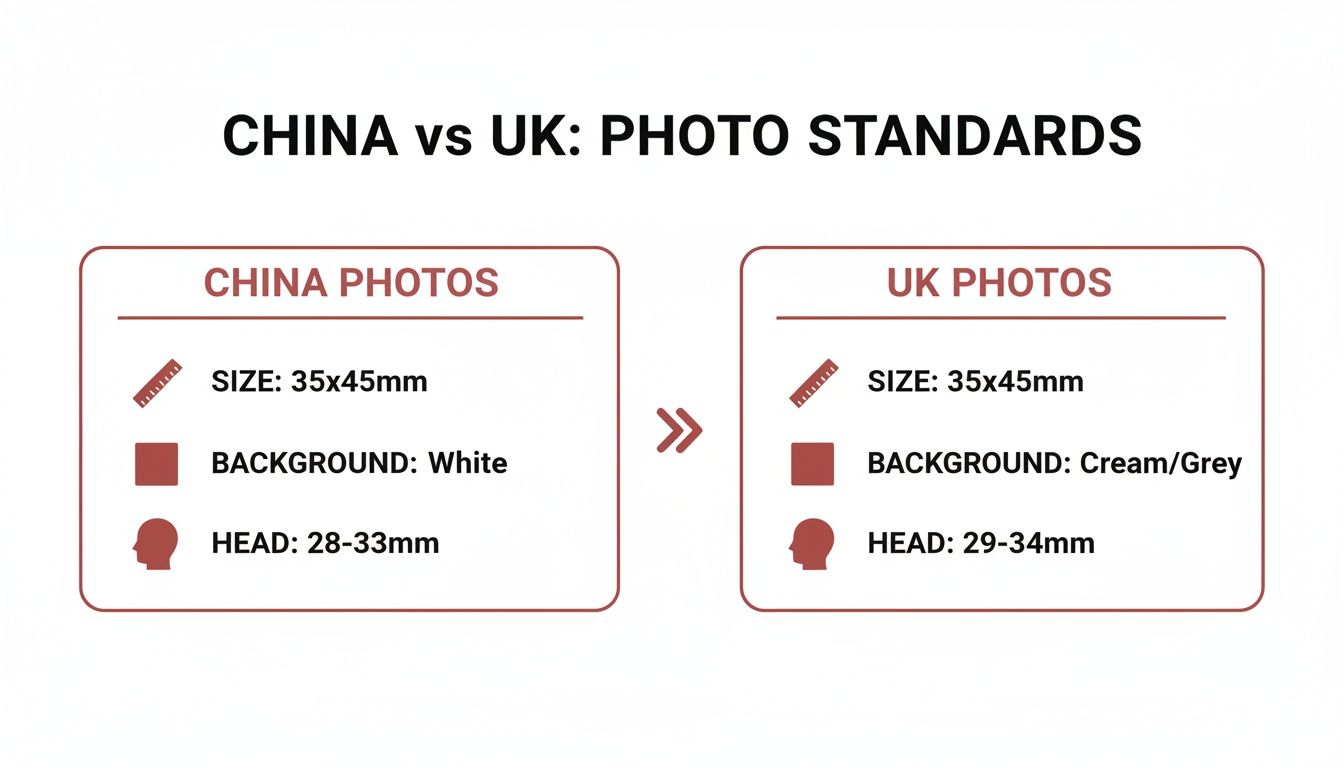
As you can see, trying to use a standard UK passport photo is a non-starter. The size and background colour are completely different, guaranteeing an instant rejection.
Getting the Background and Lighting Just Right
It’s easy to get bogged down in the technical details of dimensions and pixels, but from my experience, it’s the background and lighting that trip up most applicants. These aren’t just suggestions; the Chinese authorities have incredibly strict, non-negotiable standards designed for their biometric systems. A tiny shadow or an off-white background can be enough for an instant rejection, causing stressful and expensive delays.
For a China visa photo, the background must be plain, pure white. I can't stress this enough. There can be no patterns, no textures, no objects, and not even the slightest hint of discolouration. This is a common pitfall for UK applicants, as we're used to the light grey or cream backgrounds for our own passport photos. Any deviation from pure white will almost certainly get your application flagged.

Mastering Uniform Lighting
Just as crucial is getting the lighting perfect. It needs to be completely uniform and free of shadows. In fact, shadows on the face or behind the head are one of the most frequent reasons for rejection I see. The idea is to light your face evenly from the front, getting rid of any dark patches or glare – which is especially important if you need to wear glasses.
Professional photo services use multi-light setups for this very reason. If you’re attempting this at home, try placing two light sources on either side of your face to balance things out and cancel any shadows. Whatever you do, don't stand directly under a ceiling light; it’ll create harsh, unflattering shadows under your eyes, nose, and chin.
Insider Tip: Try standing about half a metre away from the white background when the picture is taken. This simple step helps stop your own shadow from appearing behind your head—a very common mistake that can torpedo your application.
Choosing Your Clothing and Getting the Print Quality Right
What you wear actually matters a great deal. It’s all about creating enough contrast against that stark white background. Your best bet is to wear dark, solid-coloured clothing. Think a black, navy, or dark grey collared shirt. Steer clear of white or very light-coloured tops, as they'll just blend into the background and obscure the outline of your shoulders. Busy patterns and big logos are also out, as they distract from your face.
Finally, the physical photo itself is inspected closely. It must be a high-resolution, full-colour image printed on glossy photo paper. Matte or semi-gloss paper just won’t do. The image has to be sharp and in focus, with no pixelation, blurriness, or any damage like creases or smudges. A high-quality print is the final piece of the puzzle, ensuring your facial details are perfectly clear for the biometric scanners.
Getting Your Expression and Head Position Just Right
It’s not just about the technical specs like background colour or photo dimensions; how you hold your head and what your face is doing are just as critical. The Chinese authorities are looking for a photo suitable for biometric verification, which means they need a perfectly clear, neutral, and unobstructed view of your face. Getting this wrong is a surefire way to get your application rejected, which can throw a real spanner in the works for your travel plans.
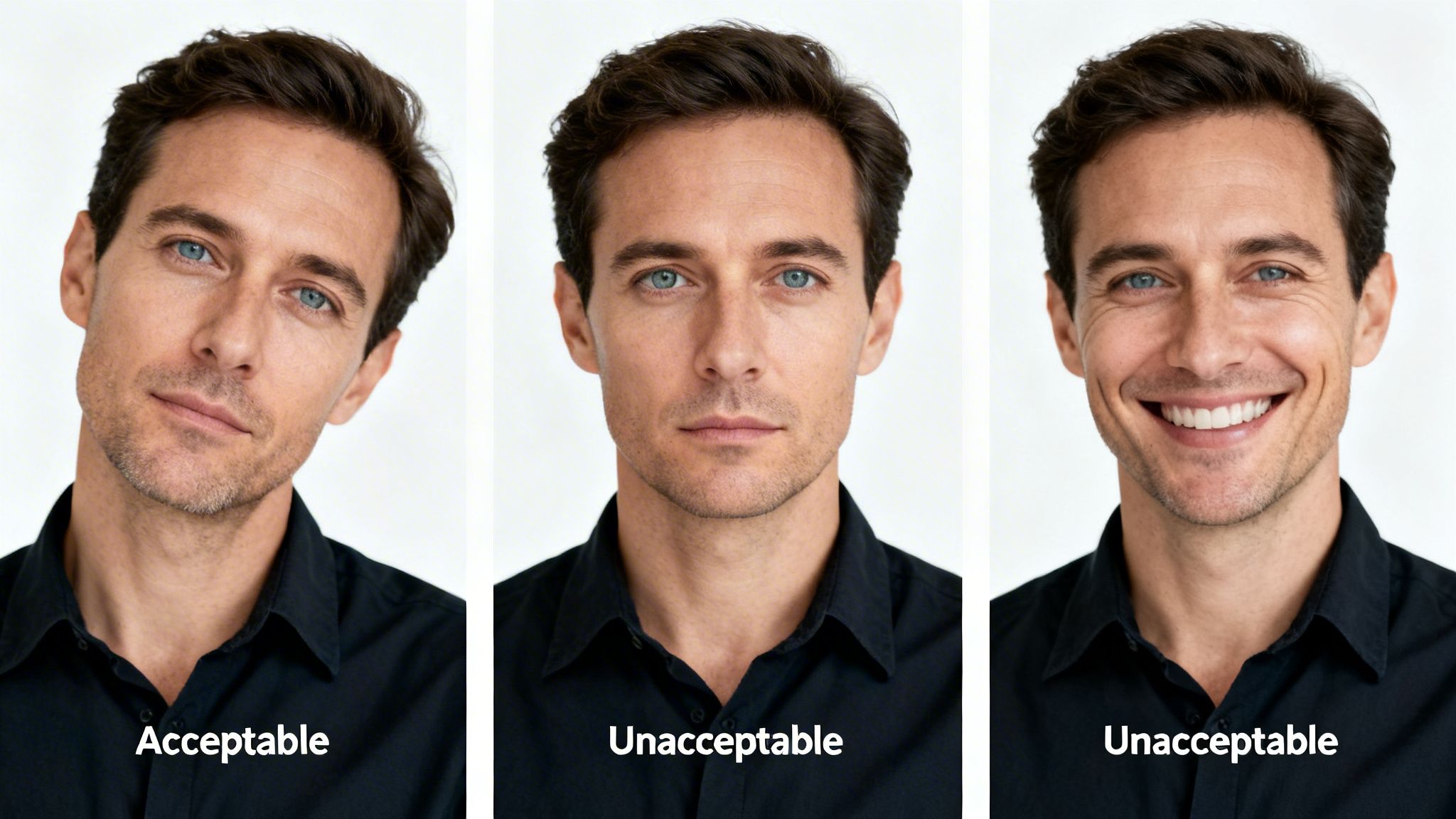
First things first, your expression must be completely neutral. That means no smiling, no frowning, no grinning – nothing. Keep your mouth closed and look directly at the camera. Your eyes need to be wide open and clearly visible. Think of it as a photo for a machine, not a person; this direct, emotionless gaze allows facial recognition software to map your features accurately.
Nailing the Correct Head Alignment
Your head needs to be perfectly centred and facing the camera head-on. Don't tilt your head up, down, or to either side. Your entire face, from the top of your hair to the bottom of your chin and from one ear to the other, has to be in sharp focus. This is a non-negotiable part of the China visa photo requirements.
This strict positioning isn't just arbitrary; it's essential for the security systems at border control.
- Biometric Scanning: A straight-on view lets scanners precisely measure the distances between your eyes, nose, and mouth.
- Symmetry Checks: The system analyses facial symmetry, which is only possible when your head is perfectly straight and not at an angle.
- Clear Features: Even a slight tilt can cast shadows or change the perceived shape of your features, causing a mismatch with the system.
Don't Forget Your Ears: A crucial detail that's often missed is that both of your ears must be visible. Make sure your hair is tucked behind them. This is a common and easily avoidable reason for rejection.
Ultimately, the goal is an image that is unambiguous and easy for a machine to read. Your head should be centred in the frame, both horizontally and vertically, with your shoulders squared to the camera. Follow these rules on expression and positioning, and your photo will sail through both the automated and manual checks, keeping your visa application moving smoothly. For anyone managing multiple applications, getting this right the first time is key to avoiding serious delays.
Rules for Glasses, Headwear and Accessories
Getting the rules right for what you can and can't wear in your China visa photo is absolutely crucial. These guidelines are incredibly strict, and even a tiny misstep can get your application bounced, leading to frustrating delays—a real headache for business travellers on a tight schedule.
Simply put, when it comes to glasses, the official stance is clear: they are generally not permitted. Your best bet is always to take them off before the photo is taken. This eliminates any risk of glare, reflections, or the frames blocking even a tiny part of your eyes, ensuring the biometric scanners get a perfect read.
Exceptions for Medical and Religious Reasons
Of course, there are a couple of very specific exceptions. The authorities do understand that some items can't be removed for genuine medical or religious reasons, but you'll still need to meet some very strict conditions.
An exception for glasses is only ever granted if they cannot be removed for medical reasons. If this is your situation, you have to make sure that:
- The frames are thin, not heavy, and don't hide your eyes in any way.
- The lenses are completely clear, with no tint or colour.
- There is absolutely no glare or reflection on the lenses. This is notoriously difficult to get right, so extra care is needed.
It's a similar story for headwear. It’s only allowed for established religious or medical purposes. If you need to wear a head covering, it must not conceal any part of your face. Pay close attention to your forehead, eyebrows, eyes, and chin—they must all be completely visible. Another critical point is that the headwear can't cast any shadows on your face, which would compromise the clarity needed for identification.
A common mistake we see is hair or a head covering slightly obscuring the eyebrows or creating a faint shadow across the forehead. Both are grounds for immediate rejection, so double-check that your entire face is evenly lit and fully visible before submitting.
Strictly Prohibited Accessories
When it comes to anything else, the rules are black and white. Any accessory that isn't required for a documented medical or religious reason is strictly forbidden. Remembering this simple point will save you a lot of trouble.
The following items are not allowed, no exceptions:
- Hats, caps, or any non-religious headbands.
- Headphones, earbuds, or any similar devices.
- Large, prominent jewellery, like chunky necklaces or dangling earrings.
- Sunglasses or fashion glasses with any kind of tint.
At the end of the day, the goal is a clear, unobstructed photo of your face for security identification. By taking off all non-essential accessories, you give your application the best possible chance of sailing through without a hitch. For frequent travellers, that kind of attention to detail is what keeps everything moving smoothly.
How to Avoid Common Photo Rejection Errors
Getting a China visa photo rejected is one of the most common—and frustrating—reasons for application delays. It all comes down to the details. I've seen countless applications held up for simple, avoidable mistakes. Here’s a breakdown of the frequent culprits and how to get it right the first time, keeping your travel plans on schedule.
Sizing Errors and How to Fix Them
The sizing requirements are strict and non-negotiable: the photo must be exactly 48 mm high by 33 mm wide. This isn't your standard UK passport size, which trips up a lot of people.
To get the dimensions spot-on:
- Use a dedicated service: Don't just crop a standard photo. Use a photo booth, professional service, or an app specifically set up for Chinese visa photos. They'll have the correct 48 × 33 mm template.
- Check the head size: It's not just the overall photo. The head itself must be between 28 mm and 33 mm tall, and 15 mm to 22 mm wide.
- Print and measure: Once you have the photo, print it on glossy paper and use a ruler to double-check the final dimensions. Don't just trust the screen.
| Common Mistake | The Fix | How to Prevent It |
|---|---|---|
| Wrong overall size | Resize the image digitally before printing, or just retake it. | Always verify the print against a ruler. Don't eyeball it. |
| Head in the wrong position | Frame the shot correctly from the start. | Use your camera's gridlines to centre your face and leave the right amount of space above your head. |
| Digital file size incorrect | Adjust the compression when you save the JPEG to get it between 40 KB and 120 KB. | Most photo editors have a 'Save for Web' or export quality setting. Tweak it until the file size is right. |
Background and Lighting Mistakes
Your background must be pure, plain white, with no shadows whatsoever. This is an automatic rejection point if you get it wrong.
Getting the lighting right is key. You'll want to position yourself at least 50 cm away from the white background—this simple trick helps eliminate any tell-tale shadows cast by the flash or overhead lights. For best results, use two light sources angled at 45° on either side of your face to ensure even, flat illumination.
Getting this wrong can cause serious delays. By 2023, the number of UK visa applications for China was already hitting 28,000 annually. Photo errors contributed to 18% of the total 7% denial rate, which for frequent flyers, often meant an average delay of 21 days. You can read more about these official findings on VisaForChina.cn.
A tip from the professionals: experienced visa consultants find that simple pre-submission checks can slash rejection rates by as much as 60%.
Expression and Accessories
The rules here are simple: look straight ahead, keep your expression neutral, and take off any accessories.
- Your eyes must be fully open, and your mouth must be closed. No smiling.
- Remove all glasses unless they are medically required. If you must wear them, make sure there's no glare on the lenses and the frames don't obscure your eyes.
- All headwear is forbidden, except for religious reasons (and even then, your full face must be visible). Tuck your hair behind your ears so your eyebrows and jawline are completely clear.
Any glare from glasses or frames obscuring your eyes is a guaranteed rejection. It's often easier to just take them off for the photo.
A Final Pre-Submission Checklist
Before you hit 'submit' or seal that envelope, run through this one last time. It takes two minutes and can save you weeks of hassle.
- Print Size: Is it exactly 48 mm × 33 mm?
- Head Position: Is the head size correct and centred?
- Background: Is it pure white, with absolutely no shadows?
- Expression: Are you looking forward with a neutral expression?
- Accessories: Have all glasses, hats, and large earrings been removed?
- Digital File: Is it a JPEG file between 40 KB and 120 KB?
Treating this like a final quality control step is the best way to avoid resubmission fees and travel disruption. For travel managers and applicants alike, a few minutes of checking is all it takes to keep things moving.
Right, let's get this final check done properly. Before you even think about sending off your China visa application, it's absolutely crucial to give the photo one last, thorough look. This isn't just a box-ticking exercise; getting it wrong can mean delays, extra costs, and a whole lot of hassle.
For anyone managing corporate travel or just flying to China regularly, this checklist is your best friend. It boils down all the official rules into a straightforward, yes-or-no format. Run through it every single time to catch any potential problems before the consulate does.
The Final Pre-Submission Photo Checklist
Go through each point below. If you find yourself ticking 'No' for any of these, stop. You'll need to get a new photo, as the one you have is almost certain to be rejected.
| Check Point | Requirement | Verification (Yes/No) |
|---|---|---|
| Physical Size | Is the photo printed exactly 48mm high x 33mm wide? | |
| Background | Is the background pure, plain white with no shadows or patterns? | |
| Head Size | Is the head height 28-33mm and width 15-22mm? | |
| Expression | Is the expression neutral with the mouth closed and eyes open? | |
| Head Position | Are you facing forward with your head centred and both ears visible? | |
| Glasses | Are glasses removed? (Or medically necessary with no glare/obstruction) | |
| Headwear | Is all non-religious headwear removed? | |
| Digital File | Is the file a JPEG between 40KB and 120KB? |
We've also made this available as a handy downloadable PDF. It’s perfect for popping into company travel packs or keeping on your desktop for quick reference.
Frequently Asked Questions
When you're dealing with the fine print of China visa photo requirements, it's easy to get bogged down in the details. This section tackles the most common questions we hear from travellers, giving you clear answers to get your application over the line without any last-minute hitches.
How Recent Must My China Visa Photo Be?
Your photo needs to be fresh. The official rule is that it must have been taken within the last six months.
Don't be tempted to reuse an old photo, especially one that's already on your passport or a previous visa. This is a classic mistake and a frequent cause for rejection. Your photo is a biometric snapshot, and if it doesn't match your current appearance, it can trip up the facial recognition systems used by Chinese immigration officials.
Can I Smile In My China Visa Photo?
No, you need to keep a completely neutral expression for this one. That means your mouth must be closed, with no smiling, grinning, or even frowning.
This isn't about looking serious for the sake of it; it's a technical requirement. A smile, however small, changes the precise geometry of your face—the distance between your eyes, the width of your mouth, and so on. These subtle shifts can be enough to confuse the automated biometric scanners, which leads to a failed check and an instant rejection of your photo.
What Should I Do If My Visa Photo Is Rejected?
If your photo gets rejected, the visa centre will let you know and ask for a new one that ticks all the boxes. Unfortunately, this means your application is on hold until they receive a compliant replacement.
The key is to find out exactly why it was rejected. Was it the background? Your expression? Once you know the reason, use the checklist in this guide to make sure the new photo fixes the specific problem. To avoid a second rejection, your best bet is often to go back to a professional service that knows the ins and outs of these strict rules. For anyone on a tight travel schedule, these delays can be more than just an inconvenience.
Can I Use a High-Quality Photo Taken With My Smartphone?
Technically, yes, you can use a smartphone photo, but it's incredibly tricky to get it right. You would have to nail every single detail—from the lighting and background to the final digital and physical dimensions.
Achieving a perfectly plain, shadow-free white background at home is tough without professional lighting. After that, the image must be resized to fit the digital specifications (354×472 to 420×560 pixels, 40-120KB) and printed to the exact physical size of 48mm x 33mm on glossy photo paper. Given how easy it is to miss a small detail, we strongly recommend using a professional service.
Juggling visa applications with a packed travel schedule is a constant challenge for global professionals. For frequent business travellers, a second passport serves as a critical 'Plan B', ensuring operational continuity by allowing you to apply for one visa while travelling on another. This legitimate HMPO service is the hidden solution for mitigating travel downtime and navigating the 'overlapping visa trap'. Start your application to secure your business travel at https://secondukpassport.com.