
Rapid Passports

How to Get a Second UK Passport: The Definitive Guide for 2026

Applying for a second UK passport is a fully legitimate process for frequent travellers and professionals with a genuine need, yet it's often misunderstood. This guide provides an authoritative overview of how to secure this essential travel document, positioning it not as a loophole but as a strategic business asset for "Operational Continuity" and "Risk Mitigation," officially facilitated by Her Majesty’s Passport Office (HMPO).

This is not about circumventing rules; it’s about using an official service designed for British citizens whose work demands complex international mobility. We'll detail the strict eligibility criteria, the application process, and why a second passport acts as a vital "Insurance Policy" against costly travel downtime. We will also address the critical February 25, 2026, UK entry rule changes, which mandate that British citizens, including dual nationals, must present a valid British passport or a digital Certificate of Entitlement (COE) for re-entry. This change makes owning a valid British passport non-negotiable for seamless entry, as British citizens are ineligible for the new Electronic Travel Authorisation (ETA) system.

Whether you are a senior executive, airline crew, or a rotational worker in the energy sector, understanding this process is key to maintaining your global operational effectiveness.

1. Switzerland – Premium Living & Wealth Management Hub

Switzerland consistently ranks as a top contender for the best country in Europe to live in, offering an unparalleled quality of life defined by political stability, exceptional security, and world-class infrastructure. Its reputation as a global financial centre and politically neutral stance makes it a magnet for senior executives, wealth managers, and business owners seeking discretion and efficiency.

For international professionals, the country’s multilingual environment (German, French, Italian, and Romansh) simplifies operations across European markets. This linguistic versatility, combined with its central location, provides a strategic advantage for managing cross-border ventures and corporate travel. The healthcare system is among the best in the world, ensuring access to premium medical care, a significant factor for those relocating with families.

Practical Considerations for Business Travellers

Switzerland's high-stakes business environment often requires frequent, complex international travel. Executives based here may face the "overlapping visa trap," where their primary biometric passport is held by an embassy for a lengthy visa application while urgent travel to another region is required.

Operational Continuity with a Second Passport
A second UK passport serves as a critical tool for maintaining business momentum. It allows you to submit one passport for a visa application to a country like China or Russia, while using the second passport for immediate, visa-free travel within the Schengen Area or to the UK, ensuring no operational downtime.

For those managing business between politically sensitive regions, a second passport is not just a convenience but a necessity. It allows for clean travel records, avoiding entry denial due to incompatible passport stamps. This is a common requirement for professionals in finance, diplomacy, and the energy sector who travel extensively between regions like the Middle East and the West. A supporting letter from a Swiss-based employer is essential for the application, validating the genuine need for uninterrupted international movement.

2. Netherlands – Tech & Logistics Gateway to Europe

The Netherlands stands out as one of the best countries in Europe to live in, blending a high quality of life with a pragmatic, forward-thinking business culture. Its reputation as a major tech and logistics hub, anchored by Amsterdam and the Port of Rotterdam, attracts a global workforce. The country's streamlined bureaucracy, combined with an exceptionally high English proficiency among its population, creates a welcoming and efficient environment for expat professionals and international businesses.
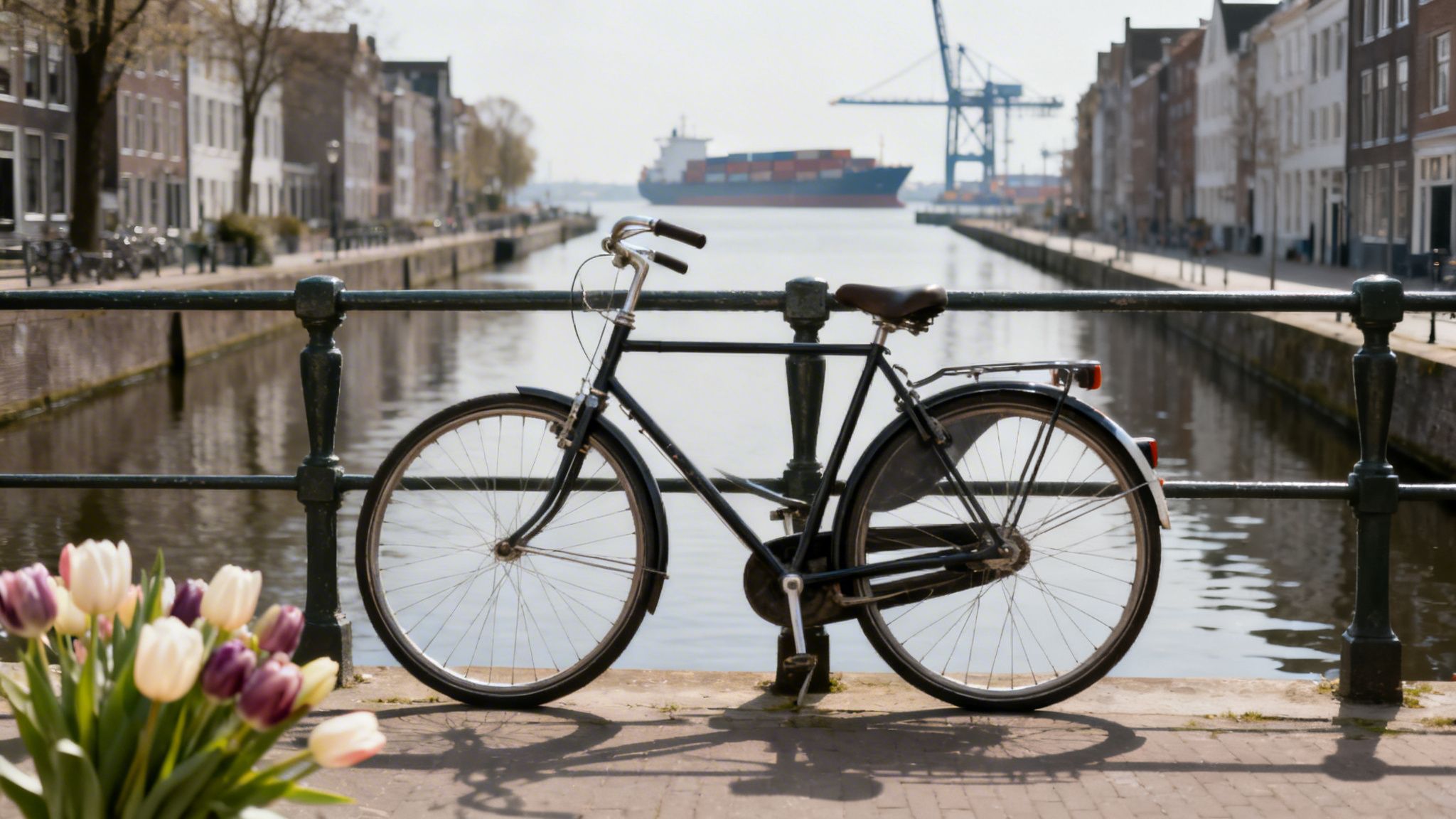
A black bicycle stands on a bridge overlooking a canal with city buildings and a distant cargo ship.

For professionals in sectors like supply chain management, technology, and international trade, the Netherlands offers a strategic base for European operations. The Dutch government's highly skilled migrant visa programme provides a fast-track route for qualified individuals, simplifying relocation. This efficiency is mirrored in its world-class infrastructure, which facilitates seamless travel and commerce across the continent and beyond, making it a prime location for those managing complex, cross-border logistics.

Practical Considerations for Business Travellers

The fast-paced nature of roles based in the Netherlands, particularly in logistics and tech, often involves urgent, multi-country travel. A senior manager might need to finalise a component deal in Asia while simultaneously overseeing a product launch in the United States, creating a classic "overlapping visa trap" where their passport is tied up in one embassy just as a new travel need arises.

Operational Continuity with a Second Passport
A second UK passport is a vital business asset for maintaining operational continuity. It enables you to submit one passport for a time-consuming visa application, for instance to India, while using the second passport for immediate, visa-free business travel to the US or within the EU. This ensures that logistical and commercial momentum is never lost to administrative delays.

For professionals whose roles involve travel between politically conflicting nations, a second passport provides a necessary layer of discretion and security. It allows for a clean travel history, preventing potential entry denials based on stamps from sensitive regions. An official supporting letter from your Netherlands-based employer, detailing the genuine business need for uninterrupted international travel, is a mandatory component of a successful application.

3. Germany – Industrial Powerhouse & Engineering Hub

Germany stands as a dominant force in the European economy, making it one of the best countries in Europe to live in for professionals in engineering, technology, and manufacturing. Its reputation for efficiency, innovation, and a high standard of living is well-deserved, with cities like Berlin, Munich, and Frankfurt acting as magnets for international talent and corporate headquarters. The country offers a robust social security system, world-class public infrastructure, and excellent educational institutions.

A metal gear and engineering blueprints on a table with a person in a factory background.

For British expatriates, Germany’s straightforward residency pathways and its generally favourable stance on dual nationality offer a stable long-term solution. The business environment is highly formalised and values precision, which extends to its bureaucratic processes. This clarity is beneficial for those navigating visa applications or establishing a business, as the requirements are well-documented and consistently applied.

Practical Considerations for Business Travellers

Professionals based in Germany, particularly those in the automotive, chemical, or heavy machinery sectors, often manage complex supply chains and client relationships that span non-Schengen territories. This can lead to logistical bottlenecks, such as needing to secure a visa for a trade mission to China while simultaneously needing to travel to a client site in the United States or the UK.

Operational Continuity with a Second Passport
A second UK passport is a vital tool for ensuring operational continuity. It allows an engineer or project manager to submit one passport for a lengthy visa process required for a market like India, while using the second passport to travel freely for urgent meetings or site inspections within Europe or North America, eliminating costly operational delays.

Furthermore, for executives managing projects in politically sensitive regions, a second passport provides a necessary layer of discretion and security. It allows for a clean travel history, preventing potential entry denials due to stamps from conflicting nations. For a successful application, a detailed support letter from your German-based employer, validating the critical business need for uninterrupted global travel, is an essential piece of evidence required by Her Majesty’s Passport Office (HMPO).

4. Portugal – Affordable Mediterranean Lifestyle & Tech Growth

Portugal has rapidly positioned itself as a leading contender for the best country in Europe to live in, blending a relaxed Mediterranean lifestyle with a dynamic and growing tech sector. It offers an exceptional climate, rich culture, and one of the most affordable living standards in Western Europe. Cities like Lisbon are now rivalling traditional tech hubs such as Berlin, but with significantly lower operational and living costs, making it a magnet for start-ups, digital nomads, and established companies.

Laptop and coffee cup on a table on a Lisbon cobblestone street at sunset, with a classic yellow tram and ocean in the background.

For internationally-mobile professionals, Portugal's appeal is amplified by its favourable residency and tax schemes. The D7 Passive Income Visa and the former Non-Habitual Resident (NHR) tax regime were designed to attract foreign talent and investment. While the NHR programme has evolved, new incentives continue to make Portugal an attractive base for those with international business interests, requiring robust travel and documentation strategies. The country's strong expat community and widespread use of English in business circles ensure a smooth transition.

Practical Considerations for Business Travellers

Professionals based in Portugal often manage business across Europe, Africa, and the Americas, taking advantage of its strategic location. This level of international engagement means visa applications to non-Schengen countries are common, creating potential travel bottlenecks when a primary passport is submitted to an embassy. This is especially true for tech entrepreneurs and consultants attending conferences or meeting clients on tight schedules.

Operational Continuity with a Second Passport
A second UK passport is a vital tool for maintaining operational continuity. It allows you to leave one passport for a lengthy visa process, for example, for a trade mission to India, while using the other for immediate, visa-free travel to the UK or for a last-minute client meeting in the United States. This ensures business operations are never halted by administrative delays.

For those whose work involves travel between politically sensitive regions, a second passport provides a clean travel record, mitigating the risk of being denied entry due to conflicting passport stamps. This is a practical necessity for consultants in global development or journalists. A formal employer support letter, written on company letterhead with a "wet-ink signature", is a critical component of the application, validating the genuine business need for uninterrupted travel.

5. Denmark – Nordic Excellence & Social Equality Model

Denmark consistently features as one of the best countries in Europe to live in, championed for its exceptional work-life balance, progressive social policies, and a culture built on trust and equality. Its capital, Copenhagen, is frequently cited as one of the world's most liveable cities, offering a blend of modern innovation and historic charm. The Danish model provides a secure and family-friendly environment, supported by a world-class public healthcare system and subsidised education.

For professionals, Denmark offers high salaries that help to offset its elevated cost of living, alongside a transparent and efficient tax system. The country’s strong emphasis on community and integration, supported by official programmes, makes it easier for expatriates and their families to settle in. Danish citizenship is an achievable long-term goal for residents, presenting a valuable opportunity for professionals looking to establish a permanent base and pursue a multi-passport strategy within the stable Nordic and EU frameworks.

Practical Considerations for Business Travellers

Denmark's strategic position as a gateway between mainland Europe and the Nordic countries means that executives and technical specialists based here often travel extensively. This can lead to logistical challenges, especially when managing simultaneous visa applications for non-Schengen destinations, such as for tech conferences in the US or trade missions in Asia.

Operational Continuity with a Second Passport
A second UK passport is an essential tool for maintaining operational momentum. It allows you to submit one passport to an embassy for a time-consuming visa application, while the second passport remains available for immediate, visa-free travel throughout the EU or for an urgent trip back to the UK, ensuring business continuity is never compromised.

For professionals in sectors like renewable energy or pharmaceuticals, who may need to travel between politically non-aligned regions, a second passport provides critical flexibility. It allows for a clean travel history, preventing potential entry denials due to stamps from certain countries. A formal letter from a Danish-based employer, detailing the genuine business need for uninterrupted international travel, is a mandatory component of a successful application.

6. Sweden – Tech Innovation & Gender Equality Leader

Sweden's reputation as a leader in tech innovation and gender equality makes it a compelling choice for professionals seeking one of the best countries in Europe to live in. Its progressive social policies, high standard of living, and thriving start-up culture, particularly in Stockholm, create a dynamic environment for entrepreneurs and tech specialists. The country is a powerhouse in the digital economy, offering a strong work-life balance supported by generous parental leave and a focus on employee well-being.

For international business leaders and tech entrepreneurs, Sweden’s highly skilled, English-proficient workforce and transparent business environment simplify market entry and operations. The country's commitment to sustainability and innovation attracts global talent, making it a hub for cutting-edge projects. Its efficient public services and excellent healthcare system provide a secure and stable foundation for professionals and their families relocating to the region.

Practical Considerations for Business Travellers

The global nature of Sweden's tech and venture capital sectors means frequent, often urgent, international travel. Executives based in Stockholm may find themselves managing simultaneous investment rounds in Asia while needing to attend board meetings in the UK or the US, creating significant logistical challenges with visa processing.

Operational Continuity with a Second Passport
A second UK passport is a vital asset for maintaining momentum in fast-paced industries. It allows you to submit one passport for a time-consuming visa application for a market like India or China, while using the second passport for immediate, visa-free travel to other key business hubs. This ensures that opportunities are not missed due to administrative downtime.

For entrepreneurs and venture capitalists operating between politically sensitive territories, a second passport provides essential discretion and operational security. It enables clean travel records, preventing potential entry refusals based on stamps from conflicting nations. An official letter from your Swedish-registered company, detailing the genuine need for uninterrupted global travel, is a mandatory component of the application and validates your requirement for this business continuity tool.

7. Belgium – EU Capital & Trilingual Professional Hub

Belgium stands as the administrative heart of Europe, making it a uniquely strategic choice for professionals in diplomacy, international trade, and corporate governance. Its status as the de facto capital of the European Union, hosting key institutions and NATO headquarters, creates a high-stakes environment where international mobility is a core operational requirement. The country's blend of Dutch, French, and German linguistic regions offers a distinct advantage for businesses operating across the continent.

For professionals engaged in EU policy, lobbying, or multinational management, Belgium provides an unparalleled ecosystem. Its central location, combined with a sophisticated high-speed rail network, facilitates seamless travel to major European capitals like Paris, Amsterdam, and Frankfurt. The quality of life is high, balancing reasonable living costs with excellent healthcare and a vibrant international community, making it a practical and enriching base for individuals and families alike.

Practical Considerations for Business Travellers

The professional landscape in Brussels is defined by constant cross-border movement and engagement with non-Schengen nations for trade, diplomacy, and regulatory affairs. This demanding schedule frequently puts executives and officials in a classic "overlapping visa trap," where one passport is tied up in a lengthy visa process for a country like India or an African nation, while immediate travel to the US or UK is required.

Operational Continuity with a Second Passport
A second UK passport is a vital instrument for professionals based in Belgium, ensuring their operational duties are never compromised. It allows one passport to be submitted for a complex visa application while the other remains available for urgent, visa-free travel or short-notice meetings in other countries. This guarantees uninterrupted movement and operational readiness, which is essential in the fast-paced world of international relations and business.

For individuals working in diplomacy or for multinational corporations, a second passport also provides a necessary layer of discretion and security. It enables clean travel records, preventing potential entry issues when moving between politically sensitive regions. An official supporting letter from a Belgium-based employer, detailing the genuine and frequent need for international travel, is a mandatory component of a successful application, validating the critical need for this business continuity tool.

8. Italy – Mediterranean Heritage & Creative Economy

Italy offers a compelling blend of exceptional quality of life, rich cultural heritage, and a burgeoning creative economy, making it an increasingly popular choice for professionals seeking a Mediterranean lifestyle. Major hubs like Milan and Rome are at the forefront of business opportunities in fashion, design, and technology. The country’s allure is enhanced by its moderate cost of living compared to other Western European nations, providing a high standard of living without the premium price tag.

For international professionals, Italy presents unique residency pathways that are highly attractive. The Italian Golden Visa programme and citizenship-by-ancestry routes provide valuable long-term settlement options, making it a strategic choice for those seeking multi-passport solutions. This combination of lifestyle benefits and practical residency options makes Italy one of the best countries in Europe to live in for entrepreneurs and creatives.

Practical Considerations for Business Travellers

Professionals in Italy’s creative and tech industries often travel extensively for international projects, trade shows, and client meetings. A fashion executive based in Milan, for example, might need to travel between Paris for Fashion Week, New York for a product launch, and China for supply chain management, all within a tight schedule. This creates a significant risk of the "overlapping visa trap," where their passport is held by an embassy for a visa just when another urgent trip arises.

Operational Continuity with a Second Passport
A second UK passport is a vital tool for maintaining business momentum. It enables you to submit one passport for a lengthy visa application to a destination like Russia, while using the second for immediate, visa-free travel within the Schengen Area or to the UK. This ensures that no business opportunity is missed due to logistical delays.

For consultants and entrepreneurs who frequently travel between politically sensitive regions, a second passport is a necessity. It provides a clean travel history, preventing potential entry denials due to conflicting passport stamps from incompatible countries. A formal letter from an Italian-based employer or your own company is essential for the application, validating the genuine professional need for uninterrupted international travel.

9. Ireland – English-Speaking Tech & Finance Gateway

Ireland presents a compelling proposition for professionals seeking a vibrant, English-speaking environment combined with full EU membership. Its cultural similarities to the UK and dynamic economy make it a strong candidate for the best country in Europe to live in, especially for those in the technology and finance sectors. Dublin has firmly established itself as a rival to London, hosting the European headquarters for giants like Google, Apple, and Meta, driven by a low corporate tax rate and a highly skilled, English-speaking workforce.

This unique combination offers British professionals seamless integration without language barriers, a significant advantage for managing pan-European business operations. The Common Travel Area (CTA) agreement ensures that British citizens enjoy the right to live, work, and access services in Ireland, simplifying the relocation process considerably. For families, the country boasts a high-quality education system and a safe, welcoming environment, blending rich cultural heritage with modern, cosmopolitan living.

Practical Considerations for Business Travellers

Professionals based in Ireland, particularly in its booming tech and pharmaceutical industries, often manage global responsibilities that extend far beyond the EU. This frequently involves concurrent travel to North America, Asia, and other regions requiring complex visa applications. A project manager overseeing a product launch might need to travel to the US for a stakeholder meeting while their passport is simultaneously being processed for a multi-entry visa for India.

Operational Continuity with a Second Passport
A second UK passport is an indispensable tool for maintaining operational momentum from an Irish base. It allows you to submit one passport for a time-consuming visa application, for instance to a tech hub in China, while using the second passport for immediate, visa-free travel to the United States or within the Schengen Area. This ensures that international business commitments are never compromised by administrative delays.

For consultants and executives navigating politically sensitive routes, a second passport provides crucial discretion. It allows for a clean travel history, preventing potential entry issues when travelling between countries with diplomatic tensions. An employer’s letter, issued from your company’s Irish headquarters, is a mandatory part of the application, officially validating the business-critical need for uninterrupted international travel and solidifying your case for approval.

10. Czech Republic – Central European Value & Emerging Tech Hub

The Czech Republic presents a compelling case as one of the best countries in Europe to live in, balancing a high quality of life with remarkable affordability. Its capital, Prague, has rapidly evolved into a vibrant technology hub, attracting start-ups, digital nomads, and international corporations. This dynamic economic environment, combined with the country's rich history and central European location, creates a unique proposition for professionals and entrepreneurs.

For international business, its EU membership provides seamless access to the single market, while its strategic position offers an ideal base for managing operations across both Western and Eastern Europe. The cost of living is significantly lower than in neighbouring Germany or Austria, yet it boasts excellent infrastructure, a reliable public transport system, and a highly-regarded healthcare network. This combination of value and quality makes it a pragmatic choice for those looking to maximise their business and personal finances.

Practical Considerations for Business Travellers

The Czech Republic’s growing ties with global markets, particularly in Asia and the Middle East, mean entrepreneurs and executives based here often require complex, multi-stage international travel. A common scenario involves applying for a long-stay business visa for a destination like India while needing to attend an urgent conference in a non-Schengen country like the UK.

Operational Continuity with a Second Passport
A second UK passport is a crucial tool for professionals based in Prague, preventing logistical bottlenecks. It enables you to submit one passport for a time-consuming visa application while using the second for immediate travel, ensuring that critical business trips are not delayed. This tool maintains operational continuity, a key advantage in the fast-paced tech and manufacturing sectors.

Furthermore, for professionals in sectors like energy or international logistics who travel between politically sensitive regions, a second passport provides a solution for managing incompatible entry stamps. By using one passport for travel to certain Middle Eastern countries and the other for destinations like Israel or the United States, you avoid potential entry denials. A formal employer support letter on corporate letterhead, validating this genuine need for uninterrupted travel, is a strict requirement for a successful application.

Top 10 European Countries to Live In — Comparison

Country (Role) 🔄 Implementation Complexity 💡 Resource Requirements ⭐ Expected Outcomes 📊 Ideal Use Cases ⚡ Key Advantages
Switzerland — Premium Living & Wealth Management Hub High: restrictive immigration, multi-permit pathways, strict banking compliance High: very high living costs, substantial savings, private health insurance, sizeable deposits Exceptional stability, top healthcare, strong privacy and wealth services Private banking, wealth management, executives needing discretion & concurrent visas Efficient infrastructure, multilingual workforce, discreet financial services
Netherlands — Tech & Logistics Gateway to Europe Medium: employer sponsorship often required; efficient digital bureaucracy Medium–High: higher rents in major cities, investor thresholds for Golden Visa High: strong logistics/tech access, fast admin processes, English-friendly Supply-chain management, tech talent relocation, logistics centralisation Fast digital services, strategic port access, strong expat support
Germany — Industrial Powerhouse & Engineering Hub Medium: transparent but document-heavy bureaucracy; Blue Card available Medium: moderate costs, social contributions, stable job market High value: good services vs cost, strong employment protections, robust benefits Manufacturing, engineering, long-term skilled employment Strong social security, free tuition, large domestic market
Portugal — Affordable Mediterranean Lifestyle & Tech Growth Low–Medium: favourable visa pathways (D7), NHR changes require tax planning Low: lower living costs, modest income requirements for visas Good: affordable lifestyle, tax incentives (historical NHR), sunny climate Remote workers, digital entrepreneurs, cost-sensitive investors Low cost of living, warm climate, growing tech scene
Denmark — Nordic Excellence & Social Equality Model High: strict residency/citizenship timelines, language and labor tests High: very high living costs and taxes, strong welfare contributions Excellent social outcomes, high life satisfaction, strong worker rights Senior executives, public-sector professionals, family-focused relocations Exceptional public services, work-life balance, high wages
Sweden — Tech Innovation & Gender Equality Leader Medium–High: residency and language requirements for citizenship; employer sponsorship common High: high taxes and living costs but strong salaries and social benefits Excellent for tech/startups, gender equality, generous family policies Tech founders, startups, VCs, entrepreneurs seeking innovation hub Leading startup ecosystem, digital public services, generous parental leave
Belgium — EU Capital & Trilingual Professional Hub Medium: complex federal administration but fast Blue Card processing Medium: moderate living costs, multilingual schooling costs Strong EU access and policy influence, solid expat services EU governance, diplomacy, policy roles, multinationals Strategic location, trilingual environment, large expat community
Italy — Mediterranean Heritage & Creative Economy High: slow bureaucracy, complex processes (Golden Visa feasible but slow) Medium: moderate living costs, investment options for Golden Visa High cultural quality of life, creative economy access, ancestry-based citizenship routes Fashion, design, luxury supply chains, ancestry citizenship claims Rich culture, Golden Visa/citizenship by descent pathways, Mediterranean lifestyle
Ireland — English-Speaking Tech & Finance Gateway Medium: favourable for English speakers; rapid corporate setup but housing constraints High: high rents in Dublin, competitive salaries in tech/finance Strong corporate/tech presence, English-language ease, low corporate tax benefits Tech & finance HQs, English-based multinational operations English workforce, low corporate tax, direct UK cultural/flight links
Czech Republic — Central European Value & Emerging Tech Hub Low: straightforward business registration, EU residence routes available Low: low living costs, affordable housing and services Good value: strong quality of life per cost, growing startup scene Entrepreneurs, remote workers, cost-sensitive businesses expanding in EU Very affordable living, central EU location, low taxes/business costs

Making Your Move: The Strategic Role of a Second Passport

Our journey through Europe's top destinations reveals a continent rich with opportunity, from Switzerland's financial hubs to Portugal's burgeoning tech scene. We have analysed ten distinct countries, each offering a unique blend of lifestyle, career prospects, and cultural depth. Whether you are drawn to the Nordic model of social equality in Denmark, Germany's industrial prowess, or the sun-drenched affordability of Italy, the choice of the best country in Europe to live in is deeply personal and depends entirely on your professional and personal priorities.

This guide has provided a practical framework, scoring each nation on tangible metrics like cost of living, healthcare, safety, and visa pathways. We have seen how the Netherlands excels as a logistics gateway, while Ireland offers a powerful, English-speaking entry point into the EU's tech and finance sectors. The key takeaway is that a successful relocation is not just about choosing a destination; it is about strategically planning the logistics of an international life.

The Overlapping Visa Trap: A Common Pitfall for Expats

For many British professionals, particularly senior executives, airline crew, and rotational workers in the energy sector, the reality of moving abroad involves complex travel schedules. A frequent and costly challenge is the "Overlapping Visa Trap." This occurs when you must submit your primary passport for a lengthy visa application for one country, grounding you completely while you await its return. This operational downtime can derail projects, disrupt flight rotations, and create significant business risks.

Imagine securing a high-value contract in Germany that requires frequent travel to a non-EU country needing a visa. While your passport is held by that country's embassy for weeks, you cannot travel elsewhere, even within the Schengen Area. This is not just an inconvenience; it is a direct threat to operational continuity.

A Second Passport: Your 'Plan B' for Uninterrupted Mobility

This is where a second UK passport becomes an indispensable business asset. It is a fully legitimate, specialised service provided by Her Majesty’s Passport Office (HMPO) for citizens with a proven "genuine need" for frequent or complex international travel. This is your official 'Plan B', allowing you to:

  • Submit one passport for a long-term visa application while continuing to travel for business on the other.
  • Navigate politically sensitive borders by using one passport for travel to conflicting regions (e.g., Israel and certain Middle Eastern nations), keeping entry stamps separate to avoid travel denials.
  • Maintain operational readiness if your primary passport is lost, stolen, or damaged while abroad, ensuring you can still return to the UK or continue essential travel.

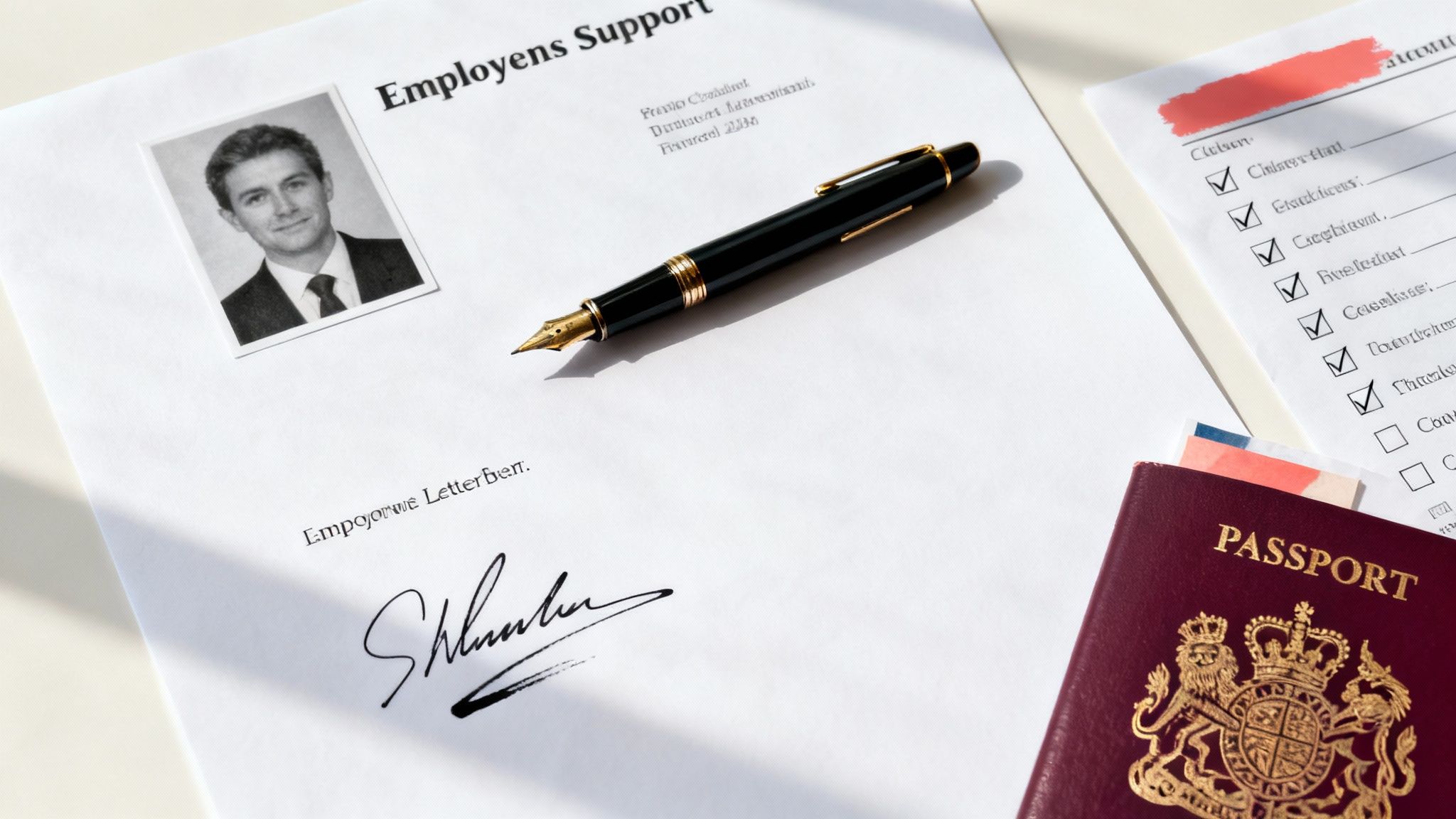
The application requires robust evidence, most critically a formal support letter from your employer on corporate letterhead, featuring a "wet-ink signature". This letter must articulate the specific business need for a second passport, proving it is an operational essential, not a mere convenience.

As you finalise your plans to move to the best country in Europe for your career, integrating this strategic tool into your preparation is a crucial step towards mitigating risk and ensuring your international mobility remains seamless. It transforms your ability to operate globally from your new European base, making you more agile, secure, and professionally effective.


Before you relocate, ensure your travel capabilities match your career ambitions. Check your eligibility for a second passport and download our Employer Letter Template to start your application and safeguard your global mobility.
A Complete Guide to China Visa Photo Requirements

Getting your visa photo right is the first, and arguably most important, step in a successful Chinese visa application. The specifications are incredibly strict and non-negotiable, so even a minor mistake can lead to an outright rejection. Your photo must be a recent, high-quality colour print measuring exactly 48mm high by 33mm wide, taken against a completely plain white background – a detail that often trips up UK applicants used to different standards.

Decoding China's Unique Photo Specifications

For anyone who travels frequently for business, a second passport is often a necessity. It lets you apply for a Chinese visa while your primary passport is off being used for another trip. But getting that visa depends entirely on submitting a photo that meets China's very specific, and often unfamiliar, criteria. It's not the same as a UK passport photo. The standard UK size is 45mm x 35mm, but for a Chinese visa, you need to follow their unique dimensions to the letter.

Even now, UK travellers must adhere to these precise rules: the photo must be 48mm x 33mm, with the head width between 15-22mm and head height from chin to crown measuring 28-33mm. All of this has to be against a flawless white background. These requirements, set directly by the Chinese Consulate, are a common stumbling block, and photo errors are a leading cause of frustrating application delays. You can learn more about how these regulations impact UK visa applicants.

To help you get it right the first time and avoid those costly delays, we've put together a quick-reference table. It’s designed to help corporate travel managers and applicants see the key differences at a glance and ensure every photo is compliant before it’s submitted.

China Visa Photo vs UK Passport Photo Specifications

One of the most common mistakes we see is people trying to use a standard UK passport photo for their China visa application. They simply won't be accepted. The dimensions, background colour, and even head size specifications are different, as you'll see below.

Specification China Visa Photo Requirement Standard UK Passport Photo
Photo Size Exactly 48mm x 33mm. Typically 45mm x 35mm.
Background Colour Pure white with no shadows, patterns, or objects. Light grey or cream-coloured.
Head Size (Height) 28mm – 33mm from chin to the crown of the head. 29mm – 34mm from chin to the crown of the head.
Head Size (Width) 15mm – 22mm at the widest part. Not explicitly specified, but must be centred.
Digital File Size 40KB – 120KB for online submissions (COVA form). N/A for standard print; digital is 50KB – 10MB.
Expression Neutral with mouth closed and eyes open. Neutral with mouth closed and eyes open.

As the table shows, the differences might seem small, but they are critical. Always double-check that your photo has been taken specifically for a Chinese visa to avoid any issues.

Getting the Photo Dimensions and Composition Right

Getting your China visa photo right comes down to the details. The Chinese authorities are incredibly specific about their requirements for both printed and digital photos, and there’s absolutely no wiggle room. If you’re used to the more relaxed rules for other countries, pay close attention here, as this is where many applications fall flat.

For the physical photo you'll submit, the dimensions are a non-standard 48mm high by 33mm wide. This is a frequent stumbling block for UK applicants, as it’s quite different from the typical British passport photo size. It’s not just about the overall size, though; what’s inside the frame is just as crucial for their biometric scanners to work correctly.

Head Size and Placement: The Make-or-Break Measurements

This is where you need to be precise. The height of your head, measured from the bottom of your chin to the crown, must be between 28mm and 33mm. At the same time, the width of your head needs to be somewhere between 15mm and 22mm.

These measurements aren't arbitrary; they ensure your facial features are perfectly proportioned for the official identification systems. You also need to leave a small, clear gap between the top of your hair and the top edge of the photo, so nothing gets cropped out.

Digital Photo Specs for Online Applications

If you're filling out the China Online Visa Application (COVA), you'll need to upload a digital copy of your photo. The technical rules for the file are just as strict as the physical ones, and getting them wrong can cause upload errors that stall your entire application.

  • File Format: It has to be a JPEG (.jpg). Don't even try uploading a PNG, HEIC, or any other format – the system will reject it.
  • Pixel Dimensions: The sweet spot is between 354 pixels wide by 472 pixels high and 420 pixels wide by 560 pixels high.
  • File Size: Make sure the file is between 40KB and 120KB. Anything smaller won't have enough detail, and anything larger will be kicked back.

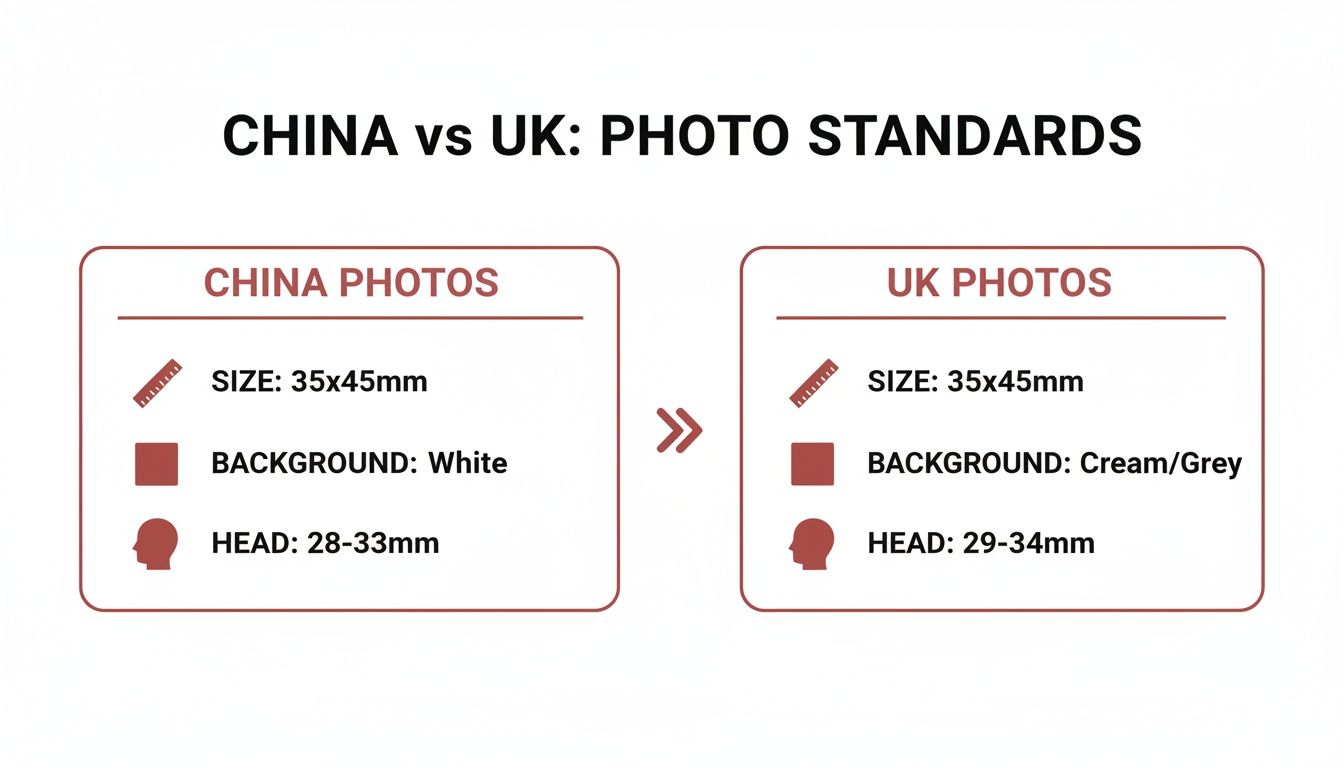
This comparison table really drives home the differences between what's needed for a Chinese visa and a standard UK passport.

Comparison table displaying passport photo standards for China and UK, including size, background, and head dimensions.

As you can see, trying to use a standard UK passport photo is a non-starter. The size and background colour are completely different, guaranteeing an instant rejection.

Getting the Background and Lighting Just Right

It’s easy to get bogged down in the technical details of dimensions and pixels, but from my experience, it’s the background and lighting that trip up most applicants. These aren’t just suggestions; the Chinese authorities have incredibly strict, non-negotiable standards designed for their biometric systems. A tiny shadow or an off-white background can be enough for an instant rejection, causing stressful and expensive delays.

For a China visa photo, the background must be plain, pure white. I can't stress this enough. There can be no patterns, no textures, no objects, and not even the slightest hint of discolouration. This is a common pitfall for UK applicants, as we're used to the light grey or cream backgrounds for our own passport photos. Any deviation from pure white will almost certainly get your application flagged.

A handsome man with dark hair, light eyes, and stubble wearing a black shirt, smiling slightly at the camera.

Mastering Uniform Lighting

Just as crucial is getting the lighting perfect. It needs to be completely uniform and free of shadows. In fact, shadows on the face or behind the head are one of the most frequent reasons for rejection I see. The idea is to light your face evenly from the front, getting rid of any dark patches or glare – which is especially important if you need to wear glasses.

Professional photo services use multi-light setups for this very reason. If you’re attempting this at home, try placing two light sources on either side of your face to balance things out and cancel any shadows. Whatever you do, don't stand directly under a ceiling light; it’ll create harsh, unflattering shadows under your eyes, nose, and chin.

Insider Tip: Try standing about half a metre away from the white background when the picture is taken. This simple step helps stop your own shadow from appearing behind your head—a very common mistake that can torpedo your application.

Choosing Your Clothing and Getting the Print Quality Right

What you wear actually matters a great deal. It’s all about creating enough contrast against that stark white background. Your best bet is to wear dark, solid-coloured clothing. Think a black, navy, or dark grey collared shirt. Steer clear of white or very light-coloured tops, as they'll just blend into the background and obscure the outline of your shoulders. Busy patterns and big logos are also out, as they distract from your face.

Finally, the physical photo itself is inspected closely. It must be a high-resolution, full-colour image printed on glossy photo paper. Matte or semi-gloss paper just won’t do. The image has to be sharp and in focus, with no pixelation, blurriness, or any damage like creases or smudges. A high-quality print is the final piece of the puzzle, ensuring your facial details are perfectly clear for the biometric scanners.

Getting Your Expression and Head Position Just Right

It’s not just about the technical specs like background colour or photo dimensions; how you hold your head and what your face is doing are just as critical. The Chinese authorities are looking for a photo suitable for biometric verification, which means they need a perfectly clear, neutral, and unobstructed view of your face. Getting this wrong is a surefire way to get your application rejected, which can throw a real spanner in the works for your travel plans.

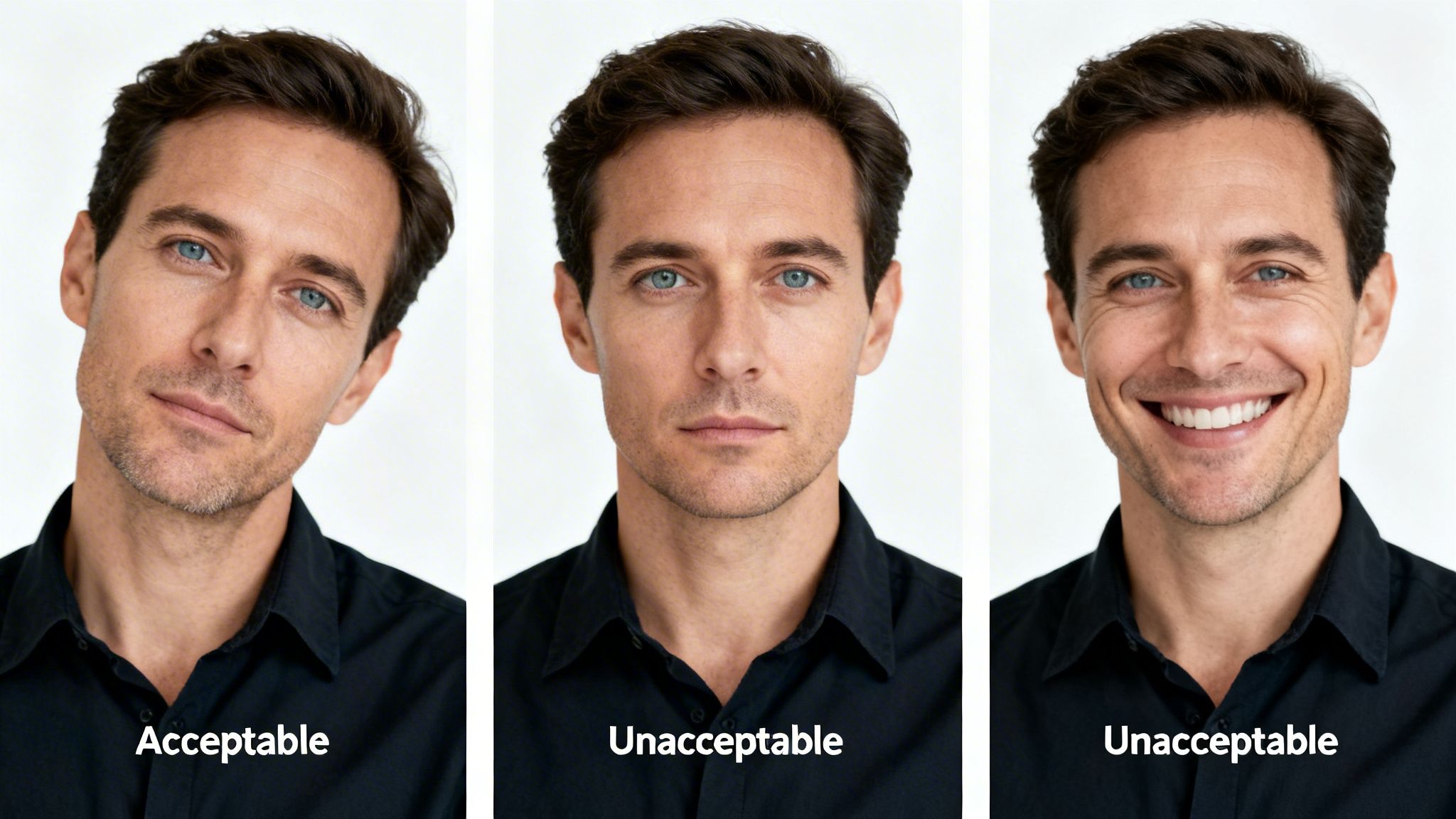
First things first, your expression must be completely neutral. That means no smiling, no frowning, no grinning – nothing. Keep your mouth closed and look directly at the camera. Your eyes need to be wide open and clearly visible. Think of it as a photo for a machine, not a person; this direct, emotionless gaze allows facial recognition software to map your features accurately.

Three visa photos of a man showing acceptable tilted head, and unacceptable straight face or smiling.

Nailing the Correct Head Alignment

Your head needs to be perfectly centred and facing the camera head-on. Don't tilt your head up, down, or to either side. Your entire face, from the top of your hair to the bottom of your chin and from one ear to the other, has to be in sharp focus. This is a non-negotiable part of the China visa photo requirements.

This strict positioning isn't just arbitrary; it's essential for the security systems at border control.

  • Biometric Scanning: A straight-on view lets scanners precisely measure the distances between your eyes, nose, and mouth.
  • Symmetry Checks: The system analyses facial symmetry, which is only possible when your head is perfectly straight and not at an angle.
  • Clear Features: Even a slight tilt can cast shadows or change the perceived shape of your features, causing a mismatch with the system.

Don't Forget Your Ears: A crucial detail that's often missed is that both of your ears must be visible. Make sure your hair is tucked behind them. This is a common and easily avoidable reason for rejection.

Ultimately, the goal is an image that is unambiguous and easy for a machine to read. Your head should be centred in the frame, both horizontally and vertically, with your shoulders squared to the camera. Follow these rules on expression and positioning, and your photo will sail through both the automated and manual checks, keeping your visa application moving smoothly. For anyone managing multiple applications, getting this right the first time is key to avoiding serious delays.

Rules for Glasses, Headwear and Accessories

Getting the rules right for what you can and can't wear in your China visa photo is absolutely crucial. These guidelines are incredibly strict, and even a tiny misstep can get your application bounced, leading to frustrating delays—a real headache for business travellers on a tight schedule.

Simply put, when it comes to glasses, the official stance is clear: they are generally not permitted. Your best bet is always to take them off before the photo is taken. This eliminates any risk of glare, reflections, or the frames blocking even a tiny part of your eyes, ensuring the biometric scanners get a perfect read.

Exceptions for Medical and Religious Reasons

Of course, there are a couple of very specific exceptions. The authorities do understand that some items can't be removed for genuine medical or religious reasons, but you'll still need to meet some very strict conditions.

An exception for glasses is only ever granted if they cannot be removed for medical reasons. If this is your situation, you have to make sure that:

  • The frames are thin, not heavy, and don't hide your eyes in any way.
  • The lenses are completely clear, with no tint or colour.
  • There is absolutely no glare or reflection on the lenses. This is notoriously difficult to get right, so extra care is needed.

It's a similar story for headwear. It’s only allowed for established religious or medical purposes. If you need to wear a head covering, it must not conceal any part of your face. Pay close attention to your forehead, eyebrows, eyes, and chin—they must all be completely visible. Another critical point is that the headwear can't cast any shadows on your face, which would compromise the clarity needed for identification.

A common mistake we see is hair or a head covering slightly obscuring the eyebrows or creating a faint shadow across the forehead. Both are grounds for immediate rejection, so double-check that your entire face is evenly lit and fully visible before submitting.

Strictly Prohibited Accessories

When it comes to anything else, the rules are black and white. Any accessory that isn't required for a documented medical or religious reason is strictly forbidden. Remembering this simple point will save you a lot of trouble.

The following items are not allowed, no exceptions:

  • Hats, caps, or any non-religious headbands.
  • Headphones, earbuds, or any similar devices.
  • Large, prominent jewellery, like chunky necklaces or dangling earrings.
  • Sunglasses or fashion glasses with any kind of tint.

At the end of the day, the goal is a clear, unobstructed photo of your face for security identification. By taking off all non-essential accessories, you give your application the best possible chance of sailing through without a hitch. For frequent travellers, that kind of attention to detail is what keeps everything moving smoothly.

How to Avoid Common Photo Rejection Errors

Getting a China visa photo rejected is one of the most common—and frustrating—reasons for application delays. It all comes down to the details. I've seen countless applications held up for simple, avoidable mistakes. Here’s a breakdown of the frequent culprits and how to get it right the first time, keeping your travel plans on schedule.

Sizing Errors and How to Fix Them

The sizing requirements are strict and non-negotiable: the photo must be exactly 48 mm high by 33 mm wide. This isn't your standard UK passport size, which trips up a lot of people.

To get the dimensions spot-on:

  • Use a dedicated service: Don't just crop a standard photo. Use a photo booth, professional service, or an app specifically set up for Chinese visa photos. They'll have the correct 48 × 33 mm template.
  • Check the head size: It's not just the overall photo. The head itself must be between 28 mm and 33 mm tall, and 15 mm to 22 mm wide.
  • Print and measure: Once you have the photo, print it on glossy paper and use a ruler to double-check the final dimensions. Don't just trust the screen.
Common Mistake The Fix How to Prevent It
Wrong overall size Resize the image digitally before printing, or just retake it. Always verify the print against a ruler. Don't eyeball it.
Head in the wrong position Frame the shot correctly from the start. Use your camera's gridlines to centre your face and leave the right amount of space above your head.
Digital file size incorrect Adjust the compression when you save the JPEG to get it between 40 KB and 120 KB. Most photo editors have a 'Save for Web' or export quality setting. Tweak it until the file size is right.

Background and Lighting Mistakes

Your background must be pure, plain white, with no shadows whatsoever. This is an automatic rejection point if you get it wrong.

Getting the lighting right is key. You'll want to position yourself at least 50 cm away from the white background—this simple trick helps eliminate any tell-tale shadows cast by the flash or overhead lights. For best results, use two light sources angled at 45° on either side of your face to ensure even, flat illumination.

Getting this wrong can cause serious delays. By 2023, the number of UK visa applications for China was already hitting 28,000 annually. Photo errors contributed to 18% of the total 7% denial rate, which for frequent flyers, often meant an average delay of 21 days. You can read more about these official findings on VisaForChina.cn.

A tip from the professionals: experienced visa consultants find that simple pre-submission checks can slash rejection rates by as much as 60%.

Expression and Accessories

The rules here are simple: look straight ahead, keep your expression neutral, and take off any accessories.

  • Your eyes must be fully open, and your mouth must be closed. No smiling.
  • Remove all glasses unless they are medically required. If you must wear them, make sure there's no glare on the lenses and the frames don't obscure your eyes.
  • All headwear is forbidden, except for religious reasons (and even then, your full face must be visible). Tuck your hair behind your ears so your eyebrows and jawline are completely clear.

Any glare from glasses or frames obscuring your eyes is a guaranteed rejection. It's often easier to just take them off for the photo.

A Final Pre-Submission Checklist

Before you hit 'submit' or seal that envelope, run through this one last time. It takes two minutes and can save you weeks of hassle.

  • Print Size: Is it exactly 48 mm × 33 mm?
  • Head Position: Is the head size correct and centred?
  • Background: Is it pure white, with absolutely no shadows?
  • Expression: Are you looking forward with a neutral expression?
  • Accessories: Have all glasses, hats, and large earrings been removed?
  • Digital File: Is it a JPEG file between 40 KB and 120 KB?

Treating this like a final quality control step is the best way to avoid resubmission fees and travel disruption. For travel managers and applicants alike, a few minutes of checking is all it takes to keep things moving.

Right, let's get this final check done properly. Before you even think about sending off your China visa application, it's absolutely crucial to give the photo one last, thorough look. This isn't just a box-ticking exercise; getting it wrong can mean delays, extra costs, and a whole lot of hassle.

For anyone managing corporate travel or just flying to China regularly, this checklist is your best friend. It boils down all the official rules into a straightforward, yes-or-no format. Run through it every single time to catch any potential problems before the consulate does.

The Final Pre-Submission Photo Checklist

Go through each point below. If you find yourself ticking 'No' for any of these, stop. You'll need to get a new photo, as the one you have is almost certain to be rejected.

Check Point Requirement Verification (Yes/No)
Physical Size Is the photo printed exactly 48mm high x 33mm wide?
Background Is the background pure, plain white with no shadows or patterns?
Head Size Is the head height 28-33mm and width 15-22mm?
Expression Is the expression neutral with the mouth closed and eyes open?
Head Position Are you facing forward with your head centred and both ears visible?
Glasses Are glasses removed? (Or medically necessary with no glare/obstruction)
Headwear Is all non-religious headwear removed?
Digital File Is the file a JPEG between 40KB and 120KB?

We've also made this available as a handy downloadable PDF. It’s perfect for popping into company travel packs or keeping on your desktop for quick reference.

Frequently Asked Questions

When you're dealing with the fine print of China visa photo requirements, it's easy to get bogged down in the details. This section tackles the most common questions we hear from travellers, giving you clear answers to get your application over the line without any last-minute hitches.

How Recent Must My China Visa Photo Be?

Your photo needs to be fresh. The official rule is that it must have been taken within the last six months.

Don't be tempted to reuse an old photo, especially one that's already on your passport or a previous visa. This is a classic mistake and a frequent cause for rejection. Your photo is a biometric snapshot, and if it doesn't match your current appearance, it can trip up the facial recognition systems used by Chinese immigration officials.

Can I Smile In My China Visa Photo?

No, you need to keep a completely neutral expression for this one. That means your mouth must be closed, with no smiling, grinning, or even frowning.

This isn't about looking serious for the sake of it; it's a technical requirement. A smile, however small, changes the precise geometry of your face—the distance between your eyes, the width of your mouth, and so on. These subtle shifts can be enough to confuse the automated biometric scanners, which leads to a failed check and an instant rejection of your photo.

What Should I Do If My Visa Photo Is Rejected?

If your photo gets rejected, the visa centre will let you know and ask for a new one that ticks all the boxes. Unfortunately, this means your application is on hold until they receive a compliant replacement.

The key is to find out exactly why it was rejected. Was it the background? Your expression? Once you know the reason, use the checklist in this guide to make sure the new photo fixes the specific problem. To avoid a second rejection, your best bet is often to go back to a professional service that knows the ins and outs of these strict rules. For anyone on a tight travel schedule, these delays can be more than just an inconvenience.

Can I Use a High-Quality Photo Taken With My Smartphone?

Technically, yes, you can use a smartphone photo, but it's incredibly tricky to get it right. You would have to nail every single detail—from the lighting and background to the final digital and physical dimensions.

Achieving a perfectly plain, shadow-free white background at home is tough without professional lighting. After that, the image must be resized to fit the digital specifications (354×472 to 420×560 pixels, 40-120KB) and printed to the exact physical size of 48mm x 33mm on glossy photo paper. Given how easy it is to miss a small detail, we strongly recommend using a professional service.


Juggling visa applications with a packed travel schedule is a constant challenge for global professionals. For frequent business travellers, a second passport serves as a critical 'Plan B', ensuring operational continuity by allowing you to apply for one visa while travelling on another. This legitimate HMPO service is the hidden solution for mitigating travel downtime and navigating the 'overlapping visa trap'. Start your application to secure your business travel at https://secondukpassport.com.

Singapore Visa for UK Citizens: A 2026 Guide

For most short trips to Singapore, British citizens do not need a visa and are granted visa-free entry for up to 90 days for tourism and most business activities. This visa-free arrangement streamlines travel, but all UK passport holders must complete the mandatory SG Arrival Card online before travel and ensure their passport has at least six months' validity. For frequent corporate travellers facing complex itineraries, a second UK passport is a strategic asset for maintaining operational continuity.

Your Essential Checklist for Entering Singapore

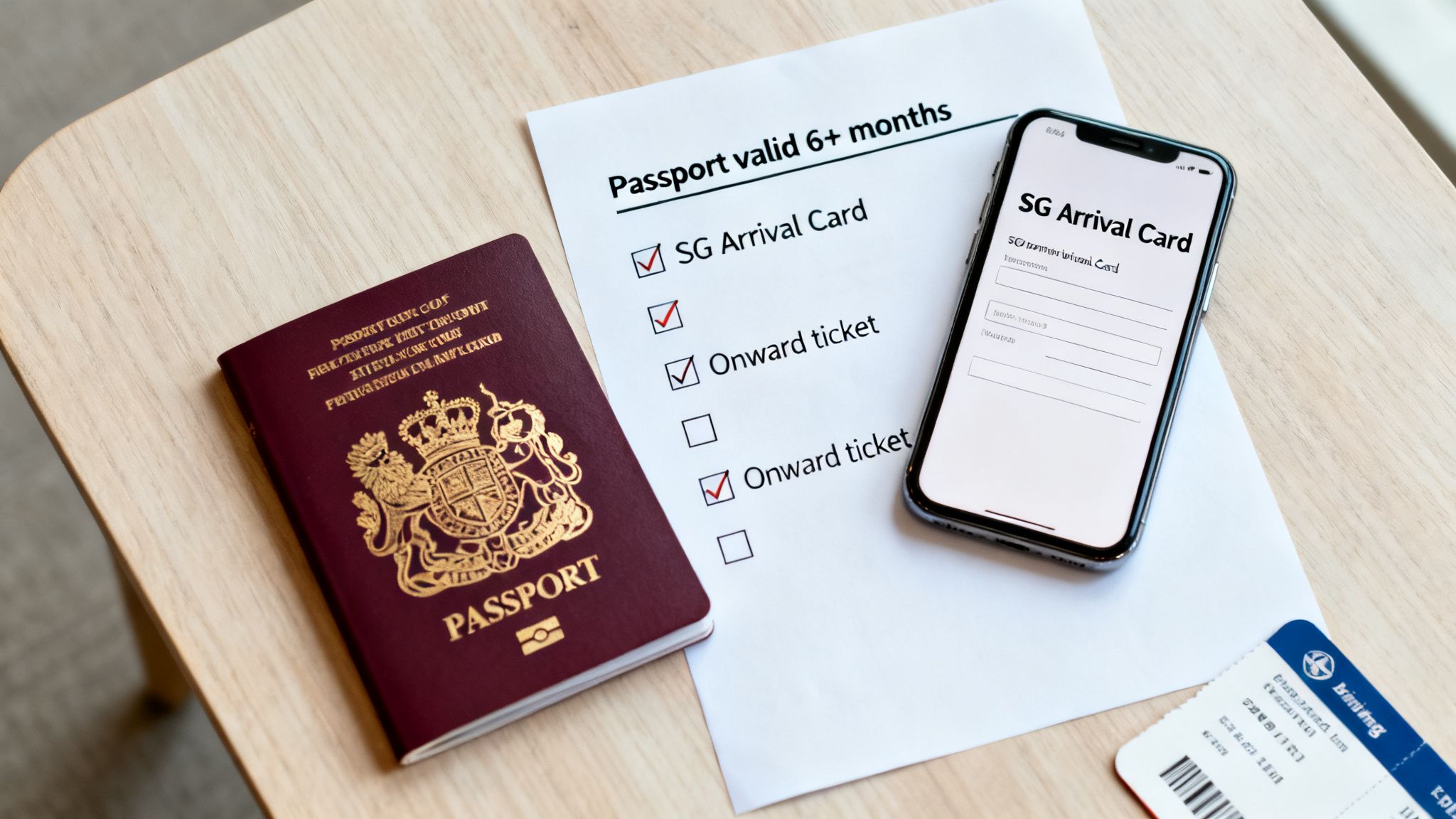
A UK passport, a travel checklist with checked items for Singapore, and a phone displaying an SG Arrival Card.

Even though a visa is not typically required, planning a trip to Singapore demands professional attention to detail. For corporate travel managers and frequent flyers, confirming every entry requirement is the first step towards a smooth, hassle-free journey. This process should be approached with the same diligence as a full visa application to mitigate any risk of travel disruption.

This pre-flight checklist provides a clear, actionable rundown of the essential requirements for any UK citizen travelling to Singapore. Adhering to these basics prevents delays at immigration and allows professionals to focus on the purpose of their visit.

Key Entry Requirements at a Glance

For short stays such as business meetings, conferences, or tourism, Singapore’s entry rules are straightforward but strictly enforced. Immigration officers expect all travellers to present the correct documentation upon arrival. This is not merely administrative paperwork; it is your permit for seamless entry.

It is important to note that the SG Arrival Card is not a visa. It is a mandatory digital declaration required for all individuals entering the country, replacing the legacy paper-based landing cards. You must complete this online within the three days immediately preceding your arrival.

The table below summarises each requirement with a practical tip based on extensive travel experience. For professionals managing complex travel schedules or simultaneous visa applications, it may be beneficial to explore the advantages a second UK passport can provide.

Singapore Entry Requirements for UK Citizens on Short-Term Visits

Here is a summary of the key requirements for UK citizens travelling to Singapore for tourism or short-term business purposes.

Requirement Details Expert Travel Tip
Visa-Free Period UK citizens can enter Singapore without a visa for up to 90 days for tourism, social visits, or business meetings. Do not mistake this for a right to work. If you plan to undertake paid employment, even on a short-term basis, you must secure the appropriate work pass.
Passport Validity Your British biometric passport must have at least six months' validity remaining from your date of entry into Singapore. Verify your passport's expiry date at the start of your travel planning. If it is approaching the six-month threshold, renew it immediately to avoid being denied boarding by your airline.
SG Arrival Card (SGAC) This is a mandatory electronic health and travel declaration. You must submit it online via the official ICA website within three days prior to your arrival. Complete this on a mobile device or laptop before leaving for the airport. The submission is free on the official government site—be cautious of third-party websites that charge a fee.
Proof of Onward Travel Immigration officers may request to see a confirmed flight ticket proving your intention to depart Singapore. Always have a copy of your flight itinerary—either digital or printed—readily accessible. This confirms your intent to leave within the permitted 90-day period.

Adherence to these guidelines will ensure your arrival in Singapore is straightforward, allowing you to proceed with your business or holiday without interruption.

Singapore's Visa-Free Entry: What UK Passport Holders Need to Know

For UK passport holders, entry into Singapore for short-term visits is remarkably efficient. As a British citizen, you are permitted to enter without a visa and stay for up to 90 days. This arrangement makes Singapore a convenient destination for tourism and business travel, reflecting the strong bilateral relationship between the two nations.

However, this 90-day entry permission is granted for specific short-term purposes. Overstaying or engaging in unauthorised activities constitutes a serious violation of Singapore's immigration laws. It is a visitor's pass, not an implicit approval for work or residency.

What You Can (and Can't) Do on a Visa-Free Stay

The 90-day visa exemption is designed for visits where you are not being paid by a Singaporean employer. A wide range of activities fall under this provision.

Here’s what’s typically allowed:

  • Tourism and Leisure: Sightseeing, visiting friends and family, and general tourism are fully permitted.
  • Business Meetings and Negotiations: Attending client meetings, negotiating contracts, or participating in conferences are standard and acceptable business visitor activities.
  • Short-Term Training: Attending a professional seminar or corporate training course is generally permissible, provided it is not a long-term, structured educational program.

The definitive restriction is local employment. If you intend to accept a job with a Singapore-based company, the visa-free entry route is not applicable. This requires a formal work pass, a separate and distinct application process.

The Mandatory SG Arrival Card

One critical step that can be overlooked is the mandatory SG Arrival Card (SGAC). To be clear: this is not a visa.

The SG Arrival Card functions as a digital landing card. It is an administrative tool used by Singapore's immigration and health authorities to pre-screen arrivals and does not confer any special permissions.

You must complete the SGAC online within the three days prior to your arrival in Singapore. It is only valid if submitted within this timeframe. The official Immigration & Checkpoints Authority (ICA) website is the sole platform for this submission, and it is entirely free. Avoid third-party sites that request payment.

How to Fill Out the SG Arrival Card

The process is efficient and takes only a few minutes with your travel details on hand.

  1. Navigate to the Official Website: Go directly to the official ICA portal for the SG Arrival Card.
  2. Enter Passport Details: Provide your personal information—name, date of birth, nationality—exactly as it appears in your biometric passport.
  3. Add Trip Information: Input your flight details, date of arrival, and the address of your accommodation in Singapore.
  4. Make a Health Declaration: Answer a few standard questions regarding your recent travel history and health status.
  5. Review and Submit: Double-check all information for accuracy, then submit the form. You will receive an email confirmation; keep this accessible on your phone to present to an immigration officer if requested.

When a Visa Is Required for Your Trip to Singapore

The 90-day visa-free arrangement is ideal for tourism and short business trips but is not suitable for all circumstances. If your plans involve employment, long-term study, or establishing residency, you must obtain a specific pass or visa.

Understanding this distinction is critical for both individual travellers and the corporate managers coordinating their assignments. Attempting to work or study on a short-term visit pass is a serious violation of Singapore's immigration laws and can result in severe penalties. Securing the correct documentation in advance is non-negotiable for any long-term stay.

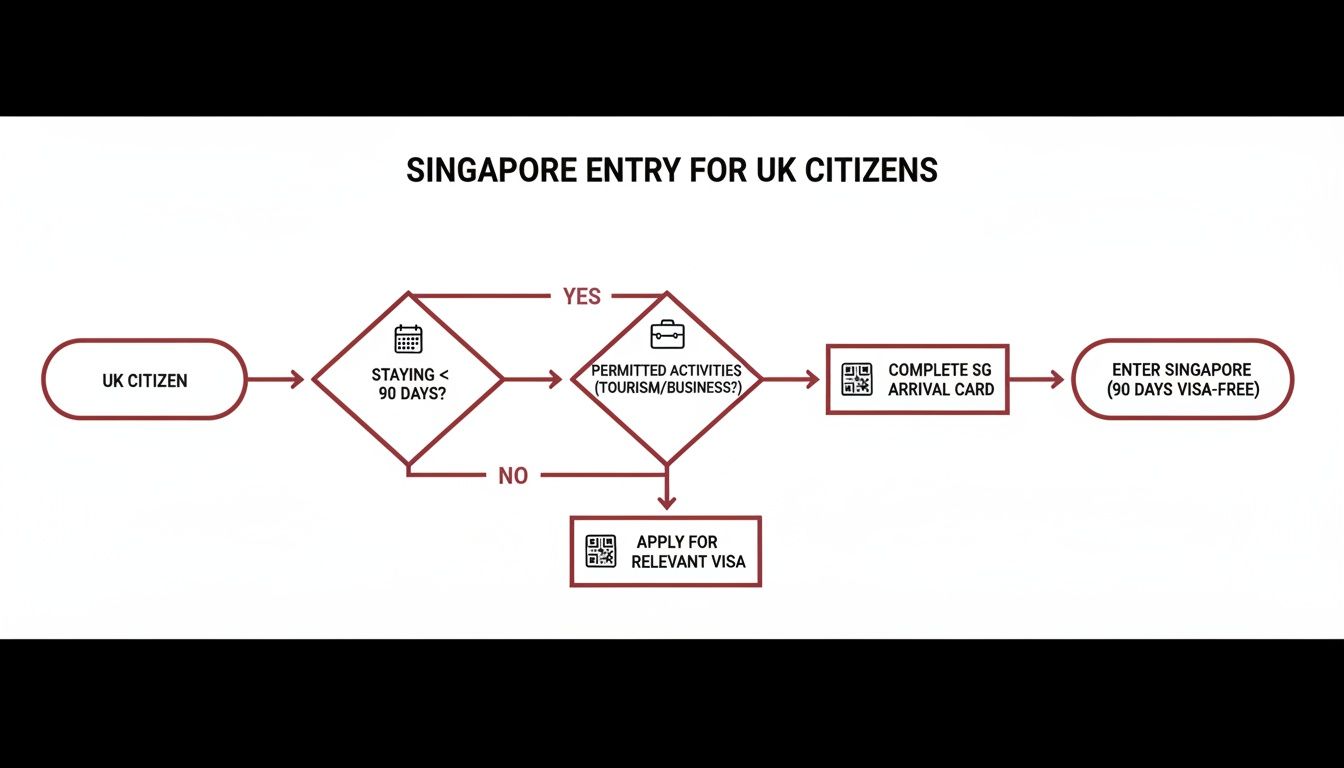
This flowchart provides a visual guide to help determine if your travel plans align with the visa-free model or require a formal application.

Flowchart detailing Singapore entry requirements for UK citizens, including visa-free eligibility conditions and visa application steps.

The primary factors are the duration and purpose of your stay. The one universal requirement for all travellers remains the SG Arrival Card.

Navigating Work Passes for Professionals

For a UK citizen with a job offer in Singapore, securing the correct work pass is the first priority. Singapore’s Ministry of Manpower (MOM) operates a structured, tiered system designed to attract global talent.

The most common work passes include:

  • Employment Pass (EP): The standard pass for foreign professionals, managers, and executives. Eligibility is based on qualifications and a minimum salary threshold, which varies by age and industry.
  • S Pass: Designed for mid-level skilled technicians, the S Pass has a lower salary requirement than the EP. Employers are subject to a quota and must pay a monthly levy for each S Pass holder.
  • Personalised Employment Pass (PEP): A premium option for high-earning EP holders or elite overseas professionals. It offers greater flexibility as it is not tied to a single employer, allowing the holder to switch jobs without reapplying for a new pass.

A critical point to remember: your employer is required to apply for the work pass on your behalf before you can legally commence employment. You cannot apply for these passes independently; a local sponsor (your employer) is mandatory.

The professional ties between the UK and Singapore are well-established. Data from 2013 shows an estimated 40,000 Singaporean nationals resided in the UK, demonstrating a strong, two-way flow of talent. Historical visa data from 2010-2014 reveals a consistent number of Singaporeans arriving under skilled work and study schemes, reflecting the mutual mobility UK professionals benefit from today. You can explore further visa statistics on the official ONS site for more detailed trends.

Securing a Student's Pass for Education

If you are a UK citizen enrolling in a full-time course at an accredited institution in Singapore, you must apply for a Student's Pass. This is required for all programmes, from university degrees to intensive language courses.

The application process is managed through Singapore's Immigration & Checkpoints Authority (ICA), initiated by your educational institution. A formal letter of acceptance is a prerequisite.

The process typically involves these steps:

  1. Receive Your Offer: Upon acceptance, the institution registers you in the ICA’s online portal, the Student's Pass On-Line Application & Registration (SOLAR) system.
  2. Submit Your Application: The institution provides you with the registration details needed to log in and complete your application online.
  3. Receive In-Principle Approval (IPA): Successful applicants receive an IPA letter, which also serves as a single-entry visa to travel to Singapore.
  4. Complete Formalities: After arriving, you will attend a scheduled appointment at the ICA to finalise the process and collect your official Student's Pass.

Your Student's Pass is tied to your specific course. Changing your course or institution necessitates a new application.

Breaking the Overlapping Visa Trap with a Second UK Passport

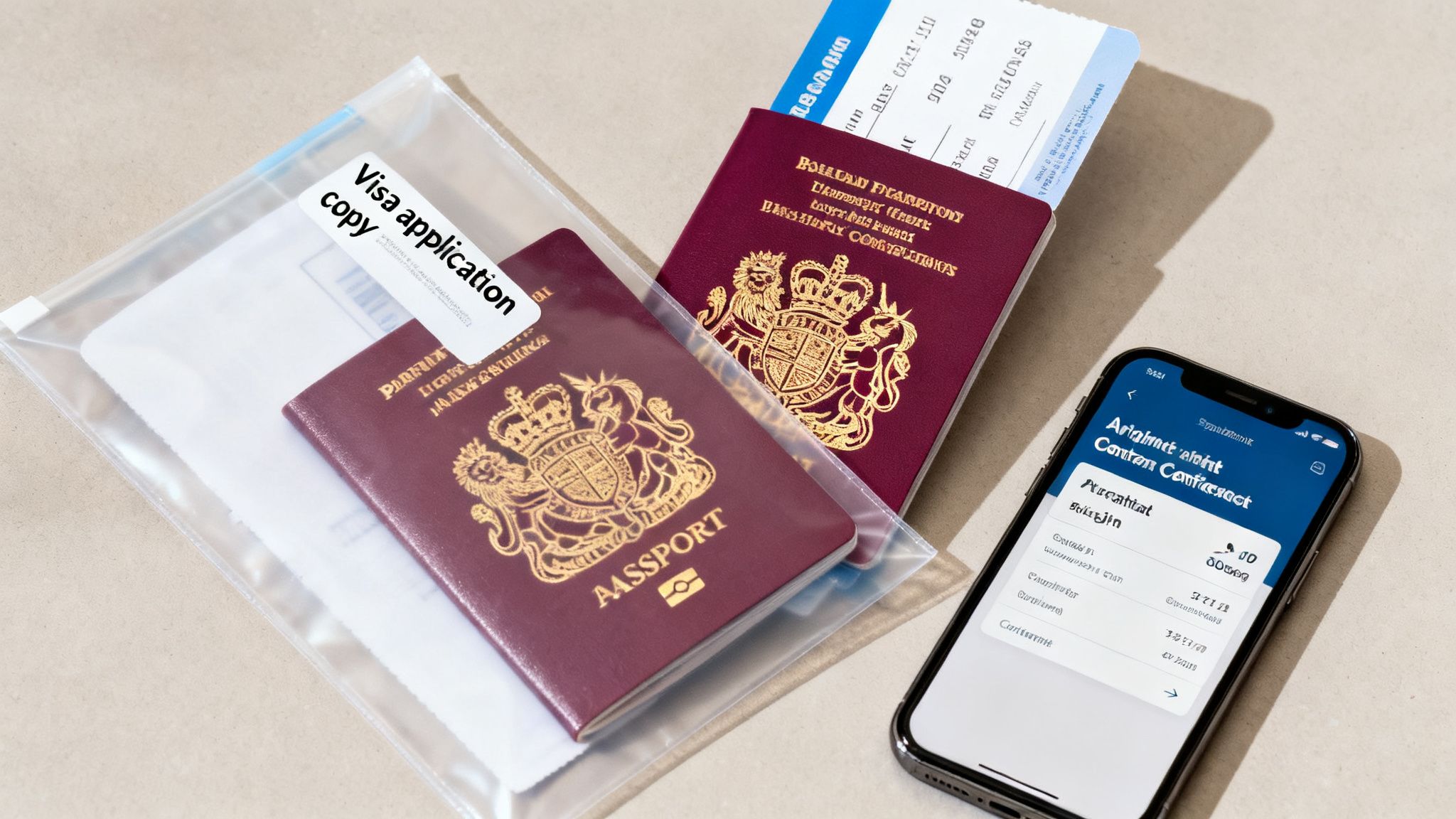
Close-up of UK passports, a visa application copy, a boarding pass, and a smartphone with a travel app.

Frequent business travellers often encounter a common logistical challenge. Your passport is submitted for a long-term Singapore work visa application, a process that takes weeks. Suddenly, an urgent, non-negotiable client meeting is scheduled in Dubai for the following week.

This is the "Overlapping Visa Trap." Your primary travel document is held by an embassy, effectively grounding you when you need to be mobile. This is more than an inconvenience; it directly impacts business outcomes. Every day your passport is unavailable represents lost revenue, stalled projects, and missed opportunities.

A second UK passport is the hidden solution—a vital tool for Operational Continuity. It is not a luxury but a strategic business asset, a legitimate "Plan B" sanctioned by Her Majesty’s Passport Office (HMPO) for those with a genuine need.

How a Second Passport Provides a Strategic Advantage

A project manager leading a major infrastructure project in Southeast Asia, using Singapore as a regional base, requires a Singapore Employment Pass. This requires submitting her passport for processing.

While the application is pending, she must fly to the Middle East to secure a critical supply chain deal. Without her passport, she is grounded. She faces an impossible choice: delay the supplier meeting or postpone her essential deployment to Singapore. Both options result in costly business setbacks. This is precisely the gridlock a second passport is designed to overcome. It is an insurance policy against travel downtime.

The Second Passport as a Solution

A second UK passport resolves this deadlock. HMPO provides this official service for individuals who can prove a genuine need for concurrent travel and visa applications.

Here is how it functions in practice:

  1. Primary Passport for Visa: She submits her primary passport to the Singaporean authorities for her Employment Pass application.
  2. Second Passport for Immediate Travel: She uses her second, equally valid British passport to fly to Dubai for the supplier meeting, maintaining business momentum.
  3. Seamless Continuity: Once the Singapore visa is issued and her primary passport is returned, she continues her travel schedule without having ever been constrained.

This two-passport strategy ensures long-term strategic goals, like securing a work pass, do not paralyse essential short-term operational tasks.

The concept is simple: a second passport allows you to be in two places at once, bureaucratically. One document can be processing in a visa application queue while the other remains with you, ready for immediate travel.

Proving Genuine Need: The Employer Letter

Securing a second passport requires proving a genuine professional need. The cornerstone of a successful application is a formal employer letter that meets strict HMPO requirements. This letter is the primary evidence used to justify your request.

The letter must be on official company letterhead, clearly state why a single passport is insufficient for your role, detail your frequent travel schedule, and highlight the need for simultaneous visa applications. Crucially, it must be signed with a "wet-ink signature" by a senior manager. Digital signatures are a frequent cause of rejection. For more information on the process for obtaining a second UK passport, consult our detailed guides.

Navigating Complex Itineraries and Conflicting Entry Stamps

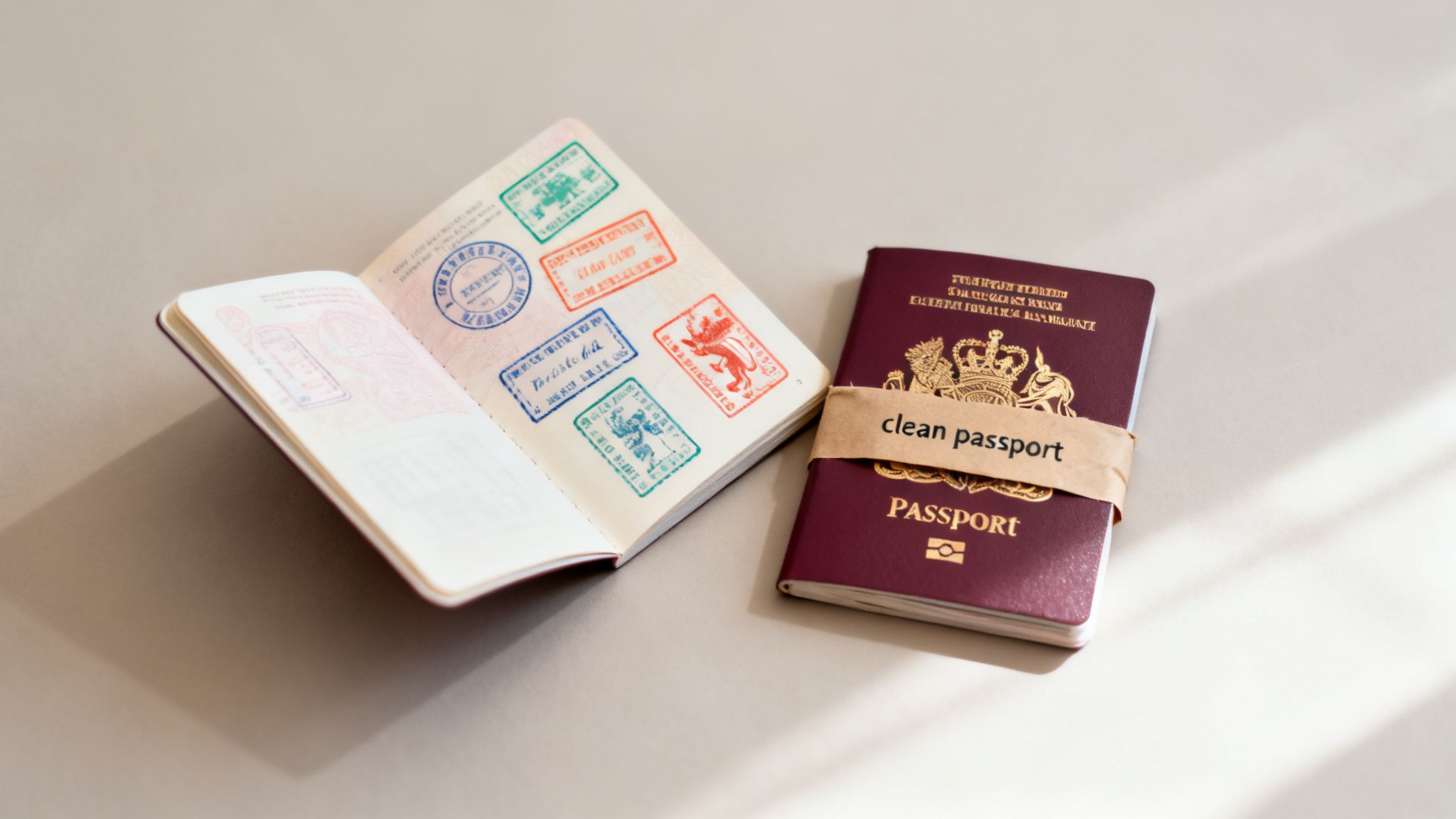
Two passports on a light surface, one open with colorful visa stamps, the other closed labeled "clean passport."

For professionals in sectors such as energy, humanitarian aid, or aviation, international travel often involves complex itineraries between countries with sensitive political relationships. An entry stamp from one nation can result in significant scrutiny—or an outright entry ban—at the next border. In these situations, a passport becomes a logistical liability.

For instance, an entry stamp from Israel can lead to denial of entry in certain other Middle Eastern countries. This is a serious operational risk that can derail critical missions and compromise personal safety. For these professionals, managing their travel history is a core component of their job.

A second UK passport is an essential tool for Risk Mitigation. This legitimate option, provided by Her Majesty’s Passport Office (HMPO), allows you to strategically separate your travel histories, ensuring operational continuity regardless of itinerary complexity.

The Strategic Value of a 'Clean' Passport

Holding two passports allows you to designate one for travel to regions that may result in politically sensitive entry stamps, while keeping the other 'clean' for seamless entry into major business hubs like Singapore.

This separation of travel history transforms your approach from reactive problem-solving to proactive risk management. Instead of facing uncertainty at immigration, you can plan complex multi-leg journeys with confidence, knowing you have the appropriate document for each destination.

A second passport functions as a geopolitical firewall. It ensures that travel to one sensitive region does not compromise your access to another, providing seamless mobility and an essential layer of personal security.

This is an official provision for UK citizens who can demonstrate a genuine need, such as rotational workers in the energy sector or NGO staff operating in volatile zones.

Ensuring Smooth Entry into Singapore and Beyond

Singapore's immigration officers are thorough. While your UK passport grants visa-free access, your travel history will be reviewed. A passport containing stamps from politically sensitive regions can trigger additional questions and cause unnecessary delays.

By presenting a 'clean' biometric passport—one used for travel to destinations like Europe, North America, and other parts of Asia—your arrival in Singapore is streamlined. It removes potential ambiguity and allows for a swift entry process. Your entry as a UK citizen is resolved quickly with the standard 90-day visa-free allowance. If this solution fits your travel profile, it is worth investigating the specific criteria for second passport eligibility.

The 2026 Legal Landscape: A New Urgency for UK Entry

Travel rules are constantly evolving. As of February 25, 2026, UK entry rules have been tightened. Dual nationals can no longer use a foreign passport alone to enter the UK; they must present a valid British passport or a digital Certificate of Entitlement (COE) to avoid being denied boarding by carriers. Furthermore, British citizens are ineligible for the UK's new Electronic Travel Authorisation (ETA) system, making possession of a valid British passport the only seamless method for entering the country.

Your Questions Answered: Singapore Travel for UK Citizens

Here we address common practical questions from UK travellers and corporate travel managers. Consider this a final pre-flight check to resolve any remaining uncertainties.

Can I Extend My 90-Day Stay in Singapore?

Yes, an extension is technically possible, but it is not guaranteed. If you require a stay beyond the initial 90-day visa-free period, you must apply for an extension of your Short-Term Visit Pass (STVP) through Singapore's Immigration & Checkpoints Authority (ICA).

A compelling reason, such as a medical issue or family emergency, is required. The application must be submitted online via the ICA's portal before your current pass expires. Approvals are granted on a strict case-by-case basis.

What Happens if I Overstay My Visa in Singapore?

Do not overstay. Overstaying is a serious offence in Singapore with severe penalties. The immigration laws are strictly enforced, and violations can impact your future travel eligibility worldwide.

Potential consequences include:

  • Significant Fines: Financial penalties can be substantial.
  • Imprisonment: For serious overstays, a jail sentence is a possibility.
  • Deportation and Ban: You will be removed from the country and may be banned from re-entering Singapore, potentially for life.

Always depart on or before the date stamped in your passport.

Do I Need Proof of a Return Ticket to Enter?

While immigration officers may not always ask to see it, they are entitled to. It is highly advisable to have it ready.

A confirmed flight itinerary showing departure from Singapore within the 90-day window is the clearest proof of your intent to comply with immigration rules. It simplifies the arrival process and preempts any challenging questions.

Failure to provide proof upon request could lead to further questioning or, in a worst-case scenario, denial of entry.

The 2026 Rule Change and Dual Nationals

As of February 25, 2026, UK entry rules require all British citizens, including dual nationals, to present a valid British passport or a digital Certificate of Entitlement (COE) to their carrier to enter the UK. Using a foreign passport alone is no longer sufficient and will likely result in being denied boarding. Additionally, British citizens are not eligible for the UK's Electronic Travel Authorisation (ETA) system. A valid British passport is therefore essential for seamless entry into the UK.


At Second UK Passports, we specialise in helping frequent travellers and corporate clients secure this essential travel asset. A second passport is the definitive solution to ensure your global mobility is never compromised by visa processing delays, conflicting stamps, or emergencies.

Check your eligibility and start your application today.

Do You Need a Visa for Malaysia? A 2026 UK Traveller’s Guide

For most trips, the answer is a straightforward no—British citizens do not need a visa for Malaysia if they're visiting for tourism or business for up to 90 days. This makes planning a trip feel refreshingly simple, but knowing the specifics is what separates a smooth arrival from a stressful one. This guide explains the current entry rules and why a second UK passport is a hidden solution for frequent travellers facing logistical challenges.

Your Guide to UK Travel to Malaysia

The question "do you need a visa for Malaysia?" is common for UK-based professionals mapping out business trips. Thankfully, Malaysia's generous visa-free arrangement means you can focus more on your itinerary and less on tedious paperwork.

However, 'visa-free' doesn't mean 'requirement-free'. There are non-negotiable conditions you must meet to be waved through immigration. Getting these right is key to avoiding last-minute hitches that could jeopardise your entire trip.

Essential Entry Conditions for British Citizens

Before booking flights, check your travel documents. The Malaysian authorities are clear about their requirements, and meeting them is essential for a hassle-free entry.

Think of it as a pre-flight checklist:

  • Passport Validity: Your British biometric passport must have at least six months of validity remaining from the day you plan to enter Malaysia.
  • Blank Passport Pages: You'll need at least one clean, blank page for immigration stamps.
  • Malaysia Digital Arrival Card (MDAC): This is a mandatory online registration you must complete within the three days leading up to your arrival.

This visa-free access for trips up to 90 days has been in place for years and is re-confirmed in the UK government's official travel advice for 2026. This means you can arrive with your valid passport and MDAC confirmation, making Malaysia an incredibly accessible destination. You can always verify the latest details on the GOV.UK travel advice page for Malaysia.

To make this even clearer, here’s a quick-glance checklist for a smooth entry.

UK Citizen Visa-Free Entry Checklist for Malaysia

This table summarises exactly what you need to have in order before you travel.

Requirement Details and Official Source Key Traveler Note
Visa-Free Period Up to 90 days for tourism or business. You cannot work or study on this entry. For longer stays or other purposes, a visa is required.
Passport Validity Must be valid for at least 6 months from your date of entry. Check your passport's expiry date now. It's the most common reason for being denied boarding.
Digital Arrival Card Mandatory MDAC must be completed online within 3 days of arrival. Keep the confirmation email handy on your phone. Some airlines ask to see it at check-in.
Proof of Onward Travel A confirmed ticket to leave Malaysia (within the 90 days). Immigration officers may ask to see your return or onward flight booking as proof you intend to leave.

Having these four items sorted gives you the best chance of walking through Malaysian immigration without a single issue.

The Challenge for Frequent Global Travellers

While Malaysia's rules are straightforward, a classic problem catches many seasoned professionals out: the "Overlapping Visa Trap." Imagine you need to be in Kuala Lumpur for a vital meeting, but your only passport is stuck at an embassy for a complex visa application for another country. This scenario can grind your business travel to a complete halt.

This is precisely where a second UK passport becomes a business asset for "Operational Continuity" and "Risk Mitigation." It's a fully legitimate service offered by Her Majesty’s Passport Office (HMPO) that allows one passport to be tied up in a lengthy visa process while your other one is free for immediate, visa-free trips to countries like Malaysia. Think of it as your strategic "Plan B" or "Insurance Policy" to eliminate travel downtime.

Navigating Malaysia's Visa-Free Entry Rules

So, do you need a visa for Malaysia? For British citizens on a short trip, the answer is usually no, but you must follow a clear set of rules. Getting these details right is crucial for any business traveller looking to avoid headaches at the border.

Your Passport: The Non-Negotiable Basics

The first and most important hurdle is your passport's validity. As highlighted by GOV.UK, Malaysian immigration is firm: your British passport must be valid for at least six months from the day you land. This is a strict requirement and a common reason people get turned away by their airline before they even leave the UK.

You’ll also need at least one completely blank page for the entry and exit stamps. This might sound minor, but for frequent flyers whose passports are a mosaic of stamps, it can be a real issue. A second passport often becomes an operational essential to ensure you're always ready to travel.

Don't Forget the Malaysia Digital Arrival Card (MDAC)

A crucial part of your pre-flight checklist is the Malaysia Digital Arrival Card (MDAC). This isn't a visa, but it is a mandatory online form that you must complete within three days of your arrival.

Once you’ve submitted it, you'll get a confirmation email. Have a screenshot of this on your phone, as airline staff and immigration officers will likely ask to see it. Forgetting to do this can lead to unnecessary delays when you land.

At the Immigration Counter

Even with the right passport and your MDAC sorted, the final decision rests with the border official. They need to be confident that you’ll leave the country within your permitted 90-day visa-free window.

Be ready to show them:

  • A confirmed return or onward flight ticket: This is the clearest proof you have a plan to exit Malaysia on time.
  • Proof of sufficient funds: They don't always ask, but you might need to show you can support yourself during your stay.

Having these documents ready will make for a smooth and professional arrival. For busy professionals juggling multiple trips, knowing these fine details is key. You can learn more about how a second passport provides vital travel flexibility in our detailed overview.

The 2026 UK Entry Rules for Dual Nationals

As of February 25, 2026, UK entry rules have tightened. Dual nationals can no longer use a foreign passport alone to enter the UK; they must present a valid British passport or a digital Certificate of Entitlement (COE) to avoid being denied boarding by carriers. Furthermore, British citizens are ineligible for the new Electronic Travel Authorisation (ETA) system, making possession of a valid British passport the only seamless way to enter the UK.

When You Absolutely Need a Malaysian Visa

The 90-day visa-free arrangement is a fantastic perk for UK citizens, but it’s crucial to understand its limits. The moment your plans involve work or study, the answer to "do you need a visa for Malaysia?" becomes a firm "yes."

Trying to work or enrol in a course on a tourist stamp is a serious breach of Malaysian immigration law. The authorities are strict, and getting caught can lead to hefty fines, detention, and being barred from re-entering the country. For anyone planning a long-term assignment, getting the right paperwork sorted from the beginning is non-negotiable.

This handy infographic lays out the essentials for a standard visa-free entry from the UK.

A decision tree flow chart outlining UK entry requirements for Malaysia, including passport, MDAC, and sufficient funds.

As you can see, the visa-free route is straightforward for tourism. But if your plans don't fit into that box, you’ll need to apply for a proper visa or pass.

Scenarios Demanding a Formal Visa Application

If your reason for travelling fits one of the descriptions below, you must secure the correct pass before you fly. You cannot just arrive on a tourist stamp and hope to change it later.

  • Long-Term Employment: Landed a job with a Malaysian company? You'll need an Employment Pass. Your employer sponsors this and handles the initial application.
  • Higher Education: If you're enrolling at a Malaysian university, a Student Pass is essential. Your educational institution kicks off this process.
  • Specialised Professional Visits: For foreign experts brought in for specific, highly skilled projects, the Professional Visit Pass (PVP) is the correct route.
  • Dependants of Pass Holders: If your spouse or parent holds an Employment Pass, you'll need a Dependant Pass to legally live with them in Malaysia.

It all boils down to your intent. The 90-day visa-free entry is for temporary visitors. A long-stay permit like an Employment Pass signals a deeper commitment to living and working in Malaysia, which involves a much more thorough application process.

Understanding the Application Process

Securing a long-stay pass for Malaysia is a multi-stage affair requiring a stack of documents and is nearly always initiated by your sponsor in Malaysia. The requirement for a formal employer support letter on corporate letterhead featuring a "wet-ink signature" is strict to avoid application rejection.

Here’s a simplified breakdown of the steps:

  1. Sponsor Application: Your Malaysian employer or university submits the main application to the Immigration Department of Malaysia.
  2. Visa with Reference (VDR): Once approved, you get a VDR approval letter. This is a crucial document, but it’s not your final visa.
  3. Embassy Endorsement: You take the VDR letter to the Malaysian Embassy or High Commission in your home country to get a single-entry visa sticker in your passport.
  4. Arrival and Final Endorsement: You travel to Malaysia on this single-entry visa, where the Immigration Department will endorse your passport with the final long-term pass sticker.

This entire chain of events can easily take several weeks. For busy professionals who can't afford to have their passport tied up, this is where a second UK passport proves invaluable. It allows you to submit one passport for the lengthy visa process while you continue travelling on the second. To see how this works, have a look at our in-depth guide on acquiring a second passport.

What Happens When Your Passport is Stuck at an Embassy?

For any frequent traveller, time is everything. Asking "do you need a visa for Malaysia?" is simple for a one-off holiday. But what if you're a professional juggling a hectic international schedule? Suddenly, a visa-free trip can become a massive headache.

Picture this: you have a vital client meeting in Kuala Lumpur, relying on Malaysia's 90-day visa-free entry. The problem? Your only passport is tied up at an embassy, waiting weeks for a visa to be processed for another trip.

This is the classic 'Overlapping Visa Trap'. It’s a common scenario that grounds key personnel, jeopardises deals, and brings business to a screeching halt. A single, slow visa application can block all other international travel.

Two British passports, a visa application envelope, and a plane ticket on a table, signifying travel preparation.

Your Secret Weapon: The Second UK Passport

This is exactly where a second UK passport becomes an essential tool for "Operational Continuity." This isn't some back-alley trick; it's a fully legitimate service offered by Her Majesty’s Passport Office (HMPO) for British citizens who can demonstrate a "genuine need" for simultaneous travel.

Holding two valid biometric passports means you can sidestep the Overlapping Visa Trap entirely.

Think of it as the ultimate "Insurance Policy" for your travel schedule. You can submit one passport for a visa application that might take weeks, while your second passport stays with you, ready for immediate, visa-free trips to places like Malaysia. Your mobility is never compromised.

A second UK passport is the definitive answer for maintaining operational continuity. It allows professionals to handle simultaneous visa applications and travel plans without conflict, turning a logistical mess into a seamless process.

This service is specifically for people whose jobs demand this kind of flexibility, a recognition that for certain roles, a single passport isn't fit for purpose.

Who Actually Needs This? Real-World Examples

The "genuine need" for a second passport is clearest in industries where constant international travel is the norm, such as aviation and energy.

The Airline Crew Imperative

For pilots and cabin crew, flight schedules are planned down to the minute. The Overlapping Visa Trap is a direct threat to their ability to do their jobs.

  • Juggling Rotations: A pilot might need a visa for China while being scheduled for flights to the Middle East and a visa-free stopover in Kuala Lumpur.
  • Avoiding Being Grounded: If they submit their only passport for the Chinese visa, they are instantly grounded for all other international duties, throwing rosters into chaos.
  • The Smart Solution: A second passport is an "Operational Essential." It lets them apply for the long-winded visa while using the other to continue flying their full international schedule.

For airlines, ensuring UK-based crews have second passports is smart risk management, preventing visa paperwork from interfering with flight operations.

The Rotational Worker Lifeline

Professionals in the energy sector, especially "Rotational Workers" in oil and gas or NGO staff, face similar challenges. Their work often sends them to visa-intensive or sensitive regions.

  • Back-to-Back Assignments: An engineer could finish a rotation in West Africa and need to fly immediately to a project briefing in Malaysia.
  • Conflicting Timelines: The visa for their next assignment might require their passport for several weeks, overlapping directly with their travel to Malaysia.
  • Eliminating Costly Downtime: With a second passport, they can leave one document with the visa agent and use the other for their immediate trip. This ensures they can move between projects without delay.

In both of these scenarios, the second passport isn't a luxury. It's a fundamental tool that keeps people working and projects on track.

When Your Passport Becomes a Political Minefield

An innocent-looking entry stamp from one country can cause a world of trouble when you try to enter another, especially if the two nations have a rocky political relationship. Suddenly, your passport isn't just a travel document; it's a political diary that border officials are ready to read carefully.

Imagine your work takes you to a country that Malaysia, or another nation on your itinerary, has a sensitive history with. The evidence of that visit, stamped in your passport, could trigger suspicion, intense questioning, and long delays at immigration.

The Challenge of a 'Marked' Passport

Certain entry stamps act like red flags for immigration officials. This forces an impossible choice: cancel a critical business trip to one place, or risk being turned away from the next? For any company operating on a global scale, that's a serious operational constraint.

This is precisely where a second UK passport goes from being a handy backup to an essential tool for "Risk Mitigation". It lets you segregate your travel, making sure the history in one passport doesn't cause problems for the journeys you take with the other.

A second passport offers a clean solution. You can dedicate one passport for travel to a specific group of politically sensitive countries, while the other remains "clean." This is a legitimate strategy, fully supported by Her Majesty’s Passport Office (HMPO) for individuals who can prove a "genuine need."

A Smart Solution for the Global Professional

For diplomats, foreign correspondents, and NGO workers, using a second passport to manage incompatible entry stamps is standard operating procedure. It’s a proactive step that ensures you can move smoothly through immigration, no matter where your work takes you.

Consider these real-world scenarios:

  • Humanitarian Missions: An aid worker might need to cross between two neighbouring countries with hostile relations. A second passport is often the only practical way to move between them.
  • International Business: A sales executive could have key clients in regions with conflicting political allegiances. Using separate passports prevents one business trip from derailing the next.
  • Energy Sector Rotations: Rotational workers in the oil and gas industry or NGO staff often visit sensitive regions requiring isolated entry stamps for security. A second passport keeps this travel history separate, preventing awkward questions.

By planning with this strategy, your ability to enter a country like Malaysia is no longer at the mercy of a border agent’s interpretation of your travel history. You present a passport perfectly suited for your destination, guaranteeing a professional and uncomplicated entry.

The High Cost of Overstaying Your Welcome

A US passport on a calendar with circled dates, next to a 'Penalty Notice' envelope.

While you don't need a visa for a 90-day trip to Malaysia, the authorities take that 90-day limit very seriously. They enforce a strict, zero-tolerance policy for anyone who stays even a day too long.

Overstaying can kick off a chain reaction of penalties that are expensive, stressful, and incredibly difficult to untangle. For any professional traveller, the damage to your travel record is not worth the risk.

Understanding the Penalties

The GOV.UK guidance is clear: the consequences for overstaying are severe. If you’re caught, you should expect to face:

  • Hefty Fines: These are the most common penalty, designed as a powerful deterrent.
  • Detention: You could be held in an immigration facility while your case is processed.
  • Deportation: Once fines are paid and detention is served, you’ll be deported at your own cost.
  • Blacklisting: A re-entry ban is almost certain, often lasting for several years.

The numbers speak for themselves. Fines for overstaying typically fall between 5,000-10,000 MYR (£850-£1,700), often with a five-year re-entry ban. Malaysian Immigration prosecuted 28,000 overstay cases in 2024 alone, a 12% jump from the previous year. You can get more details on Malaysia's entry rules directly from the official immigration portal.

How a Second Passport Provides a Safety Net

Careful planning is your best defence. But what if your passport is lost or stolen a few days before you're scheduled to fly home? Getting an emergency travel document isn't instant, and the delay could easily push you over your 90-day limit.

This is precisely where a second UK passport becomes an indispensable "Insurance Policy". If you keep it stored securely and separately, it's an immediate backup. You can use it to leave the country legally and on schedule, sorting out the replacement for your lost passport from the safety of home.

It’s a simple, proactive step that shields you from the serious fallout of an accidental overstay, proving its worth as a vital tool for any serious traveller.

Your Top Questions About Malaysia Visas Answered

Here are straightforward answers to the most common questions we hear about UK citizens travelling to Malaysia, especially when juggling complex itineraries.

How long can I stay in Malaysia as a UK citizen without a visa?

As a British citizen, you can enter Malaysia for tourism or business and stay for up to 90 days without a visa.

This is strictly for short-term visits. If you're planning to take up a job or enrol in a study course, you'll need to secure the right type of visa before you fly.

Is the Malaysia Digital Arrival Card the same as a visa?

No, it's not a visa. The Malaysia Digital Arrival Card (MDAC) is a mandatory pre-arrival registration form.

All foreign visitors, including those from the UK, must complete it online within three days of arriving. It’s a border control formality, not a permit to stay.

Can I work in Malaysia while I'm there on the 90-day visa-free entry?

That’s a firm no. The 90-day visa-free period is purely for tourism and brief business activities like attending conferences or meetings.

It absolutely does not permit you to take up formal employment. To work legally in Malaysia, your employer must sponsor an Employment Pass for you before you enter the country.

How would a second UK passport help with a trip to Malaysia?

While you don't need a visa for a short trip to Malaysia, a second passport is an incredibly useful tool for ensuring your travel plans never grind to a halt.

Imagine your main passport is tied up at an embassy for weeks, waiting for a visa to another country. With a second passport in hand, you can still fly to Malaysia without any disruption. It's a simple, legitimate strategy that prevents one administrative bottleneck from derailing your entire schedule. You can find out more in our guide to getting a second UK passport.


At Second UK Passports, we specialise in helping frequent travellers get the documents they need to stay mobile. If logistical hurdles are holding you back, we know how to help.

Check your eligibility for a second UK passport today

Applying for a Second UK Passport from Abroad: The Definitive Guide

Navigating international travel as a frequent flyer or corporate professional often presents a significant logistical challenge: your British passport is tied up in a visa application, but you need to travel now. Many mistakenly believe holding two passports is illegal, but the reality is that a second UK passport is a legitimate, official service from Her Majesty’s Passport Office (HMPO), designed as a hidden solution for those with a genuine need. It acts as a critical business asset, ensuring operational continuity and mitigating the risk of costly travel downtime.

This guide explains how to secure this vital travel tool, especially for British citizens applying from outside the UK.

The Strategic Advantage of a Second UK Passport

For professionals whose work involves constant international movement, a single passport is a single point of failure. A second passport isn't a luxury; it's a fundamental tool for risk mitigation, allowing you to manage complex travel schedules without interruption. It functions as your "Plan B" or "insurance policy," ensuring your ability to travel is never compromised by bureaucratic delays.

The core value lies in its ability to solve the "Overlapping Visa Trap." This common scenario occurs when one passport is submitted to an embassy for a lengthy visa process, effectively grounding you. With a second passport, you can continue to travel for other business commitments while the first visa is being processed.

Who Qualifies? Proving a "Genuine Need"

Approval for a second biometric passport hinges on proving a genuine and demonstrable need. HMPO does not issue them lightly. You must provide compelling evidence that your professional or personal circumstances necessitate a second travel document.

Key scenarios that establish a "genuine need" include:

  • Frequent Business Travel: You need to travel to one country while your primary passport is being held by an embassy for a visa to another country.
  • Politically Sensitive Destinations: You travel to countries with conflicting diplomatic relations (e.g., Israel and certain Arab nations), where an entry stamp from one can result in being denied entry to the other. A second passport allows you to isolate these stamps.
  • Urgent Unplanned Travel: Your role requires immediate, unplanned international travel for business emergencies or personal matters while your other passport is unavailable.

How to Apply for a Second UK Passport from Abroad

The application process from overseas is similar to a standard renewal but requires a significantly higher level of documentation to justify your request. The key to a successful application is a meticulously prepared case supported by irrefutable evidence.

Core Documentation Requirements

Every application must include the standard documents, but the supporting evidence is what makes or breaks your case.

  • Completed Application Form: Use the standard overseas application form, clearly indicating it is for an additional passport.
  • Current British Passport: You will need to submit your current passport.
  • Passport Photos: Two identical, recent photos that meet HMPO's strict specifications.
  • The Crucial Employer Letter: This is the most critical component of your application.

The Employer Support Letter: Your Key to Approval

Your application will almost certainly be rejected without a strong, formal letter of support from your employer. This document must be printed on official company letterhead and, critically, feature a wet-ink signature from a senior manager or director. Digital signatures are often refused.

The letter must explicitly:

  1. State Your Role: Clearly define your position and the international nature of your responsibilities.
  2. Justify the Need: Detail why a second passport is essential for your role. Provide specific examples of upcoming trips or conflicting visa requirements.
  3. Confirm Travel Plans: Include a forward-looking itinerary that demonstrates the overlapping travel or visa needs.
  4. Acknowledge Responsibility: The company should state it supports the application and understands the regulations surrounding the use of a second passport.

This letter serves as the primary evidence for your "genuine need" claim.

Navigating the 2026 UK Entry Rules: Why a Second Passport is More Important Than Ever

The legal landscape for British citizens, particularly dual nationals, has fundamentally changed. As of February 25, 2026, UK entry rules have tightened, making possession of a valid British passport an operational necessity, not just a convenience.

Previously, some dual-national British citizens could enter the UK using their foreign passport. This is no longer the case. Under the new regulations, airlines are mandated to deny boarding to British citizens who cannot present either a valid British passport or a digital Certificate of Entitlement (COE) linked to their foreign passport.

The ETA System and British Citizens

Furthermore, the UK's new Electronic Travel Authorisation (ETA) system, similar to the US ESTA, complicates matters for dual nationals. It is crucial to understand that British citizens are ineligible to apply for an ETA. The system is designed for visa-exempt foreign nationals.

This means attempting to enter the UK on a foreign passport without a COE will result in being blocked at check-in, as you cannot get an ETA. A valid British passport is the only document that guarantees seamless entry. For a professional with one passport stuck in a visa process, a second passport becomes the only reliable tool to ensure you can always return to the UK without issue.

Industry-Specific Use Cases

The need for a second passport is particularly acute in certain professional sectors where international travel is constant and complex.

Two passports, a flight ticket, and a calendar on a wooden table, one passport is 'in process' and 'rejected'.

Corporate & Aviation Sectors

For corporate executives and airline crew, the "Overlapping Visa Trap" is a constant operational threat. A flight attendant or pilot cannot afford to have their passport held by an embassy for weeks; it would disrupt flight rotations and staffing schedules. For airline crew, a second passport is an "Operational Essential" to maintain their flight duties while securing visas for future routes.

Energy & Humanitarian Fields

"Rotational Workers" in the oil and gas industry or NGO staff frequently travel to politically sensitive regions. A second passport is a vital security tool, allowing them to use one passport for travel to a specific region while keeping the other "clean" for entry into countries that might scrutinize their travel history. This mitigates risks and ensures safe passage across conflicting borders.


Managing the complexities of global travel requires proactive planning and the right tools. A second UK passport is a fully legitimate solution that provides the flexibility and security needed to maintain professional momentum in an interconnected world. By understanding the official requirements and presenting a well-documented case, you can secure this invaluable asset.

Check your eligibility for a second passport and maintain your operational continuity

A Complete Guide to UK Passport Photo Size and Requirements

Getting the UK passport photo size correct is a critical first step in your application. For a physical, printed photo, Her Majesty’s Passport Office (HMPO) requires a strict 45 millimetres high by 35 millimetres wide. If you are applying online with a digital photo, the file must be a minimum of 750 pixels high by 600 pixels wide.

Adhering to these dimensions is non-negotiable. The automated systems at Her Majesty’s Passport Office (HMPO) will reject an application for an incorrectly sized photo, causing unnecessary delays. For professionals relying on a passport for business, this can disrupt operational continuity.

Your Essential Guide to UK Passport Photo Dimensions

A passport photo of a person wearing a crown measured by a caliper, with a 35mm x 45mm size label.

For frequent travellers—be it corporate executives, rotational workers in the energy sector, or airline crew—a rejected application is more than an inconvenience; it represents a significant business risk. These photo size rules are a fundamental part of the UK’s biometric passport security system, designed to ensure your photo works seamlessly with automated facial recognition at border e-gates.

This is precisely why HMPO is so strict. An incorrect photo is one of the leading reasons for application rejection, turning a straightforward renewal into a serious operational delay. Understanding these standards is the best way to ensure your application is approved on the first attempt.

To ensure clarity, here is a quick-reference table outlining the key specifications for both printed and digital photos, as per official GOV.UK guidelines. Use it as a checklist to confirm your photo is compliant before submission.

UK Passport Photo Specifications At a Glance

Specification Printed Photo Requirement Digital Photo Requirement
Overall Dimensions 45mm high x 35mm wide Min. 750px high x 600px wide
File Size Not Applicable 50KB to 10MB
Head Size 29mm to 34mm (chin to crown) Proportional to overall image
Format Two identical physical prints .jpg or .jpeg file type

Think of this table as your first line of defence against unnecessary delays. Getting these details right from the outset saves you time, money, and a lot of potential frustration down the line.

Getting Printed UK Passport Photos Right

Two UK passport photos of an Asian woman in a white shirt, showing head size with a ruler.

Despite the shift to online applications, printed photos are still required for certain paper-based forms, particularly when applying from overseas or for specialised services like a second UK passport. For these cases, the rules are non-negotiable.

The standard UK passport photo size is a precise 45mm high by 35mm wide. This is not an arbitrary dimension; it aligns with International Civil Aviation Organization (ICAO) standards to ensure your biometric passport can be read by machines globally.

Head Size and Positioning

This is where many applications fail. It is not just about the photo's overall size; the size of your head within the frame is critical. Her Majesty's Passport Office (HMPO) is very specific: the measurement from the bottom of your chin to the crown of your head must fall between 29mm and 34mm.

If your head appears too large or small, it disrupts the biometric scanners. For example, a photo where your head measures only 25mm high would be instantly rejected, causing a needless delay to your application. This is a common pitfall for those unfamiliar with the process.

Photo Quality and Paper Type

The physical photo itself must meet professional standards. You cannot print it on standard paper at home. Your photos must be professionally printed on low-gloss, photographic-quality paper. Photos printed on standard office paper or those with a high-gloss finish that creates reflection will be turned down.

Top Tip: You must submit two identical photos, and they must have been taken in the last month. Ensure they are in colour and undamaged—no creases, tears, or marks. Sending two different pictures is a common and easily avoidable mistake.

Adhering to these strict rules for printed photos is not about bureaucracy. It ensures your passport meets the robust security standards required for international travel, maintaining the integrity of the UK's borders.

Getting Digital Photo Size and Specs Right

With most UK passport applications now online, getting the digital photo specifications correct is the first hurdle. When you upload a photo, Her Majesty’s Passport Office (HMPO) is looking at pixels and file data, not millimetres. Their automated systems require a specific type of image to work correctly, and getting it wrong means an instant rejection. For anyone needing a second passport for business travel—an essential "Plan B"—these small technical details can be the difference between a smooth process and a costly delay.

The absolute must-know rule is that your digital photo needs to be at least 600 pixels wide and 750 pixels tall. This is the minimum resolution their biometric software needs to accurately map your facial features. If your image is smaller, the system will not let you proceed.

File Size and Format

It’s not just about the pixel dimensions. The file itself has to tick a few boxes. First, ensure your photo is saved as a JPEG or JPG file. The online portal does not accept other common formats like PNG or HEIC.

Next, check the file size. It has to be within a specific range:

  • Minimum File Size: 50KB (kilobytes)
  • Maximum File Size: 10MB (megabytes)

A file smaller than 50KB signals poor quality and will lack the detail required for a proper biometric scan. Conversely, a file over 10MB will be rejected by the uploader. This is a simple but common mistake, so always check the file's properties before you submit.

HMPO's strict standards ensure a 98% facial recognition match rate at e-gates, getting most travellers through in under five seconds. You can find all the details on the official UK government photo requirements page. An incorrect photo remains a primary cause of application rejection, which is why professional diligence is paramount.

A Note on Photo Codes
The most secure method is to use a photo booth or professional service that provides a digital photo code. You simply enter this code into your online application, and it pulls a pre-approved, fully compliant photo directly into the system. It is the safest way to know your picture meets every single technical rule.

Avoiding Common Photo Rejection Errors

Ensuring your photo meets the correct UK passport photo size is only the start. Her Majesty’s Passport Office (HMPO) enforces a host of quality rules to ensure your photo is biometrically scannable. If it fails, your application is rejected, which can be disastrous for a professional requiring a second passport for urgent travel and operational continuity.

The most frequent errors involve lighting, the background, and your expression. Your photo must be shot against a completely plain cream or light-grey background—no textures or patterns. This allows the facial recognition software to map your features without interference. Likewise, there must be no shadows on your face or behind your head, a classic mistake in home-taken photos.

Key Rules for a Compliant Photo

Your expression must be completely neutral. This means no smiling and your mouth must be closed. Your eyes must be open, clearly visible, and with no hair obscuring them.

If you wear glasses, they cannot have any reflections or glare, and the frames must not obscure any part of your eyes. To avoid rejection, it is always easier to remove them for the picture. A rejected photo can delay a vital second passport application by weeks, jeopardising business travel. For a full breakdown, consult the official passport photo requirements.

The GOV.UK website provides clear visual guides on what is and is not acceptable.

Close-up of a person's face showing brown eyes and dark eyebrows, compliant for official identification.

This official guidance illustrates how simple errors like shadows, incorrect facial expressions, or a cluttered background can lead to rejection. It underscores why adhering to professional standards is non-negotiable for a successful application.

Passport Photos for Children and Infants: What's Different?

Obtaining a passport photo for a child can seem challenging, but the rules are more flexible. The UK Passport Office understands that getting an infant or toddler to pose perfectly is impractical, so they have built common-sense allowances into their guidelines.

For any child under six, a neutral expression is not required; a slight smile is acceptable. For infants under one, their eyes do not need to be open. This provides significant relief for parents and avoids the frustration of an application being rejected for an uncontrollable factor.

Practical Tips for Taking Kids’ Passport Photos

A compliant photo can be taken at home with a few simple techniques. The goal is a clear shot of your child against a plain background, similar to an adult photo.

Here are two effective methods:

  • For Babies: Lay your baby on their back on a simple, light-grey or cream-coloured sheet. Ensure the sheet is pulled taut to avoid wrinkles or patterns. Then, take the picture from directly above.
  • For Toddlers: If they are restless, a car seat can be useful. Drape a plain, light-coloured cloth over the seat to create a seamless background behind their head and shoulders.

Regardless of the method, the photo must be of the child alone. No toys, dummies, or visible hands supporting them are permitted. Even a stray finger in the shot will cause the photo to be rejected.

Your Final UK Passport Photo Compliance Checklist

Before submitting your application, run through this final checklist. Getting it right the first time avoids frustrating rejections and delays—a crucial advantage for professionals who need a second passport as an "insurance policy" against travel downtime.

Size and Framing

This is where most applications fail, so check these measurements carefully.

  • Printed Photos: The photo must be exactly 45mm high by 35mm wide.
  • Digital Photos: The image file must be at least 600 pixels wide and 750 pixels tall.
  • Head Size: In a printed photo, the distance from your chin to the crown of your head must be between 29mm and 34mm. This is a critical biometric measurement.

Quality and Background

The technical quality of the photo is as important as its dimensions.

  • Background: The backdrop must be a plain, uniform cream or light-grey colour. No patterns, objects, or shadows are allowed.
  • Lighting: Your face must be lit evenly, with no shadows on your face or on the background.
  • Photo Quality: Your photo must be sharp, clear, and in focus. Printed photos must be on high-quality photographic paper with no creases, tears, or smudges.

The official rules are more lenient for infants, as this graphic shows.

Infant photo guidelines for official documents, detailing requirements like neutral expression, no hats, and open eyes.

As you can see, the main takeaways for baby photos are that a neutral expression isn't strictly necessary, their head must be uncovered, and their eyes should be open if possible.

Expression and Appearance

Finally, check your pose and what you're wearing.

  • Expression: A plain, neutral expression with a closed mouth is required.
  • Obstructions: Your entire face must be visible. Hair must not cover your eyes or eyebrows.
  • Headwear/Glasses: No head coverings are allowed, unless for religious or medical reasons. It is best to remove glasses to prevent glare or reflections.

For busy professionals, getting every detail perfect is non-negotiable, especially when applying for a second passport. You can find out more about securing that vital travel document at https://secondukpassport.com/.

UK Passport Photo: Your Questions Answered

Getting the photo right is one of the most common stumbling blocks in a passport application. Here are straight-to-the-point answers to the questions we hear most often about UK passport photo rules.

Can I Wear Glasses in My UK Passport Photo?

Technically, yes, but it is strongly advised against it. The official guidelines from His Majesty's Passport Office (HMPO) are incredibly strict: there can be no glare or reflection on the lenses, and the frames must not cover any part of your eyes.

Even with professional lighting, achieving a reflection-free shot is difficult and is a leading cause of photo rejection. To ensure a successful application and avoid delays, simply remove them for the photo.

How Recent Does My Passport Photo Need to Be?

Your photo must have been taken within the last month before you submit your application. This is a strict, non-negotiable rule.

Do not use an older photo, even if your appearance has not changed. The rule ensures your biometric passport contains a current likeness for security checks. For a second passport, where scrutiny is high, a brand-new photo is essential.

A neutral expression is a strict requirement for biometric facial recognition software. Any smiling or mouth movement can interfere with the system's ability to map your facial features accurately, leading to an automatic rejection of the photo by HMPO's automated checks.

Can I Smile in My Passport Photo?

No. A completely neutral expression with your mouth closed is required. This is a technical requirement for the UK’s biometric passport system to function correctly.

What Is a Digital Photo Code?

A digital photo code is a unique code provided by a photo booth or professional photographer. When you apply online, you enter this code, and your photo—which has already been verified for compliance—is pulled directly into your application.

Using a code is an excellent way to mitigate risk and avoid issues with file sizes, formats, or other digital requirements. It effectively guarantees the photo will not be the cause of rejection.


Navigating the fine print of a passport application can be a minefield, especially when you can’t afford delays. Second UK Passports specialises in getting every detail spot-on, including photo compliance, for your second passport application.

Start your application with Second UK Passports

Discovering Your Visa for Spain from UK: A Practical Guide

Since the UK's departure from the EU, the travel rules for British citizens visiting Spain have fundamentally changed. For short trips, such as holidays or brief business meetings, the process remains straightforward: you can visit Spain and other Schengen Area countries for up to 90 days within any 180-day period without a visa.

However, if your plans extend beyond this—for instance, to work, study, or reside in Spain—securing the correct visa before you travel is a mandatory legal requirement. This guide will walk you through the essential steps to ensure your application for a visa for Spain from UK is successful.

Do I Need a Spanish Visa? A Post-Brexit Guide for UK Citizens

A British passport, boarding pass, and map next to a calendar with '90/180' circled.

The era of unrestricted movement has concluded. While short holidays are still simple, any activity resembling employment or establishing a longer-term residence now falls under strict Spanish immigration law. This makes a visa non-negotiable for such purposes.

Since the new regulations took effect on 1 January 2021, demand for Schengen visas to Spain has surged. Previously, UK citizens made over 17 million annual trips to Spain without visa concerns. Now, frequent travellers and long-stay planners face significant paperwork and potential delays.

When You Need a Visa and When You Don't

Understanding the distinction between visa-free travel and activities requiring a visa is critical. A misunderstanding can lead to serious consequences, including fines or being denied entry at the border.

To provide clarity, here is a summary of common travel scenarios.

UK Traveller to Spain Visa Requirements at a Glance

Travel Purpose Duration Visa Required? Key Considerations
Tourism & Holidays Up to 90 days in any 180 No Your passport must be valid for at least 3 months after you plan to leave Spain.
Short Business Trips (e.g., meetings) Up to 90 days in any 180 No This does not cover paid work. You can attend meetings but cannot be employed by a Spanish company.
Working for a Spanish Employer Any duration Yes You must secure a National Visa (Type D) before you travel. You cannot start work on a tourist entry.
Studying at a Spanish Institution More than 90 days Yes A student visa is mandatory. You’ll need proof of enrolment and financial self-sufficiency.
Family Reunification More than 90 days Yes This applies when joining a family member who is a legal resident in Spain.
Living in Spain (Non-Lucrative) More than 90 days Yes Ideal for retirees or individuals with sufficient savings to live in Spain without working.

This table highlights the importance of your travel's purpose. If you are doing anything beyond short-term tourism or specific business activities, a visa is almost certainly required.

The Overlapping Visa Trap for Professionals

For professionals who travel frequently, a significant logistical challenge has emerged: the "overlapping visa trap." This is a critical issue that can halt business operations.

When applying for a Spanish long-stay visa, you must submit your passport. The consulate can hold this document for weeks, or even months, during processing. This leaves you grounded, unable to undertake any international travel.

For corporate travellers, airline crew, and rotational workers, this is not a mere inconvenience—it is a critical point of failure that disrupts projects and jeopardises international commitments. This is where a legitimate, government-issued second UK passport becomes an essential tool for risk mitigation.

A second passport is a fully legitimate service offered by Her Majesty’s Passport Office (HMPO) for those with a genuine need. It allows you to submit one passport for a long-term visa application while using the other for essential travel, ensuring operational continuity.

Picking the Right Spanish Visa for Your Trip

Selecting the correct visa type from the outset is absolutely critical. A high number of applications are rejected simply because the applicant chose the wrong category. This is a fundamental error that can cost you time and money. The Spanish authorities are precise, and your application must align perfectly with your stay's purpose and duration.

You must determine where your specific plans fit within their official framework. The primary decision is whether you need a short-stay Schengen visa or a long-stay National visa.

The Schengen Visa (Type C): For Stays Under 90 Days

The Schengen Visa (Type C) is required for any trip lasting up to 90 days within any 180-day period. While most UK passport holders do not need this for tourism, it applies if you have exhausted your 90-day allowance or are a non-UK national residing in the UK. The key principle is that your trip is temporary.

Consider these real-world examples:

  • The Business Traveller: A sales director travels to Barcelona for a three-day conference and client meetings. The trip is short, has a clear business purpose, and does not involve employment by a Spanish company. A Schengen (Business) visa is appropriate, supported by a conference invitation and a letter from their UK employer.

  • The Family Visit: A family plans a six-week visit to their daughter studying in Malaga. Their intent is purely tourism and visiting family. They would apply for a Schengen (Tourism/Family Visit) visa, providing a formal letter of invitation (carta de invitación) or confirmed accommodation bookings.

In both cases, the plan involves a short visit with a definite return to the UK.

The National Visa (Type D): For Moving to Spain

If your plans are more substantial—staying in Spain for over 90 days to work, study, or live—you will need a National Visa (Type D). This visa is the first step toward becoming a resident and obtaining a Spanish residency permit. The evidentiary requirements are significantly higher.

Here are two distinct situations requiring a National Visa:

  • The Master's Student: A UK graduate accepted into a one-year Master's programme in Madrid needs a Student Visa. They must provide an official acceptance letter, proof of financial support (currently around €600 per month), and comprehensive private health insurance.

  • The Relocating Professional: An engineer hired by a Spanish tech company in Valencia needs a Work Visa. The process begins in Spain with the employer securing work authorisation. The engineer then submits their signed employment contract, proof of qualifications, and a criminal record check that has been officially translated and apostilled.

The documentation for a National Visa is extensive. Each document is scrutinised to verify that your long-term plans are genuine, you are financially stable, and you meet every detail of Spanish immigration law. A minor error, such as an incorrect bank statement or uncertified document, can lead to immediate rejection.

How to Make the Right Choice

The decision boils down to one question: Are you staying for more than 90 days, and is the reason to work, study, or live there? If the answer is yes, the National visa is your only option.

Attempting to use a tourist visa to seek employment is a serious violation of immigration rules that will likely be discovered and will jeopardise future visa applications. Be transparent about your intentions from the start to ensure you are on the correct path for your visa for Spain from the UK.

Nailing Your Spanish Visa Application First Time

Your visa application should be viewed as a formal case you are presenting to Spanish consular officials. A single missing document or error can derail the entire process. These officials review thousands of applications; yours must be clear, complete, and unambiguous. Every document serves to prove your identity, financial capacity, and intent to return to the UK.

The Core Document Checklist

Mastering the basics is paramount. These are the foundational documents, and any mistake is a major red flag.

Here is what you must have:

  • Valid Passport: Your passport must have been issued within the last 10 years. It needs at least three months of validity remaining after your planned departure from the Schengen Area. It must also contain at least two blank pages.
  • Application Form: Complete this form fully and truthfully, ensuring all information is consistent across all your documents.
  • Passport-Sized Photographs: These must meet strict biometric standards (typically 35mm x 45mm with a plain, light background). Professional visa photo services are recommended.
  • Proof of Travel Insurance: You need comprehensive medical insurance covering the entire Schengen Area for a minimum of €30,000 for medical emergencies and repatriation.

A common error is assuming a standard annual travel policy is sufficient. You must provide the policy certificate explicitly stating the coverage amount and its validity across the Schengen zone.

Showing You Can Fund Your Trip

The Spanish consulate requires robust proof of financial self-sufficiency. They need assurance that you will not become a public burden.

Official, stamped bank statements covering the last three to six months are required. They look for a stable financial history, not a recent large deposit. For employees, recent payslips and a formal employer letter are also essential.

Why Your Employer Letter is So Important

For employed individuals, the letter from your company is a critical document, even for a holiday. It must be on official company letterhead and state your job title, salary, and length of employment.

Crucially, it must confirm your leave is approved and that you are expected to return to your job. This is also where the "overlapping visa trap" becomes a problem. Submitting your only passport for your visa for Spain from the UK application grounds you for weeks. For this reason, a second UK passport is an indispensable asset for maintaining operational continuity.

Common Reasons for Spanish Visa Rejection and How to Avoid Them

Understanding common rejection reasons is the best way to ensure your application succeeds. Most refusals are due to avoidable errors.

Rejection Reason What It Means How to Avoid It
Justification for the trip was not provided The purpose of your visit is unclear or lacks sufficient evidence. Provide a clear daily itinerary, confirmed hotel bookings, and a cover letter explaining your plans.
Insufficient means of subsistence The consulate is not convinced you have enough funds to cover your expenses. Submit official, stamped bank statements showing a consistent, healthy balance. Avoid large, unexplained deposits before applying.
Passport not valid Your passport does not meet the strict issue date or expiry date requirements. Double-check your passport's issue and expiry dates before applying. Renew it if necessary.
Travel medical insurance is not adequate Your policy does not meet the minimum coverage or does not cover the entire Schengen zone. Obtain a policy certificate that explicitly states coverage of at least €30,000 for the entire Schengen area.

By addressing these potential issues, you significantly improve your chances of approval. You can prepare for complex international travel arrangements with our detailed guides.

Bringing It All Together: The Visa Submission Process

After gathering and verifying your documents, you will navigate the submission process. In the UK, applications are managed by the Spanish Consulate General offices through designated visa application centres, typically VFS Global.

These centres act as administrative gateways. They collect your documents, capture your biometrics (fingerprints and photo), and process payments. They do not decide on your visa's outcome; they prepare your application for the Consulate.

Booking Your Slot and Submitting the Application

Securing an appointment can be challenging, especially during peak travel seasons. Appointment slots on the VFS website are released periodically and fill up quickly. It is advisable to start checking for appointments several weeks to months in advance.

Here’s what to expect:

  • Fill Out the Form: Complete the Schengen visa application form online with total accuracy.
  • Book the Appointment: Create an account on the visa centre's portal to find an available slot.
  • Attend on the Day: Arrive on time with your original documents and a full set of photocopies. Your biometric data will be collected and stored in the Visa Information System (VIS) for 59 months.
  • Pay the Fees: Pay the visa and service fees at the centre.
  • Track Your Progress: Use the provided reference number to track your application's status online.

Infographic displaying the three essential steps for a flawless visa application: valid passport, compliant photo, and travel insurance.

The image above highlights the three pillars of a successful application. Master these, and you will meet the Consulate's core requirements.

Understanding the Costs and Waiting Times

The standard Schengen visa fee is €80, payable in pounds sterling. The visa centre adds a service fee, so budget for a total of around £100–£120.

The official processing time for a visa for Spain from UK is 15 calendar days from when the Consulate receives your application. However, during busy periods, this can extend to 45 days. Apply at least four to six weeks before your trip.

The post-Brexit landscape has strained the system. Spain processed 1.6 million applications in a recent year, a significant increase from 483,469 in 2021. With a refusal rate of 15.7%, delays and intense scrutiny are common. You can find more data on these trends at the Migration Observatory.

This delay is precisely where frequent business travellers face operational paralysis. Being without a passport for weeks can halt international work. A second UK passport is the strategic solution to eliminate this risk.

A Smart Solution for Frequent Travellers

For business executives, airline crew, or rotational workers, time is a critical asset. Having your only passport held by a consulate for your visa for Spain from UK application is a serious risk to your operational continuity.

Two British passports, a boarding pass, and a visa application envelope on a light surface.

A second UK passport is a legitimate and powerful tool designed for professionals with a genuine need for constant travel. It is an official service offered by Her Majesty’s Passport Office (HMPO).

Keep Your Business Moving

The strategy is simple and effective. With two valid British passports, you can submit one for your Spanish visa application while using the other for urgent travel to non-Schengen countries, ensuring your work continues without interruption.

Imagine a critical client meeting in Dubai while your primary passport is with the Spanish consulate. A single passport forces cancellation. With a second passport, you travel to Dubai while the visa application proceeds.

A second passport transforms a travel crisis into a manageable plan. It serves as an insurance policy against bureaucratic delays, providing a crucial Plan B for maintaining business momentum.

As Spain phases out its Golden Visa program, professionals require alternative strategies. A second passport allows for parallel visa processing. To understand these shifts, you can discover more insights about Spain's visa landscape at IMI Daily.

The All-Important Employer Support Letter

Obtaining a second passport requires proof of genuine need, and the cornerstone of your application is a formal letter of support from your employer. This document must be precise and persuasive.

Printed on official company letterhead, the letter must include:

  • A clear explanation of your role and travel responsibilities.
  • Specific examples of past or future travel conflicts.
  • Confirmation that the company requires you to hold two passports.

Crucially, HMPO requires the letter to have a "wet-ink signature" from a senior manager. A digital signature will result in an immediate rejection. This detail highlights the seriousness of the application.

Getting Expert Help for a Smooth Process

Navigating the detailed requirements for a second passport application can be complex. Professional assistance can streamline the process. An experienced agency can manage everything from eligibility checks and letter templates to booking an express HMPO appointment.

This comprehensive support ensures every detail is correct, minimising the risk of rejection. For busy professionals, this is a practical step to guarantee travel readiness. You can check your eligibility for a second UK passport and learn how this solution can benefit you.

Common Questions About Getting a Spain Visa from the UK

Here are answers to some of the most common questions from UK travellers to help you finalise your preparations.

How Long Does a Spanish Visa Really Take from the UK?

Officially, a Schengen visa for Spain takes 15 calendar days to process. However, this is a best-case scenario.

During peak travel seasons or for complex applications, the timeline can extend to 45 days. It is always advisable to apply at least four to six weeks before your planned travel date. Long-stay National (Type D) visas often take several months.

Can I Get a Multiple-Entry Visa for Spain?

While you can request a multiple-entry visa, the final decision rests with the Consulate. First-time applicants are typically granted a single-entry visa for their planned trip.

To improve your chances of receiving a multiple-entry visa, you must demonstrate a genuine need for frequent travel to Spain.

  • For business: An employer letter outlining a schedule of future meetings or projects in Spain is essential.
  • For personal reasons: Evidence such as property ownership or close family in Spain can support your application.

A strong travel history and a clear cover letter explaining your need for frequent visits are your best tools.

What Happens If My Spanish Visa Gets Rejected?

A visa rejection is not the end of the road. You will receive a formal refusal letter detailing the reasons for the decision.

Common reasons include insufficient funds, a vague itinerary, or doubts about your intent to return to the UK. You have two options:

  1. Appeal the Decision: You can file a formal appeal (recurso) within one month.
  2. Submit a New Application: You can correct the issues cited in the refusal letter and re-apply.

Rushing to re-apply without addressing the original problems will likely result in another rejection.

Do I Have to Hand Over My Passport During the Application?

Yes, your original passport must be submitted and will be held until a decision is made. This is a significant issue for regular travellers.

This is the classic "overlapping visa trap" that grounds frequent flyers. Your passport can be unavailable for weeks, preventing any other international travel.

A second UK passport is the definitive solution. Offered by His Majesty’s Passport Office (HMPO), it allows you to submit one passport for your visa for Spain from UK application while keeping the other for urgent travel, thereby ensuring business continuity.


For professionals who cannot afford to be grounded, our team at Rapid Passports specialises in securing this essential travel document. We have expert knowledge of HMPO requirements and can ensure your application is successful.

Find out more about securing a second UK passport today

Drafted with Outrank app

Passport Running Out of Pages? Your Guide to Renewal and Second Passports

For any professional who lives out of a suitcase, the sight of a passport running out of pages isn't just a travel headache—it's a genuine business risk that threatens operational continuity. You have two choices: renew early and be grounded for weeks, or apply for a second UK passport—a fully legitimate, strategic solution that many professionals don't even know is available. Let’s break down how to mitigate travel downtime and keep your business moving when the stamps start to pile up.

Why a Full Passport Can Derail Your Business

A person holds an open, well-traveled passport full of stamps in an airport lounge, with a black suitcase nearby.

For airline crew, energy sector rotational workers, or executives juggling global contracts, a full passport isn't a future problem—it's an imminent one that can stop operations dead in their tracks. The culprits are usually the bulky, full-page visa stickers and the endless entry and exit stamps that chew through pages far quicker than you’d expect.

While a British passport is a powerful tool, the standard 34-page booklets often don't cut it for frequent travellers. Her Majesty’s Passport Office (HMPO) recognised this issue years ago. When they introduced the Series B passports in 2015, they bumped up the standard page count from 32 to 34 and replaced the old 48-page business version with a heftier 50-page 'jumbo' passport. The reason was clear: professionals were constantly running out of space.

Think of a logistics manager whose team bounces between Europe, the Middle East, and Asia. A single trip requiring visas for countries with political tensions can easily consume 5-10 pages—a common scenario for corporate travel managers. For a deeper dive into how our passports have evolved, the history of British passport specifications on Wikipedia offers some interesting context.

A Business Continuity Blind Spot

A passport maxed out with stamps isn't a personal inconvenience; it's a direct threat to business continuity.

Imagine an engineer is urgently needed for a site visit in a region that demands a visa. If their passport doesn't have enough completely blank pages (many countries require two or more), the visa application is dead on arrival. This leads to project delays, missed deadlines, and even potential contractual penalties. That one administrative snag suddenly creates a costly ripple effect across the entire business.

Then there's the geopolitical chess game. An entry stamp from one country can get you flat-out denied entry to another. A single passport makes navigating back-to-back trips between certain nations incredibly difficult, forcing you into a logistical corner.

A passport running low on pages is more than an administrative hurdle; it's a direct risk to your ability to conduct international business. Proactive management is the only way to ensure operational readiness.

The key is to understand your options before you're in a jam. A standard renewal seems like the obvious path, but it means surrendering your current passport—along with any valid, long-term visas inside it—and being unable to travel for weeks.

The Overlooked Strategic Solution: The Second Passport

There's a better way: securing a second UK passport. This is not some back-alley trick; it's a legitimate, official service offered by HMPO for anyone who can prove a "genuine need." Many people wrongly assume holding two passports is illegal, but it's a recognized provision for professionals. It’s your travel insurance policy, giving you the power to send one passport off for a lengthy visa application while you continue travelling internationally on the other.

For professionals in aviation, energy, or global sales, it’s not a luxury—it’s an operational essential. It provides the flexibility to navigate complex schedules and visa requirements without ever being grounded. Simply put, it's the ultimate Plan B against travel downtime.

At-a-Glance: Your Options When Pages Are Low

Solution Best For Key Consideration
Standard Renewal Infrequent travellers or those who can afford several weeks of downtime. You must surrender your current passport, losing access to valid visas.
Second Passport Frequent international travellers, professionals needing simultaneous visas, or those visiting politically sensitive regions. Requires proving a "genuine need" and submitting a formal application to HMPO.
Emergency Document Urgent, one-off trips for compassionate reasons or when your primary passport is lost/stolen abroad. Highly restrictive, single-use, and not a solution for business travel.

Choosing the right path depends entirely on your travel patterns and urgency. For any serious business traveller, however, the second passport is often the only option that truly keeps you in the game.

Don't Get Caught Short: A Strategic Look at Your Passport Pages

Letting your passport run low on pages is a classic rookie mistake for any serious traveller. The smart approach isn't just flicking through and counting what's left; it's about a proper, strategic audit of your travel commitments. You have to start thinking like a corporate travel manager, even if it's just for your own schedule.

This means pulling up your calendar and looking at your likely travel for the next 12 to 18 months. You need to map out the specific entry requirements for every single destination on that list. It's easy to forget that many countries, particularly across Asia and Africa, are incredibly strict about having at least two completely blank, consecutive pages for their stamps and visas. Get this wrong, and you won't even make it past the airline check-in desk.

The Dreaded Overlapping Visa Trap

For any busy professional, one of the most common—and frustrating—passport emergencies is the Overlapping Visa Trap. It happens when your only passport is stuck at an embassy for a visa application, a process that can take weeks, just as an urgent, unexpected trip to another country crops up. Your passport, your key to the world, is effectively held hostage, grounding you completely.

This isn't just an inconvenience; it can throw a real spanner in the works. Imagine a sales director missing a make-or-break client meeting in Dubai because their passport is tied up getting a visa for Nigeria. That's a scenario that can directly impact business relationships and cost real money. It perfectly illustrates why having a single point of failure in your travel toolkit is a massive risk. For airline crew, a second passport is an operational essential to maintain flight rotations and avoid this very trap.

How to Audit Your Travel Needs and Page Usage

To sidestep this trap, you need to conduct a thorough audit of your own travel patterns. Start by looking back: how many pages did you actually use in the last year? Once you have that baseline, project forward, keeping these crucial points in mind:

  • Visa-Heavy Itineraries: If your work takes you to countries that require full-page sticker visas, like China or Russia, you'll burn through your passport far quicker than someone hopping around the EU.
  • Back-to-Back Trips: Do you often find yourself juggling trips to regions with tricky political entry requirements? A single passport can become a genuine liability in these situations.
  • Airline and Border Policies: Don't just assume. Always check the latest rules on the official GOV.UK foreign travel advice website before you book anything. The airline staff are the gatekeepers, and they will turn you away if your passport doesn't meet the destination's criteria.

This kind of forward planning shifts passport management from a last-minute panic to a core part of your professional strategy. It’s about making sure you have the documents you need, right when you need them.

Thinking ahead has never been more important. Passport demand is high, and more professionals are hitting the 'out of pages' wall. Your standard 34-page biometric passport can fill up astonishingly fast, especially when juggling multiple visa applications.

Take rotational workers in the energy sector or NGO staff who visit sensitive regions. They often require isolated entry stamps for security, making a second passport a vital tool. To get a sense of the current demand, it's worth looking at the latest government passport issuance data.

The Obvious Choice: Renewing Your Passport Early

When you start running out of passport pages, the first thought is usually the simplest: just get it renewed. It's the standard path most people take, and for a good reason. The online application process on GOV.UK is fairly slick, and it’s what everyone knows. But if you travel for a living, this "simple" solution can cause a world of headaches.

The process itself is straightforward enough. You fill out the form online, upload a compliant digital photo, and pay the fee. Then comes the instruction from Her Majesty’s Passport Office (HMPO) to post them your current passport. And that’s the deal-breaker.

The second your passport goes in the post, you’re grounded. No ifs, no buts. You can't travel internationally without it. This enforced downtime can drag on for weeks, creating a serious block on any business travel.

The Real Cost of Being Without Your Passport

For busy professionals and the companies they work for, the biggest issue with a standard renewal is having to surrender your current passport. It's not just about cancelled trips; it's about the very real risk of losing the valuable visas stamped inside.

Think about it. Any valid, long-term visas you've secured—like a 10-year US B1/B2 visa or a multi-entry Schengen visa—are physically stuck in that booklet. While some countries might let you present the old passport alongside your new one, it’s never a guarantee. More often than not, it involves a bureaucratic nightmare with the issuing embassy. In the worst-case scenario, those expensive, hard-won visas are simply cancelled along with your old passport.

For a business, the cost of having a key team member grounded for weeks, plus the potential loss of expensive visas, can be huge. It's a direct hit to your ability to operate, and it far outweighs the passport renewal fee.

This is the calculation every corporate travel manager and frequent flyer needs to make. Is the simplicity of a standard renewal worth derailing a project, missing a vital meeting, or having to re-apply for costly visas all over again? For anyone who travels regularly, the answer is almost always a resounding 'no'.

Getting to Grips with the Renewal Timeline

Before you even think about renewing, you need to check the official GOV.UK website for the latest processing times. These can change dramatically depending on the time of year and demand. While HMPO sometimes turns passports around faster than their official guidance, you absolutely have to plan for the worst-case scenario.

Let's break down what you're really looking at:

  • Getting Started: The online form is quick, but getting a digital photo that passes the automated checks can be fiddly and take a few tries.
  • Postage Time: You have to factor in the time for your old passport to get to HMPO safely and for the new one to be couriered back to you.
  • The Big Wait: This is the main chunk of time when your application is being processed, printed, and sent out. It can be anywhere from three to ten weeks, and sometimes even longer during the summer rush.

This creates a massive window of uncertainty. If an urgent client issue crops up or a new opportunity appears, you're powerless to act. For people like offshore energy workers on rotation or flight crew with tight schedules, being out of action for that long just isn't an option. It really shows the weakness of relying on a single passport and pushes many to find a better way.

The Strategic Solution: Applying for a Second UK Passport

The idea of having two passports often conjures images of spies and international intrigue. But the reality is far more practical. Getting a second, fully valid biometric passport is a completely legitimate service from Her Majesty’s Passport Office (HMPO), and for many professionals, it's an absolute necessity.

This isn't a hidden loophole. It’s an official provision designed for frequent travellers who run into very specific, and very real, logistical roadblocks. Forget the myth that holding two UK passports is illegal. Instead, think of it as a vital business asset—an essential tool for keeping things moving and avoiding the risks that come with a demanding international schedule.

When you're running out of pages, this decision tree can help you figure out if renewing early or getting a second passport is the right move for you.

A flowchart guiding passport renewal or obtaining a second passport based on available pages.

As you can see, while an early renewal is simple enough, the need for non-stop travel or juggling multiple visa applications at once often makes a second passport the only logical choice for a busy professional.

Defining the 'Genuine Need' for a Second Passport

Getting approval for a second passport all comes down to proving you have a genuine need. HMPO isn't interested in convenience; they need to see clear, compelling evidence that your single passport is actively stopping you from doing your job.

There are a few classic scenarios that HMPO recognises as valid reasons. If your situation fits one of these, you’re already on the right track to building a successful case.

These qualifying circumstances usually fall into a few key categories:

  • Navigating Incompatible Entry Stamps: Your job might require you to travel between countries with political tensions. For example, having an Israeli stamp in your passport can get you turned away at the border of several other nations. A second passport lets you keep these conflicting stamps separate, ensuring you can travel smoothly between regions.
  • Managing the Overlapping Visa Trap: This is a common nightmare for global business travellers. You’ve sent your passport off to an embassy for a visa application, a process that can take weeks, but suddenly you need to fly to another country. A second passport completely solves this problem, allowing you to travel with one while the other is being processed.
  • Supporting High-Frequency and Rotational Travel: Think of airline crew, offshore oil and gas workers, or NGO staff who are constantly on the move. Their passports can fill up with stamps and visas at an incredible speed. A second passport acts as a critical backup, making sure they’re never grounded simply because they ran out of blank pages.

The Employer Support Letter: Your Make-or-Break Document

Without a doubt, the single most critical piece of your application is the formal support letter from your employer. This is the bedrock of your case, giving HMPO the official justification they need to approve your request. A vague or poorly written letter is the quickest route to rejection.

This letter absolutely must be on official company letterhead and, crucially, feature a "wet-ink signature" from a senior manager or director. Digital signatures and photocopies are a non-starter. The letter has to spell out exactly why a second passport is essential, detailing your role, your typical travel patterns, and the specific, business-critical reasons you need it.

Your employer's letter isn't just a box-ticking exercise; it's the primary evidence HMPO uses to validate your 'genuine need'. It has to be precise, authoritative, and leave no room for doubt that a second passport is an operational necessity for your job.

The letter needs to build a solid business case. For instance, something like: "Ms. Jones is required for monthly project oversight in both our Tel Aviv and Dubai offices. Due to entry restrictions, this is operationally impossible with a single passport." That kind of specific detail is what separates a successful application from a failed one. For more detailed advice, you can find helpful information on preparing for your application for a second UK passport.

Renewing vs. Getting a Second Passport: Which Is Right for You?

For frequent travellers facing a full passport, the choice isn't always straightforward. Do you renew early and lose the remaining validity on your current passport, or do you apply for an additional one? This comparison should help you weigh up the pros and cons based on your specific travel needs.

Feature Early Renewal Second Passport
Primary Use Case Passport is full or expiring, but no overlapping travel or visa needs. Frequent, complex travel, visa applications, and travel to conflicting countries.
Travel Continuity Requires you to surrender your old passport, creating a travel "blackout." Allows you to keep your existing passport and travel while applying.
Visa Management All existing visas are invalidated when the old passport is cancelled. Preserves all valid visas in your original passport.
Cost Standard passport fee. Standard passport fee plus potential agency fees for assistance.
Application Complexity Straightforward online or paper application process. More complex; requires a strong justification and a detailed employer letter.
Validity Up to 10 years. Validity is discretionary, determined by HMPO based on need (often 2-5 years).

Ultimately, if your travel schedule can't afford any downtime and you're constantly juggling visa applications, a second passport is almost certainly the superior strategic choice.

Positioning the Second Passport as a Business Asset

At the end of the day, a second passport is far more than a travel document—it's a risk management tool. In a world of ever-changing travel rules and lengthy visa queues, relying on a single passport is a serious business vulnerability. Having a key employee grounded can mean lost revenue, delayed projects, and unhappy clients.

The cost of applying for a second passport is tiny compared to the potential financial and operational fallout from travel disruption. It’s an insurance policy against logistical headaches, giving you the flexibility and resilience to operate effectively on a global scale. By investing in a second passport for key staff, a company isn't just solving a travel problem—it's protecting its operational agility. It turns a reactive issue, like a full passport, into a proactive strategy for international success.

Why You Absolutely Need Your British Passport to Get Back Home

A maroon passport and 'United Kingdom' boarding pass on a table, with a blurred airplane outside a window.

For anyone who travels regularly, the need to have your British passport ready to go has become more critical than ever before. Recent changes to UK entry rules have slammed the door on old workarounds, making your maroon passport an absolute must-have for getting back into the country.

This isn't just about preference anymore; it's a legal requirement. The shift directly affects anyone whose passport is full, lost, or stuck in a renewal queue. That old trick of using another passport if you're a dual national? It's gone. This creates a serious risk of being stranded abroad, all because your primary travel document isn't in your hand.

Understanding the 2026 Rule Change

As of February 25, 2026, the regulations for entering the UK have tightened. British citizens who also hold another nationality can no longer use a foreign passport alone to enter the country.

This is a massive change. In the past, you might have been able to board a flight to the UK using your second passport without any fuss. Not anymore. Airlines are now under strict orders to refuse boarding to any British citizen who can't produce either a valid British passport or a digital Certificate of Entitlement (COE) to prove their right of abode.

This new rule closes a loophole that many dual nationals have relied on for years. For a frequent traveller, this means if your only British passport is with Her Majesty’s Passport Office (HMPO) for renewal, you can be legally and correctly denied boarding on a flight back to your own country.

This isn't just a theoretical headache; it's a real-world scenario that turns a routine renewal into a potential lockout. It is arguably the single strongest argument for getting a second British passport, which acts as the perfect insurance policy against this very problem.

The UK ETA System is Not Your Backup Plan

To complicate things further, the UK has rolled out its new Electronic Travel Authorisation (ETA) system. This digital permit is mandatory for many foreign nationals visiting the UK, but—and this is the crucial part—British citizens are ineligible to apply.

It’s vital to get your head around this:

  • Who is it for? The ETA is designed for visitors, not citizens.
  • What does it do? It's a pre-screening tool for people who are not British.
  • The bottom line for you: You cannot apply for an ETA to enter the UK, even if you’re travelling on a foreign passport. The system will recognise you as a British citizen and block the application.

This rule solidifies the British passport as your only seamless way to get home. Without it, you’re left dealing with the COE process, which isn't meant for regular travel and just adds layers of complexity and delay when you least need them.

The takeaway is simple. The combination of the 2026 rule change and the new ETA system means having your valid British passport with you is non-negotiable for re-entry. For any professional running out of pages, the choice between renewing—and risking being stranded—or securing a second passport for uninterrupted travel has never been clearer. It's no longer a matter of convenience; it’s about making sure you can always get home.

Your Passport Page Questions, Answered

When you’re constantly on the move, your passport is your most critical tool. But what happens when you start running out of pages? The rules can seem a bit murky, especially with a tight travel schedule looming. Let's clear up some of the most common questions we hear from professionals and frequent flyers.

Can I Just Get More Pages Added to My UK Passport?

This is easily one of the most frequent questions we get, and it's an understandable one. Unfortunately, the answer is a simple no. Her Majesty's Passport Office (HMPO) scrapped the service for adding extra pages several years ago.

So, if you're running low on space, you have two paths forward: a full renewal or applying for a second passport, assuming you meet the criteria. My advice for anyone who travels regularly? Always opt for the larger 50-page passport when you renew. It’s a simple choice that can save you a lot of hassle down the line.

How Many Blank Pages Do I Really Need to Travel?

The old "two-blank-page" rule is a decent rule of thumb, but relying on it blindly is a mistake. The truth is, it all comes down to the specific entry requirements of the country you're flying to.

Some destinations are happy with just one blank page for an entry stamp. Many others, especially across Africa, the Middle East, and parts of Asia, are incredibly strict and require at least two consecutive blank pages. This isn't just a suggestion; it's a hard rule. Airlines act as the gatekeepers here and will flat-out deny you boarding if your passport doesn't meet the standard. Before any trip, make it a habit to check the official GOV.UK foreign travel advice for your destination.

What Happens to My Visas If I Renew My Passport?

This is a massive point of concern, and rightly so. When you renew, your old passport is cancelled, and the fate of any valid visas inside it rests with the country that issued them, not the UK.

  • Some countries are pragmatic. The US, for instance, typically lets you travel with your new passport alongside your old one that holds your valid 10-year B1/B2 visa.
  • Others make you jump through hoops. You might have to go through a formal, often lengthy and expensive, process to transfer the visa to your new passport.
  • And in the worst-case scenario, the visa is simply invalidated when the passport is cancelled. You’re back to square one, having to re-apply from scratch.

This is precisely why a second passport is such a powerful tool for serious travellers. It lets you keep your original passport with all its valuable, long-term visas safe and sound, while you use the second one for new stamps and visa applications.

Can I Keep Travelling While My Second Passport Application Is In?

Yes, absolutely. This is perhaps the biggest single advantage of the second passport route. A standard renewal means handing over your passport and being grounded for weeks. For a second passport, however, the application is typically processed using certified, full-colour copies of your original.

This means zero travel downtime. You can carry on with your international schedule using your main passport while HMPO processes the application for your second one.

For anyone working in sectors like aviation, energy, or global finance where travel is non-negotiable, this is a game-changer. It’s the practical solution to the classic "overlapping visa trap" and ensures you're always ready to go.

Is a Second Passport Valid for a Full 10 Years?

Usually not. A standard passport renewal gets you up to ten years, but a second passport is different. Its validity is granted at the discretion of HMPO and is directly tied to the need you demonstrate in your application.

Expect a shorter term—often between two and five years. The goal here isn't to give you an identical spare; it's to provide a practical solution to the specific travel challenges you've outlined.


When your career is built on international travel, running out of passport pages isn't an inconvenience—it's a critical business risk. Second UK Passports provides a compliant, time-sensitive solution to keep you moving without interruption. If you need to manage simultaneous visa applications or travel between conflicting countries, check your eligibility for a second passport.

Start your application for a second UK passport

Powered by the Outrank tool

Emergency Passport Replacement UK Your Guide to Fast-Track Solutions

That gut-wrenching moment you realise your passport is gone is a traveller's worst nightmare. For an urgent emergency passport replacement UK solution, your first move must be to report it as lost or stolen on the official GOV.UK website. This is non-negotiable. Doing so instantly cancels the passport, creating a vital safeguard against identity fraud.

Whether it’s vanished from your bag abroad or simply disappeared at home, what you do in the next hour is critical. Don't panic. The key is to act quickly and methodically to get back on track.

Your Immediate 2-Step Response Plan

Losing a passport is more common than you might think. With UK travel hitting a staggering 134.8 million arrivals in the year ending June 2025 (a 5% increase), the system is under strain. Recent data shows that 1 in 10 Brits have missed travel due to passport issues, and for younger travellers, that figure jumps to 23%. You can dig into more UK travel trend data on GOV.UK.

Acting fast not only protects your identity but also gets the ball rolling on a much smoother replacement process.

Step 1: Report It Lost or Stolen Online

Before you do anything else, head straight to the HM Passport Office (HMPO) online reporting service. This is your absolute first priority.

  • Why it's essential: Cancelling your passport immediately makes it useless to anyone who might find or have stolen it. This is your number one defence against identity theft.
  • What you'll need: Be ready with your personal details – name, date of birth, and ideally, your old passport number (it’s okay if you don’t have it, but it helps).
  • The result: Once you submit the report, your passport is permanently cancelled. There's no going back. Even if you find it down the back of the sofa an hour later, it's just a souvenir. Be 100% sure it’s gone before you click submit.

Key Takeaway: Think of your passport as a key to your identity. Reporting it lost to HM Passport Office (HMPO) is the most important step you can take to lock that door against fraud and officially start the replacement process.

Step 2: Decide if You Need to Contact the Police

This next step depends on how your passport went missing. If you’re pretty sure it was stolen rather than just misplaced, you need to report the theft to the police. This isn't just a formality; it's a crucial piece of evidence.

You'll need a police report with a crime reference number for two big reasons. First, HMPO might ask for it when you apply for a replacement. Second, and equally important, your travel insurance provider will almost certainly require it before they even look at a claim for theft or travel disruption.

This flowchart breaks down the decision clearly:

A decision tree flowchart for lost or stolen passports, guiding users to report to the embassy/consulate or police first.

As the guide shows, both situations start with an official report to the government. But if theft is involved, getting the police involved is an essential extra step you can't afford to skip.

Getting a Fast-Track Passport in the UK

If you find yourself in the UK needing a passport, and fast, you're not out of options. Her Majesty’s Passport Office (HMPO) has official, well-trodden paths for urgent cases. These aren’t some secret back channels; they’re established services designed for people who simply can't wait weeks for the postman.

When travel is imminent, the standard application route just won't cut it. The fast-track options are built to deliver a new biometric passport within a much tighter, more predictable timeframe. This is your chance to take control, but it demands careful preparation.

A concerned man looks at his phone with a passport, travel ticket, and laptop on a kitchen table.

The 1 Week Fast Track Service

For most emergency passport situations within the UK, the 1 Week Fast Track service is your go-to solution. It’s flexible enough to cover everything from replacing a lost or stolen passport to first-time adult applications and child renewals.

The entire process pivots on a single in-person appointment at a passport office. You’ll need to show up with a completed paper application form, two identical printed passport photos, and every supporting document required for your case. Once everything checks out, your new passport arrives by courier within a week.

One of the biggest hurdles, especially for lost or stolen replacements, is the countersignatory. This is someone of good standing in the community who has known you for at least two years and can officially vouch for your identity. I've seen countless applications delayed because the chosen person didn't meet the strict criteria, so double-check the rules on the GOV.UK website before you start.

The Online Premium Service

If you need a passport today, the Online Premium service is as good as it gets. It allows you to collect your new passport on the very same day as your appointment. But there’s a catch: it’s not for everyone.

This super-fast service is only for renewing an existing adult passport that hasn't been lost or stolen. Think of it as the express lane for professionals or frequent flyers whose current passport is full, damaged, or about to expire. They can't afford the downtime.

Everything starts online, from booking the appointment to uploading your digital photo. Be warned, though—these appointments are like gold dust and get snapped up almost instantly.

Expert Tip: New slots are released daily, usually very early in the morning. My advice? Be persistent. Check the booking system first thing, last thing, and a few times in between. Cancellations pop up unexpectedly, and that could be your opening.

Comparing the UK Fast-Track Options

Picking the right service comes down to two simple things: what you need and how much time you have.

Service Best For Turnaround Time Key Requirement
1 Week Fast Track Lost/stolen replacements, first adult passports, child renewals. Within 7 days of appointment. Paper application and in-person document submission.
Online Premium Renewing an existing, unexpired adult passport. Same day as appointment. Booking an in-demand online slot; digital photo required.

For both services, you have to turn up in person at one of the seven UK passport offices. It’s also worth remembering that from 25 February 2026, British dual nationals must present a valid British passport or a digital Certificate of Entitlement (COE) to enter the UK. Getting caught without the right document could mean being denied boarding, which makes these services all the more vital.

Ultimately, your choice is a balance of speed versus eligibility. If you’re just renewing, the Online Premium service is unbeatable. For every other urgent scenario, including that classic emergency passport replacement UK situation where your document has vanished, the 1 Week Fast Track is your official, reliable route.

Stranded Abroad and Need to Get Home?

That sinking feeling when you realise your passport is gone while you're overseas is something else. Suddenly, international borders feel like brick walls. But don't panic. There's a well-trodden path for this exact situation: the Emergency Travel Document (ETD).

Let's be clear: an ETD isn't a new passport. It's a single-use document designed purely to get you out of a jam. It will authorise a specific, pre-agreed journey, which usually means a direct flight back to the UK. Think of it as your emergency exit ticket.

Everything is handled online through the official GOV.UK portal. The moment you know your passport is missing, get onto this. Processing times can be unpredictable, depending on where you are and how straightforward your situation is, so time is of the essence.

How to Apply for Your Emergency Travel Document

Getting the application right is all about preparation. The online form is quite direct, but you'll hit a wall fast if you don't have the right information and documents ready to go. The whole point is to prove who you are and where you're going, so have everything organised before you start.

You're going to need:

  • Your exact travel itinerary: They need flight numbers, dates, and destinations. The ETD is issued for one specific journey, so your travel plans have to be locked in.
  • A compliant digital photo: This can be a real headache abroad. Photo standards are incredibly strict and differ from country to country. Your best bet is finding a proper photo booth or studio that can meet UK specs.
  • A police report (if stolen): If your passport was nicked, you absolutely must get a police report. It’s crucial for the application and you'll need it for any travel insurance claim too.
  • Proof of identity: A clear photo of your driving licence or another form of photo ID is a lifesaver here. If you have nothing, the process gets a bit more complicated.

Picture This: A family’s holiday in Spain goes sideways when their bag—with all four passports inside—is stolen from the car. Their first move? They head straight to the local police for a report (denuncia). Next, they get online and apply for an ETD for each person, uploading the police report and their flight details for the journey home in three days. The British Consulate in Madrid gets the application, processes it, and they have the documents in time to make their flight.

Dealing with the Inevitable Roadblocks

Applying for official documents from another country is never without its challenges. The biggest one is often proving your identity when your main ID is gone. If you have no other photo ID on you, Her Majesty's Passport Office (HMPO) will need to run extra checks. This can slow things down considerably.

The digital photo is another classic stumbling block. A selfie against your hotel room wall just won't cut it and will be rejected, leading to frustrating delays. The photo must be crystal clear, taken against a plain, light-coloured background, and meet a long list of other biometric rules. Your smartest move is to find a professional photographer, show them the requirements on the GOV.UK website, and get it done properly the first time.

Finally, you need to understand the ETD's limits. It’s only valid for the journey you've specified. This document is designed to get you from Point A to Point B, not for general travel. It’s the immediate fix for an emergency passport replacement UK situation, but you'll still need to apply for a proper passport once you're back on home soil.

The Ultimate Backup: A Second UK Passport

Reacting well when a passport is lost is one thing, but for professionals who travel internationally, the best strategy is proactive risk mitigation. This is where a second UK passport—a "hidden solution" many are unaware of—becomes a critical business asset for maintaining operational continuity.

Holding two valid British passports is a fully legitimate, specialized service offered by Her Majesty’s Passport Office (HMPO) for those with a genuine need. It's an insurance policy against travel downtime, turning a potential crisis into a manageable hiccup.

A uniformed agent reviews travel documents and a passport photo for a father and his young daughter at an airport.

Escaping the Overlapping Visa Trap

What constitutes a 'genuine need'? One of the most common scenarios is the "Overlapping Visa Trap." Imagine your passport is with an embassy for a long-term visa application, and an urgent business trip arises. Without a second passport, you are grounded.

With a second passport, the problem is solved.

  • Passport A is processing the visa.
  • Passport B is in your hand, ready for immediate travel.

Business continues uninterrupted. This is an operational essential for airline crew, rotational workers in the energy sector, and international consultants juggling multiple global projects.

Navigating Political Landmines and Incompatible Stamps

Another critical reason for a second passport is travel to politically sensitive regions. Some countries will deny entry if your passport contains a stamp from a nation they consider hostile. This creates impossible situations for journalists, NGO staff, and executives in volatile areas.

A second passport provides a clean slate. It allows you to isolate entry stamps, ensuring you never present the 'wrong' travel history at an immigration desk. One passport can be for one set of countries, while the second is kept for others, ensuring security and access.

The need for this kind of backup is only getting more acute. Over 4 million British passports are set to expire in 2025 alone. When you add the estimated 10 million already expired, that means one in six UK adults could face travel disruption. For a professional traveller, waiting weeks for a standard renewal just isn't an option. Find out more about the potential travel delays facing UK adults.

Why the Employer Support Letter is Non-Negotiable

Securing a second passport requires proving your case, and the cornerstone of that proof is a formal employer support letter. HMPO is incredibly strict about this requirement. A weak letter is the single biggest reason for rejection.

Get this wrong, and you're back to square one. The letter absolutely must be:

  • Printed on official corporate letterhead.
  • Crystal clear about why a second passport is an operational necessity.
  • Detailed with upcoming travel plans that create the conflict.
  • Signed with a "wet-ink signature" from a senior manager. A digital signature is an automatic rejection.

This letter is your evidence. It has to be precise, authoritative, and leave no room for doubt.

If you need this vital travel tool, we specialise in navigating these stringent requirements. You can learn more by exploring our dedicated guide on obtaining a second UK passport. Framing the request correctly is the key to getting approved and is a vital part of any robust emergency passport replacement UK strategy.

Your Document Checklist for a Smooth Application

When you’re up against the clock, the last thing you need is a rejected application because of a missing document. Getting an emergency passport is all about precision—there’s simply no room for error. Think of this checklist as your pre-flight inspection; getting everything right first time is the only way to get back on track quickly.

No matter which urgent service you’re using, whether it’s a fast-track option in the UK or an Emergency Travel Document from an embassy abroad, a few things are always required. These are the absolute non-negotiables.

The Universal Essentials

First up, the application form itself. It has to be filled out completely and correctly. For the 1-Week Fast Track service, you’ll be using a paper form, whereas the Online Premium and overseas ETD applications are digital. Any gaps or mistakes will bring the whole process to a halt.

Next, your photos. Don't even think about a selfie. UK passport photos have incredibly strict biometric standards, and it’s not worth the risk of rejection. Your best bet is to use a photo booth or a professional service that guarantees they meet the official HMPO specifications. Finally, you have to pay the correct fee when you submit everything.

These three items—the form, photos, and fee—are just the starting point. What you need from here depends entirely on your situation.

Documents for Lost or Stolen Passports

If you’re replacing a lost passport with the 1-Week Fast Track service, you'll almost certainly need a countersignatory. This is someone in a recognised profession (like a teacher, doctor, or accountant) who has known you for at least two years and can vouch for your identity. They need to sign your form and one of your photos, so it’s a crucial piece of the puzzle.

When a passport has been stolen, you'll need everything mentioned above, plus one more critical document: a police report.

A police report with a crime reference number isn't just a bit of admin. It’s essential proof that supports your application, helps protect you from identity fraud, and is almost always needed if you plan to make a travel insurance claim. Whatever you do, don't skip this step.

Evidence for an Emergency Travel Document

Applying for an Emergency Travel Document (ETD) from another country is all about proving two things: who you are, and why your travel is so urgent.

Here’s what you’ll be asked to provide:

  • Confirmed Travel Itinerary: You must have proof of your travel plans, like a flight confirmation email. An ETD is issued for a specific, one-way journey, so these details are non-negotiable.
  • Proof of Identity: A copy of your driving licence or another form of photo ID is a massive help. If you have absolutely nothing else, the Passport Office will have to run more detailed background checks, which will definitely slow things down.
  • Police Report (if stolen): Just like in the UK, if your passport was stolen, you’ll need that official police report.

UK Emergency Passport Costs and Timelines

Figuring out the fees and timelines for an emergency passport can feel a bit overwhelming, especially when you're stressed. The costs can change, so it's always smart to double-check the latest figures on the official GOV.UK website before you start. But having a clear idea of the different price points and what you get for your money is key to making the right choice. For more tips on getting your paperwork in order, you can check out our guide on the second passport application process.

The table below breaks down the main services to help you see which option fits your timeline and budget.

Service Application Fee Typical Processing Time Where to Apply
Online Premium Service £207.50 Same day as appointment Online (UK Only)
1 Week Fast Track £166.50 Within 7 days of appointment Paper form (UK Only)
Standard Overseas £112.50 + courier fee Varies by country Online (from abroad)
Emergency Travel Document £100 Usually 2+ working days Online (from abroad)

Remember, simple mistakes are the biggest cause of delays. Having all the right documents and the correct payment ready from the start is the best way to ensure the process goes as smoothly as possible.

Your Top Questions Answered on Emergency Passport Replacement

A flat lay of essential travel documents, including an application form, a British passport, boarding passes, and a pen.

When you're in a tight spot with your passport, you need clear answers, fast. Let's cut through the noise and tackle the most common questions we hear from travellers facing a passport emergency.

Can I Really Get a New UK Passport on the Same Day?

Believe it or not, yes – but with some major caveats. The service you’re looking for is the Online Premium service, run by Her Majesty’s Passport Office (HMPO). It’s the only official route to getting a proper biometric passport in your hands the very same day.

However, it's a very specific tool for a specific job. This service is almost exclusively for renewing an adult passport that's expired or about to, not one that’s been lost or stolen. You book an appointment online, show up with your old passport, and if all your paperwork is flawless, you can walk out with the new one.

Expert Tip: Getting one of these appointments is the real challenge. Demand is sky-high, so you need to be persistent. Check the booking portal constantly, as new slots can pop up at any time. This isn't a solution for a lost passport, only for a straightforward, urgent renewal.

What If I Lose My Passport Just Before a Flight?

This is the nightmare scenario, and the answer depends entirely on where you are.

If you’re still in the UK, your only hope is the Online Premium service, and as we've just covered, you can't use it for a lost passport. This means, unfortunately, you will almost certainly miss your flight. There is no same-day service in the UK for replacing a lost or stolen passport.

If you lose it while you're already abroad, the game changes. Your immediate priority is to contact the nearest British embassy or consulate and apply for an Emergency Travel Document (ETD). This isn't a replacement passport; it's a single-use document that lets you get from A to B on a pre-approved itinerary, usually straight back to the UK. You'll need to have your flight details ready for the application.

How Long Does an Emergency Travel Document Really Take to Get?

The official line from GOV.UK is that an ETD takes at least two working days to process. From our experience, you should treat this as a best-case scenario, not a guarantee. The reality on the ground can be very different.

Several factors can slow things down:

  • Location, Location, Location: A major consulate in a city like Dubai or New York will be far busier than a smaller one, which can affect processing times.
  • Identity Verification: If they can't verify who you are quickly online, you might be asked to come in for an interview, adding another step to the process.
  • Application Errors: The smallest mistake or a missing document can send you right back to the start. Double-check everything before you hit submit.

The moment you realise your passport is gone, get online, report it, and start the ETD application. Every minute counts.

Is a Police Report Mandatory for a Stolen Passport?

Yes, and you should consider it non-negotiable. If your passport has been stolen, your first step after ensuring your own safety is to report it to the local police and get a crime reference number or a copy of the report.

HMPO will need this as proof of theft when you apply for a full replacement back in the UK. Just as importantly, your travel insurance provider will absolutely require a police report before they'll even look at a claim for the theft or any of the disruption it caused.

For a lost passport, a police report isn't always a strict requirement for the passport application itself, but getting one is still a very smart move to protect yourself from potential identity fraud down the line.


Dealing with passport issues under pressure is tough. For business travellers and those who can't afford any downtime, the best solution is a proactive one. At Second UK Passports, we specialise in helping eligible professionals secure a second passport, which acts as the ultimate backup plan for any travel emergency.

Check your eligibility for a second passport

Composed with the Outrank app

Applying for a Second UK Passport from Abroad: The Authoritative Guide

Applying for a British passport from overseas is a different challenge compared to a UK-based application. For British nationals living abroad, securing a UK passport application from overseas can be a lengthy process, often taking double the time due to international courier reliance and the absence of fast-track services. This is a critical issue for frequent travellers whose mobility is essential.

This guide provides a professional roadmap, framing the second UK passport as a hidden solution for ensuring operational continuity and mitigating travel risks.

The Hidden Solution for Frequent Travellers: A Second Passport

For professionals, business owners, and anyone who travels constantly, these delays aren't just an annoyance—they can genuinely disrupt your work and life. This is precisely why the second UK passport is such a game-changer, though surprisingly few people know it's a fully legitimate, official service offered by Her Majesty’s Passport Office (HMPO).

Many mistakenly believe holding two passports is illegal. In reality, it is an established service for citizens who can demonstrate a "genuine need." For the right individual, it acts as a business asset—a vital tool for operational continuity and risk mitigation.

Here’s why it’s so invaluable:

  • Operational Continuity: Travel on one passport while the other is submitted for a long-term visa application, eliminating downtime.
  • Risk Mitigation: If your primary passport is lost, stolen, or damaged abroad, a second passport is your insurance policy, your "Plan B" to get home.
  • Navigating Political Hurdles: A second passport allows you to manage incompatible entry stamps between politically conflicting regions, a common issue for rotational workers in energy or humanitarian sectors.

This guide will not only cover a standard renewal but also detail the specialised process for securing a second passport—an essential strategy for anyone who needs to maintain global mobility.
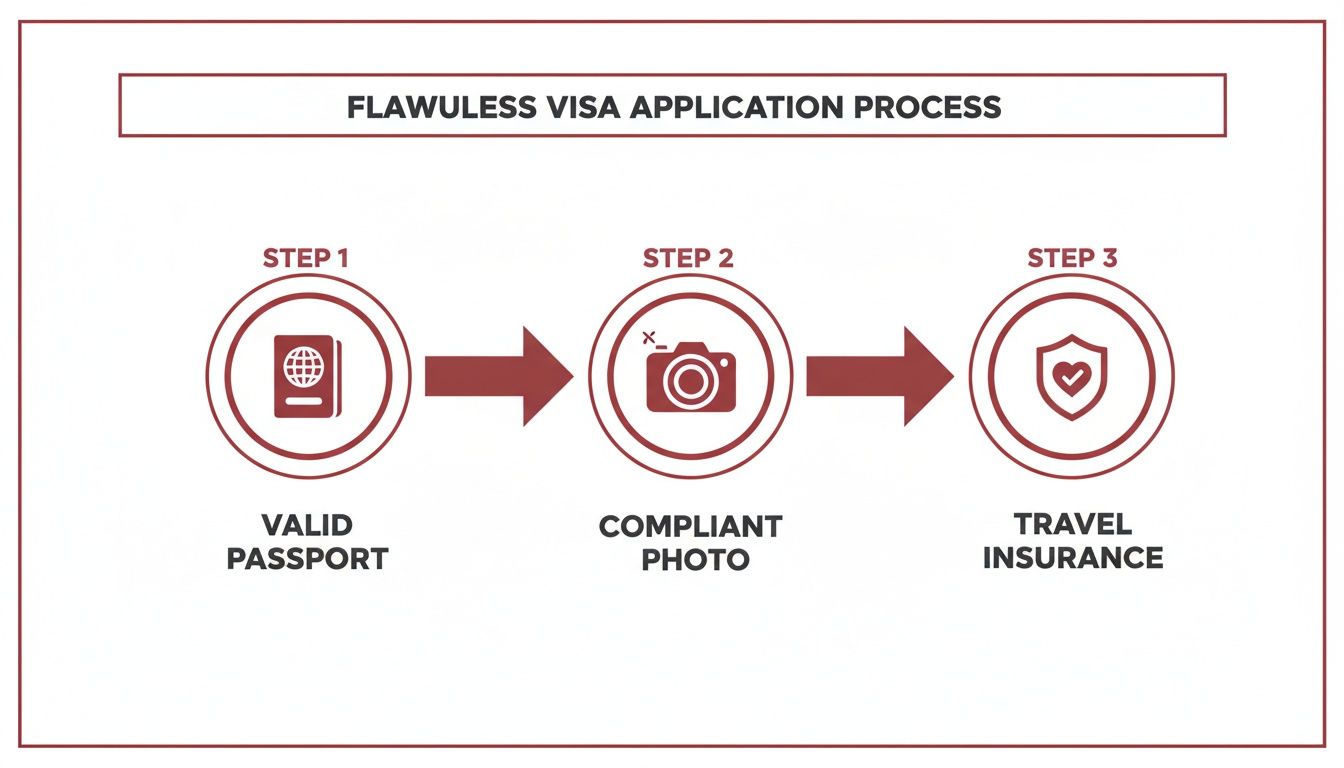
Eligibility and Application Types for Overseas Applicants

Before starting any paperwork, your first step is to identify the correct application type for your UK passport application from overseas. Her Majesty’s Passport Office (HMPO) has distinct requirements for renewals, first-time applications, and replacements for lost or stolen passports. Selecting the wrong path is a common cause of significant delays.

A simple adult renewal is the most straightforward process. A first-time application, however, requires you to prove your British nationality from scratch, while replacing a lost passport involves additional security verifications. This decision tree simplifies the initial choice.

Your answer to whether this is your first British passport dictates the entire process, including the specific documents and verification steps you will need to follow.

The Special Case: Securing a Second UK Passport

Beyond standard applications lies the specialised service for a second UK passport—a vital asset for frequent international travellers. This is a legitimate HMPO service, but approval is not guaranteed. You must prove a genuine need for it.

This is not about convenience; it is about building a robust case to demonstrate that a second passport is an operational necessity. The burden of proof is entirely on you to convince HMPO that a single passport is insufficient for your professional requirements.

What Constitutes "Genuine Need"? Professional Scenarios

HMPO’s assessment is rigorous. You must provide concrete evidence that a second passport is essential. Vague justifications will lead to immediate rejection.

Here are real-world scenarios that meet the strict criteria for approval:

  • The Overlapping Visa Trap: A professional must submit their passport for a multi-week visa application but has an urgent business trip to another country. A second passport is the only solution for maintaining business continuity.
  • Navigating Incompatible Entry Stamps: Rotational workers in the energy sector or NGO staff often travel between politically sensitive countries. An entry stamp from one nation can result in being denied entry to another. A second passport isolates travel histories, ensuring access and security.
  • Operational Essential for Airline Crew: For airline crew, a second biometric passport is an operational essential. Their primary passport is often held for crew visa purposes, making a second one necessary to maintain flight rotations and for personal travel.
  • High-Volume Travel: A sales director flying internationally every week may fill passport pages with stamps long before expiration. A second passport provides the necessary space and acts as a critical backup.

In these instances, the second passport is not a luxury; it is a critical business asset. It functions as an insurance policy against costly downtime and logistical failures that can derail international operations.

Your success depends on presenting a clear, logical, and well-documented case. Applying for a second passport from overseas requires meticulous preparation, especially a formal employer support letter.

The Overseas Application Process: What to Expect

A laptop with a travel form, a passport, boarding pass, and smartphone on a white desk.

Applying for a UK passport from overseas is a distinct process managed entirely online and through international couriers. Unlike in the UK, premium or in-person services are unavailable. Success hinges on precise execution from the start.

The entire process, from renewals to first-time applications, begins online. Be prepared for a procedure that requires patience and scrupulous attention to detail, as every document is scrutinised from afar.

Starting Your Application: The Online Form and Digital Photo

Your first port of call is the GOV.UK online portal. This digital-first process requires you to complete the application online and provide a compliant digital photo. HMPO is notoriously strict about photo requirements, as they form the basis of your secure biometric passport.

Your digital photo must be:

  • Taken within the last month.
  • Clear, in focus, and in full colour, with no filters.
  • Set against a plain, light-coloured background.
  • Free of shadows on your face or behind you.
  • Your expression must be neutral with both eyes open and visible.

A rejected photo is a common reason for application delays. Using a professional photo service that provides a digital image or code is the most reliable way to meet HMPO’s technical specifications and avoid this pitfall.

The 2026 Rule Change: A Critical Update for Dual Nationals

For British dual nationals, a valid UK passport is now more critical than ever due to a significant change in UK entry rules.

As of February 25, 2026, UK entry rules have tightened. Dual nationals can no longer use a foreign passport alone to enter the country. Airlines will be mandated to deny boarding to any British dual citizen who cannot present a valid British passport or a digital Certificate of Entitlement (COE).

This is linked to the new Electronic Travel Authorisation (ETA) system. Crucially, British citizens are ineligible for an ETA. Your British passport is the only seamless way to enter the UK.

This impending deadline makes renewing your UK passport an urgent necessity to guarantee your right of entry. Procrastination risks denied boarding and severe travel disruption.

Secure Document Submission and Return

After completing the online form and payment, you will be instructed where to send your supporting documents. This step highlights the logistical challenges of an overseas application.

It is imperative to use a reliable, tracked international courier service for two reasons:

  1. Security: It minimises the risk of your sensitive documents, including your old passport, being lost in transit.
  2. Accountability: It provides proof of delivery, offering peace of mind that your application has been safely received.

The courier fee is an additional but necessary expense. HMPO will also use a secure courier to return your new passport and supporting documents, ensuring their safe arrival anywhere in the world.

Perfecting Your Documentation for Guaranteed Success

A document with a man's photo, signature, a fountain pen, a checklist, and a UK passport, suggesting an application.

The success of your UK passport application from overseas depends on flawless documentation. Minor errors, such as a missing signature or an improperly formatted letter, are common causes of lengthy delays. The rule is simple: follow all instructions precisely and verify that every document is current, clear, and correct.

For all application types, you must send your current or most recently issued passport. This is non-negotiable. Her Majesty’s Passport Office (HMPO) must physically receive and cancel it before issuing a new one, making a tracked courier service essential.

For first-time passports or other specific cases, you must provide original documents, such as your full birth certificate or naturalisation certificate. Photocopies are never accepted; only send originals or official copies issued by the relevant authority.

The Employer Support Letter: The Cornerstone of Your Application

For a second passport application, the employer support letter is the single most important document. It is not a formality; it is the core evidence used to prove your "genuine need." A weak or poorly written letter is the primary reason for rejection.

This letter must function as a formal business case. It needs to convince HMPO that a second passport is a vital tool for your employer's operations. It must be printed on official company letterhead and, critically, feature a wet-ink signature from a senior manager or director. Digital signatures will result in automatic rejection.

The content must be specific and persuasive. Vague statements like "travels frequently" are insufficient. You must explain why a single passport creates an operational bottleneck.

How to Build a Justification HMPO Will Accept

Your employer’s letter must clearly outline scenarios that HMPO officially recognises as valid justifications. The goal is to demonstrate that a second passport is an operational necessity.

Here are examples of effective justifications:

  • Political Travel Conflicts: "Our employee manages projects requiring travel between Israel and several GCC countries. An Israeli entry stamp would result in denial of entry to key markets, causing project delays and financial loss. A second passport is essential to isolate travel histories and ensure operational continuity."
  • The Overlapping Visa Trap: "Our employee requires a six-week visa for an assignment in China. During this period, they must also attend mandatory meetings in the United States. A second passport is the only way to facilitate this concurrent travel and visa application, preventing significant business disruption."
  • Mobility for Rotational Workers: "As an engineer in the energy sector, our employee works a 28/28 rotation in West Africa. Their passport is frequently held by embassies for work permit processing. A second passport acts as a necessary 'Plan B' to prevent them from being grounded, which would halt critical infrastructure maintenance."

A strong support letter elevates your application from a request to a compelling business case. It proves that the absence of a second passport poses a tangible risk to business operations.

Remember, your application is only as strong as its documentation. Ensuring your employer letter is perfect dramatically increases your chances of a successful outcome.

Timelines, Fees, and Common Pitfalls to Avoid

Understanding the timelines and fees associated with an overseas UK passport application is crucial for managing expectations. A little planning can prevent a lot of stress.

Official fees are published by Her Majesty’s Passport Office (HMPO). Always check the latest rates on the GOV.UK website before starting. The total cost includes the application fee, professional photos, and secure international courier charges.

Overseas vs UK Passport Application Timelines At a Glance

This table breaks down the key differences in processing times and services between applying from overseas and applying from within the United Kingdom.

Application Factor Overseas Application UK-Based Application
Standard Renewal Time 3-4 weeks (often longer) 2-3 weeks (often faster)
First Adult Passport 6+ weeks 3-6 weeks
Fast-Track Service Not Available 1-week service available
Premium Service Not Available 1-day service available
Document Submission International Courier Royal Mail / In-person
Delivery Method Secure International Courier Secure UK Courier

As you can see, being abroad puts you at a distinct disadvantage when it comes to speed and convenience. This is where planning ahead becomes absolutely critical.

Common Mistakes That Cause Major Delays

Many delays are not caused by HMPO but by small, avoidable errors in the application. Getting everything right the first time is the secret to a swift process.

Here are the most common slip-ups to avoid:

  • Incorrect Digital Photo: A rejected photo is the number one cause of delays. HMPO's rules on background, expression, and quality are strict. Using a photo service that provides a digital code is the safest option.
  • A Weak "Genuine Need" Letter: For second passport applications, a vague letter is a death knell. It must present a rock-solid business case explaining why a second passport is an operational necessity.
  • Using a Digital Signature: The employer support letter must have a wet-ink signature. A scanned or digital signature will lead to immediate rejection.
  • Missing or Incorrect Documents: Forgetting to include your current passport, sending a photocopy instead of an original, or omitting a required birth certificate will halt your application.

The most effective action you can take is to triple-check your application against this list before submission. A final review can save you weeks of waiting.

After You Apply: Tracking and Receiving Your Passport

Hand holding a phone showing package tracking 'In transit' next to a brown delivery box on a desk.

Once your documents are submitted, you can monitor the progress of your UK passport application from overseas through the official tracking system.

When you submit your online form, you receive an application reference number (usually starting with 'PEX'). Use this number on the tracking portal on the GOV.UK website to see your application's status, from "Documents received" to "Passport printed and sent."

Understanding Status Updates

The tracking system uses specific terminology. "Documents received" confirms safe arrival. "Being processed" means an examiner is reviewing your file. This status may persist for some time during peak seasons. The final, positive update is "Passport printed and sent."

Receiving Your New Passport: Final Steps

For security, your new passport and supporting documents are returned in separate, tracked deliveries that require a signature.

Once your new biometric passport arrives, complete these final steps:

  • Sign It: Your passport is not valid for travel until it is signed.
  • Verify Details: Check the personal information page for any errors in your name, date of birth, or photo. Correcting mistakes later is a major hassle.
  • Store Your Old Passport: Your cancelled passport will be returned (usually with a corner clipped). Keep it in a safe place as proof of identity and nationality.
Completing these steps ensures you are ready for travel, which is especially important given the 2026 rule changes for dual nationals.

Navigating the overseas application process requires meticulous attention to detail. If you prefer expert guidance, we can manage the complexities for you. You can check your eligibility for a second passport and let us ensure a smooth process.

Frequently Asked Questions

Here are answers to common questions about securing a UK passport while living abroad, particularly for frequent travellers and dual nationals.

Can I Legally Hold Two UK Passports?

Yes, it is completely legal to hold a second UK passport. It is an official service provided by Her Majesty’s Passport Office (HMPO) for citizens who can prove a genuine professional need. It is designed to facilitate business for those whose work is impacted by visa processing delays or travel to politically sensitive regions.

Why is the Employer Letter So Important?

The employer letter is the single most critical document in a second passport application because it provides the evidence for your "genuine need." It must be on official company letterhead, present a clear business case, and, most importantly, have a "wet-ink signature" from a senior company official. A weak or improperly signed letter is the leading cause of rejection.

What Happens if I Try to Enter the UK on a Non-British Passport?

As a British citizen, you must use your British passport to enter the UK. From February 25, 2026, airlines will be required to deny boarding to British citizens who cannot present a valid British passport or a Certificate of Entitlement. British citizens are not eligible for the UK's Electronic Travel Authorisation (ETA) system, making your British passport non-negotiable for entry.

HMPO is currently handling record application volumes, which is extending renewal times. Official statistics on the GOV.UK website confirm these trends, highlighting the need to apply early.

Ready to eliminate travel downtime and secure your second UK passport? Our service has a 99% success rate in helping professionals like you.

Start your application with us today.

Published via Outrank tool