

Securing a Canada work permit from the UK is your ticket to living and working in one of the world's most vibrant economies. For UK citizens, the path you take generally depends on your age and whether you have a job offer lined up. The two most common routes are the International Experience Canada (IEC) programme, a fantastic option for younger applicants, and a traditional employer-specific permit.
Getting it right from the start means knowing which path suits you best.
Your Roadmap to Working in Canada
Applying for a Canadian work permit from the UK can feel like a mountain of paperwork, but it's completely achievable when you break it down. Whether you're a young professional looking for an adventure through the International Experience Canada (IEC) programme or a specialist who's already landed a job offer, this guide will walk you through it.
Your first move is a big one, as it sets the entire strategy for your application. You need to figure out which of the two main permit types fits your situation.
The Two Core Permit Categories
Your application process hinges on whether you're going for an open work permit or an employer-specific one. They are fundamentally different.
Open Work Permits: Think of these as your pass to ultimate freedom. You can work for almost any employer, anywhere in Canada. For UK citizens between 18 and 35, the most popular option by far is the IEC's Working Holiday stream. It’s perfect if you want to explore the country, try different jobs, and not be tied down to one company.
Employer-Specific Work Permits: This is the route for you if you've already got a concrete job offer from a Canadian employer. The permit is locked to that specific company, role, and location. This process usually requires your new employer to get a Labour Market Impact Assessment (LMIA), which is their way of proving to the government that no Canadian could fill the role.
For corporate professionals and frequent travellers, the logistics of an employer-specific application can be a real headache. The long processing times often require you to send in your passport, which can clash with other international business trips.
Nailing this distinction from the get-go is the most critical first step. It dictates the documents you'll need, the forms you'll fill out, and how long you can expect to wait. Choose the right path, and you'll have a clear plan for getting your Canadian work adventure started.
Choosing Your Canada Work Permit Pathway
When it comes to getting a Canadian work permit as a UK citizen, there isn't just one single path. Think of it more like a network of routes, each designed for different ages, career goals, and situations. The most critical first step is figuring out which pathway aligns with your circumstances, as that decision will shape your entire application process.
The two main avenues you'll encounter are the hugely popular International Experience Canada (IEC) programme and the more traditional, employer-led Temporary Foreign Worker Program (TFWP). The difference between them is massive. One offers incredible flexibility and freedom, while the other is a direct line to a specific job but puts more responsibility on your employer.
This decision tree gives you a quick visual breakdown to help you see which route makes the most sense based on whether you have a job offer lined up or are looking for more freedom.
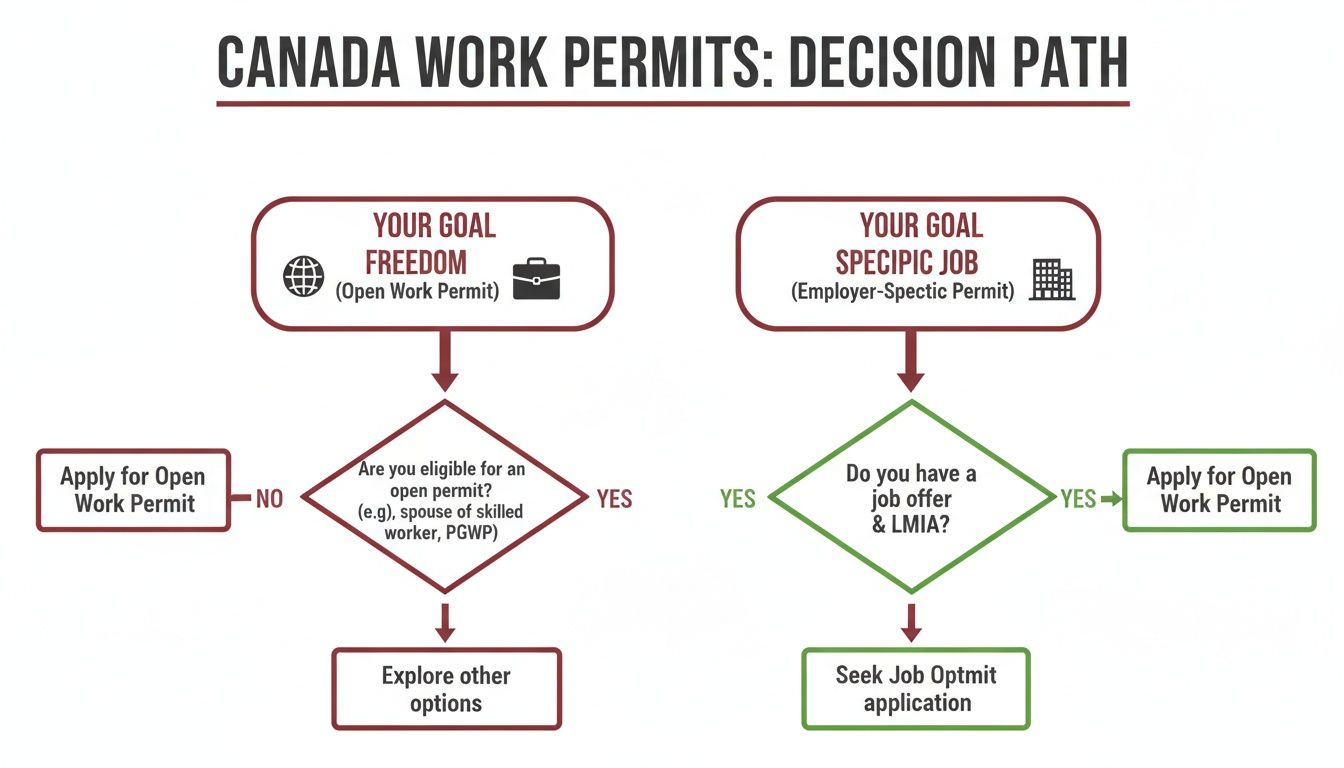
As you can see, your primary goal—whether it's flexible travel or a secured role—points you towards completely different application streams, like the IEC or an LMIA-backed permit.
The International Experience Canada (IEC) Avenues for Brits
The IEC programme is a brilliant opportunity created specifically for young UK citizens, typically between the ages of 18 and 35. It’s all about fostering cultural exchange and is broken down into three distinct streams.
The Working Holiday Stream: This is the golden ticket for many. It’s the most flexible and sought-after option because it grants you an open work permit. This means you aren’t tied to a single company and can work for almost any employer anywhere in Canada. It's perfect if your main goal is to travel and fund your adventures with temporary work. The best part? You don't need a job offer to apply.
The Young Professionals Stream: This one is geared towards career development. To qualify, you must have a job offer from a Canadian employer before you apply. The work also needs to be skilled (classified under National Occupational Classification or NOC TEER 0, 1, 2, or 3) and contribute to your professional growth. This results in an employer-specific permit, locking you to the company that provided the offer.
The International Co-op (Internship) Stream: This route is for students registered at a post-secondary institution back in the UK. If you need to complete a work placement or internship in Canada as a formal part of your studies, this is the stream for you. Just like the Young Professionals stream, it requires a pre-arranged job offer and leads to an employer-specific work permit.
The IEC is incredibly competitive, and the spots are limited. Pools for the Working Holiday stream, in particular, can fill up shockingly fast. I always advise clients to get their profile ready and enter the pool the moment it opens for the season.
The Employer-Driven Temporary Foreign Worker Program (TFWP)
What if you're over the age limit for IEC, or your job offer doesn't quite fit the Young Professionals category? That’s where the Temporary Foreign Worker Program (TFWP) comes in. This is a purely employer-driven process, meaning the company wanting to hire you takes the lead.
The whole point of the TFWP is for an employer to demonstrate that they need to hire a foreign worker because no Canadian citizen or permanent resident is available for the job.
This proof comes in the form of a Labour Market Impact Assessment (LMIA). An LMIA is a document from Employment and Social Development Canada (ESDC) that gives the employer official permission to hire a temporary foreign worker. Getting one is a complex process for the employer—they have to advertise the job extensively across Canada first. A positive LMIA confirms there's a genuine need for your skills. Once your employer has that document in hand, you can finally apply for your employer-specific work permit.
Canada Work Permit Pathways for UK Citizens at a Glance
Choosing between IEC and TFWP is a strategic decision that involves you and, in many cases, your future employer. To help you weigh your options, this table breaks down the core differences at a glance.
| Permit Pathway | Primary Eligibility | Job Offer Required? | Best For |
|---|---|---|---|
| IEC Working Holiday | UK Citizen, 18-35 years old. | No, not required. | Young travellers seeking flexibility and the freedom to work for multiple employers. |
| IEC Young Professionals | UK Citizen, 18-35, with a skilled job offer. | Yes, a compliant job offer is mandatory. | Career-focused individuals wanting to gain professional experience in Canada with a specific employer. |
| Temporary Foreign Worker Program (TFWP) | Any age, with a job offer and a positive LMIA. | Yes, along with a supporting LMIA. | Skilled professionals of any age whose employers can demonstrate a labour market need. |
For many seasoned professionals, especially those in high-demand fields, the TFWP is the most direct—and sometimes only—route. That said, the LMIA requirement adds significant time, cost, and complexity to the process for the employer. If you are eligible for the IEC, it is almost always a much faster and simpler alternative for both you and the company hiring you.
Getting Your Paperwork in Order
Think of your application for a Canada work permit UK professionals need not as a pile of forms, but as your evidence file. You're building a case, and every single document has to be spot-on—current, correctly formatted, and precise. One small mistake can lead to an outright rejection or, at best, a frustrating delay.
It all starts with your passport. This is a classic stumbling block. Canadian authorities simply will not issue a work permit that outlives your passport. Before you do anything else, check that expiry date. Make absolutely sure it’s valid for the entire time you plan to be in Canada.
This level of detail needs to apply to everything you submit, from your work history to police checks. It’s a methodical process, but getting it right from the start saves a world of trouble later.
The Core Documents Every UK Applicant Needs
While every work permit stream has its own unique quirks, there's a set of personal documents that you'll almost certainly need to provide. Getting these sorted early will put you way ahead of the game.
Here’s your essential checklist:
- A Valid Passport: We've mentioned it, but it's worth repeating. You'll need high-quality, full-colour scans of every single page, and yes, that includes the blank ones.
- A Digital Photo: This needs to be a recent, professional-quality photo that meets Canada's very specific rules on size, background, and even your facial expression.
- Proof of Funds: You have to show you can support yourself when you land. For IEC applicants, this is a set figure (usually CAD $2,500), but everyone needs to provide bank statements from the last few months to prove their financial stability.
- Police Certificates: You’ll need a police certificate from the UK. If you've lived in any other country for six months or more since you turned 18, you'll need one from there, too.
- Medical Examination: Depending on the job you’ll be doing or where you’ve travelled recently, you might have to get a medical exam from a doctor approved by Immigration, Refugees and Citizenship Canada (IRCC).
A common mistake I see is people just printing their online bank statements. IRCC is looking for something more official. You need a formal letter from your bank, on their letterheaded paper, clearly showing your account details and the closing balance for the last four months. It’s a small detail that makes a big difference.
Your Employer's Crucial Paperwork
If you're applying for an employer-specific work permit, the documents from your Canadian employer are just as critical as your own. A vague or non-compliant job offer is one of the fastest ways to get your application refused.
The employer's paperwork is what proves the job is legitimate. They'll need to provide a formal job offer letter detailing your role, salary, and working conditions. If you're coming through the Temporary Foreign Worker Program (TFWP), they also have the massive task of securing a positive Labour Market Impact Assessment (LMIA) before you can even think about applying.
It’s a true partnership. The pressure isn't just on you; it's a coordinated effort between you and your future employer.
The Frequent Traveller's Dilemma: How to Avoid Being Grounded
For consultants, executives, and anyone who lives out of a suitcase, the work permit process can create a huge logistical headache. Your passport is tied up for weeks or months, leaving you grounded and unable to take that crucial trip to another country. It's what we call the "Overlapping Visa Trap."
This is where a second UK passport becomes more than a convenience—it’s a critical business tool for Operational Continuity. It's a completely legitimate service offered by Her Majesty’s Passport Office (HMPO) for people who can prove a genuine need. Think of it as a Plan B against business downtime.
With a second biometric passport, you can have one tied up in the Canada work permit UK application queue while you use the other for essential international travel. Business continues without a hitch. As global mobility gets more complex, this strategy is becoming essential. In the year ending June 2022, the UK granted 331,233 work-related visas, a staggering 72% jump from 2019. For British professionals juggling multiple applications, a second passport is the key that keeps everything moving, especially with the number of Canadian permit holders growing to over 188,000 by 2023. You can read more about the rise in UK work visa grants from GOV.UK.
Managing the Online Application and Biometrics
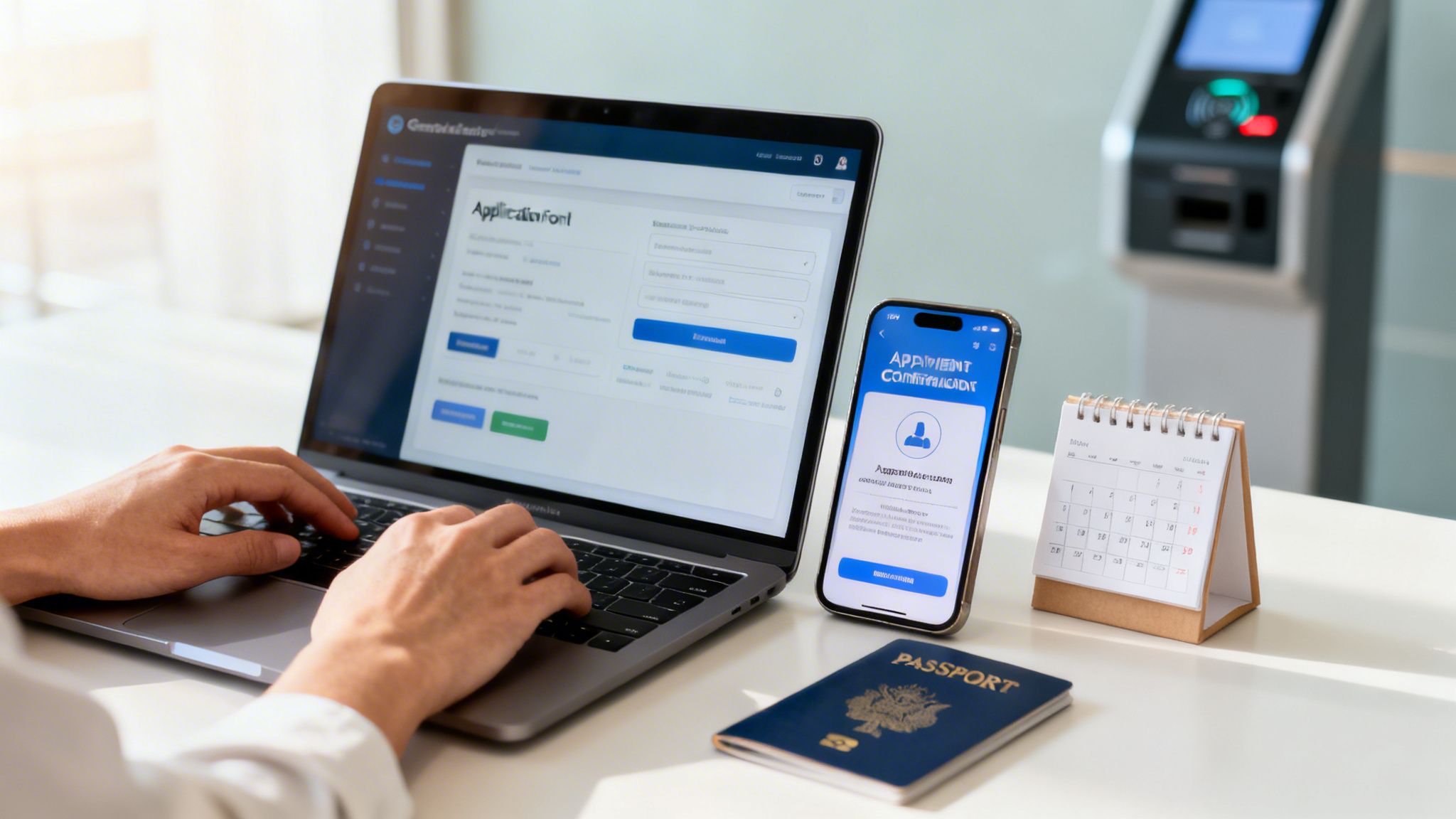
Everything for your Canada work permit UK application happens online through the official Immigration, Refugees and Citizenship Canada (IRCC) secure portal. Think of this as your digital command centre where you'll build your case, fill out the forms, upload all your carefully prepared documents, and handle the fees.
Navigating this portal is all about precision. After you hit 'submit', you’ll get a confirmation, and soon after, the crucial Biometric Instruction Letter (BIL). This letter is your green light to provide your fingerprints and photo.
Navigating the IRCC Online Portal
The first thing you'll do is create a secure IRCC account. This is where you'll live for the next few weeks, tracking progress and getting official messages. The portal walks you through a questionnaire that figures out your eligibility and spits out a personalised checklist of exactly what documents you need.
Getting the uploads right is critical. Make sure every file is in the right format (usually PDF or JPG), is clearly labelled, and comes in under the size limit. A blurry or poorly scanned document can bring your whole application to a grinding halt.
The Critical Biometrics Appointment
Once that Biometric Instruction Letter lands in your account, the clock starts. You generally have 30 days to book and show up for an appointment at a designated Visa Application Centre (VAC) in the UK. This is a non-negotiable step and a key part of the security screening for any Canadian work permit.
Booking is done online through the official VAC services provider for the UK. It's straightforward, but appointments can be snapped up quickly, especially in busy periods. Don't forget to bring your original passport and the BIL to your appointment.
The appointment itself is quick and painless, usually lasting less than 20 minutes. A staff member will scan your fingerprints and take a new photo. The good news? Once done, your biometrics are valid for ten years.
This is precisely where frequent travellers hit a wall. Imagine your main passport is tied up at another embassy for a different visa, and your 30-day Canadian biometrics deadline is fast approaching. This is a classic—and very stressful—operational continuity challenge we see all the time.
The Second Passport as Your Plan B
For professionals juggling international commitments, the biometrics request can throw a real spanner in the works. If your only passport is out of action, you risk blowing the deadline and having your Canadian work permit application cancelled.
This is where having a second, fully legitimate British passport becomes a game-changer. It's your insurance policy. If your primary biometric passport is held up, you can simply use the second one to attend the biometrics appointment in the UK. This simple move keeps your Canada work permit UK application on track and your travel schedule intact.
Competition for global talent is fierce. By late 2025, Canada was home to 1,491,500 work permit holders, a number that reflects the high demand we also see in the UK, where work visa grants to non-EU applicants reached 312,600 by 2023. With such high volumes and frequent backlogs, a second UK passport lets you run visa applications in parallel—a massive advantage when UK sponsorship is also booming, with 172,763 Certificate of Sponsorship applications in the year to June 2022. You can dig deeper into these global mobility trends from the Migration Observatory.
What Happens After Biometrics
Once your biometrics are collected, they are sent electronically to IRCC and attached to your application. This is often the last piece of the puzzle the visa officer is waiting for. You'll see an update in your IRCC portal confirming they've been received.
Now comes the hard part: waiting. Processing times can vary wildly. But by managing your application with military precision—and having a backup plan like a second passport—you’ve put yourself in the strongest possible position for a smooth and successful result.
Final Steps and Common Mistakes to Avoid
The last leg of your Canada work permit UK application is often where things can go wrong. After all that hard work pulling your documents together, it’s tempting to rush through the final submission. But this is precisely where small, avoidable errors can cause serious headaches and delays. A simple oversight on a form or a miscalculation of your settlement funds can easily push your application to the bottom of the pile.
And remember, hitting 'submit' isn't the finish line. The approval you receive is a Port of Entry (POE) Letter of Introduction, not the work permit itself. Think of it as your invitation to the border, but you still need to have your conversation with a border services officer to get the actual permit.
The Pre-Submission Sanity Check
Right before you click that final 'submit' button on the IRCC portal, pause and take a breath. This is your last chance to do a thorough sanity check and catch those common slip-ups that trip up so many applicants. Honestly, a few extra minutes here can save you months of frustration later.
Run through this final checklist:
- Form Completion: Have you answered every single question? Don’t leave fields blank, even if you think they don’t apply to you. It’s better to write "N/A" (Not Applicable) than to leave a gap that could get your application flagged as incomplete.
- Sufficient Funds: Is your proof of funds crystal clear and does it meet the threshold for your permit stream? Make sure your bank statements are recent, on official letterhead, and show a stable balance. Sudden large deposits without explanation can raise questions.
- Document Consistency: Do the names, dates of birth, and passport numbers on all your documents match perfectly? A typo or a slight difference between your passport and your job offer can create unnecessary complications.
- Eligibility Rules: Quickly double-check the eligibility criteria one last time. Life happens, and your circumstances might have changed since you started the process. It's up to you to ensure you still qualify when you submit.
A classic mistake I see all the time is a weak job offer letter. For an employer-specific permit, the offer needs to be incredibly detailed about your salary, duties, and employment conditions. A generic "you're hired" letter just won't cut it and is a frequent cause for refusal.
You’re Approved! What Happens Next?
Getting that Port of Entry Letter of Introduction in your IRCC account is a fantastic feeling—congratulations! But it's vital to understand what this letter actually is. It is not your work permit. It's the official document you need to show an officer at the Canadian border, who will then issue the real thing.
As soon as you get the letter, read it from top to bottom. Check every single personal detail: your name, date of birth, and passport number. If you find any errors, no matter how small, you must contact IRCC through their web form to get them fixed before you book any flights. The letter typically gives you a 12-month window to travel to Canada and activate it.
Preparing for a Smooth Arrival in Canada
Your arrival at the airport in Canada is the final piece of the puzzle. The secret to a stress-free entry is simple: keep all your essential documents organised and easily accessible in your hand luggage. Never, ever pack them in your checked-in suitcase. The border services officer will need to see everything to make their final decision.
Here’s your carry-on checklist:
- Your valid passport
- The Port of Entry (POE) Letter of Introduction
- Recent proof of funds (a printed bank statement is a good idea)
- The original copy of your job offer letter (if applicable)
- Any other key documents from your application, like your LMIA or police certificates.
When you speak to the officer, be ready for a few straightforward questions about your plans. They’ll likely ask what kind of work you’ll be doing, who your employer is, and where you're staying when you first arrive. Just be polite, clear, and honest in your answers.
Once the officer is satisfied, they will print your official Canada work permit and usually staple it into your passport. Before you walk away from that counter, check it for any errors. Once you're happy with it, you can officially say: welcome to Canada.
Got Questions? We’ve Got Answers
When you're navigating the Canadian work permit process from the UK, it’s natural for specific questions to pop up. Let's tackle some of the most common ones I hear from applicants, cutting through the jargon to give you the practical answers you need.
Can I Apply From the UK if I’m Not a UK Citizen?
Absolutely. The key here is your legal status in the UK. As long as you're a legal resident, you can submit your application from here.
However, your citizenship does matter for certain programmes. The popular International Experience Canada (IEC) stream, for instance, depends on whether your home country has a specific youth mobility agreement with Canada. For most employer-specific work permits, though, your application hinges on the job offer and your qualifications, not your nationality.
How Much Money Do I Need to Show for Proof of Funds?
This is a big one, and the answer really depends on the type of permit you're after.
If you’re applying through an International Experience Canada (IEC) stream, the number is quite specific: you'll need to show you have at least CAD $2,500. This isn't a suggestion; it's a hard requirement to prove you can support yourself when you first land in Canada.
For permits tied to a specific employer, there isn't usually a magic number. That said, you still need to convince the officer you won't be in financial trouble upon arrival. The required amount also increases significantly if you’re bringing your family along. Always double-check the latest requirements for your specific permit on the official IRCC website.
What Happens if My UK Passport Expires While My Permit is Still Valid?
This is a critical detail that trips up a lot of people. Your Canadian work permit is tied directly to the passport you used for the application. You simply cannot travel or work in Canada using a valid work permit with an expired passport.
Here's the most important takeaway: Canadian authorities will not issue a work permit that's valid longer than your passport. If your passport expires in 18 months, the longest permit you can get is 18 months, even if your job offer is for three years.
To avoid this headache, check your passport's expiry date before you even think about applying. If it's running low, renew it first. If you find yourself needing to renew your passport while in Canada, you'll have to go through the extra step of applying to update your work permit details with the new passport information.
For business professionals who travel constantly, this is precisely why having a second UK passport isn't a luxury—it's a necessity. It acts as an insurance policy, allowing you to keep one passport free for travel while the other is tied up in a lengthy visa application process.
If you're a frequent traveller managing complex international commitments, being without your passport is not an option. Second UK Passports provides a compliant, time-sensitive solution to ensure your business operations continue without interruption. Check your eligibility for a second passport to keep your travel plans on track while your Canadian application is processing. Learn more at https://secondukpassport.com.